One hundred and fifty years ago, on March 2, 1876, Eugenio Pacelli was born in Rome—the future Pope Pius XII (1939–1958). On this significant anniversary, we turn our attention to a lesser-known but profoundly revealing facet of his character: the intense, cultured, and spiritual bond he shared with music.
Eugenio’s love for music emerged early. The Pacelli family owned a theater box, and the young boy attended regularly, spellbound by what he saw and heard. Yet he was not a passive spectator. He observed keenly, took notes, reflected, and studied. At home, he began playing the violin. “He also enjoyed music,” recalled his nephew Carlo Pacelli (†1970), “and I remember seeing two violins at home that had belonged to him. I don’t know what music he preferred in his youth, but later, during his time in Germany, his favorite masters were the great German composers: Bach, Beethoven, and Wagner.”[1]
Of them all, it was Richard Wagner (†1883) who most ignited his imagination. Wagner’s music—with its metaphysical tension and seamless fusion of word and sound—exerted a powerful and lasting fascination. One emblematic episode came in 1954, when Pius XII received the celebrated soprano Maria Callas (†1977) in private audience. The Pope had listened with great enthusiasm to Parsifal, broadcast by the Italian Radio in 1950, and wished to personally express his admiration. “You moved me deeply,” he told her, “and that’s why I wanted to meet you.”
What followed was a lively and spirited exchange on Wagnerian opera. “It’s a pity,” the Pontiff remarked, “that you didn’t sing in German, in the original version. Wagner loses a great deal in Italian.” “The broadcast was meant for an Italian audience,” Maria replied. “Had we sung in German, few would have understood.” “That’s true,” Pius XII conceded, “but Wagner’s music is unthinkable apart from the words he himself wrote. It is music born with them—therefore inseparable.” “I don’t agree at all,” Callas retorted. “The original version is more complete, of course, but the Italian translation is not inferior. To truly understand the music, it is essential to understand the meaning of the words.” The conversation grew animated—Maria was never one to yield easily—and the Pope seemed amused.[2]
Clearly, this was no superficial interest. Pius XII’s relationship with music was anchored in deep aesthetic and spiritual reflection.
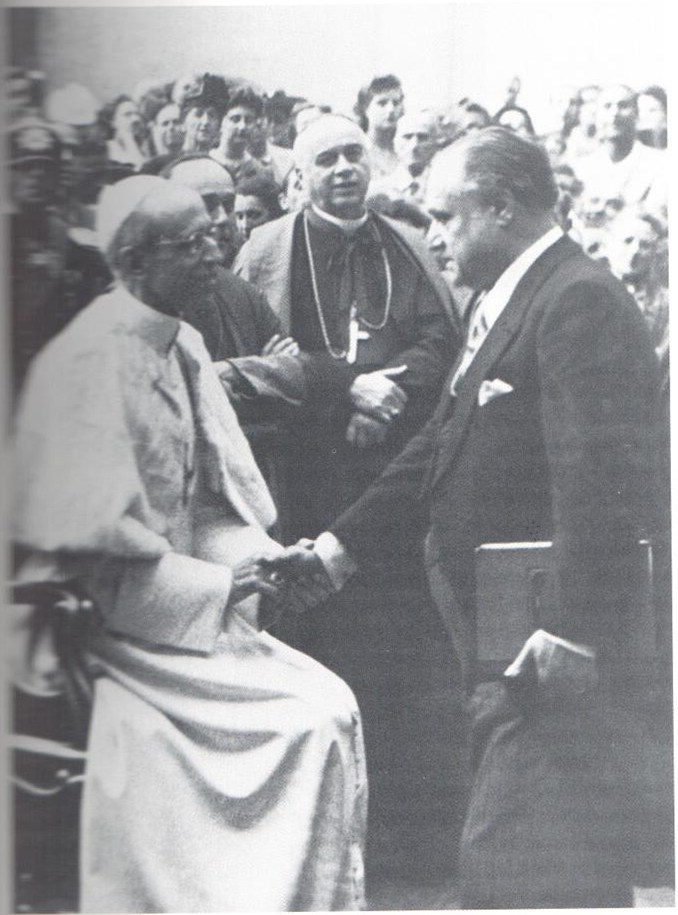
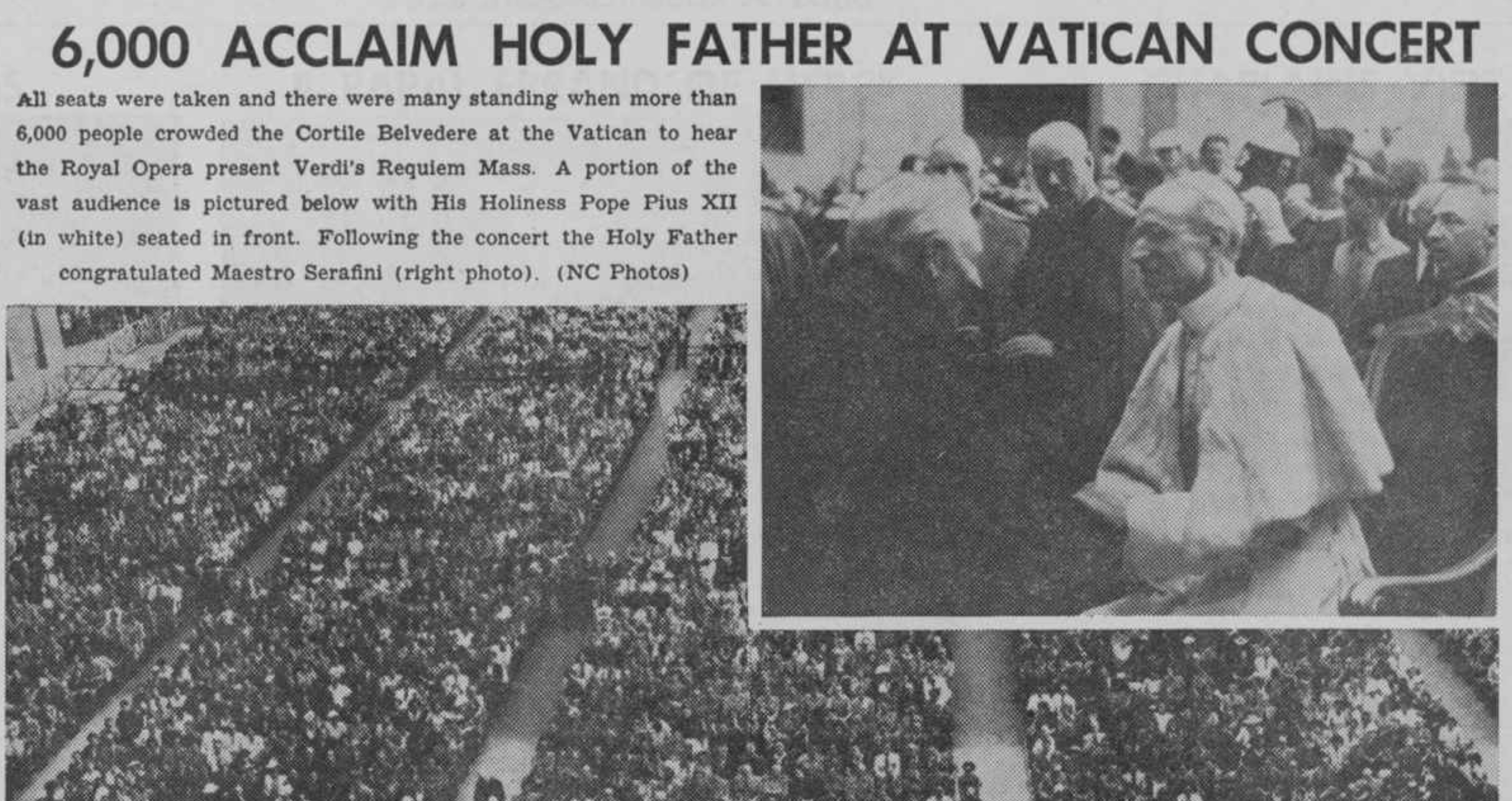
During his pontificate, music transcended the personal and permeated the very spaces of the Vatican. It became a medium of memory, beauty, and reconciliation. Unforgettable was the concert on July 2, 1945 (pictured above), when Verdi’s Requiem resounded through the Courtyard of the Belvedere, conducted by Tullio Serafin (†1968), with the tenor Beniamino Gigli (†1957) among the soloists. Equally moving was the concert of May 26, 1955, when the Israel Philharmonic Orchestra, under the baton of Paul Kletzki (†1973), performed excerpts from Beethoven’s Seventh Symphony in the Consistory Hall of the Apostolic Palace. The event was a gesture of gratitude “for the great humanitarian efforts made by His Holiness to save a large number of Jews during the Second World War.”[3]
Pius XII was also a devoted radio listener, closely following performances from Italy’s major opera houses. So it comes as no surprise that, in the final days of his life, he requested Beethoven’s First Symphony. Three days before his death in October 1958, “he spent another day in a half-sleep, listening to some music; he asked for a Beethoven record.”[4]
Many of the greatest artists of the era were welcomed by Pius XII—not out of protocol, but sincere admiration. Beyond Maria Callas, he received legendary tenors such as Giacomo Lauri Volpi (†1979), Tito Schipa (†1965), and Beniamino Gigli. The latter was astonished by the warmth of the encounter: “It was supposed to last three minutes, and it went on for twenty-one. I even told him some theater jokes.”[5] His relationship with the composer Pietro Mascagni (†1945) has been discussed elsewhere.
Particularly moving is the testimony of Giacomo Lauri Volpi, an astute connoisseur of vocal artistry, who offered a striking portrait of Pius XII’s own voice. He wrote:
Spoken word and sung word become one in the Pope’s always spiritually infused voice. Listen to him, whether addressing the crowds or engaged in conversation. His breath is calm, steady, and spontaneous. His voice is always rich with overtones and higher resonances: clear, resolute, and at times incisive. To turn speech into song, all that is needed is a deeper breath and an increase in the air pressure directed to a constant point of resonance, and suddenly the word takes flight, rises, and spreads with melodious delicacy. Listen to him recite the rosary and the litanies; listen to him articulate, with a well-modulated accent, the words of the sublime prayer: ‘Thy kingdom come, Thy will be done… give us this day our daily bread…’ —as if he wished to imprint on the minds and hearts of the faithful the true and profound meaning of those words and communicate to them his own emotion, his own faith. His soul truly flows into his voice. In it, the perfect synthesis of the vox mystica is realized: word, sound, idea, and spirit. What a joy it was for the one writing these notes to discover the vox mystica of Pius XII![6]
In an age often characterized by the formal coexistence of culture and power, the musical sensibility of the Pastor Angelicus reveals something unexpectedly intimate. For him, music was never a mere liturgical accessory or aristocratic amusement; it was the language of the soul—a path to the divine. Beneath the austere and disciplined exterior of the pope who led the Church through some of the twentieth century’s darkest hours, there beat the heart of a listener, an artist—one attuned to the mysterious echoes of grace hidden in a symphony, an opera, or a voice.
[1] A. Tornielli, Pio XII: Eugenio Pacelli, un uomo sul trono di Pietro, Milan 2007, p. 14; our translation.
[2] Cf. G. Battista Meneghini, R. Allegri, Maria Callas mia moglie, Milan 1981, p. 222; our translation.
[3] L’Osservatore Romano, May 27, 1955; our translation.
[4] A. Spinosa, Pio XII, l’ultimo papa, Mondadori 1992, p. 368; our translation.
[5] In E. Biagi, 1943 e dintorni, Milan 1983, p. 26; our translation.
[6] G. Lauri Volpi, Voci parallele, Garzanti 1955, p. 210; our translation.