
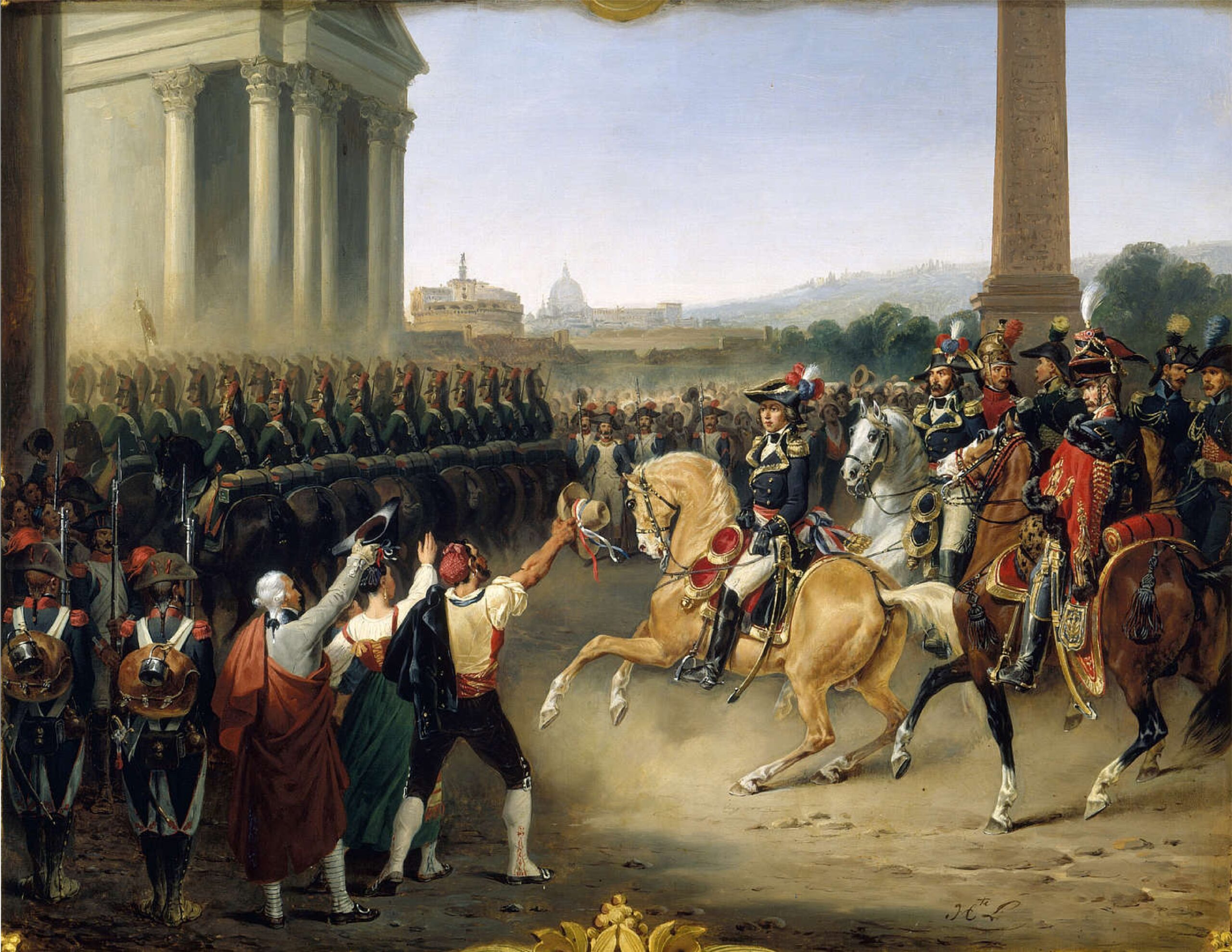
Above: Napoleon’s invasion of Rome, 1798.
On October 21, 1775, Giuseppe Baini, an important figure in 19th-century sacred music, was born. In 2025, we celebrate both the 500th anniversary of Giovanni Pierluigi da Palestrina’s birth and the 250th anniversary of Baini’s, a fortuitous convergence, as Baini was Palestrina’s first biographer. As the first “Perpetual Maestro Director” of the Sistine Chapel Choir, he authored the earliest biography of Giovanni Pierluigi da Palestrina (†1594), the illustrious “Prince of Music,” as inscribed on Palestrina’s tomb in St. Peter’s Basilica.[1]
Born in Rome to Antonio, a modest Venetian tailor, and Caterina, who passed away during his early childhood, Baini’s life combined hardship and opportunity. Taken in by the orphanage Pia Casa degli Orfani at the Church of Santa Maria in Aquiro, he found guidance under his paternal uncle Lorenzo (†1814), a Conventual Franciscan friar then at the Basilica of the Holy Apostles. Lorenzo introduced him to the world of music, nurturing a passion that would define his life.
At thirteen, Baini entered the Roman Seminary, receiving a remarkable education in theology, literature, philosophy, and sacred music. Under the tutelage of the Portuguese priest Stefano Silveyra († 1802), he displayed exceptional talent, excelling in Gregorian chant and Renaissance polyphony—key elements of the Roman school.
A skilled bass, Baini joined the prestigious Sistine Chapel Choir on March 2, 1795, before his ordination. He refined his vocal abilities under Sistine bass Saverio Bianchini, immersing himself in the rich traditions of Church music. Ordained as a priest on September 8, 1798, he continued his studies with mentors like Giovanni Battista Batti, his uncle Lorenzo, and Giuseppe Jannacconi († 1816), maestro of the Cappella Giulia from 1811. Under Jannacconi, Baini developed a deep understanding of Palestrina’s art.
Baini composed works that, while not groundbreaking, honored the Renaissance style and enriched the liturgical tradition. Among his notable contributions were O Roma felix for four voices, a hymn for the First Vespers of Saints Peter and Paul (June 28), and, most notably, a ten-voice Miserere, commissioned by Pope Pius VII († 1823) and first performed on Good Friday, April 20, 1821. The Miserere later joined iconic setting by Gregorio Allegri († 1652) in the Holy Week repertoire.
During the French occupation of Rome (1809–1814), Baini remained loyal to the Pope, declining prominent positions offered by the Napoleonic regime, including “General Director of Ecclesiastical Music” in France. Instead, he served humbly as a priest at the Basilica of San Silvestro in Capite, where he was a confessor to many, and as a teacher at the Christian Schools of the Ignorantelli at Trinità dei Monti.[2]
Baini was appointed director of the Sistine Chapel Choir in 1817. A note in the diary from that year attests to the esteem in which he was held by his colleagues:
The tireless care that our most respectable Maestro takes for the good of the entire body, in all its aspects, cannot be praised enough. Along with his profound knowledge and vast erudition, he adds all possible efforts and inconveniences to bring new glory and benefit to all. His name will remain immortal in the annals of the Pontifical Chapel for the love, esteem, and gratitude in which he is justly held by all.[3]
In December 1841, Baini received the title of “Honorary Chaplain in Purple Habit and Camerlengo Perpetual Director” of the Papal Singers.[4] Over a span of 175 years (1822–1997), only three other individuals held the esteemed title of Perpetual Director, signifying a permanent position: Domenico Mustafà († 1912), Lorenzo Perosi († 1956), and Domenico Bartolucci († 2013).
Baini also sought to advance music education. While his attempts to establish a singing school for boys were unsuccessful (discussed in this article), he nonetheless significantly enriched the training of papal singers through his teaching and workshops.
Baini’s crowning achievement was his critical biography, Memorie storico-critiche della vita e delle opere di G. Pierluigi da Palestrina (1828). This monumental work remains foundational in Renaissance polyphony studies. Despite financial struggles that thwarted his dream of publishing a complete edition of Palestrina’s works, Baini’s teachings influenced students like Otto Nicolai († 1849) and Karl Proske († 1861). Proske vividly recounted Baini’s impact:
For over a year, I witnessed all the public functions of the Pontifical Chapel, then under Baini’s direction. What a difference I perceived in this incomparable choir of artists, depending on whether Baini himself or his substitute was conducting! Unforgettable for me remains the performance of Palestrina’s Missa Brevis in the Sistine Chapel for the Feast of All Saints in 1834, conducted by Baini with utmost simplicity and such mental intensity that every glance and the slightest finger motion electrified the entire choir […]. Later, I heard the same Missa conducted by his substitute while Baini was ill—the spirit was no longer there.[5]
A staunch defender of tradition, Baini opposed the theatricalization of liturgical music. He firmly believed that sacred music should remain rooted in Gregorian chant and Renaissance polyphony, rejecting collaborations with composers such as Gaspare Spontini († 1851), whom he regarded as incompatible with the Church’s musical heritage.
Upon his death on May 21, 1844, Baini left his books and works to the Casanatense Library, where they are still preserved. Some volumes, particularly Palestrina’s printed works and those transcribed by Baini, were transferred to the Pontifical Archive, ensuring his legacy in the preservation of Renaissance polyphony.
[1] See F. M. Torrigio, Le sacre grotte vaticane, Rome 1635, p. 166.
[2] See R. Meloncelli, Dizionario Biografico degli Italiani, Vol. 5, Rome 1963, p. 289.
[3] In L. M. Kantner & A. Pachkovsky, La Cappella musicale Pontificia nell’Ottocento, Rome 1998, p. 29; our translation.
[4] Diario di Roma, December 4, 1841, p. 1,
[5] Musica divina, Regensburg 1854, Vol. 1, p. XLII; our translation.