

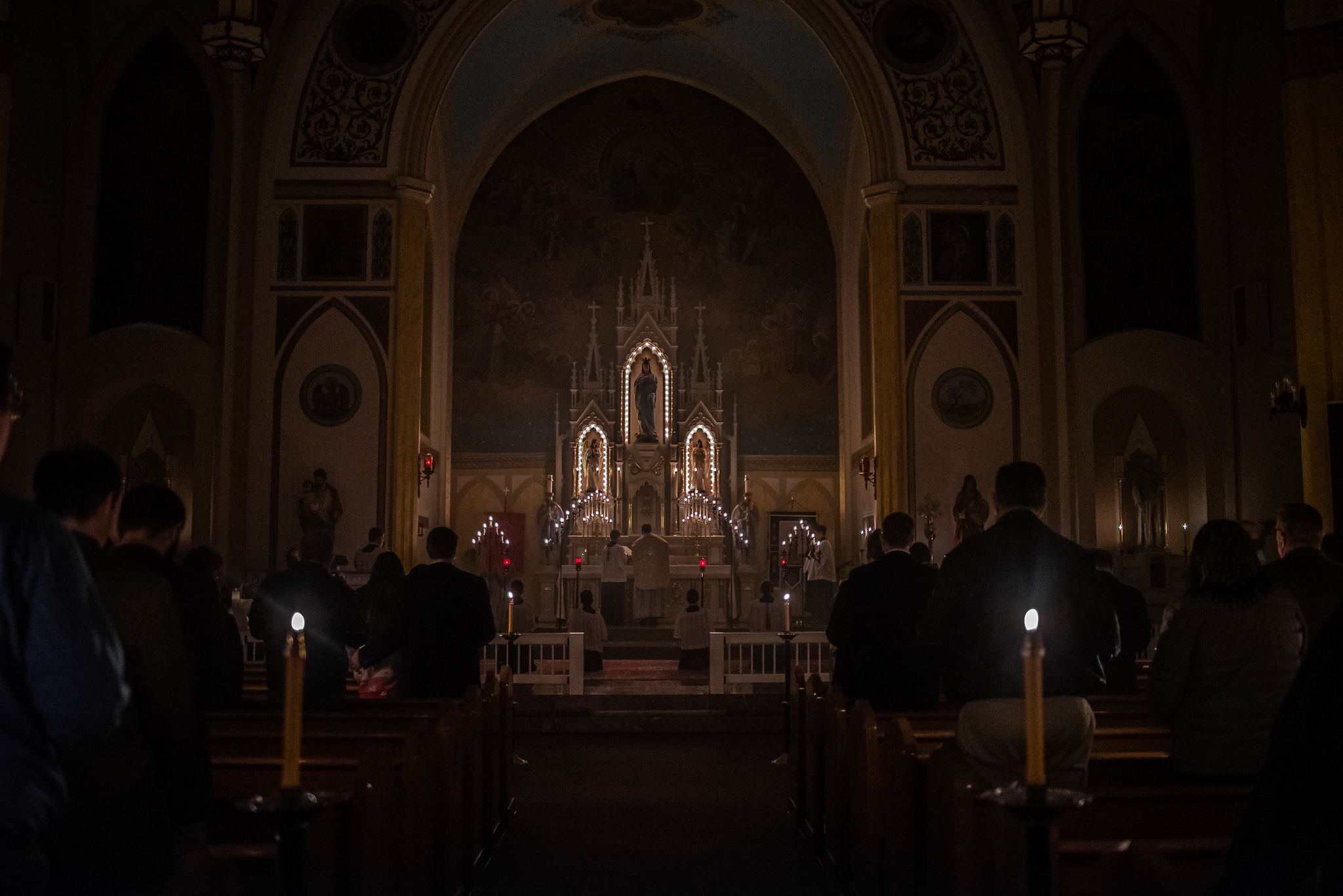
Above: Rorate Mass. Photo by Allison Girone.
This is an extended version of the 19th November ‘Chairman’s Briefing’ from Latin Mass Society, which goes out to its supporters’ email list.
Pope Leo’s comments about the Traditional Mass in his aeroplane press conference have caused a good deal of comment. He was asked if he would be loosening restrictions on the Traditional Mass, and replied as follows:
No, not right now. Traditionis custodes is the decision of Pope Francis and we will continue to follow that. Traditionis custodes includes possibilities of dispensation or of allowing the Tridentine Mass — or the Vetus Ordo Mass — to be celebrated. And so, again, for the unity of the Church, the vast majority of Catholics around the world, we celebrate the rite of Vatican II, of Paul VI, and we will continue to do that. And there is an avenue available for those who wish to apply for the dispensation.
Some people have suggested that Pope Leo doesn’t feel that he can reverse Pope Francis’ decisions; others have picked up on his stress on Church unity. I don’t think either is a very useful way of understanding this statement.
Pope Leo has reversed a number of Pope Francis’ decisions, such as Francis’ unpopular reorganisation of the Diocese of Rome, his raising of rents for curial officials, and his reform of the relationship between different financial institutions in the Vatican. If Pope Leo wants to stick with Traditionis custodes, ‘for now’, there must be another explanation.
On unity, prelates well-disposed to the Traditional Mass have been telling Pope Leo for the past year that Traditionis custodes has caused division, and that he can bring unity and peace to the Church by loosening restrictions. Pope Leo may disagree, but he can’t rely on ‘unity’ as a premise in his argument when it is precisely the point in dispute.
We need to look more closely at his words.
And so, again, for the unity of the Church, the vast majority of Catholics around the world, we celebrate the rite of Vatican II, of Paul VI, and we will continue to do that.
Unity – Novus Ordo – Vatican II – the vast majority of Catholics: Pope Leo chooses to leave the logical connections between these ideas vague. Is the unity of the Church based on the liturgical rite? That would sit uncomfortably with the authorisation of liturgical variants such as the Ordinate Use, the Congo Use, and now the ‘Mayan’ liturgical use. In any case, what has this got to do with the fact that the Novus Ordo is attended by ‘the vast majority of Catholics’: do they represent a norm to which liturgical minorities should conform themselves? Would that include the Eastern Catholics? Pope Leo doesn’t address these questions.
The point of this apparent stream of consciousness is, instead, to bring to mind the stated purpose of Traditionis custodes. Whether it was well-considered or not, the point of the provisions it brought in was to foster the unity of the Church. If TC is not being repudiated, then this must be given at least lip service. That is the significance of the word ‘again’ at the beginning of this sentence. Pope Leo has already mentioned TC, and is repeating himself.
It doesn’t follow that Pope Leo is strongly convinced by the argument, insofar as there was an argument, in Traditionis custodes. If you read a lot of Church documents you see this kind of thing a lot. Why was the liturgy put into the vernacular? For the sake of the participation of the people: that’s what Pope Paul VI said, and ever after, every document that mentions the topic dutifully says that vernacularisation increased the participation of the people. There’s no argument for this, no appeal to evidence; the writer may not even be particularly convinced. He just feels obliged to say it.
You see this even when clearly no-one believes it. The 1955 Holy Week that was torn up by the next set of reformers in 1969; the revised Latin Psalter that Cardinal Bea produced in the 1940s that was torn up by the translators of the Neo-Vulgate in the 1970s: these were regarded as defective, otherwise they would not have been set aside, but you will search the documents in vain for explicit criticisms of them. Similarly, Pope Benedict did not criticise his predecessors’ policies on the Traditional Mass, which he overturned in Summorum Pontificum, and Pope Francis did not criticise Pope Benedict when he overturned Summorum Pontificum with Traditionis custodes. It was, Pope Francis tells us, a nice idea that was abused by those annoying Trads.
To return to the present case, what we are left with is this: on the one hand, TC supposedly champions unity; on the other hand there are ‘possibilities of dispensations’ and ‘an avenue available’ for people who want the Traditional Mass. From a strictly logical point of view this is unsatisfactory – are the dispensations going to harm the unity of the Church? – but from a pastoral and political point of view, it is simply a balanced position. Taking what might look like a reasonable principle too far can be harmful. Let’s be sensible, let’s allow dispensations for the sake of complex local circumstances. This is how the Church has always worked, and TC itself made reference to exceptions ‘for the good’ of those attached to the ancient liturgy.
To see what Pope Leo has in mind in concrete terms, look at his actions. He has sent us a series of modestly encouraging messages: to the Nuncio to Great Britain, to the Bishops of France, to the Chartres pilgrims, to the Fraternity of St Peter. The treatment of the international Rome pilgrimage was not what we wanted, but it represented a kind of ‘balance’: they got some things they asked for (Vespers in the Pantheon, Mass in St Mary Major) and not others (Mass or any kind of devotion in St Peter’s).
Then again, the two most powerful anti-traditionalist actors on the scene, Cardinal Christophe Pierre as Nuncio to the United States and Archbishop Vittorio Viola as Secretary to the Dicastery of Divine Worship, have moved on to other assignments. For them, the ‘avenue’ for people to request dispensations was more like a cul-de-sac. Their replacements, let us say, appear more ‘balanced.’
Leo’s statement is certainly not the ringing announcement of a new policy that would make bishops around the world sit up and take notice. That is what we are all hoping for: something that would make it clear to the friendly but timid bishops that they could allow the Traditional Mass more openly without being shouted at by the Nuncio or the Dicastery, and to careerists among the clergy (heaven forbid there be any!) that they won’t be blotting their copy-books by being associated with it. A clear change of official direction would make a huge impact on the ground, because lots of priests and bishops are waiting for such a thing, and while they wait they hesitate to do anything. But this is not it.
No: what are getting from Pope Leo, instead, is a gentle rebalancing, where no one can claim victory. We may get more, in time, but we must ready ourselves to work within the limitations of this official attitude for the foreseeable future.
We can do some things, and not others; what is allowed in one diocese, is not in another; the spiritual lives of thousands of Catholics depend on membership of a WhatsApp group about a Mass that can’t be advertised: and so it goes on.
I spend a lot of time organising events: devotional events, training events, meetings of various kinds, all of them tainted by association with the Traditional Mass. People online are constantly calling me naïve or deluded, but I know exactly what this official policy means on the ground. The unanswered emails, the insincere smiles, the frustration of those who genuinely want to help us, the thousand little humiliations. And I know, also, that if you can put up with this, if you keep trying different options, different priests or churches or dioceses, you will lose a lot of battles, but not all of them. For the many activists, lay and clerical, on the Traditional Catholic scene, this is the service God is calling on us to do for Him today, for the sake of the Church. This is what our predecessors in the Traditional movement were doing from 1970 to 2007, when things got a bit easier – and to be honest, it was still wasn’t that easy. Because it was by this continual effort that the Traditional Mass has been kept alive, and it will remain alive only if we are prepared to keep it up.
We may not like Pope Leo’s current policy, but we must make the most of it. It’s not a programme of extermination, just a long winter.