
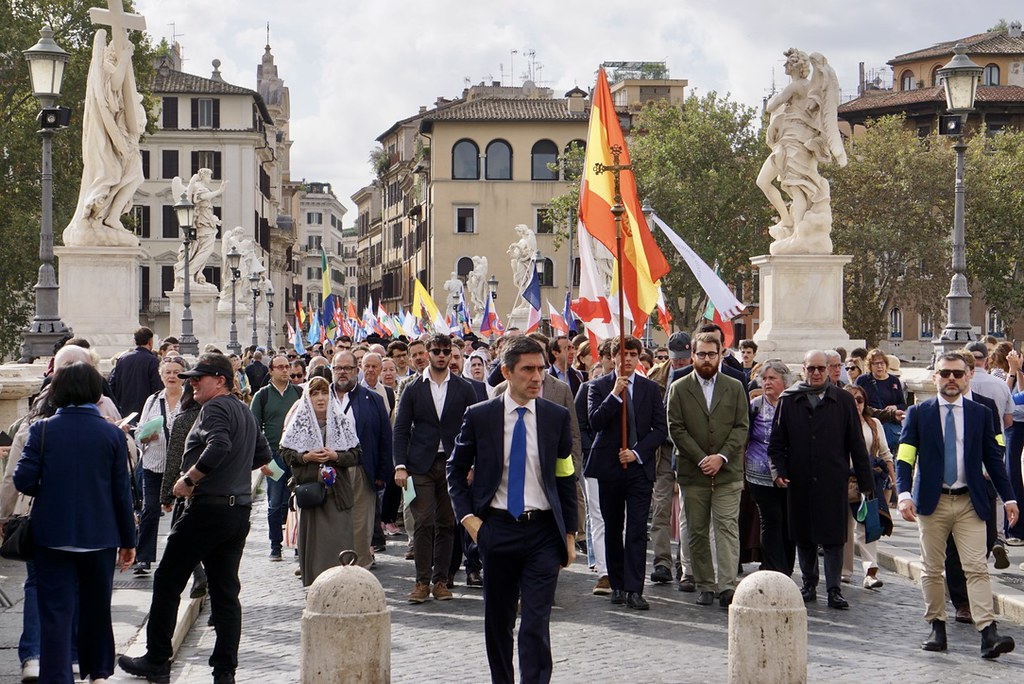
Above: the TLM pilgrimage in Rome – photo by Michael Haynes.
Last year’s traditionalist pilgrimage to Rome – the Ad Petri Sedem ‘Summorum Pontificum’ pilgrimage over the weekend of the last Sunday of October – was a big media story. It escaped containment, as they say, on the traditionalist news sites, and was picked up not only by EWTN but by AP, which made it available to the whole world. It had many of the ingredients of a good story: something apparently controversial and also rather photogenic was happening that wasn’t expected to happen. It doesn’t matter that the source of the controversy is obscure, even to the participants; it was enough that an opposing faction was available to provide outraged quotes to balance the story.
Pope Leo XIV, we have it on good authority, disliked the reportage, saying that the Mass he had permitted had been ‘instrumentalised,’ and it is reasonable to infer that this is why permission was not forthcoming for a Traditional Mass in St Peter’s this year. One can’t interrogate the Holy Father, but it would be helpful to know who he thinks instrumentalised it, and to what end. I’m sure the professionalism of AP’s excellent Rome correspondent, Nicole Winfield, is not in question – unlike a surprisingly large number of Rome journalists, she is not herself a Trad – but instrumentalization by others wouldn’t have been so effective if AP hadn’t sent the story around the world. Then again, the organisers can hardly be said to have done any instrumentalising themselves, as apart from engaging a photographer they had no role in reporting at all: they don’t even have a press officer.
It would certainly be unfair if it turned out that the instrumentalising we are being punished for came down to a set of puerile remarks by anonymous X accounts with followers in single digits, served up to the Successor of St Peter by Elon Musk’s algorithm. It would be just as unfair if it had been the sophomoric analysis of celebrity podcasters racking up vast numbers of downloads. What are we supposed to do about them? It is bishops and the pope who have disciplinary authority over the faithful, not the organisers of international pilgrimages.
If anyone in the Holy See thought that by excluding the pilgrims from St Peter’s this year would lead to more manageable and level-headed headlines, they couldn’t have been more wrong. If the pope had been irritated by being informed that the Trads are ‘back in town’ in 2025, I can only imagine what he thought about being told that he was some kind of devil in 2026, by a media environment incapable of displaying shades of grey. Nuance doesn’t get clicks; ecstasy and rage do.
I say all this in part to explain the irritation some people close to the organisers of the pilgrimage, including me, have displayed when responding to online comments. Leaving aside the contributions of bot accounts and rage generators hoping to increase their follower numbers, the picture is complicated by the presence online of supporters of the SSPX on the one side, and Liberal Catholics on the other. Both would like to see the Holy See at war with the Traditional Mass, in order to show that the patient work of mainstream traditionalists over the last six decades is doomed.
It is not doomed, however. It will surprise some readers to hear that the organisers regarded this year’s pilgrimage as a success: almost a miraculous success, in fact. It was never going to be as big and shiny as the jubilee year with Cardinal Burke, and over the last twelve months it has become clear that forces hostile to the Traditional Mass have been rallying to defend Traditionis Custodes.
Indeed, we have had a remarkable set of mixed messages under Pope Leo on this subject. We saw the pope greeting the Chartres pilgrims, sending an encouraging message to the French bishops, and telling the English bishops that requests for extensions to permissions would be granted (which they have been). Over the same period, however, we have had a series of interventions by Cardinal Arthur Roche of the Dicastery of Divine Worship: the paper he gave to the consistory of cardinals, interviews, and letters to bishops. These give the impression that the suppression of the ancient Mass is proceeding as normal, and they have been echoed by the actions of a number of bishops around the world which have treated Catholics attached to the Traditional Mass as if they have no legitimate pastoral needs at all. As Christian Marquant, the President of the ‘Coetus’ that organises the pilgrimage remarked, ‘we do not exist.’ And yet, he went on to say, somehow we are also a threat worthy of a great deal of attention.
In this context, there is everything to play for. We need to show our friends and our opponents alike that the tide has not turned so much against the Traditional Mass that we are completely unwelcome in Rome. There are still bishops who will risk association with us; the custodians of great historic churches such as the Pantheon and St Mary Major are not under orders to refuse to open their doors to us; traditional Catholics are not so demoralised that they will not turn up to these events in large numbers; curious Catholics unfamiliar with the ancient Mass are not put off using the occasion to come along to see what the fuss is all about.
This is what we can do, and what we are offered, when things are bad. When things improve, they will improve from this level, not from nothing at all.
It is important to stress that the negotiation, the docility, and the gratitude involved in a process like organising the Rome pilgrimage, like any big traditional Catholic event, is not a display of weakness. Nor is it passivity: bizarrely, this seems to be a common accusation made against us precisely when we are hard at work organising a huge and highly complex event. It is, if you like, fighting, but not against the Holy Father, nor against the Cardinal Archpriest of St Mary Major or anyone like that. It is combat against those who want the Traditional Mass to disappear from the life of the Church, who we oppose in the most direct way possible: by keeping the Traditional Mass in the centre of the life of the Church.
It is those who wish to play the victim and slink away to lick their wounds, those who want to give up, who can’t bear the idea of having respect for persons, or thanking people for the genuine hard work which big events entail for everyone involved: these are the people, I am sorry to say, who display pusillanimity: smallness of soul.
We are fortunate to have leaders in the Coetus organising this pilgrimage, as we have in general in the Traditionalist movement, both lay and clerical, who have a very clear idea of what the stakes are, what concessions are possible to gain the ultimate prize and what concessions are not. It is thanks to their extraordinary efforts over decades that we have got to the point that the Traditional Mass, in its integrity, has made its slow return to the Roman basilicas, and it is thanks to them that it remains there. The keyboard crusaders who think they can do better should try to get an ordinary Low Mass celebrated on the High Altar of their local cathedral: they’d learn something about the realities of ecclesial life, and might even achieve something good.
For the rest of my readers, let us remember Christ the King who is the centre of every Ad Petri Sedem pilgrimage: Viva Cristo Rey!