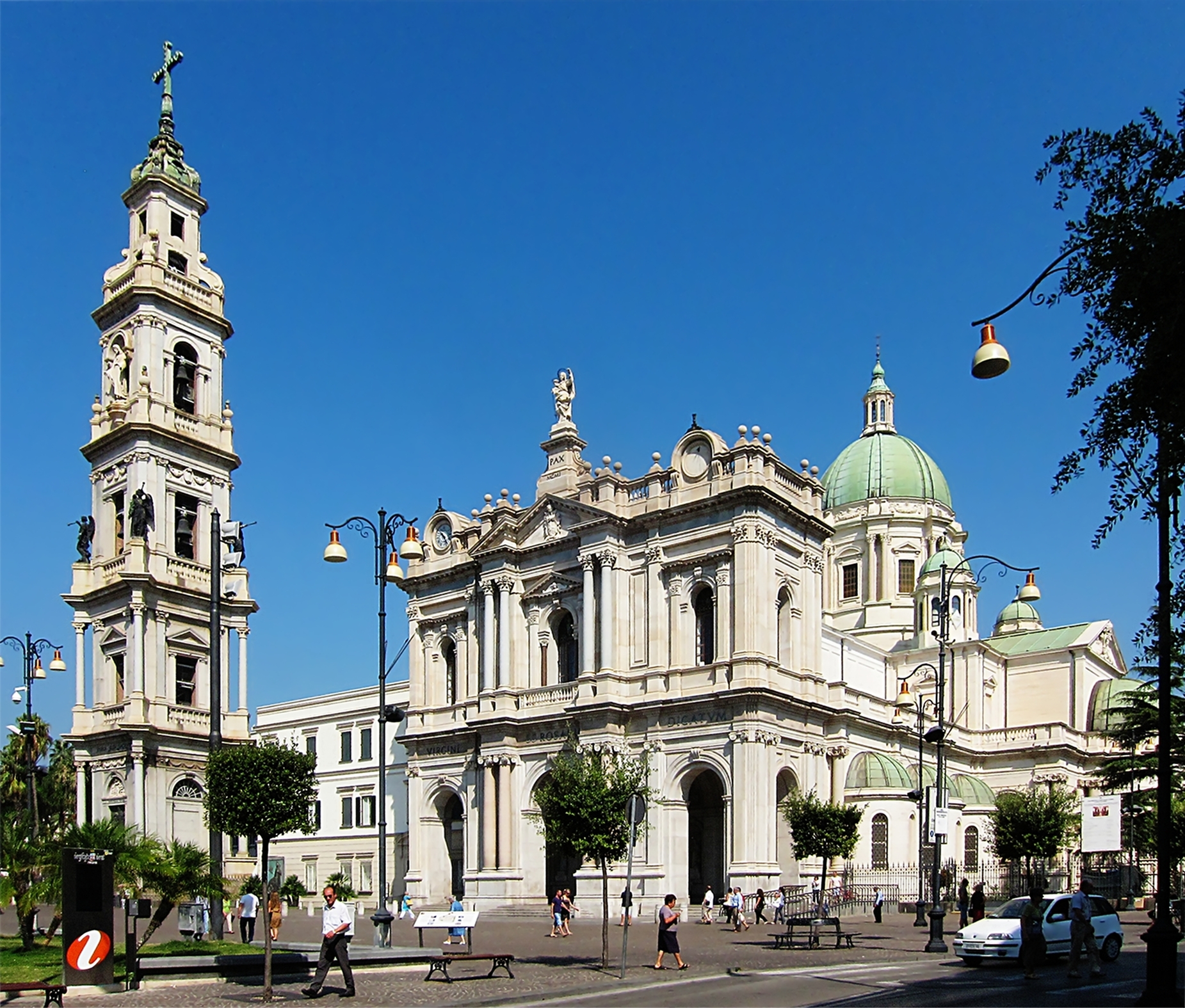
Above: Le Santuario della Beata Vergine del Rosario de Pompei (Italy).
One hundred and fifty years ago, on November 13, 1875, the “new” Pompeii was born. On that momentous day, a humble cart—ordinarily used for manure and driven by the carter Angelo Tortora—carried the venerated image of Our Lady of the Rosary into the town of Valle di Pompei. Wrapped in a simple sheet, the sacred image arrived quietly, yet its impact would soon resonate across the world.
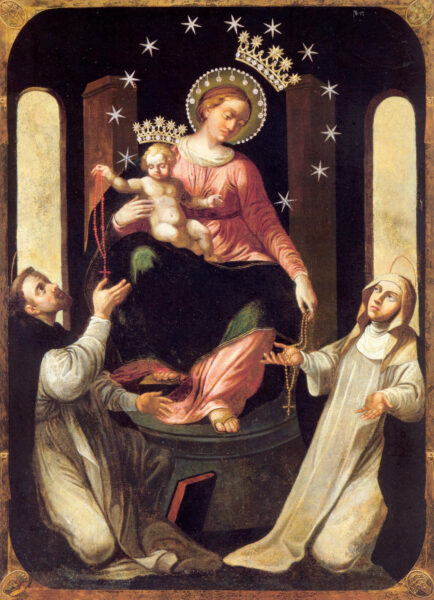
The artwork had been entrusted to Saint Bartolo Longo († 1926) by Sister Maria Concetta De Litala of the Convent of Rosariello at Porta Medina in Naples. She, in turn, had received it from Rev. Alberto Radente († 1885), Longo’s confessor. As the canvas required restoration, it was not immediately exposed for veneration. However, on February 13, 1876, the image of the Holy Virgin was finally enshrined on a majestic throne, beginning a legacy of devotion that continues to inspire the faithful worldwide.
Years earlier, St. Bartolo Longo, a lawyer by training, had experienced a profound spiritual reawakening. During his university years, he had drifted into a period of doubt and confusion, but an inner voice—echoing the traditional Rosary exhortation, “If you seek salvation, spread the Rosary”—guided him back to faith. From that moment, he dedicated his life to promoting the Rosary’s devotion through numerous initiatives, writings, and the practice of the Fifteen Saturdays. His efforts would establish him as one of the greatest champions of Marian spirituality.
The foundation of the current Pontifical Shrine of the Rosary in Pompeii was not only a testament to Longo’s faith but also to his deep appreciation for sacred music. He was determined that the Shrine’s liturgical music adhere strictly to ecclesiastical norms. His personal passion for music was evident from a young age. Longo once yearned for a piano.
He informed his family, but fearing that music would distract him from studying law, they dissuaded him and even denied him the necessary money. He then made a decision that reveals his extraordinary willpower. ‘I cannot count on my family,’ he said, ‘well then, I will rely only on myself.’ He decided to eat nothing but potatoes for an entire year to save the money needed to buy the piano, and—more importantly—he kept his word faithfully, something that, in our opinion, should have earned him the piano as a gift and perhaps something more. In fact, in addition to the piano, he also obtained a beautiful flute.[1]
On May 8, 1890, Longo crowned his musical vision by inaugurating a magnificent organ built by the esteemed Pacifico Inzoli company of Crema (Cremona). The inaugural concert, performed by the renowned composer and organist Marco Enrico Bossi († 1925) on May 29, 1890, celebrated this instrument of exceptional craftsmanship. In 1949, it was replaced by the current Eclectic Symphonic Organ, masterfully crafted by Vincenzo Mascioni of Cuvio (Varese).
Announcing the upcoming festival for the organ’s debut, Longo wrote in January 1890.
The organ of the Shrine of Pompeii must be worthy of the Shrine, and if the Shrine is already monumental, then the organ must also be a monument of art, capable of honoring Italy, which creates it, and this Church, destined to become worldwide. The day we have designated for this new glory of the Shrine of Pompeii is May 8 of this year, 1890. On that night, the sepulchral silence of this valley will be broken by unprecedented waves of melodic sound, which, from the monumental organ of the Shrine, will spread outside, enveloping the sleeping countryside.[2]
Longo’s commitment to sacred music extended beyond instrumentation. After consulting experts in sacred music and liturgy, he entrusted the basilica’s musical service to orphaned girls and daughters of prisoners, who were educated at the institute he had founded. Thus, he established a female Schola Cantorum rooted in artistic excellence and liturgical purity. Gregorian chant held pride of place, but classical and contemporary sacred music were also cultivated with great dedication.
To mark the foundation of the Schola Cantorum, Longo invited distinguished musicians from Rome to introduce the people of Valle di Pompei to the highest standards of sacred music. Between October 17 and 19, 1903, the Gregorian School of Rome, under the direction of Rev. Pietro Müller, performed an exceptional repertoire alongside organist Ernesto Boezi († 1946) and other accomplished Roman vocalists in the Basilica.
During the solemn Mass on October 19, the choir performed the Missa “O quam gloriosum” by Tomás Luis de Victoria († 1611) and the six-voice motet O bone Iesu by Giovanni Pierluigi da Palestrina († 1594), under the celebrant Rev. Ambrogio Amelli († 1933), prior of Montecassino Abbey, invited by Longo as one of Italy’s first ardent promoters of the liturgical-musical reform dear to Pope St. Pius X († 1914). This exposure to classical polyphony was a revelation to the local congregation, unaccustomed to such refined sacred compositions. Even modern sacred music found great success, as selections from Lorenzo Perosi († 1956), including his Missa Eucaristica and Confitebor, resonated deeply. Ernesto Boezi’s masterful organ performance further underscored the instrument’s remarkable capabilities.
On October 22, in the institute’s halls, a refined musical gathering showcased the talents of both the Gregorian School of Rome and the young women of the newly founded Schola Cantorum, solidifying a tradition that would shape Pompeian liturgy for generations.
Bartolo Longo was meticulous in selecting skilled musicians, both for the liturgical choir and for directing the band of the Ospizio per i Figli dei Carcerati (Orphanage for the Children of Prisoners), another of his charitable initiatives. Around 1886, the Shrine’s first organist was Giacinto Liucci († 1909), a gifted musician who lost his sight at the age of 12 due to an infection of Arabian smallpox. Following Liucci, the esteemed Luigi Ferrari-Trecate († 1964) served from 1909 to 1913, succeeded by Marziano Perosi († 1959)—brother of Lorenzo—until 1921, and then Egisto Giovannetti († 1951), who held the position from 1921 until approximately 1928, all within Blessed Longo’s lifetime.
Bartolo Longo’s life work was dedicated to honoring Our Lady of the Rosary, whose venerated image had arrived humbly on a cart 150 years ago yet became the spiritual heart of a global devotion. Through music, prayer, and service to the needy, he forged a singular mission: to spread the love and protection of Our Lady of Pompeii to all corners of the world.
[1] I. Felici, Bartolo Longo. Araldo della Gran Regina, Pompeii 1954; our translation.
[2] In N. Avellino, Pompei: il campanile monumentale, Pompeii 1997, p. 453; our translation.