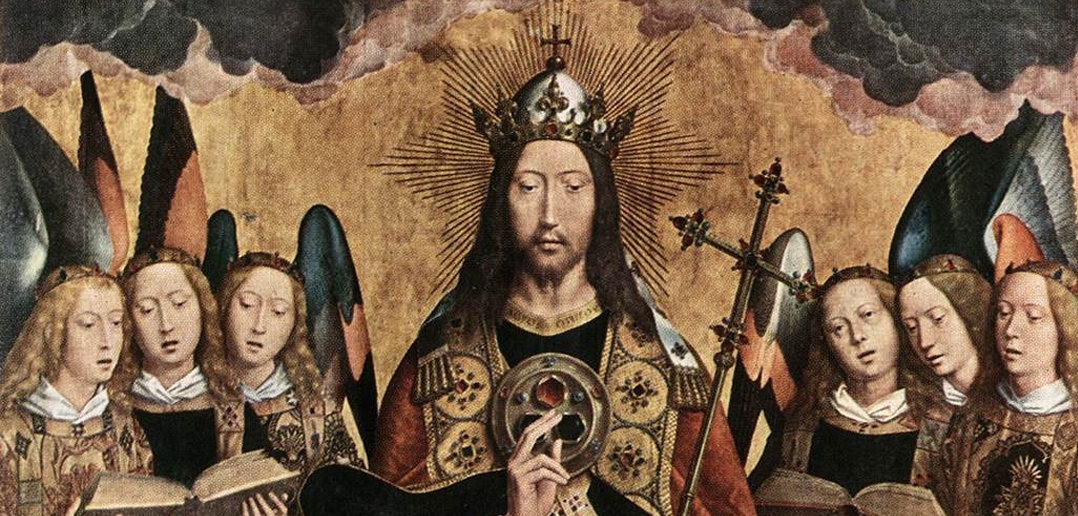


There are periods of the liturgical year that have a particularly close relationship with music—think of the music written for Christmas or for Lent. Others seem to have a less immediate connection. In June, the month dedicated to the Sacred Heart of Jesus, not many reflect on the various musical compositions that have been dedicated to this most important devotion.
If we refer to Gregorian chant, we may think of the beautiful hymn Cor arca legem continens, whose words present a comparison between the ancient Ark of the Covenant and the Heart of Jesus as the new Ark of the Covenant:
Heart, ark containing the Law—not that of ancient servitude, but the law of grace, forgiveness, and mercy; Heart, spotless sanctuary of the new covenant, temple holier than the ancient veil and more beneficial than the veil that was torn apart: Love willed that you be wounded by the thrust of a lance, so that we might venerate the wounds of an invisible love.
These are beautiful words—elevated and profound at the same time—which show us how the Sacred Heart of Jesus is an important sign of the new covenant that fulfills the ancient promise and now contains it within the new promise. Commenting on this hymn in Settimana News in 2019, Nico Guerini wrote:
The stanza of the hymn is a cascade of nouns, each deserving its own commentary: three indicate objects—heart, ark, law—and three describe interior dispositions which, in the end, are three ways of expressing the same reality: grace, forgiveness, mercy. It should also be noted that the stanza is framed by two words forming a splendid inclusion: heart and mercy.
There is another expression, mentioned only to be discarded, but which in reality becomes the keystone of a tremendous reversal: the Law that is removed and replaced is that of ‘ancient slavery.’ The new law of the heart therefore becomes, by contrast, a law of freedom that liberates. The ancient law also had this purpose, since God presents Himself as the ‘Liberator’ (Dt 5:6), and this gives the true meaning of the Decalogue. The ‘newness’ lies in the fact that Jesus complements the norms with gestures—those summarized in His pierced Heart.
The image connecting the heart with the Law is that of the ark. Any reader of the Bible knows the importance and centrality of this object in worship (cf. Ex 25:10–22). It is the supreme sign of God’s presence and remained so even after the ark was placed within that other sign of His presence: the Temple. This is because the ark contained the tablets of the Law and the manna, indicating that God’s beneficial nearness manifests itself both in the norms that trace the interior path of the people and in the nourishment that sustains them along the journey, spirit and body.
The hymn indicates that the Law had become—or risked becoming, as it always does—a yoke that enslaves, an ‘old’ yoke, not only because Jesus brings a ‘new’ Law (Jn 13:34), but also because, according to a language well known to the liturgy, ‘old age’ becomes synonymous with sin.
But this beautiful hymn is not the only musical expression dedicated to devotion to the Sacred Heart of Jesus.
The Introit for the Solemnity is Cogitationes Cordis eius, formed from verses taken from Psalm 32. The text says:
The thoughts of His Heart endure from generation to generation, to deliver their souls from death and to sustain them in time of famine. Rejoice in the Lord, O you righteous; praise befits the upright.
Here, the Heart of Jesus is presented as the means of salvation for all.
The fifth Gregorian mode used for this chant speaks of trust and manly hope in the promise of Our Lord Jesus Christ and of abandonment to His merciful Heart. According to Guido of Arezzo’s definition, the fifth mode is even described as “joyful,” if we understand this word in the sense of the restrained joy proper to Christianity, not in the sense of thoughtless cheerfulness. Perhaps it would be better to describe it as “filled with joy,” keeping in mind the distinction made by Romano Guardini in a letter written to the young people of the quick born movement between cheerfulness and joy.
I cannot fail to mention the beautiful Latin aspiration: Cor Iesu flagrans amore nostri. It was set to music by many composers and was once widely used in devotions to the Sacred Heart of Jesus: “Heart of Jesus, burning with love for us, inflame our hearts with love for You.”
Nor can I omit a nineteenth-century hymn that became very popular in Italy: Dolce cuor del mio Gesù, by the Roman composer Gaetano Capocci (1811–1898). Its beautiful melody—simple and natural—is elevated by the singing of children. This is a true example of a hymn capable of uniting popular sensitivity with the disciplined craft of an experienced composer.
Much more could be said about music for the Sacred Heart of Jesus, but I believe that these few lines are only an introduction to such a fascinating subject.