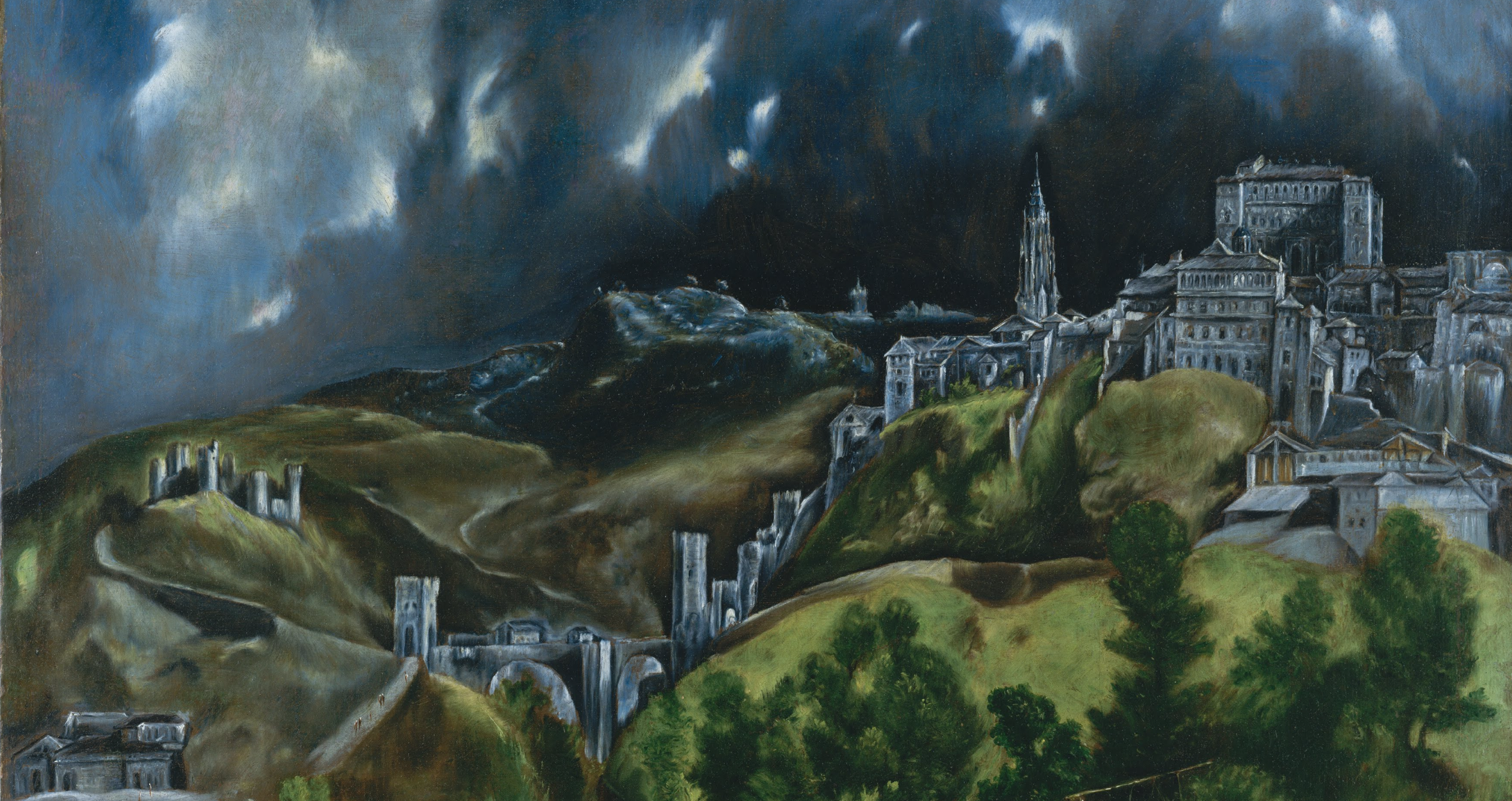
Above: El Greco’s landscape of Toledo showing the priory where St. John of the Cross was held captive.
On August 24, 1926 — exactly one hundred years ago — Pope Pius XI (†1939) proclaimed Saint John of the Cross (†1591), the great Spanish Carmelite mystic, a Doctor of the Church. In tradition he is honored with the title Doctor mysticus, the “Mystical Doctor.”
In the Apostolic Letter[1] accompanying the proclamation, Pius XI recalled how Benedict XIII (†1730), at the time of John’s canonization in 1726, had praised him not only for the sanctity of his life, but also for “his knowledge in sacred matters, so widely celebrated.”
Indeed — Pius XI noted — God had raised him up in the sixteenth century “to repair the harm inflicted on the Church by the Protestant heretics and to refute their errors.”
A close companion of Saint Teresa of Ávila in the Carmelite reform, John of the Cross endured imprisonment, during which he composed the Spiritual Canticle. In his later treatises (Ascent of Mount Carmel, Dark Night, Living Flame of Love), he described with incomparable depth the soul’s journey toward union with God. These works, though treating “difficult and profound subjects,” are so rich “in spiritual doctrine” that they appear “almost as a code and a school for the faithful soul.”
Pius XI also emphasized that numerous petitions from cardinals, bishops, and universities had urged the Holy See to study the cause. The Congregation of Rites confirmed that the saint met all the traditional requirements for the title of Doctor: “eminent holiness of life, excellence of doctrine, and the declaration of the Supreme Pontiff.”
Finally, in solemn words, Pius XI decreed:
We constitute and declare Saint John of the Cross, Confessor, Doctor of the Universal Church.
And he concluded by establishing that this decision should “always remain firm, valid, and effective.”
Thus, in 1926, the Church officially recognized in John of the Cross not only the reformer and the mystic, but also a universal master of holiness and doctrine.
The poetry of the saint from Fontiveros retained its fascination across the centuries and even inspired one of the greatest Spanish composers of the twentieth century, Joaquín Rodrigo (†1999). Blind from the age of three and world-renowned for his Concierto de Aranjuez (1939), Rodrigo turned to John’s verses early in his career.
In 1934, a year after marrying the Turkish pianist Victoria Kamhi (†1997), he composed El cantico de la sposa (Song of the Bride) for soprano and piano, later arranging it for soprano and chamber orchestra (flute, oboe, English horn, bassoon, horn, three percussion instruments, and strings). A work especially dear to the composer, it is now considered one of the masterpieces of twentieth-century Spanish song and was dedicated to his wife.
Rodrigo set to music the first four stanzas of John’s Spiritual Canticle, in which the bride seeks her Beloved by questioning creation. A contemporary critic observed:
As a good composer, Rodrigo does not apply the same music to all of them. In each one he seeks its spirit, its atmosphere, the specific music that it asks for. Thus, for example, in the first – ‘Where have you hidden?’ – one notices the suspensive sense of the voice, the questioning figures of the piano in the air, and the desperate, frustrated cry of the bride as she says: ‘I went out calling you, and you were gone.’ In the second stanza, when the bride asks the shepherds, the piano continues drawing questions, now more urgent, and the voice becomes restless and yearning. In the third – ‘Seeking my love’ – the music gains strength to express that neither beasts nor barriers will be obstacles to hold her back. It is the culminating moment of the work. In the fourth – ‘O woods and thickets’ – the voice again becomes supplicating, and the piano ends by repeating the same initial questions.
The perfection and transcendence of John’s poetry — here the opening stanzas of the Canticle — find a luminous counterpart in Rodrigo’s music, whose restrained recitative style recalls the best of late Renaissance seconda prattica. Poetry and music merge in a song that transports us both to Rodrigo’s creative moment and to the mystical world of the poet of Fontiveros.
To appreciate the dialogue between poetry and music, it is enough to read the four stanzas chosen by Rodrigo, here in English translation:[2]
1. Where have you hidden,
Beloved, and left me moaning?
You fled like the stag,
After wounding me;
I went out calling you, and you were gone.
2. Shepherds, you that go
Up through the sheepfolds to the hill,
If by chance you see
Him I love most,
Tell Him that I sicken, suffer and die.
3. Seeking my love
I will head for the mountains and for watersides,
I will not gather flowers,
Nor fearing wild beasts;
I will go beyond strong men and frontiers.
4. O woods and thickets
Planted by the hand of my beloved!
O green meadow,
Coated, bright with flowers,
Tell me, has he passed by you?
Centuries later, the mystical voice of Saint John of the Cross continues to inspire not only Christian spirituality but also art and music. In 1926, Pius XI proclaimed him Doctor of the Church; in 1934, Joaquín Rodrigo transformed his verses into immortal song. Two different yet complementary signs of the same truth: John of the Cross endures as a universal witness to divine Love.
[1] Pius XI, Litterae Apostolicae Sanctus Ioannes a Cruce Confessor…, 24 augusti 1926, in Acta Apostolicæ Sedis 18 (1926), pp. 379-384; our translation.
[2] Kieran Kavanaugh, John of the Cross: selected writings, New York 1987, pp. 221-222.