
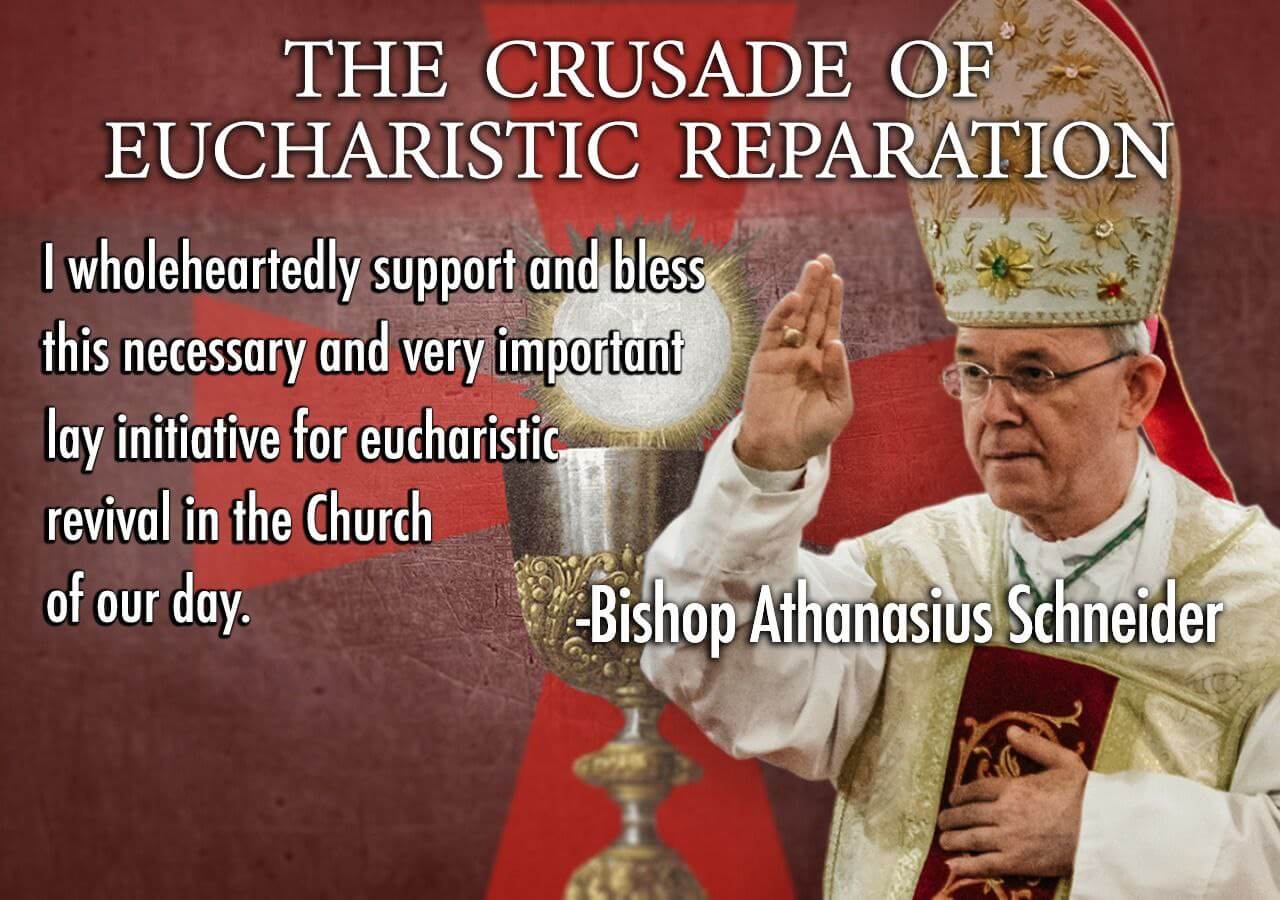
Editor’s note: join our Sacred Heart campaign to receive a Eucharistic Crusade Manual in the mail.
In the beginning of the Church’s history, the Apostles mandated that the members of Christ’s Mystical Body refrain from eating and drinking before their reception of the Blessed Sacrament: “For every one taketh [the Eucharist] before his own supper to eat” (Corinthians 11:21; Douay-Rheims Bible). Following St. Paul, there are a number of early Church authorities who supported this practice. For instance, in the third century, the Carthaginian theologian Tertullian asked wives with unbelieving husbands: “Will not your husband know what it is which you secretly taste before (taking) any food?”[1] At that time, St. Hippolytus of Rome also attested to the ancient Eucharistic Fast:
But let each of the faithful be zealous, before he eats anything else, to receive the Eucharist; for if anyone receives it with faith, after such a reception he cannot be harmed—even if a deadly poison should be given him.[2]
Finally, in the fourth century, St. Augustine explained that “for the honour of so great a Sacrament…the Body of the Lord should take the precedence of all other food entering the mouth of a Christian,” noting that the Eucharistic Fast had been a longstanding custom for quite some time.[3] In fact, the Church would continue to enjoin its observance upon Her children up until 1953. This raises the question: “What changed?”
Commenting on the social conditions of the twentieth century, Venerable Pope Pius XII observed that “out of these there may arise serious difficulties which could keep men from partaking of the divine mysteries” if the ancient Eucharist Fast were to remain binding on Catholics.[4] Among the reasons mentioned by the Holy Father include the occurrence of two World Wars; the rapid advancement of technology; and the lack of priests in proportion to the number of the faithful. In response to these concerns, the petitions of the bishops at that time became “more frequent and urgent,” leading Venerable Pope Pius XII to conclude that such a change was necessary for the Church to thrive in the modern world.[5] Consequently, he permitted Catholics to drink water at any point before receiving Our Lord and to abstain at least three hours from eating any food.[6]
Although the Holy Father maintained that the Church’s Tradition should still be kept by all Catholics who were physically capable of doing so, his pontificate would officially mark the end of the ancient Eucharist Fast.
On November 21, 1964, Pope Paul VI would give the Church the Eucharist Fast in its current form.[7] Instead of abstaining from food for three hours, Catholics are now only required to refrain for one hour. In addition to drinking water, he also allowed the consumption of alcoholic beverages. The 1983 Code of Canon Law would eventually abrogate this exception and substitute the intake of medicine as its alternative: “A person who is to receive the Most Holy Eucharist is to abstain for at least one hour before holy communion from any food and drink, except for only water and medicine.”[8]
Whatever pastoral conditions induced Pius XII and Paul VI to significantly alter the ancient fast, we know for certain the world has dramatically altered since their time. Therefore, with all due respect to my Catholic brethren, I don’t understand why the majority of practicing Catholics can’t attend Mass in the morning in order to uphold the ancient Eucharistic Fast. For example, let’s say you have to arrive at your workplace for 9:00 A.M. Given that priests usually celebrate the New Mass in about thirty minutes, you would be able to receive Our Lord any time before 8:00 A.M. and still be in the office on time. Granted, those who fulfill their Sunday obligation on Saturday and Sunday evenings would have a difficult time abstaining from food and water for the entire day, but Catholics who attend Mass during the week and on Sunday mornings could sacrifice their breakfast and still eat lunch and dinner with their families and friends. Is not the Lord worthy of our undivided attention in both our souls and our bodies? To quote the Apostle: “For he that eateth and drinketh unworthily, eateth and drinketh judgment to himself, not discerning the body of the Lord” (1 Corinthians 11:29).
In my view, Pope Paul VI’s decree doesn’t make much sense in our time. Again, no disrespect to those who keep the current Eucharist Fast, but one hour can hardly be considered a sufficient sacrifice to receive God Himself through our mouths. As Catholics, the Most Holy Sacrament of the Altar is our prized possession. One hour—let alone the entire day—is not long enough to contemplate the Sacred Mysteries of our redemption. If we neglect to venerate Our Lord’s Body and Blood properly, we will have to answer for it during the Particular Judgment. Let us pray for the restoration of the ancient Eucharist Fast in the Church!
[1] Tertullian, Ad Uxorem, Book I, Chapter V.
[2] Saint Hippolytus of Rome, The Apostolic Tradition of Hippolytus, trans. Burton Scott Easton (Cambridge University Press, 1934) “Later Additions,” art. 32.
[3] Saint Augustine, Nicene and Post-Nicene Fathers, First Series, Vol. 1, trans. J.G. Cunningham(Buffalo, 1887), Letter 54, Chapter 6, art. 8.
[4] Venerable Pope Pius XII, Apostolic Constitution concerning the Discipline to Be Observed with Respect to the Eucharistic Fast Christus Dominus(6 January 1953), at Papal Encyclicals.net.
[5] Ibid.
[6] Venerable Pope Pius XII, Motu Proprio on Laws of Fasting and the Evening Mass Sacram Communionem (19 March 1957), at Papal Encyclicals.net.
[7] Acta Apostolica Sedis 57 (1965), 186.
[8] 1983 Code of Canon Law, c. 919, §1, at The Holy See.