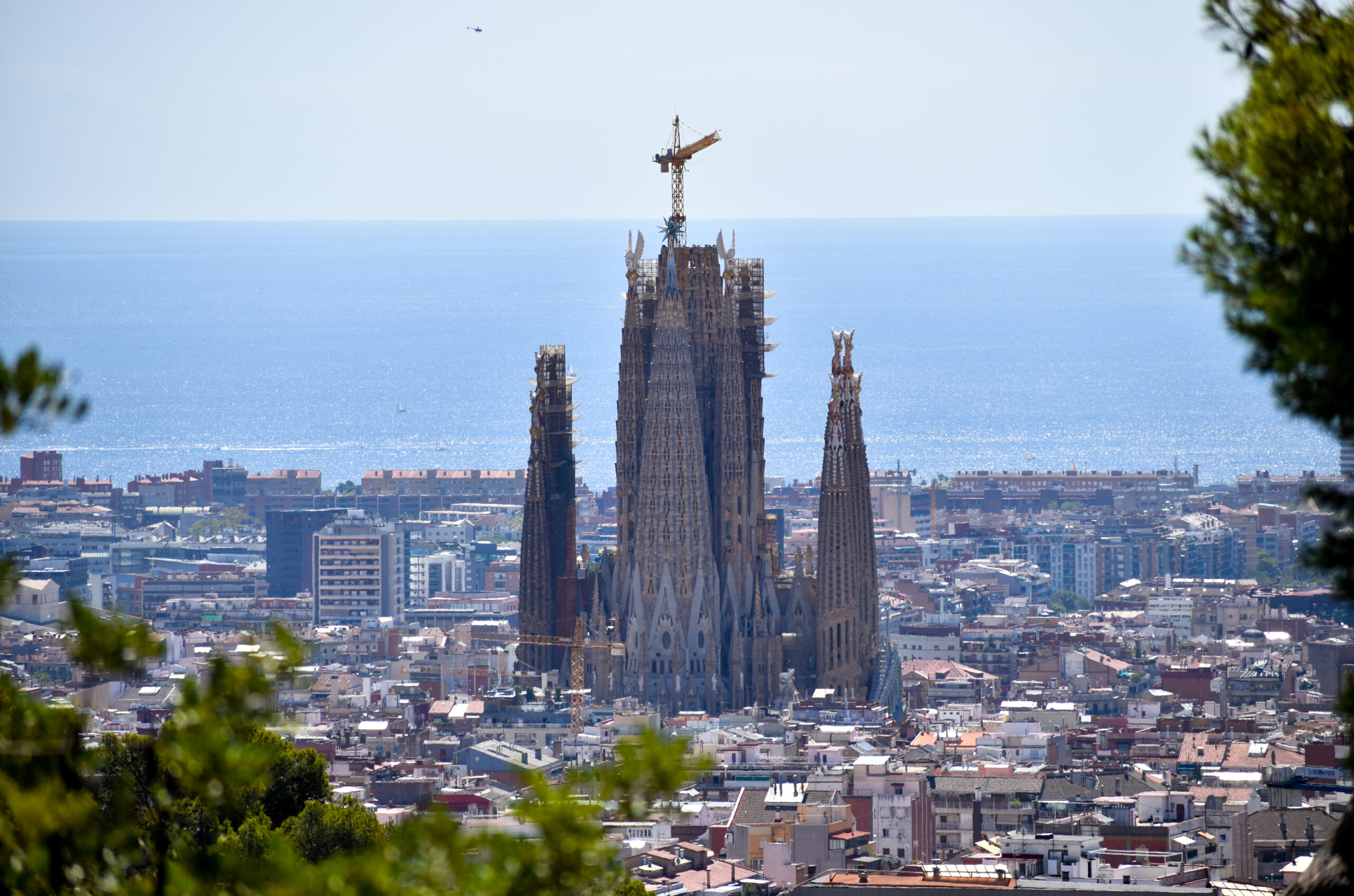
Above: the Sagrada Familia in Spain.
A century ago, on June 10, 1926, Antoni Gaudí i Cornet died in Barcelona, northeastern Spain—“a creative architect and a practicing Christian who kept the torch of his faith alight to the end of his life, a life lived in dignity and absolute austerity.”[1]
Born 74 years earlier in Reus, he was baptized the following day and raised in a deeply religious family. He studied first at the Piarist Schools in his hometown and later in Barcelona, where in 1878 he graduated as an architect. From the beginning, his career was distinguished by an extraordinarily original artistic language, in which nature, symbolism, and faith converged in masterpieces such as the Expiatory Church of the Sagrada Família (1883–1926), Parc Güell (1900–1914), and Casa Batlló (1904–1907).
In 1883 Gaudí assumed responsibility for the Sagrada Família, the project that would consume his life and, from 1914 onward, become his sole dedication. He regarded the basilica as an “expiatory altar” to be built through concrete sacrifices. For this reason, he embraced an increasingly sober and ascetic lifestyle, renouncing worldly comforts in order to devote himself fully to his work and to prayer. As Pope Benedict XVI affirmed:
Filled with devotion to the Holy Family of Nazareth, a devotion spread among the Catalan people by Saint Joseph Manyanet, the genius of Antoni Gaudí, inspired by the ardor of his Christian faith, succeeded in raising this sanctuary as a hymn of praise to God carved in stone.[2]
On the evening of June 7, 1926, while on his way to the Church of San Felipe Neri to meet his confessor, Rev. Agustí Mas i Folch (†1937), he was struck by a tram. His humble appearance and lack of identification led to his being mistaken for a beggar; medical assistance arrived too late, and Gaudí died three days later. His funeral was attended by some 30,000 people, a testimony to the immense respect and affection Barcelona held for him.
Today, the name of Gaudí immediately evokes breathtaking architecture—tree-like columns, intricate mosaics, and stone shaped into profound symbols of faith. Less well known, but no less fascinating, is his deep connection with Gregorian chant and the revival of liturgical music in Catalonia.
Guided spiritually by Rev. Agustí Mas i Folch, Gaudí developed a profound passion for the liturgy and sacred chant, which in turn influenced his vision of the Sagrada Família. He was not a mere supporter but an active participant in the musical reform movement that, at the beginning of the 20th century, sought to restore authenticity to the Church’s music. Fittingly, at his funeral on June 12, 1926, the Orfeó Català, conducted by Lluís Millet i Pagès (†1941), sang the Missa pro Defunctis by Tomás Luis de Victoria (†1611), a masterwork of Renaissance polyphony. This choice was deliberate, reflecting their shared devotion to a pure and spiritual musical language. Victoria, along with Giovanni Pierluigi da Palestrina (†1594) and Orlando di Lasso (†1594), is counted among the greatest composers of the 16th century.
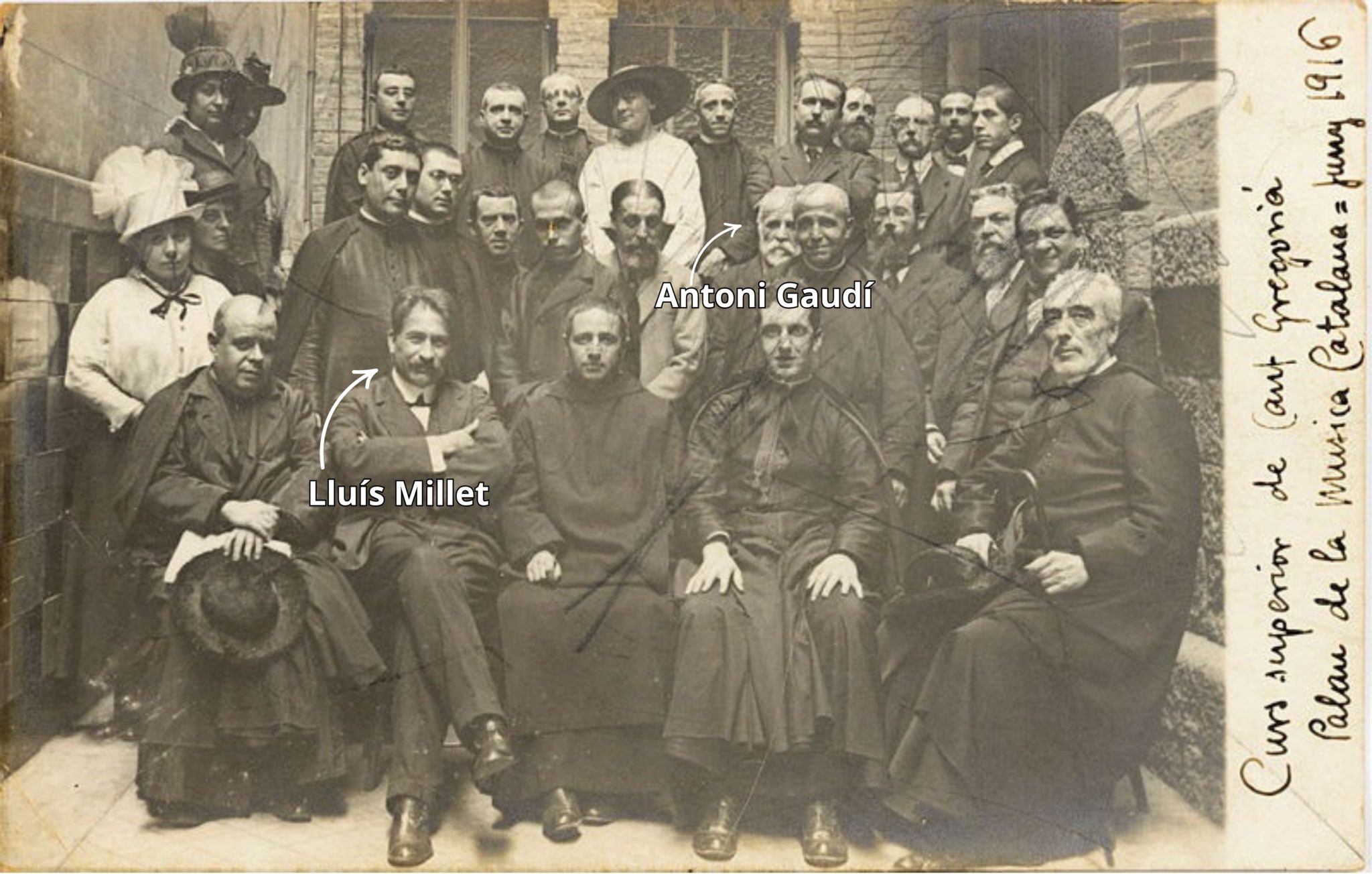
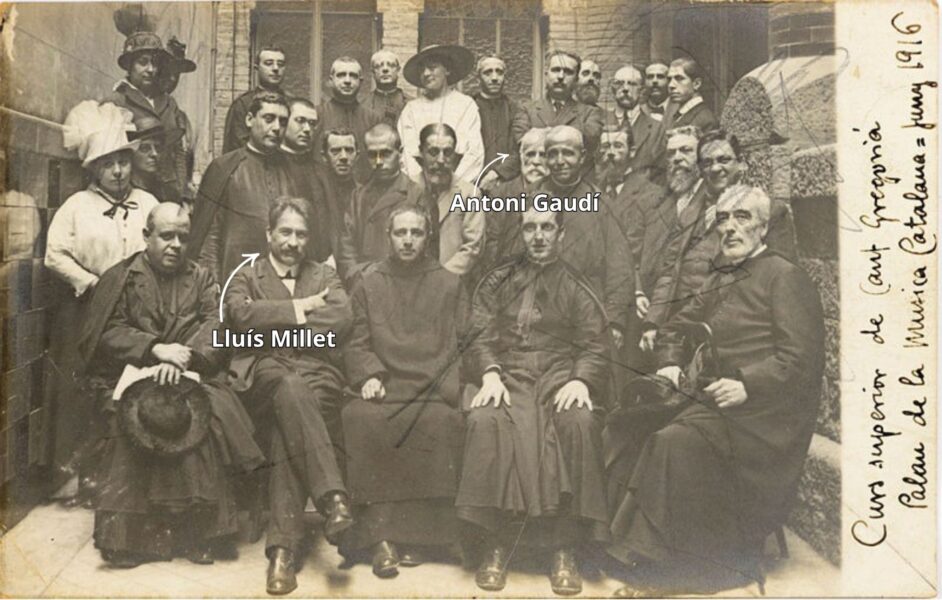
In June 1916 Gaudí attended an advanced course on Gregorian chant at the Palau de la Música Catalana, taught by Gregori Maria Sunyol, a monk of Montserrat Abbey. The decision was no coincidence: it marked his embrace of Cecilianism, a 19th-century liturgical movement that sought to recover the sobriety of medieval chant in opposition to the theatrical tendencies of contemporary sacred music.
Gaudí captured his artistic and spiritual philosophy in a single phrase:
Originality consists in returning to the origin; thus, original is that which returns to the simplicity of the first solutions.[3]
Applied to music, this meant rediscovering the primal sacredness of Gregorian chant and Renaissance polyphony, stripping them of all superficial spectacle and restoring their true spiritual function. This approach harmonized perfectly with the reform initiated by Pope St. Pius X (†1914), who issued “the Motu proprio Tra le sollecitudini [Among the cares], 22 November 1903, with which he brought about a profound reform in the field of sacred music, restoring the great tradition of the Church to counter the influence of profane music, especially light opera.”[4]
In Catalonia, this call found resonance through figures such as the musicologist Felip Pedrell (†1922), who between 1898 and 1913 published Victoria’s complete works, and Lluís Millet, who, from the Oratory of Barcelona, promoted the compositions of Palestrina—especially the Missa Papæ Marcelli—alongside the Gregorian Missa de Angelis and popular hymns in Catalan.
Gaudí placed great importance on the participation of the people in the liturgy. He wrote:
The people sing—if not the patriotic hymn, then the revolutionary hymn; if not the religious song, then the blasphemous and obscene song. Therefore, it is necessary that the people take part in the chants of the Church.[5]
And again:
The Gospel and St. Paul say that the sense of hearing is the sense of faith.[6]
Accordingly, he conceived the Sagrada Família as a space expressly designed for choral singing: choirs placed in different locations, creating a harmonic interplay of voices without the dominance of the organ. It was, in essence, musical architecture—stone amplifying the collective prayer of the faithful.
This vision was partially realized on May 18, 2012, when 615 singers, arranged according to Gaudí’s own plans—children in the presbytery, women and men on the sides—transformed the basilica into a living musical instrument, with Gregorian chant as its privileged voice.
Antoni Gaudí was not only a visionary architect but also a liturgical thinker and musical reformer, uniting tradition with innovation. His bond with Gregorian chant and with the protagonists of the Catalan musical revival reveals a larger project: a vision of harmony between stone and faith, architecture and music, sacred space and the human voice.
[1] Benedict XVI, Homily, November 7, 2010.
[2] Benedict XVI, Angelus, November 7, 2010.
[3] I. Puig-Boada, El pensament de Gaudí, Barcelona 1981, p. 220
[4] Benedict XVI, Letter to the Grand Chancellor of the Pontifical Institute of Sacred Music, May 13, 2001
[5] A. Gaudí, Gaudí x Gaudí, Barcelona 2001, p. 160; our translation.
[6] A. Gaudí, Manuscritos, artículos, conversaciones y dibujos, Murcia 1982, p. 93; our translation.