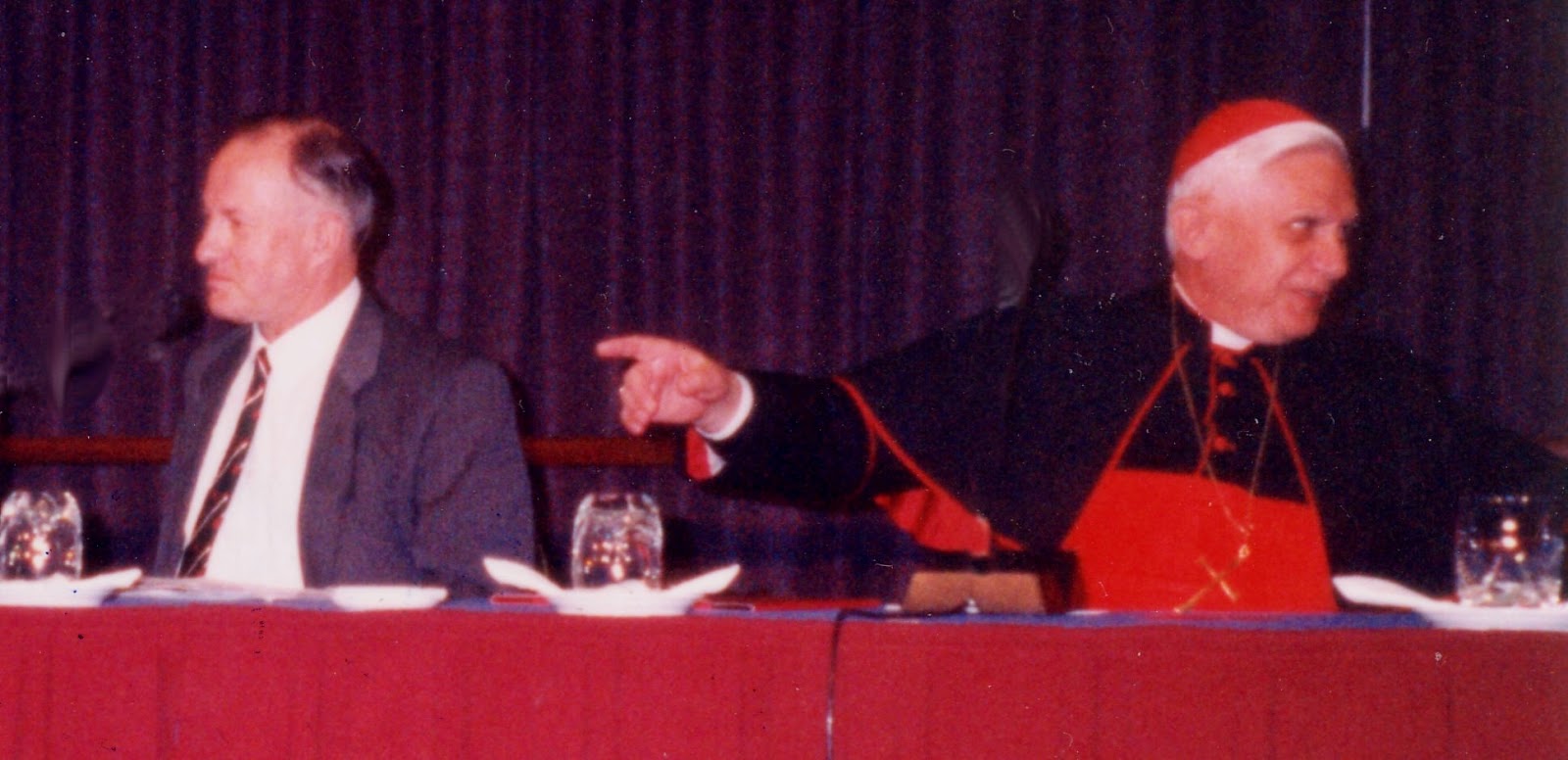
Above: Michael Davies (left) with Cardinal Joseph Ratzinger at a general assembly of Una Voce. Photo credit: Una Voce.
As a 25-year-old who had just entered the seminary, I lacked the proper vocabulary to articulate my dissatisfaction with Catholic liturgical life as I experienced it. I was born in 1965, the last year of the Second Vatican Council, and so had lived my Catholic faith and discerned a priestly vocation entirely under the new rite of the Mass established by Pope Paul VI after Vatican II. Yet I had come to see, in how the liturgy was typically celebrated, serious problems that (as I later learned) derived from its departures, in ways big and small, from the form and ethos of the historical Roman Rite. Providentially, it was not long before likeminded seminarians put me on to the works of a British Catholic layman named Michael Treharne Davies (1936-2004).
A former soldier, a primary school teacher, and a convert to Catholicism (his Welsh father was Baptist but quite indifferent to religion; his English mother was Anglican and quite anti-Catholic), Michael Davies was a prolific author and speaker in defense of the Traditional Latin Mass and Catholic orthodoxy in general. In fact, he was the most widely published English-language proponent of Catholic traditionalism. “His books and encouragement,” wrote Davies’ obituarist Leo Darroch, were “like manna from heaven” for the many faithful who, dismayed by liturgical turmoil and confusion, “were ploughing a very lone ‘traditional’ furrow in their parishes.”1 For decades, Davies’ books, pamphlets, and recorded talks were “the bridge you had to cross” in order to start learning about the traditionalist position, said Joseph Shaw, current Chairman of the Latin Mass Society of England and Wales and President of the International Federation Una Voce (FIUV).2 If you, dear OnePeterFive reader, are too young to have knowledge of Michael Davies and his work, just think of him as the Peter Kwasniewski of his time, without benefit of the internet and social media.
At first somewhat enthusiastic about the renewal of the Church undertaken by Vatican II, by the early 1970s Davies began to adopt a critical reading of the conciliar documents and their application (or misapplication) to the Church’s life and mission. His encyclopedic research into the sweeping overhaul of Roman Catholic worship led to the publication of his monumental Liturgical Revolution trilogy of books, first published in England by Augustine Publishing Company and available today in updated editions from Angelus Press. Volume One, Cranmer’s Godly Order (1976) traces the process by which the sixteenth-century English Reformers transformed the Holy Sacrifice of the Mass into a Protestant Lord’s Supper, and shows how the architects of the post-Vatican II liturgy followed along similar lines;3 Volume Two, Pope John’s Council (1977) chronicles the hijacking of the council by a clique of theological liberals who co-opted the media to promote the so-called “spirit of Vatican II”; and Volume Three, Pope Paul’s New Mass (1980), is an exhaustive critique of the New Order of Mass (Novus Ordo Missae) promulgated in 1969 and published in the Roman Missal of 1970.
Mr. Davies felt strongly that the French Archbishop Marcel Lefebvre (1905–1991), founder of the Priestly Society of St. Pius X, had been grossly misrepresented in a pamphlet published in 1976 by the Catholic Truth Society of England and Wales. When the pamphlet’s author, Msgr. George Leonard, refused either to substantiate or to recant his allegations against the archbishop (chiefly, that Lefebvre rejected Vatican II tout court), Davies penned his own pamphlet in defense of Lefebvre; it proved so popular that he decided to write a book-length apologia. Published by Angelus Press in 1979 as Apologia Pro Marcel Lefebvre, this became the first volume of Davies’ second trilogy, the subsequent volumes appearing in 1983 and 1988. Totaling over 1,400 pages, these books portray the conflict relating to the grievances between the archbishop and Roman authorities. Since Volume Three covers the years 1979–1982, it predates the breach opened in 1988 when Archbishop Lefebvre consecrated four bishops for his Society without the canonically required papal mandate and in defiance of Pope John Paul II.4
Despite his unpopularity with the liturgical establishment and its members and admirers among the bishops, Mr. Davies was unflagging in his respect for ecclesiastical authority and in his attachment to the See of St. Peter. He held no truck with sedevacantism and in fact strongly opposed it.5 Unlike the sedevacantists, Davies never denied the legitimacy of the Vatican II and post-conciliar popes; nor did he deny the validity and orthodoxy of the Mass of Paul VI and the other new sacramental rites. He did, however, expose their deficiencies when compared to the traditional rites they displaced, and showed that many of the changes make the Church’s liturgy much more acceptable to Protestants.6
In his carefully documented book, The Order of Melchisedech: A Defence of the Catholic Priesthood, first published in 1979 and expanded in 1993, Davies was critical of the post-Vatican II (1968) rite of priestly ordination for its ambiguities concerning the sacrificial nature of the Eucharist and the specifically sacrificial role of the ordained priest. He likened the new Roman Ordinal to the Anglican Ordinal of 1662 (slightly revising the one in use from 1552), which Pope Leo XIII, in his bull Apostolicae curae (1896), cited as the cause for declaring Anglican holy orders invalid. On the basis of the Catholic Church’s indefectibility, Davies affirmed the validity of the new Ordinal in its Latin and English versions, but deemed it “manifestly inferior to the traditional rite as a liturgical expression of Catholic teaching on the priesthood.”7
From 1965 through the 1980s, Catholics who resisted the liturgical revolution, both lay and clerical, were widely dismissed as intransigent nostalgics or schism-prone cranks. That began to change in the 1990s, thanks largely to the frankness of no less a personage than Cardinal Joseph Ratzinger, Prefect of the Congregation for the Doctrine of the Faith. Ratzinger did not conceal his conviction that “the crisis in the Church that we are experiencing today is, to a large extent, due to the disintegration of the liturgy.”8 Although he had never criticized Paul VI’s missal per se, he did express misgivings about the way in which it was prepared and imposed, bluntly declaring in 1992: “We abandoned the organic, living process of growth and development over centuries, and replaced it — as in a manufacturing process — with a fabrication, a banal on-the-spot product.”9 His Eminence had even suggested the necessity of a liturgical “reform of the reform.”10 Such candor from so important a prelate naturally helped to mainstream critical discussion of the official liturgical reform and encouraged efforts to find avenues for an end to the “liturgy wars.”
The blowing of new winds in Rome meant that when Michael Davies assumed the presidency of FIUV on New Year’s Day of 1995, he could “[move] that organization forward in years that were not as bleak as previous ones.”11 Now with increased international status and a higher “official” profile, he became a respected visitor to the Congregation for the Doctrine of the Faith, the Congregation for Divine Worship and Discipline of the Sacraments, and the Pontifical Commission “Ecclesia Dei.” His several meetings with Cardinal Ratzinger convinced him that this prince of the Church fully understood what was at stake over “the question of the liturgy.” Although Ratzinger’s hands were tied by a largely hostile Curia, Davies trusted him to advocate for the Catholic faithful who prefer the treasures of the older rites.12 Had he lived just a few more years, he surely would have been elated to see his convictions and labors validated by Pope Ratzinger’s (Benedict XVI) Motu Proprio Summorum Pontificum (2007), which established in Church law that everyone who wants the pre-reform Roman liturgy, be they clergy or laity, is entitled to it. 13
Michael Davies’ numerous books, booklets, essays, and public addresses (some of which are available on YouTube) — done alongside his responsibilities as a teacher, and often at the expense of personal time with his Croatian wife of forty-three years, Marija (née Milosh, b. 1938) — brought to popular light facts about the liturgical revolution not generally known to the people in the pews: that the Fathers of Vatican II did not call for the abolition of Latin and Gregorian chant from the liturgy (quite the contrary!); nor did they mandate the celebration of Mass “facing the people,” the composition of new Offertory prayers and new Eucharistic Prayers, and the removal of altar rails for the reception of Holy Communion standing and in the hand.
Although Davies focused mainly on post-conciliar controversies, he also wrote about the not-altogether-unrelated Modernist crisis in the Church in the first decade of the twentieth century: Partisans of Error: St. Pius X Against the Modernists (The Neumann Press, 1983). His other historical works include For Altar and Throne: The Rising in the Vendée (The Remnant Press, 1997), on the uprising in France’s Vendée region (beginning in March 1793) sparked by the anti-Catholic policies of the revolutionary government, and biographies of such impressive churchmen as Saint Athanasius (Angelus Press, 1985), Saint John Fisher (The Neumann Press, 1998), Father Adrian Fortescue (Roman Catholic Books, 1999), and Cardinal (now Saint) John Henry Newman (The Neumann Press, 2001).
In late 2002, Davies was diagnosed with terminal prostate cancer, which he regarded as more irritating than fearsome. Cancer diminished his energy but not his determination. He wanted desperately to update his great trilogy on the liturgy and was working on Pope John’s Council when he died suddenly of a heart attack on September 25, 2004. The years just prior to his death also saw him preparing a revision of his study of the alleged Marian apparitions at Medjugorje in Bosnia-Herzegovina, which he regarded as fraudulent; this unfinished work was finally published in 2023 by Arouca Press as Medjugorje: The First Twenty-One Years (1981–2002).
Immense though his legacy is (seventeen full-length books and several dozen booklets and pamphlets), Michael Davies remains largely unknown to the Catholic Millennials and Gen Zers who find themselves drawn to the Mass of the Ages. One is doubly grateful, then, to see this remarkable figure the subject of two biographies: one published six years ago (still fairly recent relative to 2004), and the other published earlier this year.
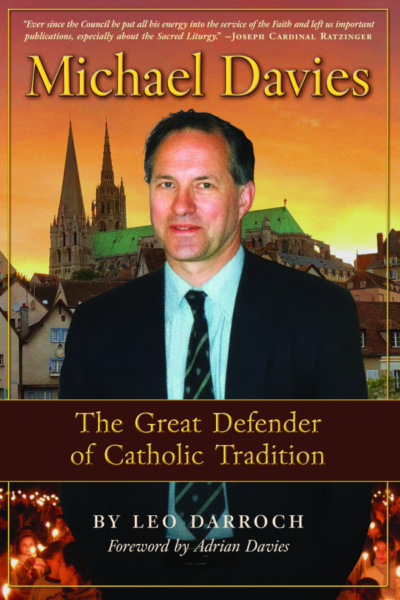
In 2020, the Italian composer, conductor, and writer Aurelio Porfiri gave us A Future in Tradition: Remembering Michael Davies (Chorabooks), which carries a foreword by Peter Kwasniewski. Arranged topically (“Vatican II,” “In Defense of the Priesthood,” “Modernism,” etc.), this slim (97 pages) but informative book contains a lengthy, hitherto unpublished interview that the author conducted with Davies in 2001. And now we have Leo Darroch to thank for Michael Davies: The Great Defender of Catholic Tradition, released this past March by Arouca Press. Darroch was Davies’ successor (by two removes) as President of FIUV from 2007 to 2013. Michael’s son Adrian contributed the foreword to this 415-page biography (not counting its appendices and index).
Michael Davies did everything that an educated and zealous layman could do to call out misguided reform, refute falsehoods and half-truths, and promote the beauty and riches of Catholic tradition, especially the old Mass. This he did often at great cost, and despite reception ranging from polite condescension to almost abusive hostility, without ever losing his humility, good manners, or the common touch. “He could engage his listeners whether the subject be a motorcycle, Highland malt, or ancient liturgical practice,” said one tribute.14 Most importantly, he engaged his opponents with Christian charity.15 Good Catholic that he was, he knew that without charity he could not hope to join the heavenly banquet of which the Holy Eucharist is a foretaste and pledge.
- Leo Darroch, obituary for Michael Treharne Davies. ↩︎
- “A Future in Tradition: Remembering Michael Davies,” YouTube channel Ritorno a Itaca, Nov. 21, 2020. ↩︎
- As Davies has shown, any analogy between the Mass of Paul VI and the Reformation liturgies is at best partial. Whereas the Protestant Reformers had systematically expunged from the Mass everything that denoted propitiatory sacrifice and transubstantiation, in the Roman Missal of 1970 the sacrificial language is attenuated but not eliminated, the result being in certain cases (as when Eucharistic Prayer II is used) an offering of the Eucharistic sacrifice that is capable of a Protestant interpretation. ↩︎
- Davies’ position on the 1988 consecrations is discussed in this recent article. ↩︎
- See: “The Sedevacantists,” Christian Order, November 1982; I Am With You Always (Long Prairie, MN: The Neumann Press, 1986; rev. ed. 1997). ↩︎
- Davies writes: “I cannot prove that the Consilium [the committee charged by Paul VI with implementing the liturgical reform outlined by Vatican II] made a single change in any sacramental rite with the object of making the Catholic liturgy acceptable to Protestants. What can be proved is that many of the changes do make the liturgy more acceptable to Protestants.” Liturgical Revolution, Vol. III: Pope Paul’s New Mass (Dickinson, TX: Angelus Press, 1980), p. 319. ↩︎
- Michael Davies, The Order of Melchisedech: A Defence of the Catholic Priesthood (Harrison, NY: Roman Catholic Books, 1993), p. 206. Following its initial publication in 1979 by Augustine Publishing Co. (Chulmleigh, Devon, UK), this book sold out quickly, leading to a long-standing demand for a second printing. The updated edition of 1993 includes a detailed examination of the revised edition (1989) of the 1968 Ordinal, which Davies regarded as only marginally better. ↩︎
- Joseph Ratzinger, Milestones: Memoirs 1927–1977, trans. Erasmo Leiva-Merikakis (San Francisco: Ignatius Press, 1998), p. 148. ↩︎
- This text appears on the back cover of Klaus Gamber, The Reform of the Roman Liturgy: Its Problems and Background, trans. Klaus D. Grimm (San Juan Capistrano, CA: Una Voce; Harrison, NY: Foundation for Catholic Reform, 1993), translating Ratzinger’s text published in Klaus Gamber, La Réforme Liturgique en Question (Le Barroux, France: Éditions Sainte-Madeleine, 1992), p. 8. ↩︎
- The “reform of the reform” probably takes its name from Msgr. Klaus Gamber (1919-89), cofounder and director of the Institute of Liturgical Science in Regensburg, Germany. Gamber used the phrase “reform of the reform” in a publication that appeared shortly before his death; thereafter, Cardinal Ratzinger repeated the phrase a number of times in lectures and interviews. ↩︎
- Alcuin Reid, “Liturgy and Laity,” First Things (August/September 2018): 59-63. ↩︎
- In his book-length interview with the German journalist Peter Seewald, Cardinal Ratzinger expressed his opinion “that the old rite should be granted much more generously to all those who desire it. […] A community is calling its very being into question when it suddenly declares that what until now was its holiest and highest possession is strictly forbidden and when it makes the longing for it seem downright indecent.” Joseph Ratzinger, Salt of the Earth: The Church at the End of the Millennium. An Interview with Peter Seewald, trans. Adrian Walker (San Francisco: Ignatius Press, 1997), p. 176. ↩︎
- That is, the 1962 Roman Missal (the last editio typica of the 1570 Missal of St. Pius V) and the other liturgical books in use prior to the reforms enacted in the name of Vatican II. ↩︎
- Tribute by Anthony S. Fraser in Leo Darroch’s biography, p. 451. ↩︎
- See, for example, this YouTube video of Davies’ lively but civil exchange with Msgr. Joseph Champlin on William F. Buckley, Jr.’s television program Firing Line. Leo Darroch recounts this debate in chapter 17 of his biography. ↩︎