
Above: Florence, Italy.
Fifty years ago, on May 8, 1976, Valentino Bucchi—composer, music critic, and distinguished teacher in the Italian twentieth-century music scene—died in Rome.
He is a composer of singular interest, not only for his works, created over the course of more than thirty-five years of activity, but also for his position—perhaps unique in Italy—as an imaginative secular figure in music, free from the yoke of any organized current, political or artistic.[1]
Indeed, Bucchi’s life and work resist easy classification. Born in Florence on November 29, 1916, he studied under two towering figures of Italian music, Vito Frazzi (†1975) and Luigi Dallapiccola (†1975). His intellectual horizons were broad: alongside his musical training, he earned a degree in philosophy in 1940, completing his diploma in composition four years later.
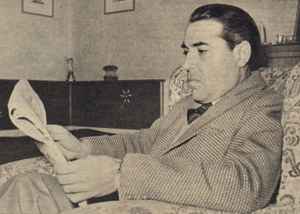
Bucchi’s musical language was economical in means yet rich in color and lyrical vitality, able to reach audiences both aesthetically and on human and social planes. For all his public roles, composition remained his core vocation.
A gifted pedagogue, he taught at the conservatories of Florence and Venice from 1945, became director of the Conservatory of Perugia in 1957, and in his final years led the Florence Conservatory (1974–1976). Beyond academia, he was an artistic director and consultant to major opera institutions, as well as an incisive contributor to music journals and Florentine newspapers.
Whether for the stage, the orchestra, or the intimacy of chamber music, Bucchi’s works blend clarity of design with emotional immediacy. Among his ten stage works, two stand out: Laudes Evangelii (1952) and Il contrabbasso (1953–1954), the latter a one-act grotesque of striking originality. His Cori della pietà morta for mixed choir and orchestra evokes comparisons with the austere grandeur of Goffredo Petrassi (†2003) and the refined neoclassicism of Igor Stravinsky (†1971). His Lettres de la religieuse portugaise for solo voice (1970) distills intimacy into concentrated lyrical form.
At the heart of Bucchi’s output lies Laudes Evangelii, a “choreographic mystery” inspired by medieval Umbrian poetry adapted by Giorgio Signorini, conceived in the tradition of the fourteenth-century sacra rappresentazione—the Italianholy performance.
The choreography, by Léonide Massine (†1979), drew on the splendor of Byzantine mosaics, the austerity of Umbrian and Tuscan primitives, and the serene grandeur of Giotto’s frescoes (†1337). The result was a seamless fusion of sight and sound.
Massine was well acquainted with spiritual themes: in 1938 he had collaborated with Paul Hindemith on Nobilissima visione (The Noblest Vision), a ballet on the life of St. Francis of Assisi. In Laudes Evangelii, his visual sensibility met Bucchi’s deep study of the laudi and religious songs of the 13th and 14th centuries, especially the Laudario di Cortona (1260–1270)—the earliest known collection of Italian vernacular sacred music.
Bucchi treated these sources with both fidelity and freedom. As he explained in the program notes for Teatro alla Scala in 1960:
For the musical text we have followed, with few exceptions, the ancient Laudi, remaining faithful to the original melodic language harmonized according to the canons of the ars antiqua; while for the orchestration and tonal structure we have allowed ourselves the greatest freedom. (our translation)
Even Time magazine took note, remarking that “composer Valentino Bucchi’s measured music was a careful reflection of medieval modes” (October 6, 1952).
The premiere, in Perugia on September 20, 1952, was a triumph. The work travelled widely: a choreographic preview in Nantes (1951), a return to Perugia (1954), a production at La Scala (1959), and a television version by Associated Rediffusion in London, broadcast across Europe and the United States in 1962.
Its structure unfolds in eight tableaux, each framed by short intermezzi:
Part I
1. The Annunciation
Intermezzo: Joseph’s Dream
2. The Nativity
3. The Massacre of the Innocents
Intermezzo: Rachel’s Lament
4. The Flight into Egypt
Part II
5. The Garden of Gethsemane
Intermezzo: The Flagellation of Jesus
6. The Way of the Cross
Intermezzo: The Soldiers Cast Lots for Jesus’ Garments
7. The Deposition
Intermezzo: The Three Marys at the Tomb
8. The Resurrection
The first part radiates the stillness and composure of Giotto’s panels; the second builds inexorably toward the luminous affirmation of the Resurrection. The forces are substantial: four soloists (soprano, mezzo-soprano, baritone, and bass), a mixed choir, a ballet corps, and a full orchestra rich in woodwinds, brass, percussion, and two harps—but conspicuously without violins, giving the score its distinctive tonal hue.
Bucchi was neither a doctrinaire modernist nor a nostalgic revivalist. His was a rare artistic space—steeped in historical sources yet unbound by them, bringing medieval forms into vivid, contemporary life.
Pope John Paul II (†2005) referred:
to the support that the Church has constantly given to the dramatic arts, recognizing their value and educational potential. For this reason, it has always permitted and encouraged the sacre rappresentazioni, beginning in the Middle Ages. The [Spanish] Autosacramentales and other forms of popular sacred performances, which took place especially during the most important liturgical seasons, remain famous.[2]
Laudes Evangelii stands in this lineage, not as an archival reconstruction but as a work still capable of moving modern audiences.
Half a century after his passing, Valentino Bucchi remains a figure apart in Italian music: learned yet accessible, serious yet humane, and able to weave the archaic breath of medieval song into a modern idiom that continues to speak with clarity and force.
Photo by Heidi Kaden on Unsplash
[1] L. Pannella, Valentino Bucchi. Anticonformismo e politica musicale italiana, Florence 1976; our translation.