Editor’s note: reminder that anyone who devoutly visits a cemetery during the Octave (between November 1st and 8th), praying — even mentally — for the departed, may obtain one plenary indulgence per day, applicable only to the souls in Purgatory, under the usual conditions.
℣. Grant, Lord, a blessing.
Benediction. May God the Father Omnipotent, be to us merciful and clement.
℟. Amen.
Reading 4
From the Sermons of the Venerable Bede, Priest at Jarrow.
18th upon the Saints
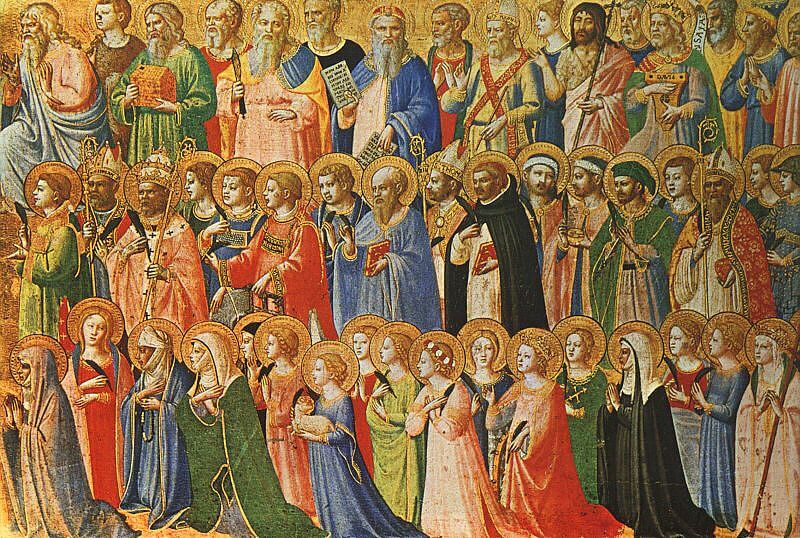
Dearly beloved brethren: This day we keep, with one great cry of joy, a Feast in memory of all God’s holy children; His children, whose presence is a gladness to heaven; His children, whose prayers are a blessing to earth; His children, whose victories are the crown of the Holy Church; His chosen, whose testifying is the more glorious in honour, as the agony in which it was given was the sterner in intensity, for as the dreader grew the battle, so the grander grew the fighters, and the triumph of martyrdom waxed the more incisive by the multiplicity of suffering, and the heavier the torment the heavier the prize. And it is our Mother, the Catholic Church, spread far and wide throughout all this planet, it is she that hath learnt, in Christ Jesus her Head, not to fear shame, nor cross, nor death, but hath been strengthened more and more, and, not by fighting, but by enduring, hath breathed into all that noble band who have come up to the bitter starting-post the hope of conquest and glory which hath warmed them manfully to accept the race.
℣. But thou, O Lord, have mercy upon us.
℟. Thanks be to God.
℟. The Fore-runner of the Lord cometh, to whom He Himself bare witness, saying:
* Among them that are born of women there hath not risen a greater than John the Baptist.
℣. A Prophet? Yea, and much more than a Prophet. This is he of whom the Saviour saith:
℟. Among them that are born of women there hath not risen a greater than John the Baptist.
℣. Grant, Lord, a blessing.
Benediction. May Christ to all His people give, for ever in His sight to live.
℟. Amen.
Reading 5
Of a verity thou art blessed, O my Mother the Church! The blaze of God’s mercy beateth full upon thee; thine adornment is the glorious blood of victorious Martyrs, and thy raiment the virgin whiteness of untarnished orthodoxy. Thy garlands lack neither roses nor lilies. And now, dearly beloved brethren, let each one of us strive to gain the goodly crown of one sort or the other, either the glistening whiteness of purity, or the red dye of suffering. In the army in heaven peace and war have both chaplets of their own, to crown Christ’s soldiers withal.
℣. But thou, O Lord, have mercy upon us.
℟. Thanks be to God.
℟. These are they who while yet they lived in the flesh, planted the Church in their own blood;
* They drank of the Lord’s cup, and became the friends of God.
℣. Their sound is gone out through all the earth, and their words to the ends of the world.
℟. They drank of the Lord’s cup, and became the friends of God.
℣. Grant, Lord, a blessing.
Benediction. May the Spirit’s fire Divine in our hearts enkindled shine.
℟. Amen.
Reading 6
Moreover, to this also hath the unutterable and boundless goodness of God seen, that He spreadeth not the time of working and wrestling, neither maketh it long, nor everlasting, and, as it were, but for a moment, so that in this short and scanty life there is wrestling and working, but the crown and the prize is in a life which is eternal. So the work is soon over, but the wage is paid for ever. And when the night of this world is over, the Saints are to see the clearness of the essential light, and to receive a blessedness outweighing the pangs of any torment, as testifieth the Apostle Paul, where he saith: The sufferings of this present time are not worthy to be compared with the glory which shall be revealed in us. Rom. viii. 18.
℣. But thou, O Lord, have mercy upon us.
℟. Thanks be to God.
℟. O ye My Saints, who, being in the flesh, didst have striving
* I will render unto you a reward of your labours.
℣. Come, ye blessed of My Father, inherit the kingdom
℟. I will render unto you a reward of your labours.
℣. Glory be to the Father, and to the Son, * and to the Holy Ghost.
℟. I will render unto you a reward of your labours.
℣. Grant, Lord, a blessing.
Benediction. May the Gospel’s holy lection Be our safety and protection.
℟. Amen.
Reading 7
From the Holy Gospel according to Matthew
Matt 5:1-12
At that time: Jesus, seeing the multitudes, he went up into a mountain, and when he was set down, his disciples came unto him. And so on.
Homily by St. Augustine, Bishop of Hippo.
Bk. I on the Lord’s Sermon
If it be asked what is signified by the mountain, the said mountain may well be understood to figure the higher and greater commandments of righteousness, since those that have been given to the Jews are the lesser. The one God, in an excellent order of times, gave, by His holy Prophets and servants, His lesser commandments unto the people whom it still behoved to be bound by fear, but by His Son He gave the greater unto the people whom it now beseemed to set free by love. But whether it be the lesser to the lesser, or the greater to the greater, all are alike the gift of Him Who alone knoweth what is in each epoch the seasonable medicine of mankind.
℣. But thou, O Lord, have mercy upon us.
℟. Thanks be to God.
℟. Let your loins be girded about, and your lights burning;
* And ye yourselves like unto men that wait for their lord, when he will return from the wedding.
℣. Watch therefore, for ye know not what hour your Lord doth come.
℟. And ye yourselves like unto men that wait for their lord, when he will return from the wedding.
℣. Grant, Lord, a blessing.
Benediction. They whose feast-day we are keeping, be our Advocates with God.
℟. Amen.
Reading 8
Neither is it a marvel that the greater commandments be given touching the kingdom of heaven, and the lesser touching a commonwealth upon earth, since both are alike the gifts of that one God Who is the Maker alike of heaven and of earth. The higher and greater righteousness, then, is that whereof the Prophet saith: Thy righteousness is like the mountains of God (Ps. xxxv. 7). Thus is that Teacher, Who alone can give such teaching, mystically represented as teaching upon a mountain. And when He was set. The attitude of sitting while teaching appertaineth to the majesty of His instruction. His disciples came unto Him nearer in the body, to hear those precepts, by the fulfillment of which they should be nearer in spirit. And He opened His Mouth, and taught them, saying. These words appear redundant to the sense. It may possibly be that this more pompous introduction is adopted on account of the exceptional length of the discourse to follow. But it may also be that these words are not really redundant, but the pointed declaration that He now opened His Own Mouth, Who, under the Old Law, had been used to open the mouths of the Prophets.
℣. But thou, O Lord, have mercy upon us.
℟. Thanks be to God.
℟. At midnight there was a cry made:
* Behold, the Bridegroom cometh, go ye out to meet him.
℣. Trim your lamps, O ye wise virgins.
℟. Behold, the Bridegroom cometh, go ye out to meet him.
℣. Glory be to the Father, and to the Son, * and to the Holy Ghost.
℟. Behold, the Bridegroom cometh, go ye out to meet him.
℣. Grant, Lord, a blessing.
Benediction. May He that is the Angels’ King to that high realm His people bring.
℟. Amen.
Reading 9
Commemoration of Sts. Vitalis and Agricola
Vitalis was a slave, and Agricola his owner. They were arrested at Bologna in the persecution under Diocletian and Maximian, for preaching Jesus Christ. Vitalis, the more he was implored and threatened to change his mind so much the more proclaimed himself a worshipper and servant of Christ, and after bravely bearing a course of diverse tortures, gave up his soul in prayer to God. The execution of Agricola had been put off, in the hope that the agonies of his servant might scare him into denying Christ; but the sight only hardened him. He was therefore crucified, and so became sharer and fellow with his slave Vitalis in the glory of testification. Their bodies were laid in the Jews’ burying-place, where they were found by St. Ambrose, who removed them to an hallowed and honourable sepulchre.
℣. But thou, O Lord, have mercy upon us.
℟. Thanks be to God.
Te Deum.