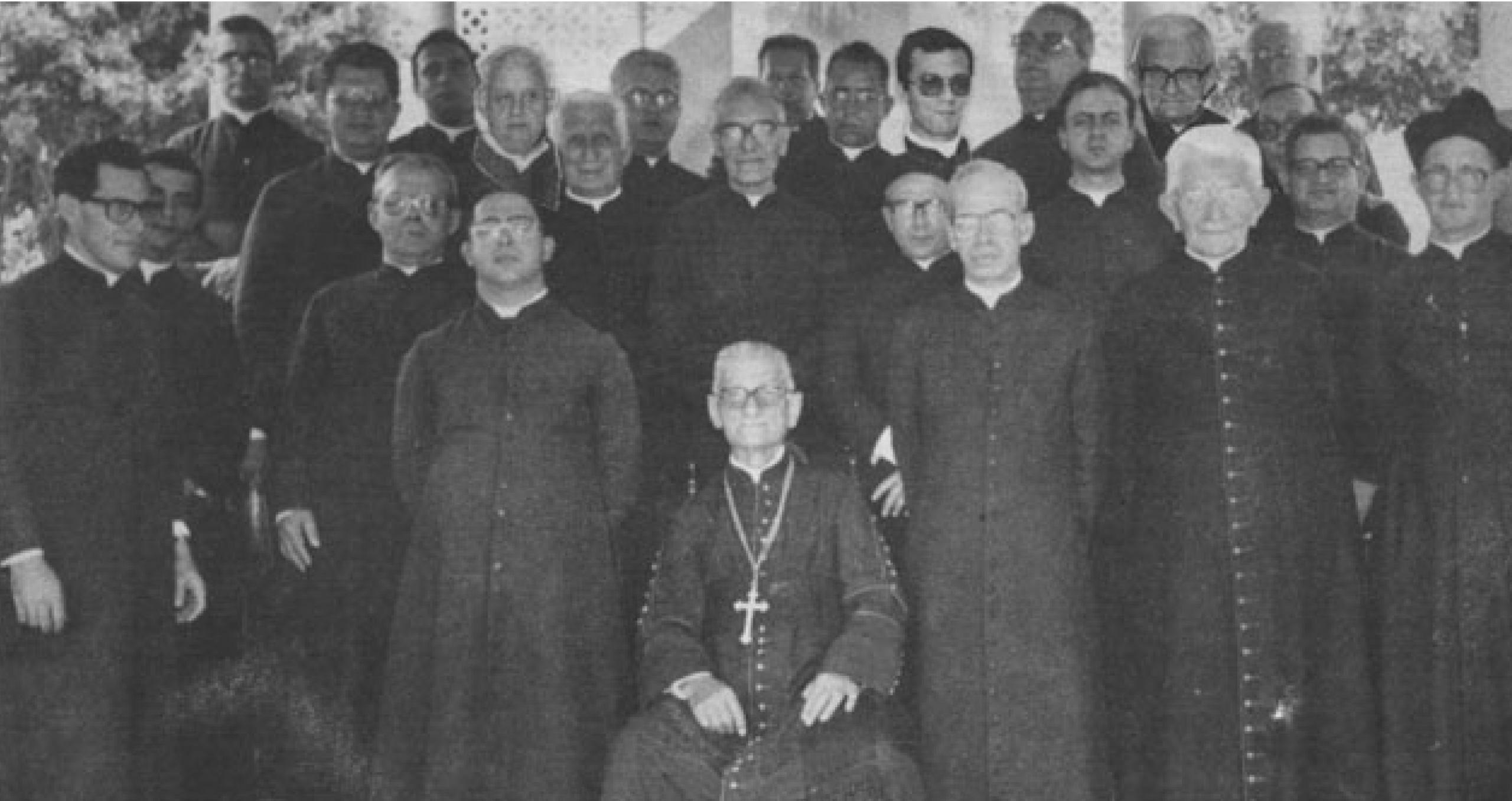
Above: Bishop Antônio de Castro Mayer, center.
Early Years, Family Environment, and Priestly Vocation
Antônio de Castro Mayer was born in the city of Campinas, in the state of São Paulo, Brazil, on June 20, 1904. He grew up in a deeply Catholic family of humble origins, being one of twelve children. His father, Johannes (João) Mayer, was a German stonemason from the region of Bavaria who had emigrated to Brazil in search of better work opportunities and stability for his family. His mother, Francisca de Castro, was a devout Brazilian peasant woman whose profound religiosity shaped the domestic environment and the spiritual life of her children. The Mayer family’s childhood was marked by severe financial limitations and poverty, a situation that worsened drastically with the premature death of his father in 1910, when Antônio was only six years old.
The family, having moved to the state capital in 1909, had to struggle hard to stay united and secure basic sustenance for everyone, as the patriarch left no financial inheritance or material goods. From a very young age, Antônio began working to help his mother with household expenses, assuming early responsibilities that caused him to mature quickly compared to his peers. Despite their material hardship, Castro Mayer often recalled in his writings and sermons that his father had left him the greatest treasure possible: unequivocal fidelity to the Catholic Faith. The devotion cultivated in the home bore fruit in several religious vocations in the family; besides Antônio, two of his sisters entered religious life as nuns, and later, one of his nephews was ordained to the priesthood.
Antônio’s primary schooling took place at the Grupo Escolar do Pari, in São Paulo, between 1911 and 1916. It was during this period, specifically in 1912, that he made his First Communion, an event that marked the beginning of his desire to serve the Church. At twelve years old, on February 16, 1916, he entered the Minor Seminary of the Archdiocese of São Paulo, located in Bom Jesus de Pirapora, an institution that at the time was directed by the Premonstratensian fathers. After completing the initial stage of his studies, he transferred, between 1921 and 1922, to the Major Seminary of the Archdiocese of São Paulo, located in the traditional Luz neighborhood.
During his training at the major seminary, Antônio studied humanistic and scientific subjects such as Universal Philosophy, History of Philosophy, Mathematics, Physics, Chemistry, Literature, Brazilian History, and Classical Greek. He quickly stood out among his peers and professors for his sharp intelligence, tireless discipline, and remarkable capacity for intellectual work. He was seen by his formators as an exemplary, focused, cultured, and extremely pious seminarian, who frequently dedicated his free time to helping classmates who faced difficulties in their studies, especially in the subjects of philosophy and theology.
Academic Formation in Rome and Ordination
The young seminarian’s academic brilliance caught the attention of his ecclesiastical superiors. In 1924, the rector of the São Paulo Seminary, Father Alberto Teixeira Pequeno, requested and secured a place for him at the Pontifical Latin American College in Rome. Sent to Italy to refine and complete his theological studies, Castro Mayer entered the prestigious Pontifical Gregorian University, an institution directed by the Jesuit fathers and whose rector was Father Giovanni Battista Janssens.
The study environment at the Gregorian was strictly guided by the Ratio Studiorum of the Society of Jesus, prioritizing philosophical and theological studies based on Aristotelianism and the Thomistic synthesis of Saint Thomas Aquinas. This solid scholastic and Romanized formation aimed fundamentally at instilling in future Church leaders an attitude of absolute submission to the papacy and a stance of strict doctrinal intransigence against the liberal, relativist, and modernist currents of the time. According to analysts of his career, it was in Rome that Castro Mayer definitively assimilated the traditional thought of the Church, based on the magisterium of successive popes.
At the Gregorian University, Castro Mayer studied under eminent European professors and theologians, completing an extensive and rigorous curriculum. In his first year, he studied Moral Theology under Father Vermeersch, Fundamental Theology under Fathers Fabbri and Van Laak, Introduction to Sacred Scripture under Father Rosadini, Church History and Christian Archaeology under Father Domenici, and Hebrew under Father Nevrand. In his second year, he took Moral Theology with Father Vermeersch, Canon Law Institutions with Father Cappello, Dogmatic Theology with Fathers Huarte and Palermo Lazzarini, and History of Dogma with Father De Groot. In his third year, he deepened his knowledge of Dogmatic Theology, Old and New Testament Exegesis, Biblical Greek, and History of Dogma.
The academic excellence and spiritual discipline of the young student culminated in his priestly ordination on October 30, 1927, which took place in the chapel of the Germanic College and was celebrated by Cardinal Basilio Pompilij, then Vicar General of Pope Pius XI. Shortly after his priestly ordination, Castro Mayer defended his thesis and earned his Doctorate in Theology from the Roman institution. This solid Thomistic foundation and his aversion to theological innovations permanently shaped his intellect and his future episcopal ministry, constituting the fundamental bedrock of his resistance to the reforms of the Second Vatican Council.
Acceleration of the Priestly Career and Ostracism in São Paulo
After returning to Brazil at the end of 1927, Father Antônio de Castro Mayer began a rapid rise in the structure of the Archdiocese of São Paulo, initially distinguishing himself through his work as an educator. For about thirteen years, he taught subjects such as Philosophy, History of Philosophy, and Dogmatic Theology at the Archdiocesan Seminary of Ipiranga. His contemporaries and students described him as an extremely rigorous professor and a priest committed to transmitting Catholic doctrine without shortcuts or concessions to the spirit of the age.
His administrative capacity and analytical intelligence led him to assume high-level positions in the diocesan administration. In 1940, Archbishop Dom José Gaspar de Affonseca e Silva appointed him General Assistant of Archdiocesan Catholic Action. In 1941, he became a Canon of the Metropolitan Chapter of São Paulo, serving as First Treasurer. The peak of his career in São Paulo occurred in 1942, when he was appointed Vicar General of the Archdiocese, becoming one of the most influential figures in the management of that ecclesiastical jurisdiction.
In parallel with his administrative and teaching duties, Father Castro Mayer engaged heavily in the conservative intellectual apostolate. He established a strong alliance with the lay leader Plinio Corrêa de Oliveira and served as Ecclesiastical Assistant to the newspaper O Legionário, the official organ of the Archdiocese. Together, they articulated a combative stance to denounce what they saw as Leftist infiltrations and progressive trends in the Brazilian Catholic sphere.
This stance of doctrinal intransigence ended up triggering serious internal conflicts. In 1943, Plinio Corrêa de Oliveira published the book In Defense of Catholic Action, a work that openly criticized certain innovations and lay autonomy within the movement. Castro Mayer firmly supported the publication and granted it the imprimatur (official ecclesiastical approval). This action caused deep displeasure among progressive sectors and tension with the new Archbishop of São Paulo, Dom Carlos Carmelo de Vasconcelos Motta.
As a direct consequence of this ideological clash, Castro Mayer suffered retaliations and was removed from the decision-making core. In February 1945, he was dismissed from his position as Vicar General and transferred as a simple parish priest to the Parish of São José, in the Belenzinho neighborhood—a working-class, peripheral area of the capital. This transfer was interpreted by observers as political exile aimed at curbing his influence. During his time at the parish, he continued teaching Religion and Catholic Social Doctrine at academic faculties that would later form the Pontifical Catholic University of São Paulo (PUC-SP). He remained in Belenzinho until March 1948, when Pope Pius XII appointed him Titular Bishop of Priene and Coadjutor Bishop of Campos dos Goytacazes.
The Episcopate in Campos and Role at the Second Vatican Council
Dom Antônio de Castro Mayer was consecrated bishop in May 1948 and formally took charge of the Diocese of Campos, in the state of Rio de Janeiro, in January 1949, following the death of his predecessor. Throughout his thirty-three years as diocesan bishop, he transformed the region into a stronghold of traditional and anti-Modernist Catholicism. His pastoral work was guided by rigorous catechesis, combating secularism, defending indissoluble marriage, and strongly encouraging devotion to Our Lady of Fátima and the recitation of the Rosary. He published numerous Pastoral Letters warning the faithful against Communist doctrines and progressive theology. In 1951, together with Plinio Corrêa de Oliveira, he founded the periodical Catolicismo, which became the main publication of counter-revolutionary thought in Brazil.
When Pope John XXIII convened the Second Vatican Council (1962–1965), Dom Antônio traveled to Rome with vast experience in combating modern ideas. He had a prominent participation in the event, being the Brazilian bishop with the second highest number of official interventions, delivering thirty oral and written contributions during the plenary sessions.
To counter the reformist wing of European bishops, Castro Mayer organized and articulated the creation of the Coetus Internationalis Patrum (International Group of Fathers). Serving as vice president and primary theoretical strategist of this conservative block—alongside Dom Marcel Lefebvre (President) and Brazilian Archbishop Dom Geraldo de Proença Sigaud (Secretary)—he advocated firm positions on the conciliar floor:
First, he defended the unrestricted maintenance of Latin in the liturgy, arguing that the sacred language guaranteed the dignity and mystery of worship, protected the precision of dogmas, and expressed the unity of the universal Church. He discouraged certain forms of active lay participation that could obscure the distinction between the ministerial priesthood of the clergy and the common priesthood of the faithful. Second, he opposed episcopal collegiality as proposed, seeing in it an attempt at decentralization and democratization that threatened the monarchical structure of the Church. Based on the First Vatican Council, he reiterated that supreme jurisdiction and infallibility belong strictly to the Roman Pontiff. Third, he rejected documents on ecumenism and religious liberty, stating that “error has no rights” and that the only valid approach would be one that invited non-Catholics to return to the Church of Rome. Finally, he organized an episcopal petition demanding an explicit condemnation of Communism by the Council and requested the consecration of Russia to the Immaculate Heart of Mary.
Post-Conciliar Resistance in Campos and the Schism
At the conclusion of the Second Vatican Council, faced with the triumph of reformist theses, Castro Mayer returned to Campos determined to block the application of the new pastoral and liturgical directives in his diocese. When the new missal (Novus Ordo Missae) was promulgated by Pope Paul VI in 1969, Dom Antônio sent a letter to the pontiff requesting authorization to maintain the Tridentine Rite (Mass of Saint Pius V) in his territory, citing reasons of theological conscience. Receiving no conclusive response from the Holy See, he maintained the ancient Mass as the official and exclusive rite for the diocesan clergy.
During the 1970s, he refused to implement the pastoral plans of the National Conference of Bishops of Brazil (CNBB) and prevented the formation of Ecclesial Base Communities (CEBs) in the diocese. He went so far as to expel religious orders from his jurisdiction that sought to introduce conciliar reforms. In 1974, in response to inquiries from the Vatican, he formally reaffirmed to Paul VI his refusal to adopt the new liturgy, the declaration on religious liberty, and other post-conciliar documents.
In August 1981, upon turning seventy-seven, Castro Mayer became bishop emeritus. Pope John Paul II appointed Dom Carlos Alberto Etchandy Gimeno Navarro as his successor, with the explicit task of bringing the diocese into line with post-conciliar norms. The transition generated a severe conflict: 25 of the 36 priests in the diocese, trained under Castro Mayer’s direction, refused to celebrate the new Mass. Between 1982 and 1987, the new bishop removed these priests from their parishes, which in several cases required the intervention of court orders and police force.
Supported by Castro Mayer, the removed priests founded the Priestly Union of Saint John Mary Vianney. They established a parallel diocesan structure, celebrating the Sacraments in newly built chapels, private halls, cinemas, and garages, maintaining the support of thousands of faithful. Between 1982 and 1984, Castro Mayer publicly broke his historical alliance with Plinio Corrêa de Oliveira and the TFP, accusing the group of promoting a cult of personality around its leader and manifesting an anti-clerical spirit.
The peak of the dispute with the Holy See occurred in the summer of 1988. Invoking a “state of necessity” in the Church against what they considered the destruction of the faith, Castro Mayer traveled to Écône, Switzerland. On June 30, 1988, he served as co-consecrating bishop alongside Dom Marcel Lefebvre in the episcopal ordination of four priests of the Society of Saint Pius X (SSPX), without papal mandate.
On July 2, 1988, through the motu proprio Ecclesia Dei, Pope John Paul II declared that Lefebvre, Castro Mayer, and the four new bishops had incurred automatic (latae sententiae) excommunication for committing a schismatic act. Castro Mayer rejected the excommunication, declaring it null because he considered Roman authority to be under the influence of Modernism. He returned to Campos and continued providing spiritual assistance to the Priestly Union until his death on April 25, 1991, at the age of 86.
Resolution and Reconciliation of the Campos Group
After the death of Dom Antônio de Castro Mayer, the priests of the Priestly Union of Saint John Mary Vianney organized the consecration of an episcopal successor to ensure the continuity of their activities. On July 28, 1991, Father Licínio Rangel was consecrated bishop in a ceremony without Vatican approval, celebrated by three bishops of the Society of Saint Pius X. The situation of division between Campos and the formal structure of the Catholic Church persisted until the beginning of the 21st century.
The institutional impasse was finally resolved in 2002, during the pontificate of John Paul II. Following negotiations led by Cardinal Darío Castrillón Hoyos and Dom Licínio Rangel, the group of traditional priests from Campos signed a protocol of reconciliation with the Holy See. The Pope lifted the excommunications and erected the community as the Personal Apostolic Administration of Saint John Mary Vianney, an ecclesiastical structure circumscribed within the territory of the Diocese of Campos that allows its members the exclusive celebration of the Sacraments and liturgy according to the Tridentine Rite in full communion with the Holy See.