

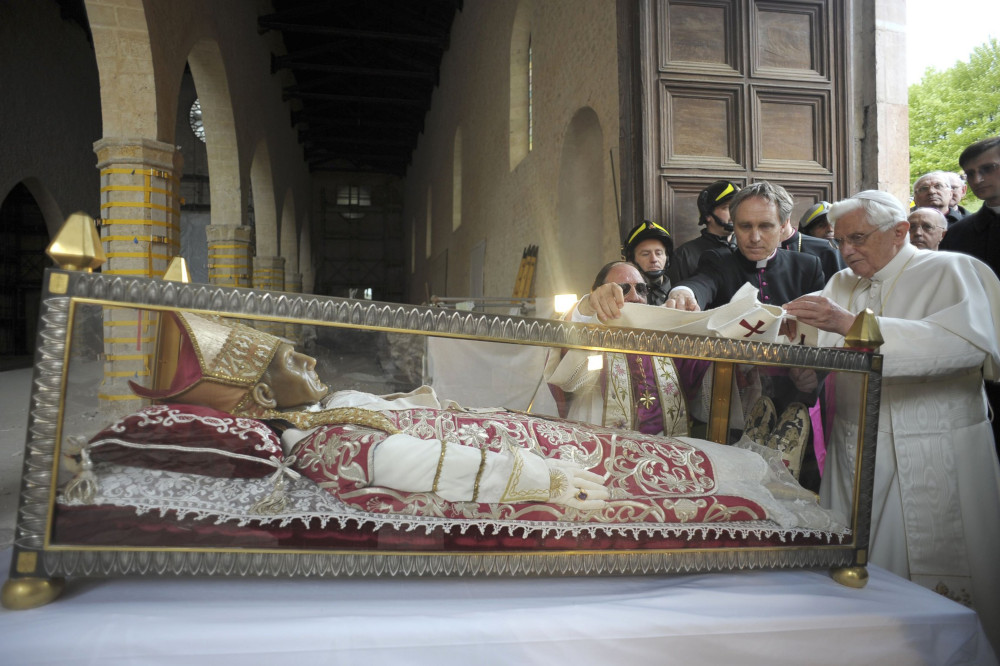
Above: Pope Benedict places his pallium on the relics of Pope St. Celestine V, the last pope to resign.
Curious as it may seem to many, there are still Catholics out there who claim Benedict’s resignation was invalid. Yet, this belief has become the foundation on which some Catholics reject not only the papacy of Pope Francis, but that of Pope Leo XIV as well.
One category of theories held by the “Benepapists” – i.e., those who claim Pope Benedict XVI’s resignation was invalid – is that Pope Benedict XVI was forced to resign, making his resignation invalid.
Among these theories, one claims that a globalist cabal shut down the Vatican’s ATM system in January 2013 to force Benedict to resign. This particular theory has circulated for at least ten years or so. It had faded into the background for the last year or so, but recently came storming back on social media last month after one Catholic podcast highlighted it again.
This theory alleges a shutdown of the Vatican’s ATM/SWIFT system in January 2013 was intended by someone to pressure Benedict to resign. The main ‘proof’ of their theory is that the Vatican’s ATM services were only restored on February 12, 2013, the day after Benedict announced his resignation. To some, this theory claims this timing proves Benedict was forced out. She said on the aforementioned podcast (at 14:00 and beyond):
…To anyone looking at the situation, it was a quid pro quo. There was no rhyme or reason why suddenly after the announcement of the resignation that the ATMS should be suddenly turned back on.
Not to be left out on the social media sidelines, the excommunicated archbishop Carlo Maria Viganò then came out with his own communique which, in part, asserted that Hillary Clinton and John Podesta “went so far as to block in the Vatican banking transactions via the SWIFT network.”
While there are a few different forced resignation theories, this article will focus on the one involving the Vatican ATM question as it is the main one.
Providing Context
The leading Benepapist purveyors of the forced resignation narrative would have Catholics believe either the U.S. government, certain U.S. persons, e.g., Clinton and Podesta, or a globalist cabal shut down the ATMs to pressure Pope Benedict XVI to resign. The Benepapists say it was only after Benedict actually announced his resignation on February 11 that the globalist cabal restored ATM services to the Vatican on February 12. This timing, they say, proves there was a quid pro quo, i.e., if you resign, we’ll restore ATMs service.’
This is the Benepapist claim in essentially the same original form as found ten years ago, with the same minimal details, and the same pure speculations. Unfortunately, ten years on, the leading Benepapists have not bothered to delve more deeply, if at all, into the actual facts of the matter. If they had, they could not honestly suggest the shutdown of the ATMs was proof of anything related to Benedict’s resignation.
In reply to the Benepapist claims, I would first state I am not one who would ever want to defend the likes of a Hillary Clinton or John Podesta. However, the problem is, Viganò’s claim that they played a part in the Vatican ATM shutdown is a bald assertion. There is absolutely no proof or evidence whatsoever they played any part in the shutdown. None. Even the famous Wikileaks documents do not mention or even suggest it.
There is no factual basis to support the claim Clinton, Podesta, and or the US government, etc., were part of a mysterious, evil cabal which shut down the ATMs to force Benedict to resign. In fact, there is no good reason to suggest they did so. It is not even good speculation. There is no need at all for such a theory. I say this because we already know who was behind the shutdown, and why.
The ATM shutdown needs to be understood in the context of the long-standing problems and issues facing the scandal and corruption-ridden Vatican Bank or Institute for the Works of Religion (IOR), which has long had a tarnished reputation. For example, in 2010, Vatican bank funds totaling 23 million Euros were frozen “in Italian banks as part of a money laundering investigation.”
Due to such problems, Pope Benedict XVI had long been trying to bring IOR into compliance with financial crime and money laundering prevention standards. For example, Pope Benedict XVI issued a Motu Proprio to establish an anti-money laundering protocol for the Holy See. He wrote in part (Italics mine):
…Most appropriately the international community is increasingly equipping itself with the juridical principles and instruments that enable it to prevent and to counter the phenomena of laundering of money and the financing of terrorism.
The Holy See approves this commitment and intends to adopt these laws as its own in the utilization of the material resources that serve to carry out the mission and duties of Vatican City State…
The point being, Pope Benedict XVI knew the Vatican had problems in this area, and that they needed fixing. In this vein, in June 2012 the Vatican was awaiting a report by a committee of the Council of Europe (MONEYVAL) on Vatican compliance with norms for preventing money laundering. According to Inside the Vatican, MONEYVAL is “the Council of Europe’s primary monitoring arm in anti-money laundering and countering the financing of terrorism.”
La Stampa reported this committee’s report, issued in July 2012, found the Vatican only met 9 of 16 core recommendations. La Stampa further reported the Vatican:
…did not fulfil or only partially fulfilled customer due diligence requirements, assessment of suspect operations, supervision and monitoring, other forms of cooperation, the implementation of UN instruments and the freezing and confiscation of terrorist assets.
Come December 2012, the Vatican was still considered noncompliant by European Union anti-money laundering standards. As a result, the Bank of Italy (BoI)—the regulatory body for the Italian banking system—refused to authorize the Vatican’s ATM service provider (Deutsche Bank Italia) to continue providing ATM services to the Holy See. As the Guardian reported at the time (Italics and bold mine):
It is understood that Deutsche Bank Italia (DBI), which has handled bank card payments on Vatican soil until now, was refused authorisation by the Bank of Italy (BoI) to continue its activities due to concerns over the city state’s status concerning international banking regulations.
A source at the BoI, who did not want to be named, told the Guardian it had been decided in December that neither DBI nor any other Italian-registered bank should be granted permission to work on Vatican territory because of its failure to meet certain “preconditions” concerning, among other things, efforts to crack down on money laundering.
Electronic payments will continue to be suspended until the Vatican finds a bank to replace DBI – a task the Vatican spokesman, Federico Lombardi, said was already under way. He declined to comment on the reported cause of the suspension, saying only that he expected it to be “brief.“
Furthermore, Inside the Vatican in February of 2013 reported (bold added):
In a statement explaining its decision last month, the Bank of Italy said EU law prevented EU banks from operating in non-EU states unless they had an adequate supervisory system or were deemed “equivalent” for anti-money laundering purposes. The Vatican failed on both counts, it said.
The bottom line is, at the core of the ATM system shut down in early 2013 was Vatican noncompliance with anti-money laundering standards, norms, and procedures. As Inside the Vatican reported above, EU law prevented EU banks from operating in non-EU states that were not compliant with anti-money laundering standards.
Given the Vatican’s deficiencies in enforcing anti-money laundering measures, the BoI, as the Italian regulatory body, could not authorize Deutsche Bank Italy to continue to operate in the Holy See, a non-EU state. It is unlikely the course of events came as a surprise to the Vatican. The Vatican likely—if not almost certainly—knew of the impending shutdown by at least late December of 2012, and by then was already working on finding a replacement ATM service-provider.
In fact, a Vatican spokesman on January 3, 2013, said the suspension was expected to be “brief” and the search for a replacement company was “already under way.” Indeed, after only six weeks, the Vatican ATMs were up and running again by February 12. In this period, the Vatican had found another service provider – a Swiss company named Aduno – which did not require authorization from the BoI because Switzerland, like the Holy See, is not a part of the European Union.
There was no Quid Pro Quo
Remember, the Benepapist claim that there was a clear “quid pro quo” – that is, the entity that wanted Benedict to resign is the one that shut down the ATM services, and that the same forces restored them only after—and only because— Benedict had announced his resignation.
However, the facts do not support this interpretation. The BoI, the regulatory body enforcing EU anti-money laundering law in Italy, is the institution that ordered the shut down the Vatican ATMs. However, the BOI was irrelevant in the restoration of ATM services at the Vatican.
Rather, the Holy See, as a non-EU country, simply replaced its EU-based service provider (Deutsche Bank Italy) with a non-EU-based service provider (Aduno). Problem solved. Thus, the original shutdown, though certainly a headache and a nuisance, was circumvented by the Vatican with relative ease.
In conclusion here, The Vatican was in control of its own destiny in finding a replacement provider, and restoring ATM services on its own sovereign territory. This means Pope Benedict XVI was not at the mercy of a mysterious cabal that had shutdown ATM services at the Vatican. Therefore, it follows that Benedict was not pressured to resign by a quid pro quo condition imposed upon him.
But what about the timing?
Still, let us indulge the Benepapists who have claimed the coincidence in the timing is itself a proof of a quid pro quo. They say the Vatican ATM “turn on” date of February 12th—the day after Benedict’s resignation announcement—is proof of a quid pro quo. However, this is not proof. Correlation does not mean causation.
Vatican ATM services were cut off on January 1, 2013. Of course, after this date, it would take time for the Vatican (1) to source a new non-EU service provider; (2) to negotiate terms; (3) to review and sign contracts; (4) to put any technology and communication links in place; and, finally, (5) to restore active ATM services. All these steps together, which Pope Benedict XVI was undoubtedly briefed on, could easily take six weeks to iron out. Nothing suspicious here.
Even so, let us consider the following. We do know with regard to the Vatileaks scandal of 2012, Benedict said of a potential papal resignation that “…one is not permitted to step back when things are going wrong, but only when things are at peace.”[1] When things did return to “peace” after the criminal trials in Fall of 2012, Benedict proceeded with his plan to resign.
One might be tempted to say Benedict would have taken the same “only when things are at peace” approach with the ATM issue. However, this assumes Benedict even considered the ATM shutdown as being the same sort of “going wrong” situation like the Vatileaks scandal.
Personally, I doubt he even saw it that way. Certainly, the ATM shutdown was a nuisance and headache for the Vatican, but it hardly constituted a papacy-ending threat. For that matter, it was not a credible, conspiratorial point of leverage for an attempt to force a pope to resign.
Regardless, Pope Benedict XVI would not have wanted to dump the ATM problem into the lap of his successor. He would have wanted to ensure that ATM services had been restored before his papacy ended. And this he did! The effective date of Benedict’s resignation was February 28, 2013—more than two weeks after the restoration of the ATM services on February 12th!
The facts and common sense suggest we may more credibly speculate the following. When Benedict XVI made his resignation announcement on February 11 — at the pre-scheduled consistory of cardinals; he knew the restoration of the Vatican ATM services, through Aduno, was imminent. Final resolution was near. The problem was solved. There was no need to either delay or hold hostage the dates of either his announcement or of his effective resignation.
In sum, given that Pope Benedict XVI was not responding to a sinister quid pro quo dynamic, the timing of the restoration of ATM services was coincidental.
Benedict XVI’s own words vs. the claims of a forced resignation
On February 11, 2013, one day before the restoration of ATM service, Pope Benedict XVI declared in his Declaratiothat he was resigning the papacy “with full freedom” due to a lack of strength.
Then, again, in a papal audience on February 13, 2013, the day after the resumption of ATM services, Benedict XVI repeated the same themes found in the Declaratio, including calling God as his witness — i.e., having examined his “conscience before God” — and saying he resigned the papacy with “full freedom” due to a lack of strength.
On top of these examples, there are other occasions after his resignation where Benedict XVI again reiterated that he had resigned freely. For example, he did so in a 2016 with Peter Seewald interview where Benedict XVI affirmed a pope could not resign under pressure.[2]
Therefore, given Benedict explicitly affirmed he resigned freely on several or more occasions, to suggest that he resigned due to pressure or coercion—whether by ATM shutdown or another cause—is to make of him both a liar and a coward. Yet, many of the Benepapists do just that, even if only by implication. This is uncharitable and unjust.
Final Thoughts
There are various claims the Benepapists make to say Benedict resignation was invalid. I have addressed these in various places.[3]
As we have seen, the Benepapist claim certain individuals, a mysterious cabal, or whomever shut down the Vatican ATMs to force Pope Benedict XVI to resign the papacy does not hold water.
Unfortunately, leading Benepapists with significant social media platforms and presence keep recycling the same story, as if throwing chum into the social media waters. The ensuing feeding frenzy on podcasts, X, blogs, and comboxes has been a sight to behold.
The Benepapist purveyors of the ATM theory never mention or address the sorts of counter arguments made above. None of the facts above (e.g., EU money laundering laws, the BoI, Deutsche Bank Italy, Aduno, etc.) show up in their podcasts or articles when discussing the Vatican ATM topic. I leave it to the reader to wonder why that might be. They have done their readers and listeners a great disservice, generating smoke and not light.
[1] See Peter Seewald, Benedict XVI: Last Testament in his own words (London: Bloomsbury Publishing Company Plc, 2016), p. 23. Responding to a question as to whether the pressure of the Vatileaks scandal led to his resignation, Benedict told Seewald: “No, that is not right, not at all. On the contrary, the Vatileaks controversy was completely resolved. I said while it was still happening – I believe it was to you – that one is not permitted to step back when things are going wrong, but only when things are at peace. I could resign because calm had returned to this situation. It was not a case of retreating under pressure or feeling things couldn’t be coped with.”
[2] Ibid., loc. cit.
[3] See my blog Roma Locuta Est, and in my book, Valid? The Resignation of Pope Benedict XVI. See also a detailed interview on the Conor Gallagher Show. Also, there are several opinion pieces on LifeSiteNews, including Why Pope Benedict’s resignation was valid: a response to Dr. Mazza; Benedict XVI did not fake his resignation: a response to Patrick Coffin; Here’s what Benedict XVI meant by ‘pope emeritus’: a second reply to Dr. Mazza; Anti-popes were never as universally and peacefully accepted as Pope Francis: Steven O’Reilly; Benedict XVI’s own words show that he really did resign the papacy.