
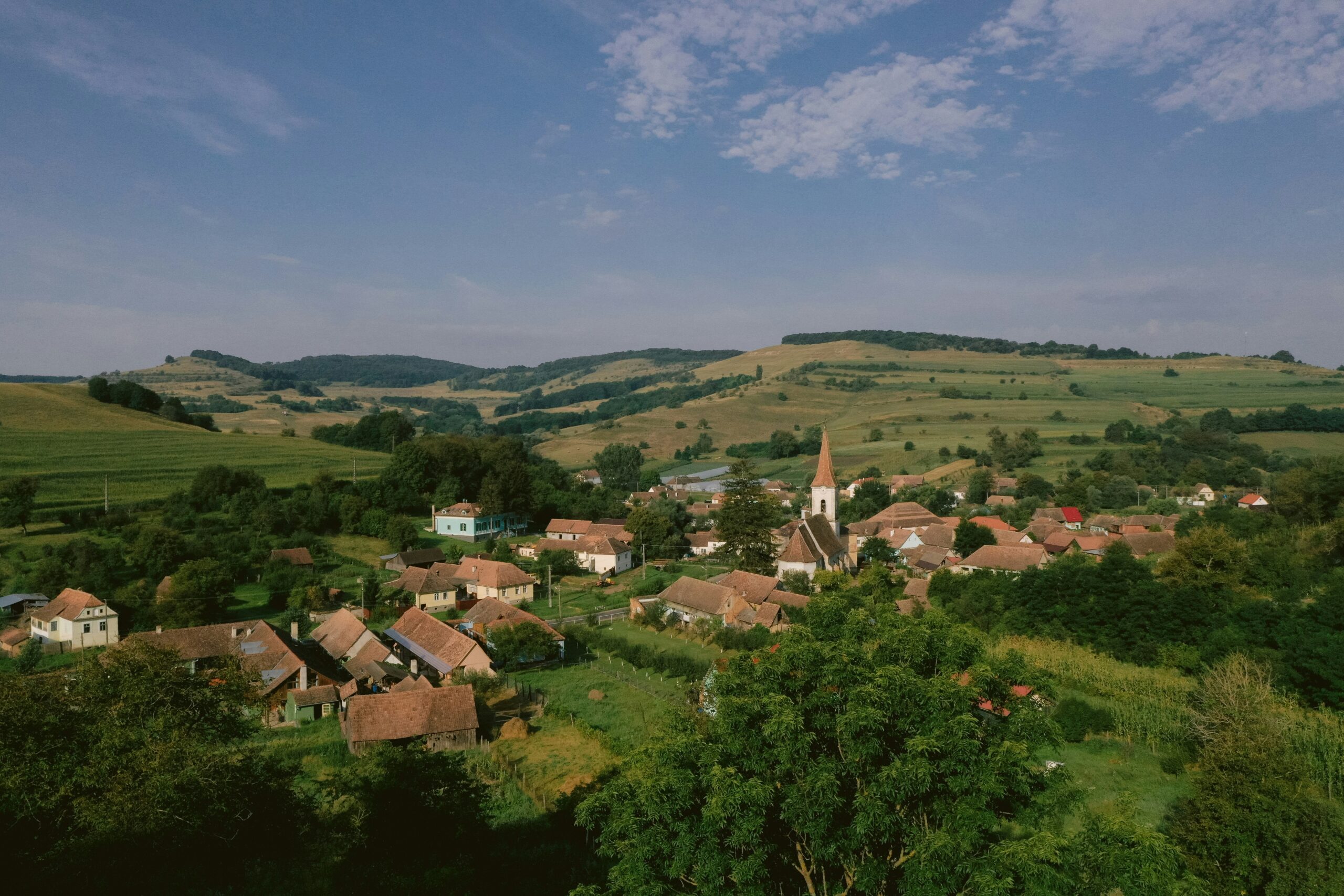
Above: village in rural Transylvania, Romania.
The country parson is a lover of old customs, if they be good and harmless; and the rather, because country people are much addicted to them, so that to favour them therein is to win their hearts, and to oppose them therein is to deject them…Particularly, he loves Procession, and maintains it, because there are contained therein four manifest advantages. First, a blessing of God for the fruits of the field: Secondly, justice in the preservation of bounds. Thirdly, charity in loving walking and neighbourly accompanying one another, with reconciling of differences at that time, if there be any. Fourthly, mercy in relieving the poor by a liberal distribution and largesse which at that time is, or ought to be used. Wherefore he exacts of all to be present at the perambulation, and those that withdraw and sever themselves from it, he mislikes and reproves as uncharitable and unneighbourly; and if they will not reform, presents them. Nay, he is so far from condemning such assemblies, that he rather procures them to be often, as knowing that absence breeds strangeness, but presence love.
—George Herbert, The Country Parson.
One of the major elements of the Church’s Liturgical Year in all its varieties – Roman, Ambrosian, Mozarabic, Lyonnais, Sarum, Braga, Ordinariate, Dominican, Carmelite, Byzantine, West Syriac, East Syriac, Armenian, Maronite, Coptic, Ethiopian, Malabarese, and Syro-Malabar – is its connection with agricultural life, upon which everything depends. A favourite motif of medieval art featured the three estates: priest, knight, and peasant. Under each would be three mottoes. Under the cleric, “I bless all;” under the knight, “I defend all;” under the peasant, “I feed all.” It is no coincidence that the Liturgical Seasons broadly correspond to those of the farm.
But the Roman Rite features two emphatically farming-referential observances – the Greater Litanies of the Feast of St. Mark, and the following Lesser Litanies of the three Rogation Days. Both of these feature processions at once invoking God’s blessings on the crops and atoning for sin. Turning to the indefatigable Dom Guéranger’s Liturgical Year, we see his commentary on the first named:
This day is honored in the Liturgy by what is called Saint Mark’s Procession. The term, however, is not a correct one, inasmuch as a procession was a privilege peculiar to April 25 previously to the institution of our Evangelist’s feast, which even so late as the sixth century had no fixed day in the Roman Church. The real name of this procession is The Greater Litanies. The word Litany means Supplication, and is applied to the religious rite of singing certain chants while proceeding from place to place in order to propitiate heaven. The two Greek words Kyrie eleison (Lord, have mercy on us) were also called Litany, as likewise were the invocations which were afterwards added to that cry for mercy, and which now form a liturgical prayer used by the Church on certain solemn occasions.
The Greater Litanies (or processions) are so called to distinguish them from the Minor Litanies, that is, processions of less importance as far as the solemnity and concourse of the faithful were concerned. We gather from an expression of St. Gregory the Great that it was an ancient custom in the Roman Church to celebrate, once each year, a Greater Litany, at which all the clergy and people assisted. This holy Pontiff chose April 25 as the fixed day for this procession, and appointed the Basilica of St. Peter as the Station.
In addition to useful material on the history thereof in this section, the good Benedictine gives a fairly pointed comment about those who do not attend such processions:
We take this opportunity of protesting against the negligence of Christians on this subject. Even persons who have the reputation of being spiritual think nothing of being absent from the Litanies said on St. Mark’s and the Rogation Days. One would have thought that when the Holy See took from these days the obligation of abstinence, the faithful would be so much the more earnest to join in the duty still left—the duty of prayer. The people’s presence at the Litanies is taken for granted: and it is simply absurd that a religion rite of public reparation should be one from which almost all should keep away. We suppose that these Christians will acknowledge the importance of the petitions made in the Litanies; but God is not obliged to hear them in favor of such as ought to make them and yet do not. This is one of the many instances which might be brought forward of the strange delusions into which private and isolated devotion is apt to degenerate. When St. Charles Borromeo first took possession of his see of Milan, he found this negligence among his people, and that they left the clergy to go through the Litanies of April 25 by themselves. He assisted at them himself, and walked bare-footed in the procession. The people soon followed the sainted pastor’s example.
The three days preceding the Ascension on which the Lesser Litanies are recited in procession are called the Rogation Days, and have the same object as the Greater Litanies, as well as a single Mass proper to all three days in the Traditional Rite. Here too, Dom Guéranger offers a masterful explanation. His history of the practise must be read to fully appreciate how grand it was. But the good Benedictine’s description of the point the observances is crucial:
The object of the Rogation Days is to appease the anger of God, and avert the chastisements which the sins of the world so justly deserve; moreover, to draw down the divine blessing on the fruits of the earth. The Litany of the Saints is sung during the Procession, which is followed by a special Mass said in the Stational Church, or, if there be no Station appointed, in the Church whence the Procession first started.
The Litany of the Saints is one of the most efficacious of prayers. The Church makes use of it on all solemn occasions, as a means for rendering God propitious through the intercession of the whole court of heaven. They who are prevented from assisting at the Procession, should recite the Litany in union with holy Church: they will thus share in the graces attached to the Rogation Days; they will be joining in the supplications now being made throughout the entire world; they will be proving themselves to be Catholics.
As before, he also had some sharp words for those who did not participate:
If we compare the indifference shown by the Catholics of the present age, for the Rogation Days, with the devotion wherewith our ancestors kept them, we cannot but acknowledge that there is a great falling off in faith and piety. Knowing, as we do, the importance attached to these Processions by the Church, we cannot help wondering how it is that there are so few among the Faithful who assist at them. Our surprise increased when we find persons preferring their own private devotions to these public Prayers of the Church, which to say nothing of the result of good example, merit far greater graces than any exercises of our own fancying.
In the Middle Ages, the course of the procession followed the boundaries of the parish. This was an important feature, not least because it often involved questions of property rights. When the Protestant Revolt enveloped England, although the Rogations lost their penitential and some of the benedictory character, they retained, as our opening quote shows, their social character. Reduced to “Beating the Bounds,” even to-day these functions are still important in many parts of the Church of England’s service area.
Despite the warnings of such as Dom Guéranger, throughout the 19th century the popularity of the practice waned, even in rural areas. After Vatican II, the Rogation Days were removed from the Roman Calendar. Even refuges of the Traditional Mass often confined their observances of St. Mark’s and the Rogations to the proper Masses of the day, without any thought of a procession around the block – much less of circumscribing parish boundaries.
But a very strange thing happened, in America at any rate. From its inception in the 1920s, the National Catholic Rural Life Movement had encouraged farmers to engage in Rogation Day Processions. Sister Mary Nickel wrote:
In November 2018, Catholic Rural Life (CRL) celebrated its 95th anniversary. CRL, originally called the National Catholic Rural Life Conference (NCRLC), was founded by Archbishop Edwin O’Hara, who was concerned about the renewal of the Liturgy in Rural America. Already in 1920 he assisted with the reintroduction of Rogation Days in agrarian parishes (Some Seed Fell on Good Ground: The Life of Edwin V. O’Hara, by Cardinal Timothy Dolan; CUA Press, 2012). When Bishop James Conley was installed as the Bishop of the Diocese of Lincoln, Neb., he included a significant observation in his homily, ‘Building a Catholic culture, is the work of tilling the soil.’ Quoting a college mentor the bishop continued: ‘The restoration of culture, spiritually, morally, physically, demands the cultivation of the soil in which the love of Christ can grow and flourish in our hearts, bearing abundant fruit. Rogation and Ember Day celebrations can assist in the restoration of a Catholic Culture, at least in rural America.’
Later on, Sister noted:
Certainly the practices of fasting, penance, petition and processions have not lost their relevance. Each requires the participation, both interior and exterior, of the whole person, body and soul. Could it be that a flawed anthropology had something to do with the virtual abandonment of Ember Days and Rogation Days? Perhaps even more time is needed to reflect on the Second Vatican Council and reclaim its true intentions in order to propose what is most necessary for our contemporary culture. It is our hope to work toward establishing in the Liturgical Calendar of the United States the restoration or Rogation and Ember Days, at least for the rural dioceses of America.
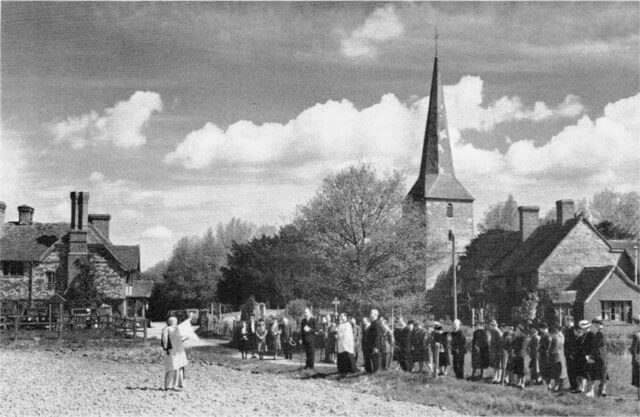
In addition to Traditionalists and Catholic Rural Activists, however, a third proponent of Rogation Days has emerged: the Anglican Ordinariates. As earlier noted, a remnant of the earlier customs survived in Anglicanism – and so in the Ordinariates. But it should not be presumed that the Greater and Lesser Litanies are unimportant or should be forgotten outside those favoured places. If anything, we need them now more than ever.
To begin with, we should be in favour of processions of any kind – not just these, but Candlemas, Palm Sunday, Corpus Christi, Assumptiontide, Christ the King, and whatever other festivals can employ them. Processions take the Faith from inside the churches, and bring it out to where the majority of people are. By such doings, Christ’s sovereignty over everything is reaffirmed.
Secondly, given the sheer amount of evil unleashed in to-day’s world, we should relish any attempt to alleviate it via penance and reparation. The penitential aspect of the Greater and Lesser Litanies gives one the chance with his entire parish to strike a blow against evil. This alone is a tremendous grace.
Thirdly, here and around the world we remain dependent upon the work of farers to keep us fed. In an age of possible disruption in worldwide supply lines, praying for God’s blessing upon the crops is always a good thing. Indeed, this can be a kind of quiet resistance to those European political forces which wish to destroy their countries’ agricultural sectors.
Beyond all of these, there is also the purely local demonstration of love of place, as one explores various nooks and crannies of one’s own neighbourhood. In preparation, one can study the histories of the local area and the parish.
But even if you cannot attend such a rite you can read the Mass and the Litanies on the appointed days. The work of prayer in the Church is universal, and may be pursued anywhere. It is outside of time and space, and awaits your cooperation.
Photo by The Now Time on Unsplash