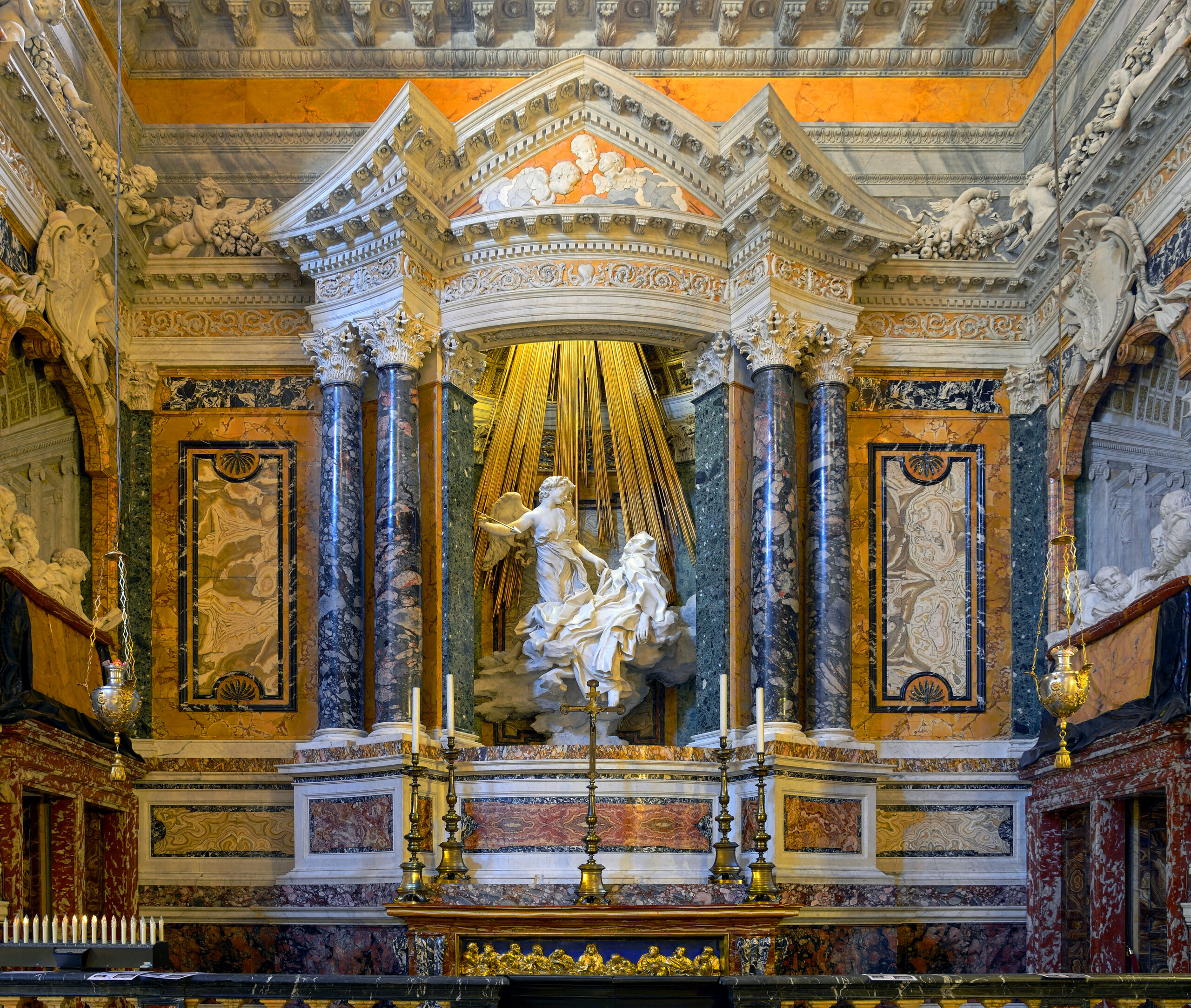
Above: “The Ecstasy of St. Teresa” by Gian Lorenzo Bernini (1598–1680).
The historical period known as the “Baroque” was not regarded positively even by those who gave it this name. Indeed, the term derives from the Portuguese “barroco,” which carries a negative connotation, referring to something irregular or uneven. Perhaps this judgment arose from a comparison with Renaissance art, which was seen as Apollonian and marked by a highly ordered flow. In the Baroque, by contrast, one perceived an apparent fragmentation, an irregular movement expressed in a famous line by the Baroque poet Giovan Battista Marino (1569–1625):
The aim of the poet is wonder (I speak of the excellent, not the clumsy): whoever cannot astonish, let him take up the currycomb!
This line tells us that the goal of art is to provoke wonder in the listener; those incapable of doing so would do better to change profession.
This idea is certainly present in Catholic sacred music of the Baroque era, a period which, in Rome alone, saw the activity of great composers such as Virgilio Mazzocchi (1597–1646), Orazio Benevoli (1605–1672), Paolo Lorenzani (1640–1713), Giuseppe Ottavio Pitoni (1657–1743), and many others.
What characteristics can we identify in the sacred music of this period? Certainly, one important principle is what we might call that of “excess” or “overflow.” There was no fear of investing in music for liturgical ceremonies, even when this led at times to a certain excess. This “ex-cedere” signaled a desire to go beyond ordinary conditions, almost as if to enter a supernatural dimension through musical means that exceeded the ordinary (and were therefore perhaps excessive?). We might think also of certain artistic manifestations of the period, such as the astonishing “Glory of St. Ignatius” by the Jesuit painter Andrea Pozzo (1642–1709), or the “Ecstasy of St. Teresa” by the extraordinary Gian Lorenzo Bernini (1598–1680). These are just a few examples that speak to us of an extraordinary virtuosity placed at the service of sacred art, always running the risk that such virtuosity might overshadow the necessary orientation of this art—namely, toward God. And yet the risk was taken, because the results of this art truly embodied Marino’s verse cited above: they inspired a sense of wonder which, echoing Aristotle in some way, is the first mover of knowledge, and thus of philosophy. In our case, wonder becomes the driving force of another kind of knowledge, one that leads from philosophy to theology and then to mysticism. We need to return to seeing Catholicism as the mover of our culture, the engine of our civilisation.
One might think of one of the most distinguished musical genres of the Baroque era: polychoral music. In these compositions, two or more choirs were placed in different parts of the liturgical building, creating remarkable effects and requiring extraordinary compositional virtuosity. Consider the famous Missa Salisburgensis for fifty-three voices, once attributed to Orazio Benevoli but now attributed to the Austrian composer Heinrich Ignaz Franz von Biber (1644–1704). This composition—probably the most representative of the style known as “colossal Baroque” and written for Salzburg Cathedral—not only speaks of an excess placed at the service of the divine, but also exalts the magnificence and splendor of the Catholic Church, qualities that stand far above the shortcomings of churchmen, which have never been absent, in the Baroque era as in our own. We should look at the magnificence of the Catholic Church and not only regret her many problems. Because if we only look at the problems – that are here to stay – our faith will be soon in big trouble. Let music show us that greatness that is in the Church, in her tradition, doctrine, spirituality, liturgy and so on. When I hear certain psalms from baroque time, full of vibrant rhythms and deep pathos, I am really moved not only from the beauty of the music but also from the deep feelings that music communicate to me. Saint Augustine, many centuries before, has said very important things on the deep power of music.
Polychoral music, which flourished magnificently in both Rome and Venice, is a splendid example of contrapuntal virtuosity that unites musical and architectural monumentality to impress the souls of the faithful with a music capable of conveying wonder for art directed toward God and the splendor of the Church, which from its militant state looks toward the triumphant one.