
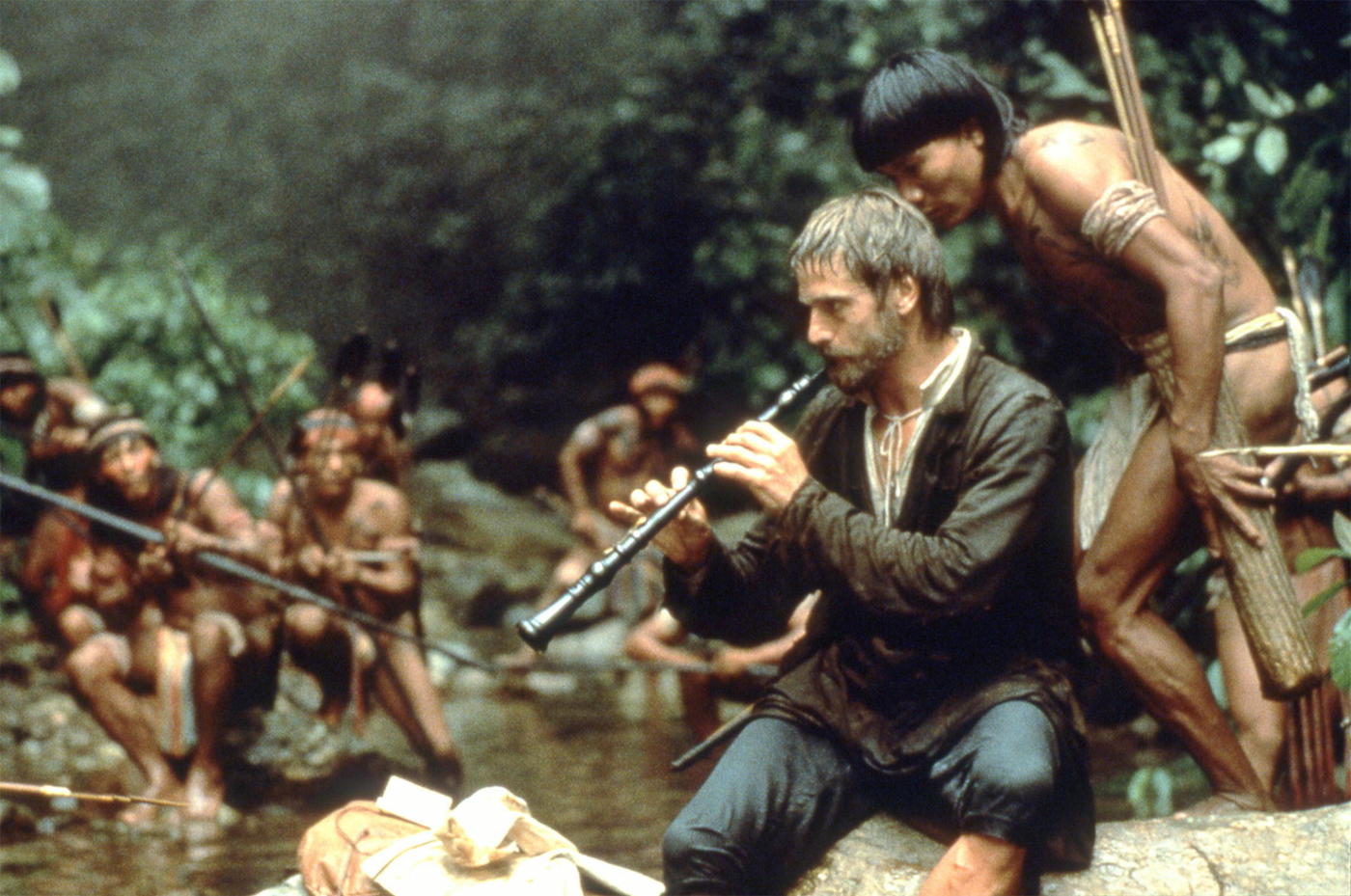
Above: a scene from the film The Mission (Roland Joffé, 1986), which depicts the Jesuit Reductions, highlighting the use of music in the missions.
Three hundred years ago, on January 2, 1726, Domenico Zipoli died of tuberculosis. A leading composer of his time, he was the most celebrated musician among the Jesuits and a central figure in the musical life of the Reductions of Argentina, Paraguay, and Bolivia.
Born thirty-seven years earlier in Prato, a town just eight miles northwest of Florence, Zipoli came from humble origins. He received his early education locally, later pursuing advanced musical studies in Florence, Rome, and Bologna under distinguished masters such as Alessandro Scarlatti (†1725) and Bernardo Pasquini (†1710). In Rome, he launched a promising career, joining the prestigious Congregation of Musicians of Santa Cecilia and composing notable oratorios, including Sant’Antonio di Padova (1712) and Santa Caterina Vergine e Martire (1714).
His most enduring legacy, however, is the Sonate d’intavolatura per organo e cembalo (1716), a collection that secured his reputation as “the successor of Frescobaldi and the final representative of the great Italian organ tradition.”[1] The collection’s standout piece, the Pastorale, is a masterclass in chromatic nuance and expressive delicacy.
Yet Zipoli’s growing artistic success did not deter him from answering a deeper spiritual calling. In 1716, he entered the Society of Jesus as a novice in Seville. A year later, he set sail for the Americas, eventually settling in Córdoba—then a prominent intellectual and cultural center of the Jesuit missions. There, as in Europe, he quickly distinguished himself as an organist and composer of remarkable talent.
Contemporary musicological research recognizes Zipoli as an heir to Girolamo Frescobaldi (†1643), the foremost organist and keyboard composer of the seventeenth century. Yet Zipoli consciously departed from Frescobaldi’s complex contrapuntal style, opting instead for a more dialogical, lyrical, and transparent approach. His compositions are marked by grace and clarity—qualities ideally suited to the liturgical and pedagogical needs of the missions.
Within the broader context of the Reducciones—which thrived from 1609 to 1767—music played a foundational role. These missionary settlements were part of the Jesuits’ grand vision of evangelizing the Guaraní people through cultural immersion and education. They established schools, workshops, and music conservatories; children were taught from an early age to sing, play instruments, and participate in liturgies and festivities. Music even accompanied agricultural labor, blending daily life with spiritual harmony.
This musical flourishing did not go unnoticed in Europe. In Annus qui (no. 5), dated February 17, 1749—the first papal document devoted specifically to sacred music—Pope Benedict XIV wrote,
Indeed the use of polyphonic or figured chant and of musical instruments in Masses, during Vespers, and in other ecclesiastical functions has proceeded a long way thus far, that it had reached unto the realm of Paraguay. And so since those new faithful of the Americas possess the finest natural and innate disposition towards polyphonic singing and towards pulsating instruments of the organ, and easily learn by heart those that pertain to the musical art; thereafter, having seized the opportunity, the missionaries, in accommodating the propensity of their souls, made use of pious and devout singing in leading them to the Christian faith; to such an extent that in the present, hardly any difference, neither as far as singing is concerned, nor as far as sound is concerned, comes between the Masses and Vespers of our realms and theirs.
Zipoli’s contribution stands as the creative zenith of Jesuit musical production in South America. His compositions, widely disseminated in Córdoba, survive in transcriptions that occasionally raise questions about their fidelity to the originals. His American works, while retaining their Baroque character, reflect local adaptations: the lack of bass voices led him to write for three-part choirs (soprano, alto, and tenor), simplifying both harmonies and melodies. Echoes of Italian comic opera also surface, blending with native sensibilities and shaping a distinctive hybrid style—what scholars now call the American Baroque. This stylistic fusion helped lay the foundations for música culta criolla, which would endure even after the Jesuit expulsion.
A particularly striking example of this cultural synthesis is the sacred drama San Ignacio de Loyola, based on the life of the Jesuit founder and his bond with St. Francis Xavier.
Though rooted in the Baroque operatic tradition and sung in Castilian Spanish, the work reveals a profound local imprint. Its structure is deliberately simple, with symbolic characters and streamlined action, aimed at maximum clarity. Notably, the inclusion of a parallel text in the now-lost Chiquitano language—intelligible to the Indigenous audience—and the presence of a mediator character, Torribio, exemplify the opera’s cross-cultural intent.
San Ignacio, written for performance by Indigenous actors themselves, stands alone in the history of missionary opera: a catechetical instrument, but also a vehicle for cultural agency and self-expression. At a time when Jesuit activities were increasingly scrutinized in Europe, the work may also have served as an implicit defense—demonstrating how the “Indies” could become fertile ground for a new, autonomous, and vibrant culture.
Domenico Zipoli’s life and music remain a profound testament to the power of art to transcend borders—geographical, cultural, and spiritual. His legacy is one of humanism and vision: not domination, but dialogue; not superiority, but exchange; not conversion as conquest, but communion in creativity. In the heart of colonial South America, Zipoli was not merely a European emissary—he was a builder of bridges. His music, suspended between two worlds, still speaks to us today of the enduring possibility of an art that unites, elevates, and liberates.
[1] L. Szarán, Domenico Zipoli: una vita, un enigma, Prato, 2000, p. 64; our translation.