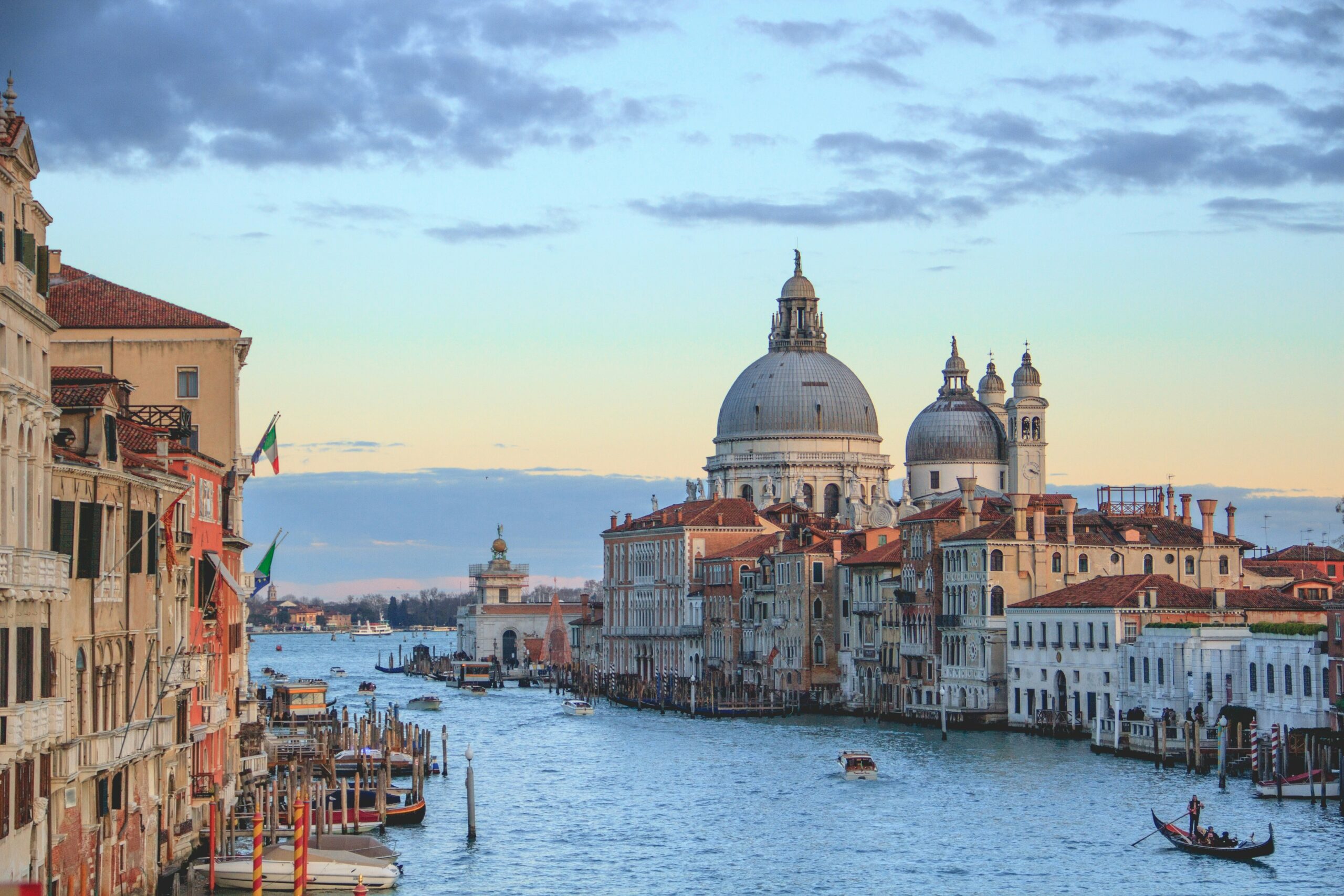
Above: Venice, Italy.
Three hundred and fifty years ago, on January 14, 1676, Venice mourned the death of Francesco Cavalli, the eleventh maestro di cappella—that is, the director of music—of St. Mark’s and one of the most influential figures of the Baroque musical period.
Born in 1602 in Crema, near Cremona, Cavalli—christened Pier Francesco Caletti-Bruni—was immersed in music from an early age. His father, Giovanni Battista Caletti, known as “Il Bruno” († 1622), served as director of music of Crema’s cathedral and was his first teacher. On December 18, 1616, thanks to the patronage of the Venetian governor of Crema, the nobleman Federico Cavalli—whose last name he adopted in gratitude—the young boy soprano entered the choir of San Marco Basilica in Venice.
Cavalli would spend nearly his entire life in the Serenissima, save for a brief sojourn in Paris. He advanced steadily within the musical establishment: from choirboy to tenor in 1627, then second organist in 1639, first organist in 1645, and finally, in 1668, maestro di cappella. In this final and most prestigious role, he succeeded his teacher Claudio Monteverdi († 1643), the pioneering architect of early opera, who had held the same post from 1613 until his death.
Though Cavalli is chiefly remembered as a composer of opera—he wrote around forty, more than any of his contemporaries—his contributions to sacred music are no less significant. His operas, such as La Didone (1641), L’Ormindo (1644), Il Giasone (1651, his greatest triumph), L’Eritrea (1652), and L’Ercole amante (1662), are marked by dramatic intensity and a seamless fusion of music and text. Eschewing dense contrapuntal complexity, Cavalli favored expressive clarity and theatrical immediacy, helping to define the post-Monteverdi Venetian operatic style.
Yet it is time his sacred music received its due.
Contemporary voices praised his artistry. In a 1645 dedication, organist Giovanni Battista Volpe, a colleague at San Marco, extolled the living vitality of Venetian music:
Indeed, as three eminent qualities converge in her [Venice]—that she can nobly clothe subjects, sing them incomparably, and accompany them with elegant precision on the instrument—I believe Your Lordship would do her an injustice by committing to print her excellent compositions, which are better sung and played, living treasures unfit for the printed page.[1]
The German composer Paul Hainlein († 1686), writing from Venice in 1647, placed Cavalli—“Sig. Gaballi”—alongside Girolamo Frescobaldi († 1643), one of the century’s greatest keyboard masters. And in 1671, Venetian historian Giovanni Nicolò Doglioni observed:
Francesco Cavalli truly has no equal in Italy, whether for the exquisiteness of his singing, the quality of his organ playing, or his rare musical compositions, which bear witness in print to his greatness.[2]
Among Cavalli’s sacred works, three monumental collections stand out:
1. Musiche sacre (Venice, 1656). This ambitious anthology, published under the patronage of Cardinal Giovan Carlo de’ Medici († 1663), bears the full title: Musiche sacre concernenti Messa, e Salmi concertati con istromenti, Imni, Antifone et Sonate, a 2, 3, 4, 5, 6, 8, 10 e 12 voci. It comprises 28 compositions: a mass for eight voices, eleven psalms, a Magnificat, five hymns, four Marian antiphons, and six instrumental sonatas.
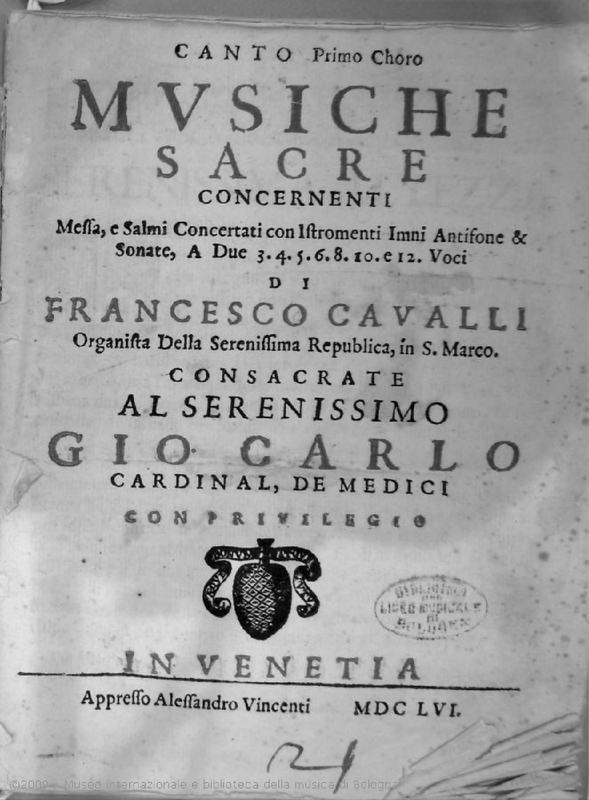
The collection calls for richly varied forces: theorbo, two violins, three violas (possibly replaced by or doubling trombones), two four-part choirs, vocal soloists, continuo (likely two organs, bassoon, and chitarrone), and three trombones—used both independently and as harmonic support.
The Missa concertata’s Gloria and Credo are striking for their sectional architecture (five and fourteen parts, respectively), each movement shaped by sensitive musical interpretation of the text—far beyond rhetorical gesture. The Kyrie, in the expected tripartite form, opens with a sinfonia and unfolds in a tapestry of imitation, metrical variation, and rhythmic vitality. Cavalli’s frequent shifts in tempo, texture, and dynamics echo the polychoral splendor of Giovanni Gabrieli’s In ecclesiis (1612), though the melodic contours are more fluid and lyrical, reflecting the operatic cantabile style of the mid-seventeenth century.
2. Vesperi a otto voci (1675). Published a year before his death, this double-choir Vespers collection includes three liturgical cycles: Vespero della Beata Vergine Maria (Vespers of the Blessed Virgin), Sunday Vespers, and Vespero delli Cinque Laudate (so named for the psalms used, concluding with the Magnificat).
With its rhetorical flair, vivid contrasts, and grand ceremonial spirit, the collection is firmly rooted in the Venetian tradition, while revealing Cavalli’s dramatic instincts shaped by decades of operatic composition.
3. Missa pro defunctis (1673). Cavalli composed this Requiem—Missa pro defunctis octo vocibus cum responsorio Libera me Domine—for his own funeral. It adheres to the Venetian polychoral style, scored for two four-part choirs and continuo. He stipulated that the mass be performed twice yearly: once in the Ducal Chapel of St. Mark’s, and again in the church of San Lorenzo, where he was ultimately interred.
Francesco Cavalli died at 73, leaving behind a body of work that bridges the refined polyphony of the late Renaissance and the expressive immediacy of early Baroque opera. While his operas have found renewed life on the stage, his sacred music—majestic, intricate, and profoundly spiritual—is still awaiting full rediscovery.
His legacy, both secular and sacred, invites us to listen anew.
Photo by Henrique Ferreira on Unsplash
[1] J. H. Moore, Vespers at St. Mark’s, Ann Arbor, 1981, p. 238.
[2] Le cose notabili et maravigliose della città di Venetia, Venice, 1671, p. 208.