
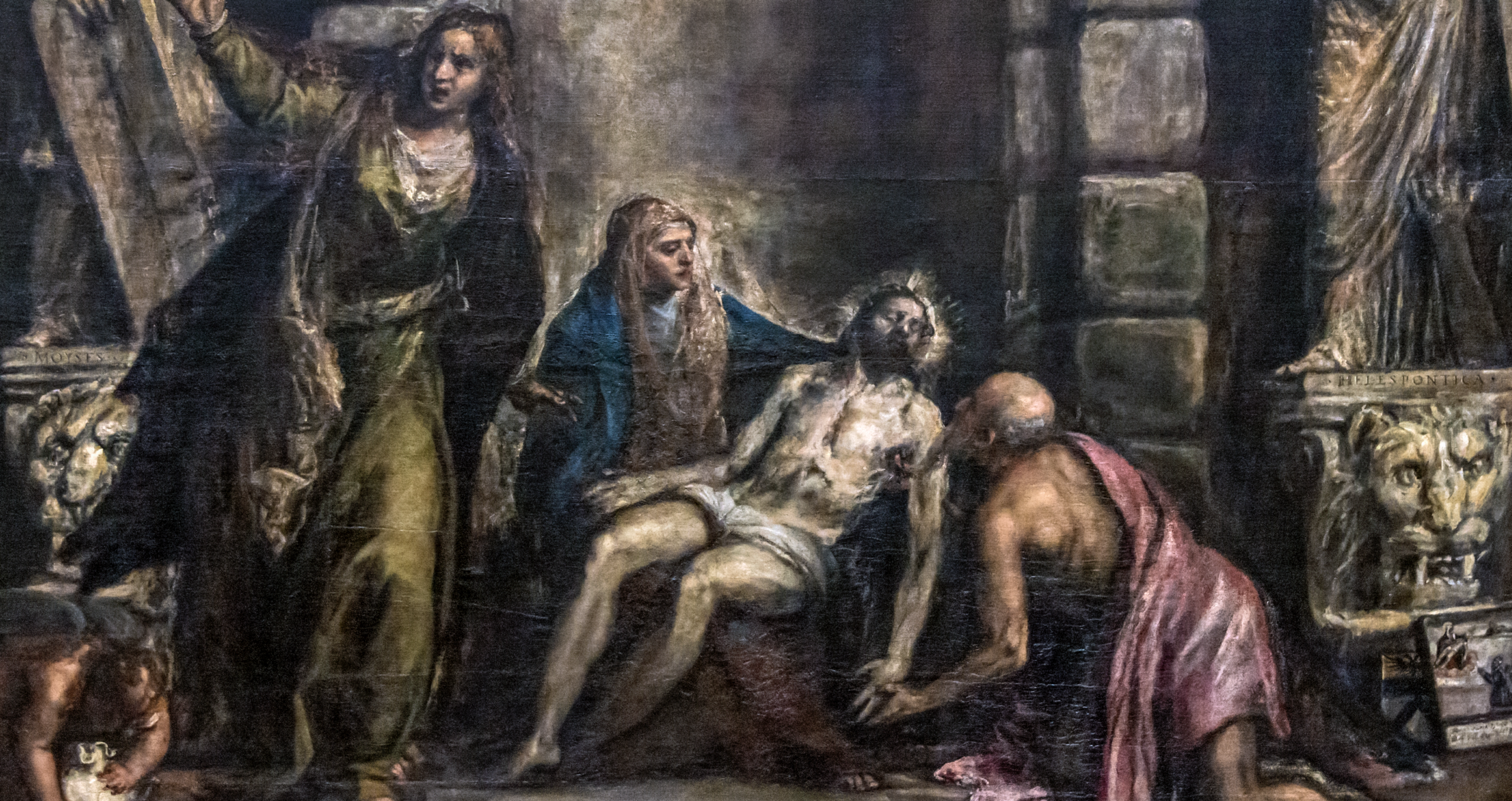
Above: Pieta, his last painting.

Four and a half centuries ago, on August 27, 1576, Titian passed away in Venice, likely at the age of eighty-seven, amid a plague epidemic. Yet, his death could not dim the brilliance of a legacy that would enshrine him as perhaps the greatest painter of the Venetian Renaissance. Today, 450 years later, his name continues to resonate—not merely for the extraordinary vibrancy of his colors or the grandeur of his compositions, but for the profound spiritual intensity that permeates his sacred works. Titian’s art bridges the material and the divine, making the ineffable tangible through pigment, form, and light.
This enduring significance was formally recognized in 1976, on the fourth centenary of his death, when Pope Paul VI (†1978) addressed a letter to Cardinal Albino Luciani—then Patriarch of Venice and the future Pope John Paul I (†1978)—honoring the artist. In this remarkable text (here rendered in translation), the Pope spoke of a “feeling of profound gratitude” for “the extraordinary felicity of the images with which [Titian] enriched the iconographic heritage of the Christian faith.” From the earliest days of Christianity, he noted, art has served as a “precious instrument to make the world of the spirit accessible and almost tangible.” Within this framework, Titian emerges not merely as heir but as innovator—one who, “from his earliest years… devoted attentive and devout study to the sacred repertory.” Religious subjects were, for Titian, a lifelong meditation, explored in pigment and canvas.
Paul VI’s letter retraced the major milestones of Titian’s religious output: from the Sacred Conversations, where human and divine meet in contemplative encounter, to depictions celebrating the mystery of Christ—from the Nativity to the Adoration of the Magi, from the Transfiguration to the Last Supper. The Pope emphasized the Assumption of the Virgin in Santa Maria Gloriosa dei Frari, where Titian, “now in full command of expressive autonomy and stylistic means, inaugurates a new vision of sacred art.” In this monumental canvas, Mary rises to heaven amid a multitude of angels, while earth and heaven converge in a radiant interplay of light—a visual hymn to the union of the terrestrial and the divine.


Titian’s work, Paul VI observed, constitutes a continuous testament of faith: “Of very few painters, as of him, can it be said that there passed no year, month, or perhaps day in which… he did not recall to his own attention and that of his contemporaries the reality and vitality of the religious event.” Examples abound: the Madonna of the Accademia Carrara, the Madonna of San Rocco, numerous Annunciations, the Mater Dolorosa, and the Virgin grieving over the dead Christ or radiant before her risen Son. Even in the unfinished Pietà of the Accademia, where Titian portrays himself in supplication beside his son Orazio, the work resonates with intimate spirituality, which Paul VI described as “the ultimate message of his art as a message of faith and hope.”


Beyond spiritual depth, modern scholarship highlights another dimension of Titian’s sacred altarpieces: music. Not audible music, but painted music—angels holding instruments, evoking the sonic tapestry of Venetian liturgy. In this way, Titian’s art becomes a multi-sensory experience, where sight and imagined sound coalesce.
In the Assumption of the Virgin, angels play flutes and tambourines, instruments that evoke celestial harmony while reflecting the auditory reality of the Franciscan basilica. Within this sacred space, choral singing and organ accompaniment marked solemn liturgical celebrations. Titian transforms this temporal, sonic, and spiritual atmosphere into a visual hymn, rendering the imagined sounds of worship nearly audible. His angels, consistently youthful and serene, are depicted with meticulous precision, suggesting that the paintings function not only symbolically but also as records of contemporary musical practice. Allegorical yet rooted in reality, they resonate with the rich liturgical soundscape of sixteenth-century Venice, from Gregorian chant to polyphony at its height.

Consider Venice itself: during Titian’s lifetime, the Flemish composer Adrian Willaert (†1562) shaped the Venetian School with grand polychoral motets at San Marco, exploiting the basilica’s architecture through antiphonal choirs. Later, Andrea Gabrieli (†1585) and his nephew Giovanni Gabrieli (†1612) expanded this tradition, weaving voices and instruments into immersive, spatially dynamic dialogues. Titian’s angels, poised in musical gesture, seem to anticipate this auditory culture, rendering his sacred altarpieces as pictorial counterparts to Venice’s rich liturgical soundscape.
In this sense, Titian’s art is genuinely liturgical. Color, light, and music converge in a single act of devotion, creating a total celebration of the Christian mystery. Paul VI concluded that “a religious art of such splendor and such fervor survives the wear of centuries and speaks still today with a resounding voice.” That voice is both seen and imagined, heard in the mind’s ear, where angels’ instruments, human devotion, and divine presence harmonize.
Thus, 450 years after Titian’s death, we can fully appreciate his legacy: a painter who united heaven and earth, body and spirit, image and sound. His work remains a living testament to how beauty—visual and musical—can serve as a privileged path to faith, offering a gift not only to the Church but to all humanity. Titian’s art endures, timeless and transcendent, a bridge between the temporal and the eternal, inviting viewers to witness the sacred with both eye and soul.