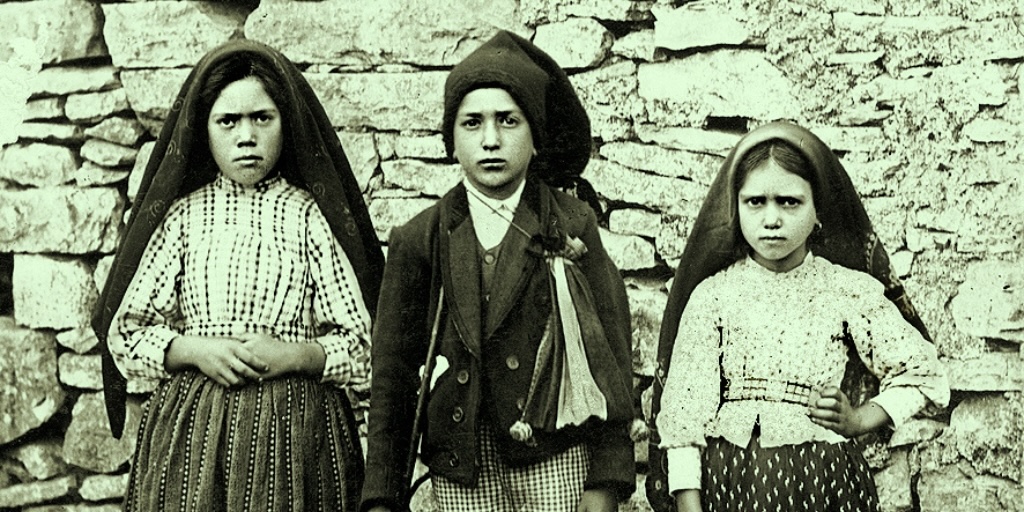
Above: (left) Servant of God Sr. Maria Lucia of Jesus and of the Immaculate Heart as a young child, with Ss. Francisco and Jacinta Marto, the children of Fatima.
On the Third Part of the Secret of Fatima, part 2
In the first article, we discussed some of Lúcia’s early formation and how her Memoirs came to be written. In the present article, we’ll focus upon the composing of the third part of the Secret.
The writing down of the third part came about separately from the Memoirs but is organically connected to their history. As the Memoirs were addressed to Bishop da Silva, he read them along with his close associates. Shortly after the completion of the fourth Memoir in late 1941, Lúcia became quite ill. Her health was so precarious that people genuinely feared her life was in peril. Bishop da Silva’s associates encouraged him to order that Lúcia write down the third part, lest she die without leaving this knowledge to the Church.[1]
Bishop da Silva was, at first, reluctant to order Lúcia and left the matter to her discretion. Later, he became convinced of the gravity of the situation and gave her a direct order.[2] Lúcia had maintained silence on the third part since July 13, 1917, having been expressly commanded by the Virgin to be silent. Heaven’s permission to write down the first two parts had been given, but not the third. Being set on religious obedience, Lúcia believed that a command from her religious superiors was as if it came from God. So, now she had a serious conundrum: who was she to obey, the Blessed Virgin or Bishop da Silva?
Owing to this conundrum, Lúcia experienced a physical inability to write down the third part at Bishop da Silva’s command. Yet, if she set her mind to write anything else, she could do so without any problem.[3] In the midst of this difficulty, in early January of 1944, Our Lady appeared to Lúcia. During this apparition, the Virgin told her that this difficulty was a test to prove Lúcia’s faith, humility and obedience. Our Lady then commanded Lúcia to “write down what they command you, but not that which is given to you to understand of its meaning.”[4] A further order was given to seal the text in an envelope and write on the outside that the envelope “could only be opened in 1960 by the Cardinal Patriarch of Lisbon or by the Bishop of Leiria.”[5]
The detailed information about the January 1944 apparition only recently appeared. In October 2013, the Carmelites of Coimbra published a biography of Sr. Lúcia entitled “A Pathway under the Gaze of Mary” (Um caminho sob o olhar de Maria). Prior to the publication of the book, the public knew about this apparition, but not the precise words of Our Lady. The Carmelites used the spiritual diary (O meu caminho)that Lúcia kept for sixty years to provide the public with the words of Our Lady.
It is enough to say that for her part, Lúcia obeyed this new command. She wrote down the third part of the Secret (in less-than-ideal conditions) and put it into two envelopes for security reasons. On the outside of these envelopes, she wrote “By the express order of Our Lady, this envelope can only be opened in 1960 by the Cardinal Patriarch of Lisbon or by the Bishop of Leiria.”[6] The Carmelites of Coimbra relay a powerful story about how Lúcia obtained the wax to seal the envelopes.[7] The story is powerful because it is a further testament to her obedience, though we need not go into it here.
Lúcia held onto the text until she was able to pass it along in June of 1944 to Bishop José da Silva through another bishop she knew, Bishop Manuel Maria Ferreira da Silva.[8] The envelope was tucked away in a notebook that Bishop José was to read.[9] Bishop José held onto the text, but didn’t read it, keeping it secure within the diocesan chancery offices. He put Lúcia’s envelope into a larger one with his own inscription. It was taken out once and photographed for Life magazine in 1948. An image of the text in front of Bishop da Silva was published along with the following text: “In the sealed envelope above lies an undivulged prophecy which Lúcia says she got from the Virgin. Only Lúcia is supposed to know what mystery it contains. Lúcia hopes the prediction will come true but will not allow it to be opened until 1960 . . . .”[10]
Putting the third part of the Secret before the public with the 1960 note raised expectations. While certainly not the only publication that discussed the third part and 1960, Life was a prominent publication within the English-speaking world. The closer the world got to 1960, the more the expectation grew that the text was going to be read. John Haffert of the Blue Army, for example, even initiated a program series called “Zero 1960” that was designed to prepare people for the anticipated reading of the third part.
Despite the anticipation, it is quite clear that the Virgin said to Lúcia in 1944 that the text was to be opened and read in 1960 by the two people she specified. To be opened is not the same as being published. Here, the facts begin to get a little murky and we’ll attempt to provide some clarity in the next article.
[1] Carmelo de Santa Teresa – Coimbra, Um caminho sob o olhar de Maria, 262-263; see also Fr. Joaquín María Alonso, La verdad sobre el secreto de Fátima: Fátima sin mitos (Madrid: Centro Mariano, 1976), 29ff.
[2] Carmelo de Santa Teresa – Coimbra, Um caminho sob o olhar de Maria, 262-263; Alonso, La verdad sobre,32.
[3] Carmelo de Santa Teresa – Coimbra, Um caminho sob o olhar de Maria, 264.
[4] Ibid., 266-268.
[5] Ibid., 266.
[6] Ibid.
[7] Ibid., 273-274.
[8] Cf. “Archbishop Manuel Maria Ferreira da Silva, S.M.P.” Catholic Hierarchy.
[9] This book was likely Lúcia’s earlier-mentioned spiritual diary O meu caminho.
[10] Henry R. Luce (Editor-in-Chief). “The Miracle of Fatima.” Life (December 20, 1948): 36.