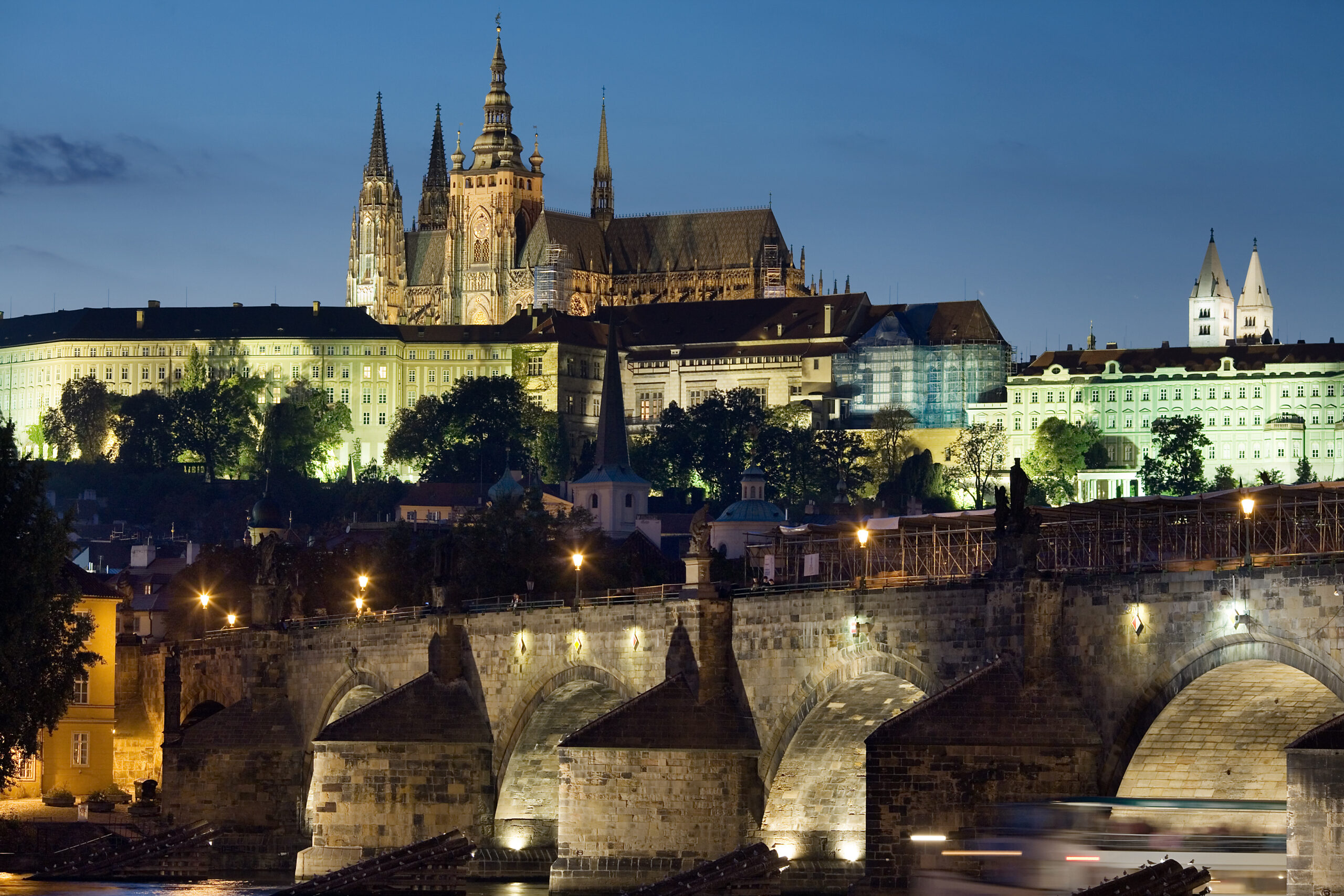
Above: Prague Castle, the ancient seat of Bohemian dukes and kings, Roman kings and emperors, and after 1918 the office of the Czechoslovak and Czech presidents
On December 4, 1875, Rainer Maria Rilke was born in Prague, a city that, at the time, was part of the Austro-Hungarian Empire—an irony for the man who would rise to become one of the foremost lyrical poets of 20th-century Germany. Despite his complex origins, Rilke’s literary legacy knows no boundaries, continuing to inspire readers, writers, and artists across the world. His life, dedicated to the pursuit of inner truth and the articulation of the ineffable, remains a profound embodiment of artistic devotion and spiritual exploration.
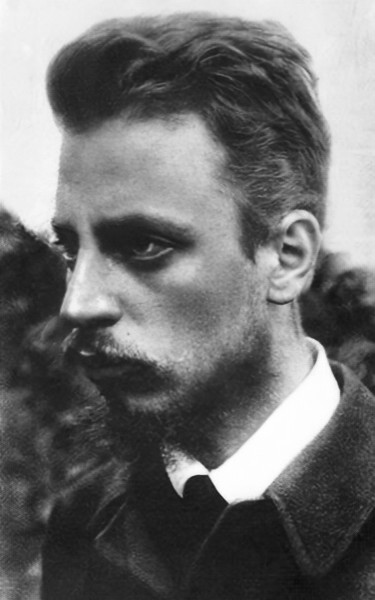
Born into an aristocratic Carinthian family, Rilke wrote in German, a language that became the vehicle for his deep poetic vision. His extensive travels across Europe—through cities such as Berlin, Trieste, and Paris, where he served as secretary to the renowned French sculptor Auguste Rodin († 1917)—broadened his understanding of art and culture. His exposure to distant lands like Egypt, Algeria, and Tunisia further expanded his worldview, infusing his poetry with rich, diverse influences. After World War I, Rilke took up permanent residence in the quiet solitude of Muzot, Switzerland, where he spent the remaining years of his life in profound reflection and creative output.
Rilke’s early works, including Early Poems (1899) and Stories of God (1900), reveal his sensitivity and spiritual yearning, capturing his deep engagement with existential questions. With The Book of Images (1902), Rilke began to explore the evanescent nature of time and the evocative power of imagery. His growing reputation was solidified through works like The Lay of the Love and Death of Christoph Cornet Rilke (1899) and The Book of Hours (1905), a three-part cycle that meditates on themes of monastic life, pilgrimage, and mortality.
A pivotal moment in Rilke’s artistic development came through his collaboration with Rodin, which inspired him to produce New Poems (1907-1908). These works are characterized by a new formal rigor and precision in imagery, reflecting Rilke’s evolving poetic vision. Yet, his existential unease continued to surface in The Notebook of Malte Laurids Brigge (1910), a semi-autobiographical novel that delves into the anguished depths of self-reflection and isolation.
In the final years of his life, Rilke achieved what would become the pinnacle of his poetic achievements: Duino Elegies and Sonnets to Orpheus (1923). These late masterpieces are steeped in abstraction, introspection, and a quest for transcendence. Exploring themes of transformation, memory, and the human condition, Rilke established himself as one of the most influential poets of the 20th century. His work continues to resonate deeply, inspiring poets, thinkers, and artists around the world.
Rilke’s profound spirituality extended beyond literature and into the realm of music. Between 1922 and 1923, German composer Paul Hindemith set Rilke’s Das Marienleben (The Life of the Virgin Mary) to music, composing fifteen lieder for soprano and piano.
Hindemith’s Das Marienleben, Op. 27 (see the original text and its English translation here), now regarded as some of the most profound and inspired works of the 20th century, were later orchestrated by Hindemith—four pieces in 1938 and two more in 1948. Hindemith’s music delves into the emotional depth of Rilke’s verses, tracing the stages of Mary’s life through a series of soundscapes that elevate human emotion into the transcendent mystery of the Incarnation.
Hindemith’s music can be seen as an aural reflection of Rilke’s poetry—a vivid interpretation of the themes and imagery within the text. In The Birth of Mary, the music evokes the quiet suspension of angels watching over Mary’s birth, creating an atmosphere of stillness and anticipation. In The Presentation of Mary, Hindemith uses the form of a passacaglia to mirror the visual structure of Rilke’s poem, gradually intensifying the musical tension. In The Annunciation to Mary, the sound of a trumpet announces the angel’s arrival, adding a tangible element to the ethereal tone of Rilke’s words. Similarly, in The Birth of Christ, Hindemith conjures the joy of Christmas through harmonies in thirds, reflecting the warmth and joy of carols.
Hindemith’s composition often emphasizes the relationship between form and content, with repeated motifs providing structural clarity. Despite the dissonance woven into much of the work, the music retains clarity and coherence, owing to its formal organization and thematic repetition. The vocal and instrumental parts are treated with equal prominence, with the music remaining predominantly polyphonic—except in Pietà, where the piano serves as a subtle accompaniment.
Das Marienleben marked a pivotal shift in Hindemith’s style, steering him toward neoclassicism. The work was quickly hailed as his finest creation to date, though Hindemith would later express dissatisfaction with it. In 1948, he revised several of the compositions, sparking a debate among musicians about the merits of the original versions versus the revisions. Some preferred the youthful vibrancy of the original, while Hindemith defended his revisions. Today, listeners can compare both versions, not to pass judgment, but to appreciate the distinct qualities each brings to the work.
Throughout his life, Rilke carved a literary legacy that balanced reverence for tradition with a resonance that speaks powerfully to the modern world. His exploration of transformation and transcendence through poetry found an equally innovative expression in the music of Hindemith, who translated Rilke’s words into a vibrant and contemporary soundscape.
Pope Pius XII († 1958) eloquently encapsulated the relationship between Hindemith’s music and Rilke’s poetry, stating
He, surely the first among the German representatives of a new musical art, from which one is meant to hear the harsh rhythm of the present, shapes in his creations its vigor and harshness, but with an increasing recognition of the timeless musical laws by which the great masters have always formed themselves.[1]
These words underscore the dual nature of contemporary music—its raw energy and its reverence for the eternal laws of artistry. In much the same way, Hindemith’s music and Rilke’s poetry embody this delicate balance, fusing the intensity of modernity with the enduring beauty of tradition. Their combined legacy continues to inspire and offer us a transcendent vision of the world, one that reaches beyond both time and space.