
Editor’s note: this is an English translation of the original Spanish text.
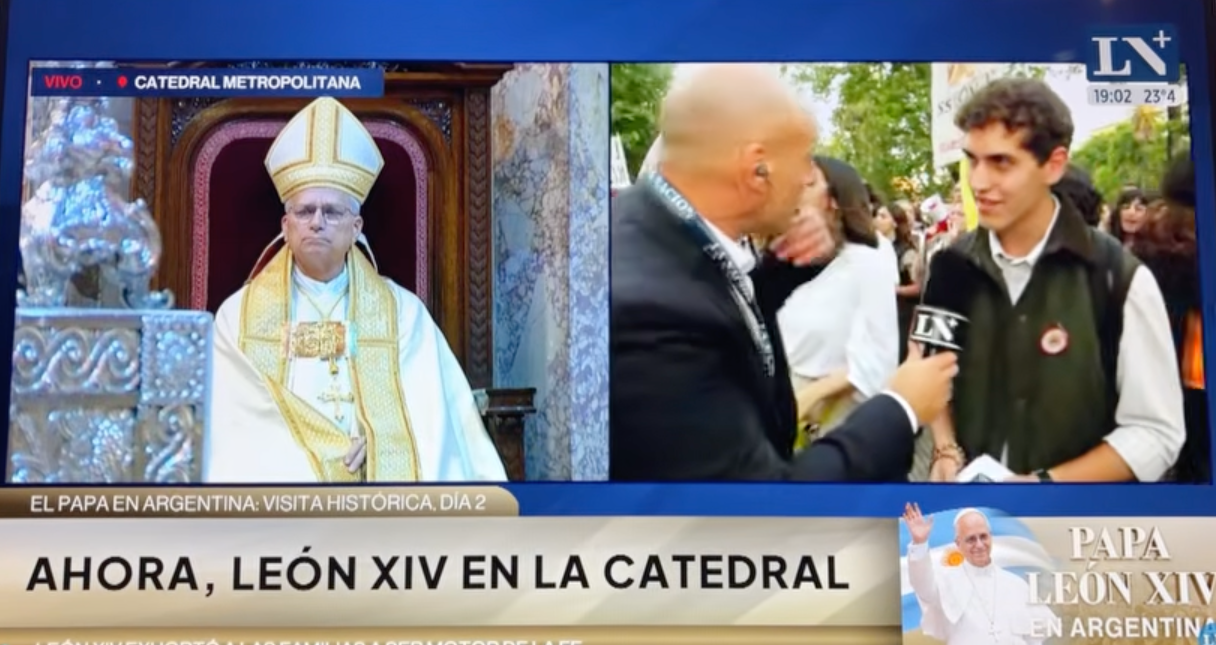
Note from Organiser, Mr. Sebastian Altarmirano: As you may know, from November 8 to 11, Argentina had the grace and joy of welcoming His Holiness Pope Leo XIV. In this context, a group of young Catholics organized ourselves not only to participate in the scheduled events (Masses, vigils, etc.), but also to bring a petition to the Pope: the liberation of the Traditional Latin Mass. We raised our banners along the popemobile routes during all the celebrations, and we also gathered a large group of young people on Monday, November 9, in Plaza de Mayo, in front of the Buenos Aires Metropolitan Cathedral, where the Pope met to pray Vespers with all the bishops of the country. There, we prayed the Rosary and sang chants in Latin and Spanish, imploring Our Lady that His Holiness might hear our request. Numerous media outlets covered the event, such as EWTN, La Nación +, Infobae, and TN, among others.
In Argentina, the celebration of the traditional rite is unfortunately severely restricted. Aside from a tiny number of diocesan priests who have authorization (as the bishops are reluctant to grant it), there is no presence of former Ecclesia Dei institutes. We are sharing with you the brief explanation of our request that we distributed when calling for this event, along with several photographs and links to some of the many news features covering our gathering. We sincerely appreciate your help in spreading the word, and we especially ask for your prayers that the Pope may welcome our petition. Greetings in Christ and Our Lady of Luján, Patroness of Argentina. -SA
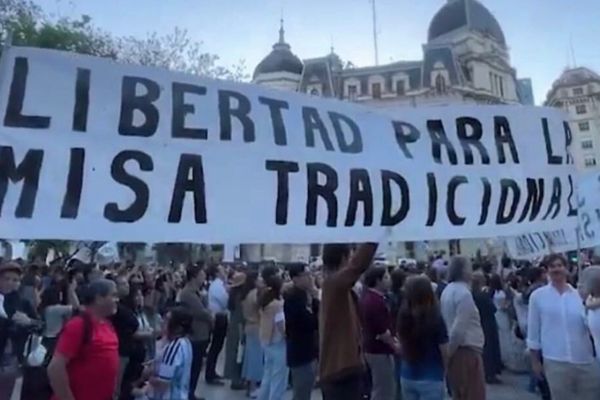
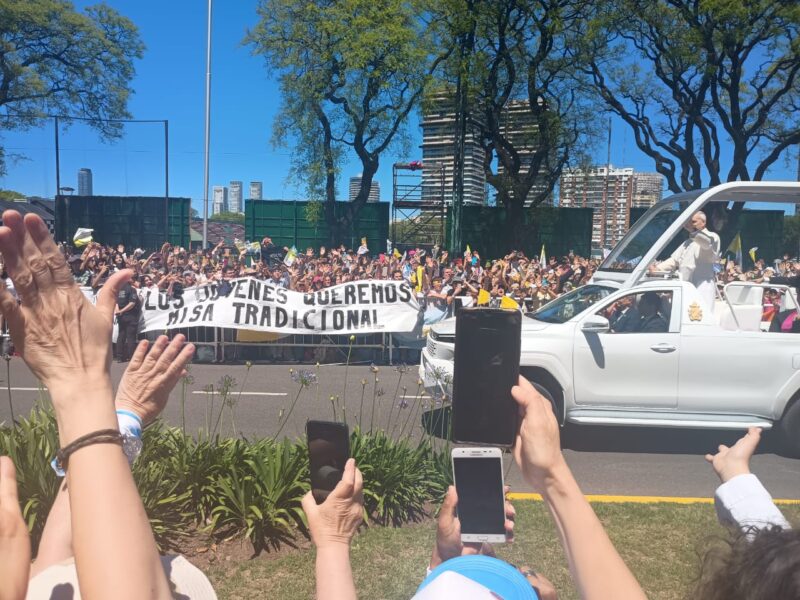
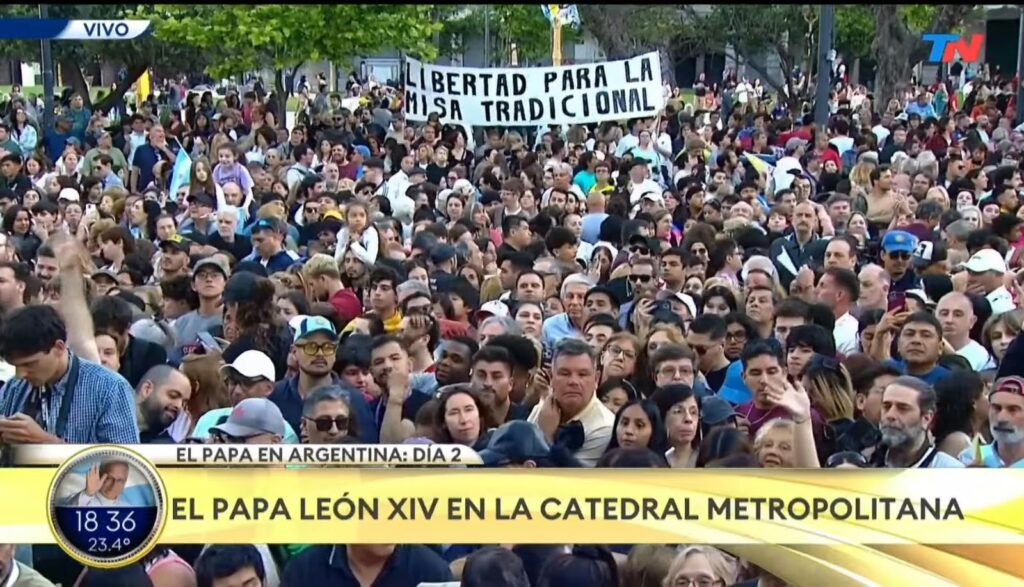
PETITION FOR FREEDOM FOR THE TRADITIONAL MASS
1. Who are we and what do we ask for?
We are lay faithful of the Catholic Church who ardently desire that in our beloved Argentina the Holy Mass may be celebrated with freedom according to the traditional Roman Rite, in accordance with the Roman Missal of 1962.
We simply want those faithful who find in the traditional liturgy a source of clarity that – through its numerous visible signs – feeds and strengthens our faith, to be able to participate in it, in full communion with the Church and with full fidelity to the Supreme Pontiff.
The Code of Canon Law itself recognizes the right of the faithful to make known to their pastors their needs, especially spiritual ones, and their desires (canon 212, §§ 2 and 3).
2. What is the traditional Mass?
The traditional Mass, also popularly known as the Tridentine Mass, is the rite that the Church bequeathed to us in the West from the first Christian centuries, which throughout history has undergone minor revisions and purifications (after the Council of Trent, from which it takes the name “Tridentine”), up to the last edition of the Roman Missal promulgated by H.H. John XXIII in 1962.
It is the rite that prevailed in the Catholic Church until the liturgical reform following the Second Vatican Council.
It is characterized, among other elements, by the use of Latin, Gregorian chant, sacred silence (that invites recollection), the richness of its prayers and gestures, and the common orientation of the priest and the faithful towards the altar.
In it, all visible signs transmit the profound reality in which we participate: the holy sacrifice of Our Lord Jesus Christ.
It is not another Sacrifice or a different Sacrament.
It is the unbloody renewal of the sacrifice of the cross, offered in reparation for our sins, with the same real presence of Christ and the same Catholic faith, celebrated with the liturgical rite that the Church perfected over the centuries.
3. Why did it cease to be celebrated and when was it restricted?
After the Second Vatican Council (1962–1965), the Church undertook a reform of the liturgy, concerned about the crisis of faith, seeking to attract more people and adapt to modern times.
In 1969, H.H. Paul VI promulgated a new Roman Missal, with its definitive Latin text being approved in 1970.
The new Missal became the ordinary form of celebration in the Church of the Roman Rite.
Numerous changes were introduced into the liturgy, seeking greater active involvement of the faithful in the Mass: celebration in the vernacular language (that is, in Spanish, English, etc.) was authorized; responses of the faithful were increased; the priest’s quiet prayers were reduced to a minimum; among many other changes.
However, the traditional Mass was never declared invalid, nor was the 1962 Roman Missal abrogated.
In 1988, H.H. John Paul II in the motu proprio Ecclesia Dei asked the bishops to guarantee broad and generous permissions for the previous rite; later, in 2007, Pope Benedict XVI through the document Summorum Pontificum, declared that priests were free to celebrate according to the traditional rite or the new one, without having to request any permission.
This situation changed on July 16, 2021, when Pope Francis promulgated the document Traditionis Custodes.
In it, he restricted the freedom of priests, requiring them to obtain permission from their bishop to celebrate the traditional rite.
In February 2023, a new rescript from the Holy See further restricted it, declaring that the traditional rite could not be celebrated in parish churches except by dispensation from the Pope.
In addition, priests ordained after July 2021 also require authorization from the Pope to celebrate the traditional rite.
In summary, the Holy Traditional Mass remains valid, but in order to celebrate it, extremely difficult-to-obtain permissions are required.
4. Why do we want the traditional Mass?
Because we love God and what we want most is to unite ourselves closely to Him. In prayer we find that the means to encounter God and speak with Him vary according to each person’s interior dispositions; therefore, if there is a way of praying in the Holy Mass that is suitable due to its recollection, silence, and signs, it is entirely legitimate and proper to ask the Church not to deprive us of such a great treasure.
We want it because it strengthens us and increases our faith, causing us to participate with greater devotion and fervor in the holy sacrifice of Calvary, expressing through its visible signs that tremendously real reality that is made present.
Furthermore, the silence, the orientation of the altar, and the priest’s numerous gestures of exterior reverence put God at the center and reflect the transcendence and immensity of the mystery celebrated, favoring the recollection, adoration, and interior participation of the faithful.
Its prayers and formulas also contain a doctrinal richness of great theological precision, incorporating throughout the entire rite numerous prayers taken from the Psalms and other texts of the Bible.
Latin in turn manifests the unity of the Church and its universality across time and nations throughout the world.
5. What do we ask for?
With immense love for the Church and the Pope, whom we keep especially present in our prayers, and seeking only unity in Christ, “In illo uno unum”, in communion of faith and charity, we come to request with respectful filial boldness that this petition be heard.
We ask the Holy Father to restore to priests the freedom to regularly celebrate the Holy Mass according to the 1962 Missal wherever there are faithful who request it, for the good of souls and for the greater glory of God.
What for previous generations was sacred, also remains sacred and great for us and cannot be all of a sudden entirely forbidden or even considered harmful — H.H. Benedict XVI on the traditional Mass
All for the greater glory of God,
Young Catholics