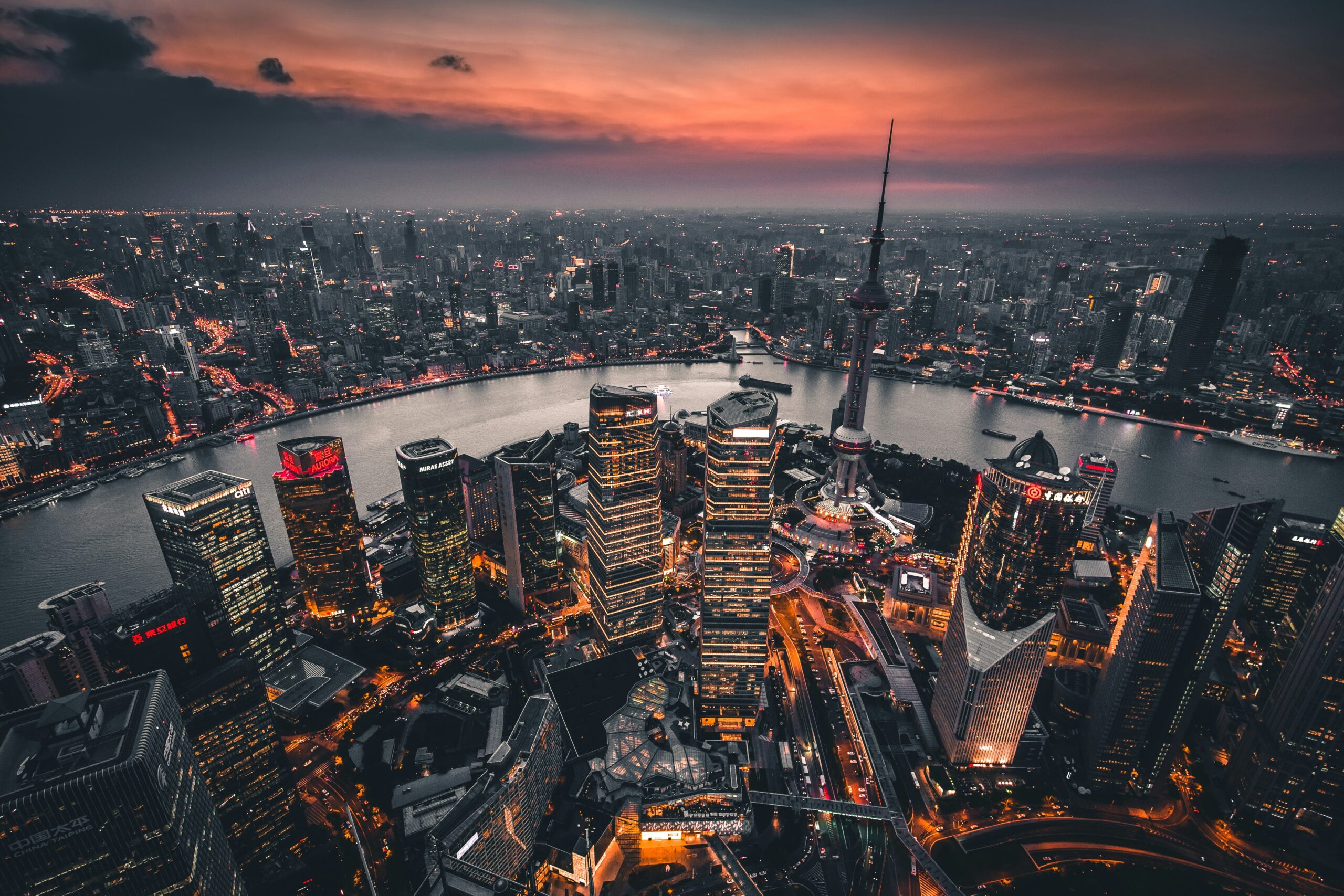
Above: Shanghai, China.
In late April of 2025, the cardinals of the Roman Catholic Church were in the middle of their multi-day General Congregation. The one question on their minds: who shall take up the responsibility of steering the Barque of Peter? As the cardinals discussed the qualities of the next pope and what problems he must solve, the Chinese Communist Party announced the results of their own conclave. Rather than electing a Pope, they, instead, elected two priests to become bishops of their own dioceses.
During a period of sedevacante, that is, the period when no one occupies the papal throne, the Holy See can pass no legislation, no papal dispensations or approvals may take place, and certainly, no episcopal appointments may be made or announced. But on April 28, 2025, the day after Pope Francis’ funeral, and before the conclave, the CCP announced the “election” of Father Ignatius (Joseph) Wu Jianlin as Auxiliary Bishop of Shanghai and Father Li Jianlin as bishop of Xinxiang.
The election of both men as bishops was troubling, to say the least. The deal with the CCP is obscure, as it has never been publicized. Reports contend that bishops are elected by Chinese clergy, and are presented to Rome for approval by the Holy Father. But Wu Jianlin was elected to a diocese that already held two bishops and an auxiliary bishop. Li Jianlin was elected to a diocese that already had a bishop.
The Cardinals did not release any statement regarding the appointment of the bishops during the General Congregation. As such, the conclave continued as normal, and Leo XIV was appointed as the successor to the Prince of the Apostles.
The issue, however, loomed. Intentionally or not, the Chinese government appeared to be posing a challenge to the new pope: Will Leo disavow the Chinese government for acting on their own accord, declare the consecrating bishops in schism, and effectively end the Sino-Vatican agreement, or will Leo accommodate the act of disobedience and the thwarting of papal authority?
The first consecration was set for October 15, and as the days approached, no word was given as to how the Vatican might respond to what appeared to be an act of schism. The Catholic Herald wrote an article on October 14 posing the question which had been nearly forgotten by the Catholic press up to that point (“Illicit episcopal consecration in Shanghai tests Vatican–China accord”).
Then the day arrived.
October 15, the day of the first consecration, the Vatican announced the appointment of Father Joseph Wu Jianlin as auxiliary bishop of Shanghai. It was revealed in the Bollettino from that day that Leo had privately accepted his appointment on August 11, but with no fanfare. Similarly, Li Jianlin was appointed on the day of his ordination on December 5 with the Bollettino from the day mentioning that Leo accepted this appointment on August 11.
Normally, the Vatican announces a bishop-elect within the weeks leading up the episcopal consecration. In this case, it was announced at the last minute. But, to the CCP this was nothing new. This was not the first act of defiance in their deal with the Holy See. In Francis’ pontificate, the Holy See accepted an illicit transfer of Bishop Shen Bin from Haimen to Shanghai. The late pontiff supposedly did so “for the good of the diocese.”
One might reasonably say that this rationale is applicable also for Leo. The Holy Father perhaps thinks it better that communion remain between the Holy See and the CCP even if tenuous, and even if it looks as though Rome has compromised authority in favor of said communion.
The SSPX Connection
To those who are following the SSPX situation, there appears to be a double standard. The Society of St. Pius X is soon to consecrate bishops in a way similar to the CCP. It similarly has “elected” four men and submitted them for approval. While they argue that they will have no jurisdiction, they are certainly not men that the Vatican was looking to ordain. But in this case, Leo has not issued a last-minute Bollettino, nor a last-minute approval of the bishops (at least at the time of me writing this). So, how should we as good Catholics react to this?
First Catholics should remember the moral theology taught to them by their mothers that “just because other people get away with something, doesn’t make it right.” It is not a morally cohesive argument to say that the SSPX is justified in carrying out actions that put the Vatican in a tight spot, simply because the CCP has “gotten away with it” in recent years. There are far better arguments for and against the SSPX consecrations that do not invoke any kind of moral relativism.
Second, while the above principle is truly the case, it’s still appropriate to ask for an equal application of the law. This comes from the most basic principle of justice. Each must receive that which is due to him. It does not seem just that the Chinese government can be given bishops by their own will, yet the Society is being threatened with excommunication if they do the same on July 1.
Either the law must be wholly repealed (or never applied) or always applied and no accommodation be given to any group that goes outside of the ordinary means to consecrate bishops. If a law is to retain credibility, it must be applied consistently. That is justice. No degree of diplomacy or distain can override this virtue that governs the will of man and the will of the state. Which will it be?
Until then, with regards to both the Sino-Vatican deal and the SSPX, we pray to the Holy Spirit that all is brought back into the fullness of justice and truth, and that in these difficult situations, the Holy Father models the Good Shepherd who seeks after the lost sheep and does not sleep until it is brought back into the fold.
Photo by Denys Nevozhai on Unsplash