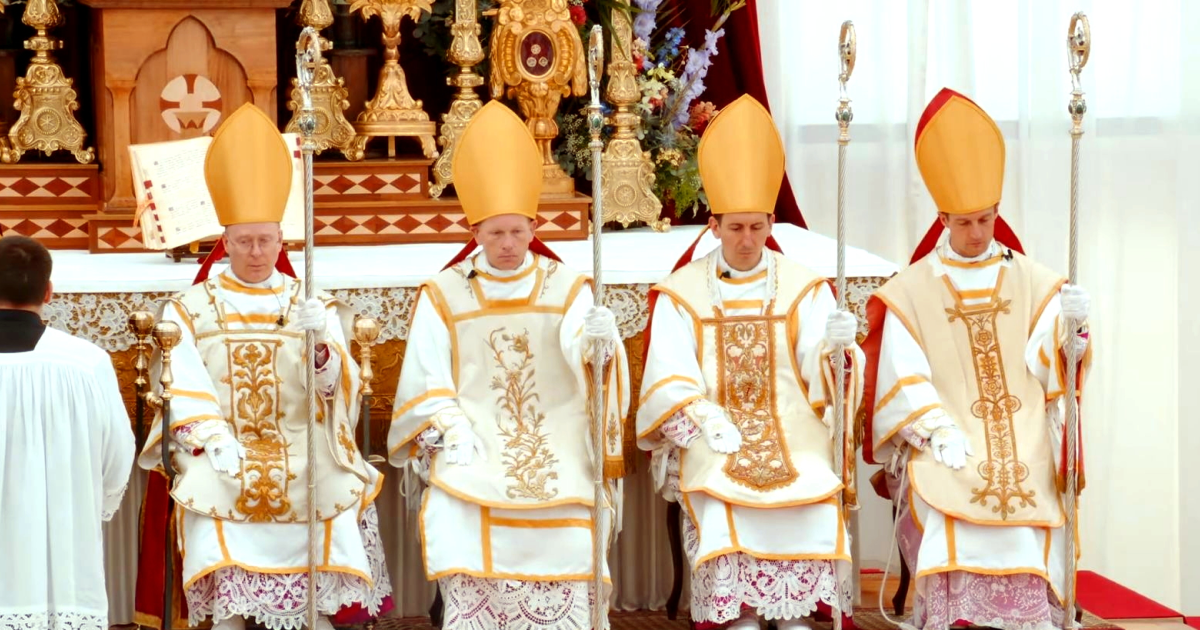
Above: the four new SSPX bishops. Photo credit: Catholic Herald.
Écône Diary: Thursday 2nd July, the Feast of the Visitation
The momentous day of Wednesday, 1st July, the Feast of the Precious Blood, concluded with Second Pontifical Vespers of the Precious Blood of Jesus and Benediction. The American Rector of Saint Thomas Aquinas Seminary in Virginia, the newly-consecrated Bishop Michael Goldade, gave a short sermon in which he shared how touched the newly-consecrated bishops were by the fidelity, prayers and sacrifices of the faithful, clergy and religious.
After invoking the life-giving abundance of the Catholic Church, he continued:
Today we see such wreckage. If the Catholic Church in Her tradition brings forth life, the modernist church is a desert, it kills, it kills everything that it touches, it kills the supernatural life, it kills the sources of grace, it dries up everything because it has placed man in the place of God and therefore turned away from the sources of life. So, this is a reminder today to be faithful, to be faithful to the sacred entrustment which Our Lord has given to His Church and continues down through the Apostolic Tradition.
I heard… leading up to the consecrations from faithful who are not part of our circles, from those outside of the Society, even those outside tradition. I head a common thought… The Church needs these consecrations and that was surprising to me. But it shows that these faithful, who do not understand the complexities of modernism, of the modernist disease, that they see something is wrong, something is dying with this new religion, and in fact it is tradition which is making a restoration, that is giving life. Yes, my dear faithful, we do need these consecrations, we do need to continue this sacred legacy of Archbishop Lefebvre given by Holy Mother the Church.
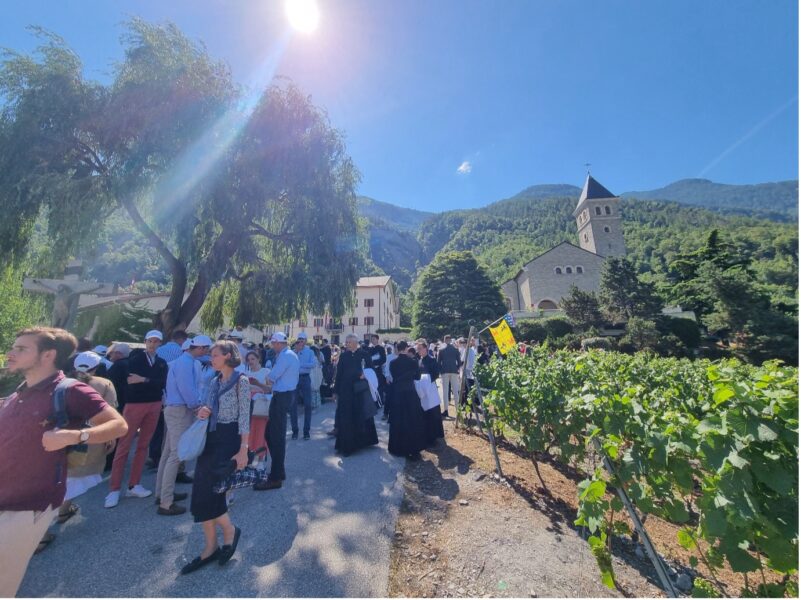
Thursday dawned bright and sunny in the Swiss Alps and, by my estimate, well over 2,000 faithful were present on the Feast of the Visitation to attend the First Pontifical Mass offered by the newly-consecrated Swiss Bishop Pascal Schreiber – the oldest of the four new SSPX bishops.
Just as Holy Mass was beginning, the news filtered through of the decree of excommunication issued by the Dicastery of the Doctrine of the Faith and signed by the Prefect, Cardinal Víctor Manuel Fernández.
In his sermon, given in German, French and English, Bishop Schreiber recapitulated the Society’s resolution to follow Archbishop Lefebvre’s line despite the Vatican’s condemnation (translation from LifeSite):
The Society will continue to work to renew the priesthood. She will likewise do everything in its power to ensure that Tradition fully recovers its rights. Even if the situation within the Catholic Church is still far from this; even if the number of those who remain faithful to traditional doctrine sometimes seems small, this must not discourage us.
Referring to the massive participation by the faithful, clergy and religious this week, he said:
The joy which we have been privileged to experience in these days is extraordinary. Rarely in her history has the Society experienced such enthusiasm and such unity. At last she once again has a sufficient number of bishops. On the one hand, this fills us all with great gratitude. On the other hand, one fact pains us greatly. A year ago we went on pilgrimage to Rome in our thousands, to pray at the tombs of the holy Apostles. And now we are called schismatics by some.
But this does not prevent us from doing everything we can, out of love for the Church and out of love for souls. Precisely in this difficult situation, we wish to hold fast to the Church of Jesus Christ and to work with all our strength for her renewal.
Bishop Schreiber then offered an indication of the ongoing position of the society – balancing both the ‘filial devotion’ that Fr Pagliarani offered in his consecration sermon yesterday with the denouncement of official modernism that Bishop Goldade made in his sermon at Pontifical Vespers:
In this time of confusion, two extreme positions must be avoided. Let us avoid, on the one hand, the bitter zeal which our patron, the holy Pope Pius X, condemned in his inaugural encyclical. We fall into this danger of bitter zeal when we combat errors only with harsh reproaches and sharply censure faults. On the other hand, there is the danger of being ready to make false concessions. Those who hold this position wish to please men more than God. They are not heirs of the martyrs.
Virtue lies in the middle, in a balanced equilibrium. It is precisely this balance between two extremes that St Paul urged upon his disciple Timothy: “Convince, entreat, rebuke” — but he adds: “with all patience.”
After the events of recent days, the question inevitably arises: What happens now? We do not know what the future will look like. It lies in the hand of God. But our task we know very well.
The principal task consists in the formation of zealous and doctrinally sound priests and in the sanctification of priests. The central point remains the orientation towards the Holy Sacrifice of the Mass, for which the priest is primarily ordained.
Invoking the words of the composer Gustav Mahler in English, he said:
What is tradition? Tradition is not the preservation of ashes, but the passing on of fire. Ashes are something dead, dark, cold, dirty, and grey. Fire, however, brings light and warmth. It is no coincidence that on the day of Pentecost the Holy Ghost descended upon the Apostles in tongues of fire, to bestow his gifts and fruits upon them.
For us in the Society, this means that we do not preserve the Catholic tradition out of nostalgia. We preserve it because we wish to pass on the Catholic faith, the sacraments, and traditional doctrine in their authentic form to the next generation.
The atmosphere at Écône remained sanguine and peaceful. Around midday, I spoke to an anglophone Society priest who had not yet heard about the Vatican decree of excommunication. His first response was that we were back to 1988, and it was a familiar experience for the Society. “We know how to get through this,” he said.
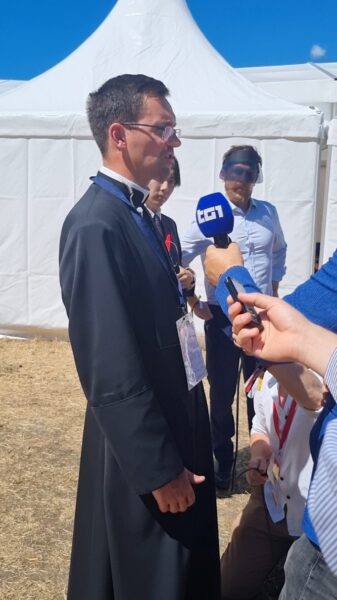
Responding to a journalist who asked him what he thought about the accusation that all the faithful who had just participated in the Pontifical Mass were no longer part of the Church, Abbé Michel Rion responded:
All the parishioners who are here are certain be in the Church and sons of the Pope and they are hurt and so sad that they may be considered that way, even from their father, the Pope and from the other people around… We simply hope and we pray because we know that it [the consecrations] was the right thing to do, that soon enough they will see the importance of it. I think history shows as well, after 1988 that it was the right thing to do like Fr Pagliarani said in his last letter to the Pope.
It is very important to just go back to the documents of the Society and, as well, I could lead you to Bishop Schneider… he is not a Society priest, he is a bishop who took the time to be in the Society, to be at our seminaries, to be at our table, to speak to us, and he says why are they [Rome] finding new ways to define what it means to be Catholic?
It is clear that Rome wants traditional faithful to take the plain reading impression of the DDF decree and the associated media headlines: every layperson who associates with the SSPX is jeopardising their membership in the Church, and therefore their eternal salvation. In fact, while being much less equivocal about clergy (all sacred ministers of the Society are now stated to be in schism, and excommunicated) the decree makes the excommunication of laity dependent on their “formal adherence” to the SSPX. It defines formal adherence by a 1996 Explanatory Note of the Pontifical Council for Legislative Texts which says that such situations must be assessed on a “case-by-case basis” by individual tribunals. The decree is therefore canonically dubious and characteristic of the dissolution of the rule of law in the Church by subjectivism, from the papacy of John XXIII onwards, that I will explore in a future article.
The provisions of the decree of excommunication are largely similar to that of 1988, therefore returning to the status quo from 1988-2009 for the SSPX, but are expressed in stronger and clearer language. This has undoubtedly caused serious reverberations and “whiplash” through the “traditionalist movement.”
My time in Écône for these historic days has come to an end. The fallout has already been intense, not least in traditional Catholic media. Tragically, as it unfolds, the news will cause significant personal costs for faithful Catholics throughout the world and even end good Catholic friendships. Let us redouble our prayers and offerings for the spiritual battle ahead – knowing it is all in God’s hands – that Tradition be restored and this nightmare of the Church’s modernist crisis comes to an end.