
A soul! a soul! a soul-cake!
Please good Missus, a soul-cake!
An apple, a pear, a plum or a cherry,
Any good thing to make us all merry,
One for Peter, two for Paul,
Three for the One (Him) who made us all.
—Traditional Souling Song
With the approach of Halloween, another “Holiday” battle begins. Unlike the annual fracas every December which pits believers in Christ’s birth and cultural traditionalists on the one side against those who believe that the celebration of Jesus’ birth should be submerged in a generic “Holiday Season,” this one sends Christians against Christians. On the one side are those who believe that anything to do with the dark or spooky – to include Halloween itself – must be linked directly to the Satanic. On the other are those who believe that there is nothing wrong with a bit of a fright – and more importantly the carving of pumpkins, the wearing of costumes, and the collection of candy in one of the few remaining communal observances left in modern North America. The cause of the latter is not helped by the ever-increasing appropriation of Halloween by Wiccans and outright Satanists, as well as the fact that it has outdone Easter as the number two holiday in retail terms. Against this onslaught, most Christian defenders of Halloween have only wholesome memories or parties and trick-or-treating to offer in defence of their position.
Of course, the entire societal scene has grown much darker – indeed, much more Satanic since this writer was a child in the 1960s. Infanticide is embraced by both political parties, and – if their behaviour during COVID is to be believed – most of the Catholic Church hierarchy believe their Sacramental ministrations to be optional extras, ultimately unnecessary for Salvation. Their attitudes are echoed by the laity in the universalism that Pope Benedict XVI decried in 2016. In such an atmosphere, one might be forgiven for thinking that almost anything or anyone, from presidents to prelates, may well be agents of the prince of darkness – as indeed we ourselves are so often whenever we sin.
But we do need to get a grip, and remember the reality underlying all else: the Church’s teachings are true, and her rites efficacious, regardless of follies in Church and State. We need to remember that a great deal of what we take as information regarding the preternatural comes from Protestant sources, who often regard Catholicism (and Orthodoxy) as little better than paganism. The meaning of symbols can change over time, and if we are not aware, we can make egregious mistakes. Many regard the pentagram as a symbol of witchcraft and evil. Not knowing their history, they do not realise that the Satanists invert it, as they do the Crucifix, to blaspheme it. In this they are not trying to offend the Wiccans and Neopagans, who use it in an upright manner, but its older Christian meaning. As readers of Sir Gawain and the Green Knight will remember, to our Catholic fathers it symbolised both the Five Wounds of Christ and the Five Joys of Our Lady (two more were added later to this number). Tourists visiting California’s Missions may be horrified by seeing the Eye in the Triangle on various of St. Junipero Serra’s chasubles. Lest they assume that the Golden State was a Masonic plot from the beginning, it were well for them to remember that the offending image was a perfectly decent symbol of the Trinity in Medieval times. Spain in the 18th century had not yet gotten the news that it was to be reserved to the use of an Order whose basic belief – Conduct over Creed – would one day completely obscure St. Junipero’s message of Salvation through Christ and His Church. Indeed, in this area, most of us are probably as Masonic as those who have undergone their strange rites of initiation.
This kind of straining after gnats subsequent to a full dinner of whole camel is very common to-day, and can give us quite the feeling of virtue. Into this situation falls poor hapless Halloween and its central – if latter-day – rite of Trick or Treat. So we must use our imaginations, and return to a time when Europe was Catholic and primarily agrarian. Even in the towns with their merchants and artisans, markets and fairs, and their cities (who added cathedrals to the other four items of urban life in that time), as in the countryside with its forests, fields, and manors, there was no secular popular entertainment; no movies, radio, television, nor computers. Life was very much governed by the dogmas and practises of the Church – and of the latter, not least the Liturgical Calendar.
From the rites of the Church re-emerged the theatre, in the form of miracle, morality, mystery, and mummers’ plays, which brought the teachings of the Church to life in full view of the faithful. These in turn filtered down to everyday life. Depending on specific locales, eves of major feasts – Candlemas, Ss. Philip and James, the Nativity of St. John the Baptist, St. Peter in Chains, All Saints, and the Circumcision in particular, though there were others – lent themselves to bonfires, ghost stories, and the like. Folklore spoke of various sorts of enchantment, of fairies, ghosts, and witches – of preternatural evil repelled by supernatural means – the Church’s Sacramentals in particular. There were often also performers – usually local youths or children – going from house to house, singing seasonal songs or performing simple plays that illustrated the nature of the season.
The triduum of All Hallows tide – the Eve of All Saints, the feast itself, and the following day’s observance of All Souls – lent itself to all sorts of these observances, given that all of us have many deceased loved ones – family and friends. As with other such vigils, folklore played a big role; in many places, the dead were believed to return for meals with their families – ideas that survive in Catholic places from Brittany to Mexico.
There was in a great number of places – and especially in the British Isles – “Guising” or “Souling.” Dressed in costumes, believed in some places (though far from everywhere) to hide one’s identity from any of the hostile unseen forces, people went from house to house, soliciting goodies in return for prayers for the living and dead of the house visited. In places where this was called “Souling,” “Soul Cakes” were the expected reward, along with some variety of the song quoted at the beginning of this article.
After the Protestant revolt, a lot of these customs were continued, although severed from their original intent due to the new official theology, which frowned on prayers for the dead (a liability which would be overwhelmed by the tide of aspirations after the bloodbath of World War I, but that is another story). A great many of these then crossed the Atlantic during the colonial settlement of the Atlantic States, and with subsequent immigration. Among them was Halloween.
Of course, it was somewhat different from what it had been. Although its Irish proponents still prayed for the dead, most of its Scots importers did not. Halloween parties were spooky, and often included light-hearted fortune-telling, generally aimed at figuring out one’s future spouse. The bonfires survived; and the tradition of playing pranks and tricks grew up. As the 19th century went on the tricks escalated into widespread vandalism. (This era is depicted in the Halloween scenes of the classic film, Meet Me in St. Louis.) “Trick or Treat,” developed as a kind of extortion – and it was no empty threat.
After World War I, cities across the United States made a determined effort to end the mayhem. From these efforts emerged the sanitised trick-or-treating with which we are familiar, as parents were encouraged to get younger children into the act and accompany them while doing so. Advertising swiftly arose to encourage the trend – not least by makers of both candy and holiday decorations.
As the 1930s wore on, and both the horror and science fiction genres arose in the movies – Dracula, Frankenstein’s Monster, the Wolfman, the Mummy, and (after World War II) the Creature from the Black Lagoon accompanied diverse aliens and robots in joining the ranks of ghosts and witches in the ranks of trick or treat costumes. After World War II, trick or treating came into its own; in many ways the 1950s were (as with so much else) its Golden Age. This continued into the late 1960s.
My own first experience with the practise came in 1964, in Mount Kisco, New York. My brother was dressed as the devil; I was at once Heckle and Jeckle, two wise-cracking cartoon blackbirds. We went out with a mob of neighbourhood kids. Suburban Westchester County was in those days a Trick-or-Treaters paradise. The houses were all decorated for the holiday; having “helped” my father to carve our own Jack O’Lantern that night, I fancied myself a connoisseur of pumpkin sculpture. I was not disappointed by the various faces the locals bestowed on their own gourds. But above all was the delicious haul of candy that fell to us. When we returned home, filled with delight, our parents only allowed us a single piece of candy each. The rest was saved for All Saints’ Day, we were told. Needless to say, the almost immediate consumption of the candy was a prominent part of our celebration after our return from Mass the following day.
Oddly enough, after we moved to Hollywood, California we were still able to trick-or-treat. Hard to believe though it may be now, Hollywood in those days still had a large proportion of middle-class families. Of course, it was still Hollywood, and the film monsters earlier referred to were represented everywhere on Hollywood Boulevard. Given that our landlord was the then famous television psychic Criswell, Halloween never quite left our premises at any time of year; but to be fair, he and his wife were very generous in the candy department.
Eventually we left Hollywood, and my last forays into trick-or-treating were in the San Fernando Valley’s suburban paradise of Lake View Terrace. Those last years – 1969, 1970, 1971, and 1972 – saw the addition to the trick or treater costume display of characters from then-popular soap opera, Dark Shadows. Alas, the time had come for my retirement from the trade.
Starting in the late 1960s, there began a determined campaign against trick or treating, with dark urban legends of razor blades in apples and hallucinogenic drugs in candies. Whether these ever actually occurred is a matter of some dispute. Of course, if either happened only once, one did not want one’s own child to be the lone example. In many places the custom suffered a decline. But at various times it has undergone a resurgence as well. Frankly, I find it typical of the killjoyism of the present that children are deprived of the innocence of childhood by the regime under which they live – and of the innocent joys proper to that time by would-be Puritans.
Nevertheless, I do think that trick-or-treating can be improved, and not just by dressing children as saints rather than monsters (I have no objection to either, to be honest). It is to return the practise to its original role of souling – albeit in an underground manner. When I was still living in California, for decades I would include a short note with each of bag of candy I gave out, asking for prayers for my dead family and friends – in just those terms. As the years went by, quite a number of returning children (and occasionally accompanying parents) would assure me that they and their parents had done just that and would again. If I had children of my own, before they (or I!) had a touch of their haul, we would pray for the dead of those whom the kids had visited.
In the struggle in which we are engaged, with the forces arrayed against us being so powerful, we should not give the enemy an inch of territory we can retain. Transforming Trick-or-Treating into souling would make a merely innocent activity an occasion of both evangelisation and catechesis, and a spiritual work of mercy – and yet retain the pleasure involved. Moreover, it would return Halloween to its proper roles as the first day of Hallowtide (as would keeping it as a day of fast and abstinence). Uniting their faith with joy is an important part of keeping children Catholic in the face of a world whose satanic universalism is waiting to gobble them up. This last is far more frightening than any Halloween costume, and for all that we accept it as normal.
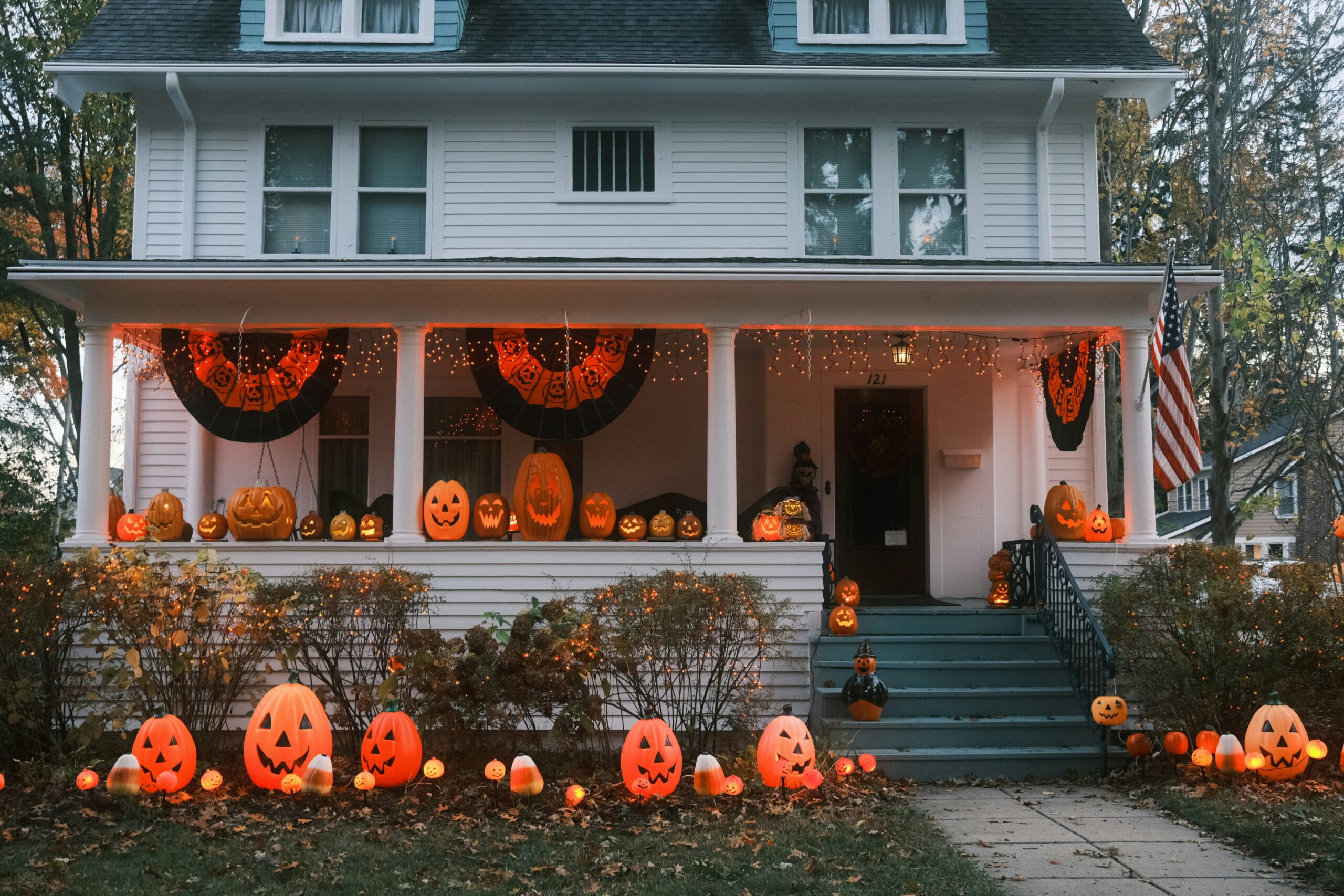
Photo by Bruno Guerrero on Unsplash