

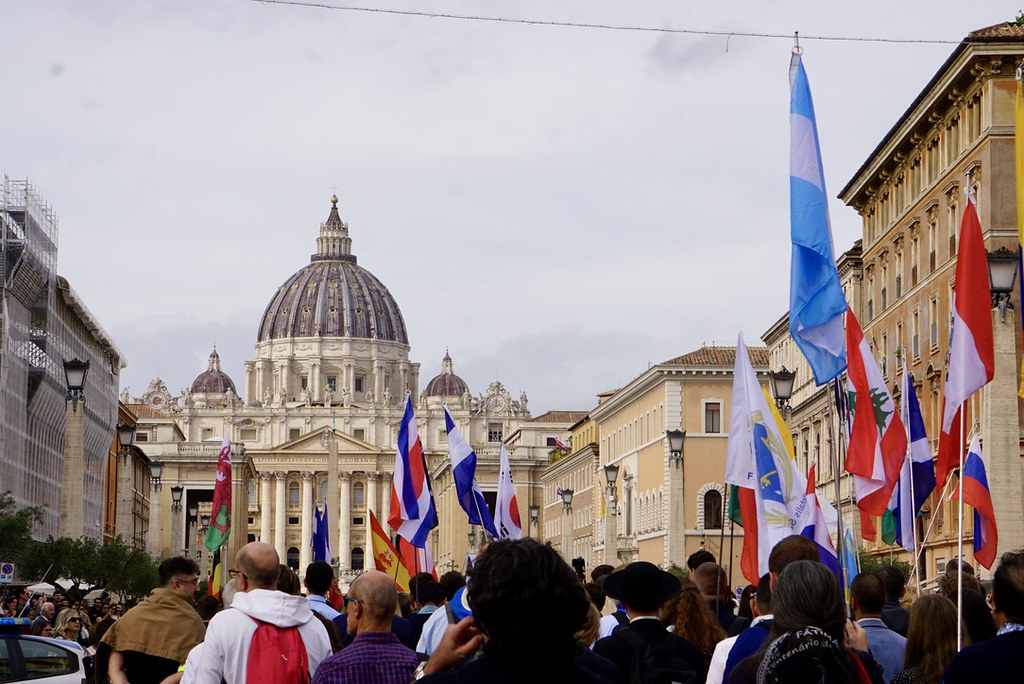
Above: the traditionalist pilgrimage in Rome. Photo by the author.
Throughout the highs and lows experienced by the traditional movement in the last fifteen years, one event has remained key in the calendar, and this year was no exception. The 2026 edition of the annual Ad Petri Sedem pilgrimage once more served as the siren call for Latin Mass devotees across the globe to descend upon Rome on this last weekend of October.
Once in the city though, it is fair to say, that the pilgrimage faced more upheaval than of late. Certainly there was a very different feel compared to the lavish scenes of last year’s pilgrimage, which saw Cardinal Raymond Burke offer a solemn pontifical Mass in St. Peter’s Basilica. Last year there were too many pilgrims to fit in front of the Altar of the Chair: this year the pilgrimage was not even allowed inside to pray at the tomb of the prince of the Apostles.
The three-day pilgrimage is customarily spread across the city. With proceedings opening on Friday, the first event is Vespers in the Pantheon. Saturday normally sees pilgrims praying the Rosary and singing litanies as they process through the streets, across the Tiber and up into the Vatican. Once inside the pilgrimage used to annually have Mass at the Altar of the Chair, although in 2023 and 2024 permission was only given for a short period of prayer.
Then on Sunday, the traditional feast of Christ the King, pilgrims choose from one of the number of traditional Masses celebrated around the Eternal City. Communities such as the Institute of Christ the King and Fraternity of Saint Peter welcome the large proportion of those present for the event, while in the afternoon former papal MC Monsignor Marco Agostini offers the last Mass of the pilgrim schedule, in a church just metres away from St. John Lateran – the Pope’s own cathedral.
Estimates vary for the attendance, but some of the organisers suggest that upwards of 1,500 were present for this year’s edition, albeit a smaller crowd than last year. The pilgrimage is always a wonderful opportunity for devotees of the traditional Mass to witness the ancient rite in all its beauty against the backdrop of Rome. Set amidst the many tombs of saints and popes, the old rite feels very much at home in the glorious basilicas which were built to house such a liturgy.
Except that this year, the pilgrimage was unavoidably overshadowed by the fact that it was denied a home for the key event of the weekend. Friday’s Vespers proceeded as planned, as did all three different Masses on Sunday. Instead, it was the doors of the Vatican which remained firmly shut both to the Mass and even to the procession.
Controversy over this decision has played out over the weekend on social media networks, but it dates back many months. Astana’s Bishop Athanasius Schneider presented Pope Leo XIV with a direct request for the Mass from the organisers, during his December 2025 private audience. Yet organisers of the pilgrimage had to wait until August to receive a response.
Their request was rejected, not by the Pope or the Cardinal Archpriest of the Basilica, but by the Secretariat of State. This fact itself is notable: the Secretariat’s decision to get involved is unnecessary, since it is not under the purview of the Secretariat to approve such a liturgy.
Some months prior in April, organisers had already received permission to enter the basilica in procession. But upon receiving news of the ban on holding a Mass, they wrote to the Secretariat in September to confirm the procession could still take place. Once more, a negative response was delivered by the Secretariat, sent via post to the Nuncio in France and thence to the pilgrimage chaplain, Abbé Claude Barthe. (OnePeterFive readers will also find on this site a statement from Una Voce regarding the confusion over the various pilgrimage events)
Contrary to widespread theories online, the Vatican did not offer alternative dates or times. Nor was there any reason given for denying permission for both the Mass and procession. Instead, the organisers were left with the simple reality that the doors of St. Peter’s were closed for the traditional pilgrimage.
Many attendees spoke of their sorrow at this decision and not a few contrasted the Vatican’s rejection with the warm welcome afforded to the LGBT Jubilee pilgrimage of September 2025. All are welcome except traditionalists, was the thought expressed by many Ad Petri Sedem pilgrims.
The closed doors of the Vatican were felt even more keenly after the opulence of last year’s pilgrimage, which saw well over 3,000 people attend the high-profile Mass offered by Cardinal Burke. His Mass was the first Mass the annual pilgrimage had been authorised to celebrate in the Vatican since 2022, and was viewed as reversal of fortune for the future of the traditional Mass under Leo XIV.
Fast forward twelve months and that same prediction appears less certain. With restrictions still in place and actively being implemented, especially in American dioceses, the much-awaited liturgical peace still appears somewhat out of sight. The Secretariat of State prohibiting the Latin Mass pilgrimage from entering the Vatican did nothing to qualm the fears already felt by many.
Nevertheless, the Ad Petri Sedem has always been about expressing Catholics’ love of the traditional Mass and of the papacy – this year was no different. A non-liturgical walk was held, bringing pilgrims to the obelisk in front of the Vatican – at which point the Vatican police stopped them – where they sang the Creed and prayed for the Pope.
Then the pilgrimage moved to the papal basilica of St. Mary Major, where Bp. Schneider offered a prelatial low Mass. Not a seat was to be found in the entire building as the bishop encouraged pilgrims to remain faithful in their love of the ancient liturgy and the Church. He did not shy away from addressing the issue at hand, decrying liturgical restrictions as rendering Latin Mass attendees like “second-class Catholics.” Yet neither did he urge revolution: instead he called on those present to work and pray for “liturgical peace.”
“May those who hold responsibility within the Church foster the advent of such liturgical peace by allowing themselves to be touched by the voice of the Regina Pacis and by the voices of the Church’s youngest children – those marginalized in the liturgical sphere,” he said.
Schneider is a much loved figure in traditional circles, and during the weekend he spoke about the paternal duty he felt to provide for the pilgrims who simply desire to be nourished by the ancient liturgy and also to pray for the Pope in the Eternal City itself.
His appeal for liturgical peace is central to the pilgrimage itself. Faced with the ongoing reality of the liturgical persecution enacted by Traditionis Custodes, events such as the Ad Petri Sedem highlight the pressing crisis which Rome is enforcing via its maltreatment of the ancient liturgy.
Pilgrims were left with a bitter taste in their mouth at their treatment by the Vatican this year. Yet as Bishop Schneider said in St Mary Major’s, Catholics must turn to the Mother of the Church with ever more zeal to ask for her intercession in the current state of affairs.