
Opinions on the SSPX and the upcoming consecrations are a dime a dozen and often emotionally charged with little or no element of charity. A common opinion especially among traditional Catholics is that this is a crossroads for the Church. As Dr. Kwasniewski notes, It can either go exceptionally well or be catastrophic for the Church. This topic does not unite, but divides Catholics. Where there is division there is the enemy, and a very cunning one at that. Of course we as Catholics in good faith want to be united for Christ and together as one Holy Church and with the grace of God inheritors of His eternal Kingdom. Here the motto of OnePeterFive is “unite the clans.” So given this will for unity, where is this source of division? What is this point where we cannot find a means to reconcile. If we find this point, we find the perpetrator and then maybe we can move together as Catholics united in the mystical body of Christ.
A significant portion of my growth and development in the faith was spent in FSSPX chapels, retreats, pilgrimages and events. I even became directly involved by starting the first youth ministry for the SSPX in Poland in the Warsaw chapel. There are many graces that came from exposure to fervent, unapologetically traditional Catholic teaching. It felt like an oasis in the desert of Modernism and its heresies where the spirit of the world seems to have hopelessly taken hold of the Catholic Church as if only the direct intervention of God could save it. But then a few years back I stopped going to the SSPX, completely.
The reason why is directly tied to the current anticipated situation on the horizon and the crossroads that not only the SSPX but above all, the Catholic Church faces. Without further ado, lets dive into it.
The Achilles Heel of the SSPX
This topic is not frequently touched upon in discussions, and if it is, then in a passing manner. Because of how little it is talked about, many Catholics, even those generally supportive and sympathetic to the FSSPX and their mission are not aware of it. The single weak point of the FSSPX is their official position to never attend a Novus Ordo mass even if it is the only option reasonably available to fulfil ones Sunday obligation. As any Catholic knows (or should know), attending a Catholic Mass on Sunday is required under the pain of mortal sin.
Canon 1248 §1: The Sunday obligation is fulfilled by assisting at Mass: In a Catholic rite anywhere it is celebrated validly in a Catholic communion.
The Church recognizes legitimate reasons for not attending Mass on Sunday, such as serious illness or circumstances that make attendance morally or physically impossible, including truly unreasonable distances. These are long-standing principles. The issue at hand is different. The practical effect of the Society’s position is that, when the only Mass reasonably available is the Novus Ordo, the faithful are advised not to attend in order to fulfill their Sunday obligation. For clarity and fairness, lets permit the Society to explain in their own words this position from their official English YouTube channel: https://youtube.com/watch?v=5hZrRGMs6CY
This concern was brought up in a previous article on OnePeterFive that seems to draw the line at permitting attending a “Reverent” Novus Ordo. I will not go into the discussion as to how bad a Novus Ordo needs to be until one can omit going to mass completely on Sunday, or if there can be no exception at all. I will refrain from sharing my opinion as it is not relevant for the purposes of this article. There have been discussions on this topic for those interested.[1]
These positions on exceptions to the positive precept of attending Mass to fulfil one’s Sunday obligation are rooted in the reality of many Novus Ordo masses and the pain that it causes faithful Catholics. The fact that there are discussions and opinions on this reflects the issue the Church is facing post-Vatican II.
The SSPX in the above video states that “Because of a danger to the faith, Catholics are not obliged to attend the new mass.”
This article presents a novena of arguments on the metaphysics of the new mass vs the traditional Latin rite. All of the arguments fully support and strengthen the thesis and pastoral direction to avoid the new mass in favour of the objectively superior traditional Latin rite. However, these arguments crumble the moment they attempt to cross the line of advising the faithful to not go to the Novus Ordo if that is the only option available to fulfil ones Sunday obligation.
The facts remain: this is a valid rite of Mass, promulgated by competent authority, which confers Sacramental Grace, and includes Eucharistic miracles. Telling the faithful to totally avoid the Sacramental Grace contained in this rite – despite any and all deficiencies – is not acting for the salvation of souls. Let’s pray that correct diagnosis of the current challenges in the church do not lead to fatal conclusions such as boycotting the one Church instituted by Jesus Christ with St. Peter as the visible head with the explicit guarantee that the gates of hell will not prevail. Note that the directive and guarantee were both given in the same sentence.
Prudence suggests that one should follow the objective precepts of God rather than the subjective opinion of man and this is felt deep in the conscience of any Catholic with the Faith. How can the FSSPX claim to uphold the true Faith, and advise the faithful to consciously refuse the Sacraments (even if only in fringe cases)? Few faithful that attend SSPX masses or traditional Catholics would disagree with the statement that the New Mass is problematic. However many do have a problem with not attending it at all if it is the only option available. It is on Sunday, the holy day of obligation that their faith draws them to be close to the Presence their creator and His sacrifice for their souls even if the context is not of their preference especially when it is outside of their control.
There is another side to this position that is rarely discussed: the lack of charity toward priests who are faithfully living out their vocation within the Church’s canonical structure. Many of them celebrate the Novus Ordo not because they prefer it, but because they are obedient to the hierarchy Christ established. Are we really to suggest that every priest who wishes to remain truly Catholic must leave his diocese and join the Society?
As admirable as many priests within the SSPX are (and they have shown courage and conviction, especially in difficult times) there are also many solid, orthodox priests serving within the ordinary structures of the Church. The Society is small; naturally its internal cohesion appears stronger. But that does not mean fidelity is absent elsewhere.
If a faithful Catholic finds himself in a place where there is no SSPX chapel and no traditional Latin Mass, is he truly to boycott the Mass offered by a priest who loves the faith, the TLM that he may not be able to celebrate, believes in the Real Presence, and sincerely desires to save souls? Many such priests would gladly welcome those SSPX faithful, even if only to pray together for the restoration of Tradition in their parish. To dismiss them outright risks not only division, but injustice.
Officially the FSSPX supports the faithful attending the diocesan TLM or that of other former “Ecclesia Dei” communities. In practice and from sermons and discussions the faithful are advised against it because although the Mass is proper, there remains a risk to the faith as these priests have supposedly been forced to compromise with the post-conciliar church and may not preach true faith from the pulpit.
I am no canon lawyer, but the 1983 Code of Canon Law defines schism as
the refusal of submission to the Supreme Pontiff or of communion with the members of the Church subject to him (Can. 751).
The definition does not concern the Pope alone, but communion with those who are in union with him.
When faithful Catholics are advised not to attend Mass celebrated by priests in good standing, even when no other option exists to fulfill the Sunday obligation, one must ask whether this risks placing the Society in precisely that posture. At the very least, it fosters division and weakens charity among Catholics who profess the same faith and worship the same Lord.
Now to be fair, we hasten to add that some of the Catholics who do not attend the SSPX seem to hold an uncharitable attitude toward the SSPX that is unjustified and against communion. Therefore there is a another side to “schism” that is much broader and it also concerns the obligations of “Novus Ordo Catholics” to hold the bond of charity with the SSPX priests and faithful, since they do share Sacramental Communion.
Moreover, everyone should respect that the FSSPX’s fervent objections to heresy and unapologetic preaching of traditional Catholic teaching have, without a doubt, brought many into the Catholic Church. However, the position of the FSSPX regarding Novus Ordo attendance is the single obstacle to their full unity and may be what forever prevents it.
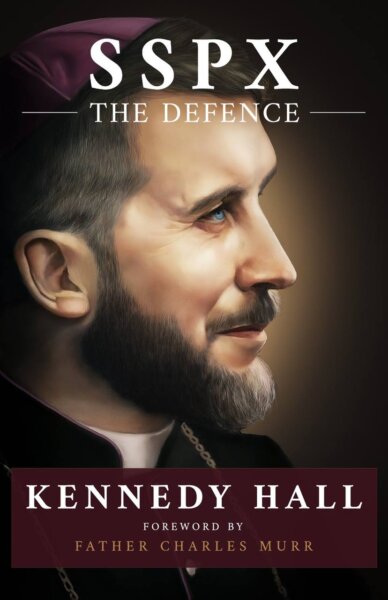
In my efforts to seek an explanation to this position I’ve read SSPX: The Defence by Kennedy Hall. This is an excellent book that does a fantastic job exhaustively debunking lowball attacks from both the sophisticated and unsophisticated against the FSSPX. I highly recommend it especially that the consecrations have been announced.
However this single point was not addressed (probably because it really is indefensible) which leads me to address it in this article. The burden of evidence lays on the SSPX to explain how staying home to read the Missal in fulfilment of the Sunday obligation would not be a greater threat to the faith then attending any Novus Ordo with the true sacrifice and presence of Jesus Christ along with associated sacramental grace.
The good news is that many of the faithful, and even some priests, are clearly uncomfortable with this position. It goes against what they instinctively know as Catholics: that Sunday Mass matters and that we are bound to it. Even among most of those deeply committed to the Society, this point does not sit well. Support for this stance seems far weaker than one might expect.
I write this with full awareness of the root and cause of the existence of the Novus Ordo. That it was created by Annibale Bugnini of whom evidence strongly suggests was a Freemason (which would mean that he would have been de facto excommunicated latae sententiae under the then applicable 1917 code of canon law[2]) and was removed from his position allegedly amid suspicion by Pope Paul VI. It was also clear that one intent of the reform was to change the Roman Rite to a level that would be acceptable to heretics (Protestants), of course under the explicit intent of fostering unity. That historical context explains why many traditional Catholics approach the Novus Ordo with caution. However, the rite itself was promulgated by papal authority and remains a valid expression of the Roman Rite despite its deficiencies.
In some sermons, one hears the claim that the Society is Tradition, and that without the SSPX, Tradition would disappear. Statements of this kind, whether explicit or implied, suggest an identification between one priestly fraternity and the living patrimony of the Church. While such rhetoric may stir loyalty, it cannot withstand serious theological scrutiny.
Tradition does not belong to any single community. It is the living transmission of the faith entrusted to the whole Church. The Society has undeniably played an important role in preserving elements of Catholic tradition during decades of confusion. That contribution deserves acknowledgment. But to equate the survival of Tradition with the survival of the SSPX is to confuse instrument with substance.
Even if such statements arise from isolated sermons, they reflect a mindset that has developed within the community. The Church existed before the Society, and Tradition will not vanish if one particular structure changes or even disappears. The gates of hell were not promised immunity from error to a fraternity, but to the Church founded upon Peter. Decades of unresolved tension have allowed the Society to develop in relative isolation from the broader ecclesial structure. This has fostered a certain internal coherence, but also has resulted in intellectual and pastoral insularity. This is dangerous and makes a positive outcome to the current state more difficult. And again, we need to fair here to both sides: responsibility for this situation does not lie on one side alone.
The Big Picture
Taking a few steps back and observing the SSPX in the context of the Catholic Church as a whole one can come to certain conclusions.
The traditional Catholic teaching that the SSPX preaches resonates strongly with Catholics who seek Christ and His teaching but cannot find it in their local parish. These faithful start to attend the SSPX more and more regularly. In time many these people start to subscribe to the more extreme positions of the SSPX and effectively start to boycott the Church that they so dearly wanted to come closer to. In other words:
The Modus Operandi of the SSPX, intentional or unintentional is the boycotting of the Catholic Church by some of the most devout Catholics.
The impact of such a position:
The position of the SSPX is not a merely theoretical dispute but one with practical effects in the lives of some of the faithful. These attitudes vary and cannot be ascribed to all who attend its chapels, yet patterns are observed: Among these are the refusal to visit family on major holy days such as Christmas or Easter when no Traditional Latin Mass is available, the reluctance to serve as godparent for a child baptized in the reformed rite, discouragement from post-conciliar devotions such as the Divine Mercy Chaplet or the Luminous Mysteries of the Rosary, and a general avoidance of Masses outside the Society, even when celebrated according to the traditional Roman rite.
Once, traveling abroad with a friend from the SSPX, we arrived to find the SSPX chapel unexpectedly closed. I insisted we go to the cathedral to fulfil our Sunday obligation. I stayed to the end; he left before the Offertory as he could not stand the Novus Ordo liturgy (it was a “regular” Novus Ordo, not the praise and worship style) and consequently did not fulfil the Sunday obligation.
In an unrelated event, in confession at an SSPX chapel, I was told I should have known better than to go to a “non-Catholic” Mass. This was when I went to visit family during the weekend outside the city. This was the last straw for me and was the last time I went to the SSPX for confession. It seems to me that this position that treats the Church’s own rite in this way places one, at least materially, in schism.
There is a very fine line between avoiding post-conciliar theology and avoiding the whole post-conciliar church.
Given this established modus operandi, the claim that the Society’s stance is justified by a canonical “state of necessity” is difficult to defend. Such a provision could only exist for the good and unity of the Church. Many Catholics, not only traditionalists, acknowledge a grave crisis, or at least a great challenge in the Church and can understand how one might invoke necessity to justify extraordinary measures. Yet when, in practice, the effect of the SSPX’s work is that some of the most devout Catholics distance themselves from their own parishes and pastors, the very premise of necessity is undermined.
The official slogan the SSPX is that the salvation of souls is the highest law of the Church, but under this modus operandi the faithful end up boycotting the Church to which this highest law applies.
They may face the question from the Vatican: how is it that you seek unity and permission for consecration from the church where you advise your own faithful against attending valid Sacraments as prescribed by the same code of canon law you cite?
Perhaps the Only Correct Way Forward
It is most fortunate that a solution to this problem is simple, easy, and just. The SSPX need only to change their official position on Mass attendance to fulfil the Sunday obligation to something along the lines of the following:
1. Recommend faithful to first attend an SSPX chapel (perfectly reasonable if the Society believes in the capacity of their own priests to spiritually guide the souls of faithful)
If no SSPX chapel is reasonably available then:
2. Recommend faithful to attend a non-SSPX TLM
So far the above is perfectly consistent with the official FSSPX position. And in the event that no TLM is available:
3. Recommend faithful to attend the only available Catholic Rite, and if it is the Novus Ordo to offer up prayers for the increased access to the TLM for the parishioners. If the grace of suffering is felt due to the liturgical style, it is to be combined with prayers and offered up to God for the said intention.
Such a clarification would require only a modest adjustment in expression, yet it would profoundly alter the Society’s modus operandi and premise of its existence. Instead of deepening divisions within the Mystical Body, it would direct its considerable zeal toward healing and strengthening it, helping to prepare the Church as the spotless Bride for her Bridegroom. The faithful, rather than being warned away from the Novus Ordo as though it were foreign to the Church, should be equipped with the spiritual tools to preserve their faith when circumstances oblige them to attend it in order to fulfill their Sunday duty. In such cases they should be urged to pray for the restoration of Tradition in the parish and to unite any suffering endured to Christ for the renewal of His Church. In this way the obligation is objectively met, and charity is preserved.
This would not constitute a compromise, but the only coherent Catholic path forward. It would foster unity with diocesan clergy who love the faith and would gladly celebrate the traditional liturgy if permitted, and who would welcome the Society’s support in rebuilding what has been weakened. Correcting this single point would remove the principal moral obstacle to full canonical regularization. The Society would then clearly be acting not alongside the Church, but within her. As matters stand, the practical effect of the current stance is to encourage some of the most serious Catholics to distance themselves from their own parishes and pastors. The same fervor, rightly directed, could instead fortify both their faith and the Church herself. We are not called to withdraw from the present trials of the Church, but to bear them with Christ, praying and laboring for her renewal rather than retreating from her visible life.
The Great Hope
Notwithstanding the SSPX’s unfortunate explicit refusal of dialogue and decision to continue with the consecrations against the will of the Vatican, there remains a real and attainable hope of reconciliation. The Holy Father could step in personally and offer immediate and direct dialogue to establish the minimum requirements for their full canonical regularisation under the reasonable condition that the society cancel the consecrations. Much public discussion has already happened amongst even the most conservative bishops and cardinals who have provided diverse or sometimes seemingly contrary opinions (Bishop Schneider vs Cardinal Sarah for example). The Society and Rome could acknowledge, with humility, that both exist to serve the one Holy Catholic and Apostolic Church, founded by Christ upon Peter. The Society has repeatedly expressed the desire for canonical regularization; Rome has repeatedly expressed the desire for unity. The path forward requires clarity, trust, and a willingness on both sides to correct what has wounded the Mystical Body.
A decisive step would be the Society’s formal clarification that when neither an SSPX chapel nor a traditional Latin Mass is reasonably available, the faithful may attend the Novus Ordo to fulfill their Sunday obligation, while praying for the restoration of Tradition in their parish. Such a statement would not dilute doctrine. It would affirm that the Church’s rite, though often impoverished in execution, remains Catholic. In turn, Rome could grant the requested episcopal consecrations within an official canonical structure and even permit them to take place in St Peter’s Basilica as a visible sign of full communion with the Roman Pontiff.
The Holy See could permit the consecration of the five bishops requested by the Society. Alternatively, it could propose respected prelates trusted by many traditional Catholics, such as Cardinal Gerhard Müller, Cardinal Raymond Burke, Bishop Joseph Strickland, Cardinal Robert Sarah, or Bishop Athanasius Schneider, while also consecrating one or some of the Society’s own candidates within the Vatican itself. Such an arrangement would both integrate the Society more fully into the life of the Church and serve as a test of its stated desire for regularization.
Canonical recognition requires trust. Once regularised, Rome would possess the authority to appoint bishops not of the Society’s choosing or to modify its structure. This possibility must be accepted in confidence that divine Providence governs the Church. The lack of such trust lay at the heart of the 1988 consecrations. If that trust cannot now be given, then the claim to seek full communion loses credibility.
Amen, amen I say to you, unless the grain of wheat falling into the ground die, Itself remaineth alone. But if it die, it bringeth forth much fruit. -John 12:24-25
The Society has much to contribute. It has been firm in resisting relativism, in rejecting the notion that all religions lead equally to God, and in upholding traditional doctrine and moral teaching. Regularised, it could assist the Church in a serious theological reflection on the interpretation of the Second Vatican Council and its pastoral consequences. It could become a defender of the papacy where clergy openly defy papal authority, and a pillar of support for Catholics seeking orthodoxy and stability, building on the rock so as not to be swept away. In other words, the SSPX could become the right hand of the Pope fighting for the Church against heresy just as the Jesuits used to be in long times past.
Reconciliation will demand humility from both sides. Each has contributed, in different ways, to the present wounds. Yet history shows that divisions can be healed when shepherds act with courage and charity. Those entrusted with the care of souls bear grave responsibility. There is no reason why they should not, through truth and trust, restore visible unity for the salvation of many.
A Potential Tragedy
There are two potential negative outcomes. One is greatly unfortunate but just, and the other is nothing short of a tragedy and a victory for hell. The unfortunate but just outcome could look like something along the lines of the following. (This is just a hypothetical illustration of an alternative scenario to the previously stated hopeful, best case one and does not reflect any attempt to predict outcomes.)
The faithful of the Catholic Church are entitled to know what are the intentions of the SSPX are. Are the intentions really true unity in the Church to ensure the salvation of souls of the faithful? Or is it the freedom to operate in a canonical grey area to divert the most conservative Catholics away from the Church and into their pastoral care? Based on the SSPX resistance movement, it would seem that some who are associated with the SSPX desire the latter, but others truly desire the former.
In pursuit of clarifying those intentions, the Vatican would have successfully tested the Society as to reveal all to the faithful so that no doubt remains as too its standing and impossibility of full communion with the Catholic Church. This would include the testing of unity across at least two points:
- Its willingness to advise faithful to attend the Novus Ordo if even under the last case scenario of no other option available in the fulfilment of the objective, divine and traditional precept of the Sunday obligation.
- Its willingness to accept some of the most orthodox bishops of the Catholic Church within its ranks and full canonical regularity and full submission to the Holy Pontiff. (Refusal to accept liberal bishops would be justified under the eyes of faithful Catholics)
A latae sententiae excommunication would, as in 1988, automatically apply to episcopal consecrations carried out without papal mandate. This is well known to the SSPX. Since 1988, much of the Society’s defense has rested on the claim that no binding penalty was incurred because a state of necessity prevented the automatic excommunication from taking effect. That argument relies precisely on the ambiguity inherent in automatic penalties, where imputability and necessity are contested. When Pope Benedict XVI later lifted the declared excommunications, the Society maintained that no penalty had ever bound in the first place.
The position appears unchanged. In response to the possibility of new canonical penalties following the recently announced consecrations, Fr. Davide Pagliarani stated in an interview published on the Society’s own website: “First of all, let us recall that in such circumstances any canonical penalties would have no real effect.” This suggests a continued reliance on the same necessity-based reasoning.
Before the consecrations were announced on February 2nd, orders have been given to the clergy to prepare the faithful for the consecrations. In other words, for exactly this kind of scenario. The faithful have been provided elaborate arguments on the SSPX position that the expected penalties will not bind, frequently citing provisions such as Canon 1323:
Can. 1323— No one is liable to a penalty who, when violating a law or precept:
4° acted under the compulsion of grave fear, even if only relative, or by reason of necessity or grave inconvenience, unless, however, the act is intrinsically evil or tends to be harmful to souls;
7° thought, through no personal fault, that some one of the circumstances existed which are mentioned in nn. 4 or 5.
This argument functions primarily in relation to automatic penalties (latae sententiae excommunication), where imputability is debated.
Consequently, for the sake of clarity and for the good of souls, should the Supreme Pontiff judge the act gravely unlawful, he could initiate a proper canonical ferendae sententiae process. Such a formal judgment would remove ambiguity and establish objective certainty regarding the Society’s status and the applied penalties.
It is conceivable that Pope Leo XIV might extend an olive branch to clergy of the Society who sincerely seek full unity with the Church. Many of them could find themselves in a difficult position, unsure whether diocesan bishops would receive them or fearing that they would be required to abandon the traditional liturgy altogether. In such circumstances, some might remain within a separated structure not out of conviction, but out of uncertainty and lack of options.
The Holy Father could establish, by decree or motu proprio, that any such priest be granted perpetual faculties for the celebration of the traditional liturgy, attached to his person for the duration of his priestly ministry and not revocable except by the Apostolic See itself. Bishops could be required to make suitable pastoral provision, even to the extent of designating a parish or personal apostolate where necessary. Such a measure would safeguard Tradition, remove fear, and provide continuity for the faithful who might follow these priests into regularized ministry.
If this reconciliation does not come to pass, it would be tragic for the SSPX in light of what they could have been but now cannot be. For the positive impact that they could have had on the Church but the door would now be sealed shut. For the Catholic Church this would be both a substantial loss of what could have been, but also a victory of justice.
However, this would not be the worst possible outcome.
The gravest scenario would not be a clear separation over defined principles, but a rupture arising from secondary disputes while the central core issues remain unresolved and the true intentions and position of the Society not revealed and tested by presenting them with appropriate options. If Rome were to require assent to propositions widely perceived as contradicting prior teaching, such as the claim that God positively wills a plurality of religions or that the divorced and civilly remarried may receive Holy Communion without amendment of life, the Society would immediately claim vindication. In such a case, any penalties imposed would be interpreted by many as persecution rather than correction.
The result would not be clarity but ambiguity. The Society could find itself canonically separated yet morally justified in the eyes of a substantial number of the faithful. Its modus operandi would continue, and division within the Church would deepen rather than resolve. The true loss would be borne by the Church herself, deprived of the constructive role the Society might have played in addressing real theological and pastoral crises from within her visible structure.
Such a prolonged grey state would generate confusion rather than purification. Some faithful, persuaded that the Society had been unjustly treated, would continue to adhere to it despite formal penalties. The wound to ecclesial unity would therefore remain open.
The tragedy would be immense. Souls who trusted the Society’s pastoral authority could find themselves objectively outside full communion by formal judgment. The Church would suffer another wound, and hell would rejoice at the division among those who profess the same Creed.
For this reason, the manner in which any resolution is pursued matters greatly. A prudent and transparent test of the Society’s stated desire for full regularization would be the above concrete points. Acceptance of these conditions would demonstrate trust in the Church’s visible authority and a genuine commitment to communion. Refusal would inevitably raise serious questions. The issue is not institutional advantage but the unity of the Church and the salvation of souls. May humility, faith, hope, and charity prevail before positions harden into irreversible division.
FSSPX Faithful on the Announced Consecrations
When I attended a local gathering to meet former acquaintances after the announcement, the subject of the consecrations dominated nearly every conversation. The tone was not one of surprise, but of a mix of both readiness and uncertainty.
Some were already planning to travel to Écône, Switzerland, where the consecrations are supposedly expected to take place, irrespective of the outcome of any ongoing discussions with Rome. A common refrain was, “We have been through this before.” Yet when the possibility of a formally imposed ferendae sententiae excommunication was raised, and the implications of such a judgment calmly explained, the conversation often fell silent. The theoretical confidence wavered when confronted with the concrete possibility of objective separation.
There are, to be sure, a few who would scarcely flinch at such an outcome, even viewing it positively, as freeing the Society to act without restraint. But they are not representative of the whole. The majority of faithful under the Society’s pastoral care sincerely desire to remain Catholic and in unity with the Church. The recent announcement has already caused some to distance themselves, though longtime adherents often dismiss this as evidence of an insufficient grasp of the “crisis.”
Many simply do not know what they would do if formal penalties were imposed. They are torn between loyalty to priests they grew to trust who preach traditional doctrine with clarity and the instinctive desire for visible unity with the Church. Among some, the perception has developed that only the Society truly preserves Tradition, with even formerly regularized traditional communities regarded as a compromise.
The question of attending the Novus Ordo when no other Mass is available has now come to the forefront. What was once quietly ignored or set aside has become unavoidable. In speaking with many, most actually do not subscribe to the SSPX hardline and if presented with no other choice, will fulfil their Sunday obligation at a Novus Ordo parish. In others, I found not defiance but discomfort with the position. The virtue of faith inclines them to fulfil the Sunday obligation and remain within the sacramental life of the Church, even when liturgical conditions are difficult. Consciences are divided, and many look to their trusted SSPX priests for resolution, the same ones that caused the division to begin with.
It would be unjust to categorize all within the Society as schismatic in intention. Most appear to be trying sincerely to live the Catholic faith as they understand it. There are hardliners who openly reject any participation in the Novus Ordo and would welcome excommunication as vindication. But they seem to be a minority. The greater number appear caught between fidelity to Tradition and fidelity to visible unity, unsure how the two are to be reconciled.
Conclusion/Closing Thoughts
The frequently cited comparison between the Society’s consecrations and the clandestine episcopal ordinations associated with Cardinal Karol Wojtyła and Cardinal Josyf Slipyj does not withstand scrutiny. Those consecrations were undertaken to preserve and strengthen the life of the Church under persecution, sustaining the faithful within visible communion. The present case is different in character. The question is not merely the preservation of apostolic succession within the Society, but the effect of the SSPX pastoral direction that, in practice, distances the faithful from the ordinary life of the Church, its sacraments, and creates division in their conscience.
This is the golden hour in Church history for reconciliation with the SSPX. It is in the interest of the Church to prevent schism. In the best outcome, the Society becomes an integral and fruitful part of the Church’s visible structure, contributing its strengths from within. In the worst, adherents of the SSPX will face a stark and painful choice: choosing to be faithful to the SSPX founded by Lefebvre who claim to maintain the One Church, or be faithful to the visible, regularised Bishops who claim to maintain the One Church. From recent conversations, it is clear that some SSPX adherents have already resolved this interior conflict, while many remain uncertain and deeply torn.
There is a gap between the likely outcome and the hopeful one. A gap that can only be bridged with prayer. Specifically prayer for the intervention of Jesus Christ, Our Lord through His and our mother the Blessed Virgin Mary, Mediatrix of All Graces, the Destroyer of All Heresies. We must never forget that at the end of the day, the Catholic Church does not belong to us, it belongs to Our Lord Jesus Christ. The stakes are not institutional victory, nor vindication of past decisions, but the salvation of souls and the visible unity of the Church founded upon Peter. May all involved remember before Whom they must one day give account.
[1] Here is a link to a discussion between two respected traditional Catholics that discuss exceptions to the Sunday obligation. Its not clear whether the argument pertains to any Novus Ordo mass (the FSSPX position) or a Novus Ordo Mass where liturgical abuses and spiritual harm can be expected (The Peter Kwasniewski / Bishop Schneider position) This is just a perspective and providing this link is not an endorsement of these viewpoints but simply pointing towards some discourse on this topic among trad Catholics.
[2] Canon 2335 (1917 Code)