


Taking into account that I wrote this review under the impression left by the events that took place in Milan in October, which I followed in astonishment from the vicinity of Lake Maggiore, the value of Chantal Delsol’s work, La Tragédie migratoire et la Chute des empires: Saint Augustin et nous (The Tragedy of Migration and the Fall of Empires: Saint Augustine and Us – 2026), has increased even further in my eyes. To put it briefly, in the words of Prince Dimitrie Cantemir, this is a story of the “rise and fall” of the Western Liberal-Technocratic Empire.
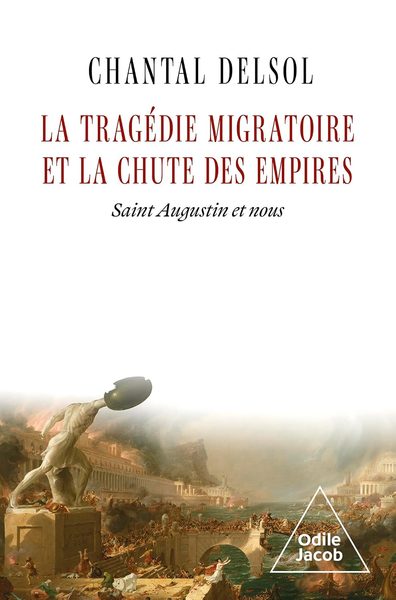
Although the work draws on the erudition of a serious scholar of Greco-Roman history, it is not, however, an academic treatise. It is not another volume of history destined to gather dust on library shelves. Despite appearances, Delsol’s book is much more: it is the cry of despair of an intellectual belonging to the distinguished tradition of Hannah Arendt, confronted with events such as those that happened in Milan. It is also a sweeping critique of a political class that believes it can solve the demographic collapse facing twenty-first-century Europe through the mass importation of immigrants. The tone of the book is as grave as it could possibly be. And it is anything but politically correct. Although the author seeks to avoid pessimistic diagnoses, the overwhelming concern experienced by the inhabitants not only of Western metropolises such as London, New York, Paris, Berlin, Milan and Rome, but also of Timișoara, Bucharest and other, less “central” cities, resonates throughout its pages.
Drawing on carefully selected quotations from classical Greek and especially Roman authors, Delsol offers a mirror-image analysis of two worlds confronted with the same predicament: the collapse of their own civilization, marked by the invasion of multitudes arriving from every corner of the earth. The first is the Roman world of Saint Augustine, which falls ill and dies in 430, the year in which the Vandals invade Roman Africa and lay siege to Hippo. The world whose destiny the author seeks to understand through comparison is that of the contemporary West.
Across six chapters (I. An Eternal Situation; II. The Clash of Cultures; III. Revolts and Remorse; IV. Variations on the Theme of the End of the World; V. Detachment; VI. The “Cursed World” and the Love of the World), Chantal Delsol examines the signs of the end of the Roman Empire and those of the crisis of the contemporary West. Her discussion does not necessarily follow a systematic sequence, but is invariably marked by lucidity and erudition.
Nothing is overlooked: neither the opportunism, inertia and instinct for self-preservation of today’s political classes, nor the disappearance of the aura surrounding the principal Roman virtues (pietas and gravitas), nor the “demographic winter,” nor the sin of hybris underlying the imperialist expansions of yesterday and today, nor the implementation and consequences of so-called “soft power,” nor the excessively heavy taxes that stifle creative enterprise—in short, nothing. The only thing that somewhat surprised me was the absence of the key concept through which Saint Augustine critically explained the ascendancy of empires: libido dominandi (the lust for domination). Yet even without it, the hollow root at the heart of every empire is laid bare, without prejudice:
If you are a Christian, or belong to a Christian culture, you cannot conquer, colonize or rule an empire without denying your very self.
From all this, it is easy to understand why I consider Delsol’s work so important. This monograph gets to the heart of the matter, calling into question all the fundamental principles capable of guiding and sustaining a culture and a civilization. One particularly weighty subject, for instance, is the guilt of Westerners that has led to the wholesale opening of borders to the non-European world. When applied to politics, her diagnosis is deeply theological:
Yet without transcendence, and therefore deprived of the sanctifying grace that enables the sinner to rise again and hope, our overwhelming remorse takes up all the available space, leaving room only for despair in the face of an inexorable judgment before which we have no advocate to defend us. Our attitude is that of Augustine’s age, except that it has become radicalized as a result of our extinguished faith: since all previous hopes have proved criminal, all that remains for us is to die alone of shame, yielding our place to those we once conquered. For contemporary Westerners, there is neither a statute of limitations nor forgiveness: our transgressions are branded into the whole of the past and the whole of the future. Consider, for example, the Germans, who are no longer having children and are inviting millions of immigrants into their country: if Goethe could not prevent Nazism, then Goethe himself can disappear. The fear of Islamophobia and the obsession with cultural amalgamation go hand in hand with the shame of being oneself: many Westerners can no longer find any reason to defend their own culture. The collapse of the birth rate is a self-inflicted defeat, reminding us of the Native Americans who believed themselves to have been abandoned by their gods.
Terrible words indeed! The Germans could be joined by citizens of England, the United States, France, Switzerland or Italy. The essence is the same: the disappearance of the desire to procreate and thereby pass on to future generations the cultural heritage and creative achievements of those who came before us. This is the consequence of the disappearance of that Christian living faith and of the virtues that gave rise to both the religious and secular – cultural and artistic – masterpieces we admire nowadays with astonishment. Ultimately, the supreme act of creation, which precedes every other, is the birth of children, from whom the gifted and virtuous individuals of the future will emerge.
A glance at the statistics concerning the desire to emigrate is enough to make one’s head spin: nearly one billion people would be ready, given a favorable opportunity, to leave their homelands in search of more promising horizons. This phenomenon calls for reflection and discussion in its own right, but it is accompanied by another equally revealing one. Regardless of where these potential wanderers might come from, their preferred destination is invariably the same: the Western world (with the United States, of course, occupying first place). Realistically speaking, nothing in history has ever been able to prevent such exoduses—and today, this seems even more difficult and maybe even unconceivable, due to the presence of politicians and individuals driven by a desire for wealth who are ready to exploit such a situation.
Following the logic of Thucydides, who was among the first to investigate the origins of wars in ancient Greece, Chantal Delsol identifies the prosperity generated by the Western world as the fatal magnet. Without a certain degree of vitality capable of sustaining its capacity for self-defence, no civilization and no empire can withstand those who covet its riches. Without political elites who are aware of realities on the ground, neither resistance nor prudent protective measures are possible. Delsol’s diagnoses are precise and uncompromising. This is why I believe that an English translation of her work, The Tragedy of Migration and the Fall of Empires: Saint Augustine and Us, is truly necessary. Indeed, this is one of those books that deserves to be known by as many readers as possible.
Photo by Matthew Henry on Unsplash