
Perhaps you’ve wondered what was the most “spectacular” miracle performed by our Lord Jesus Christ during His earthly life. Reading the sacred texts of the Bible sometimes stirs such curious questions in our minds. As for me, I consider His walking on the waters of the Sea of Galilee and the Resurrection of Lazarus to be the most suitable “candidates” for answering that question. And yet, since the latter was a miracle witnessed by many, I am inclined to believe that the resurrection of Lazarus of Bethany is one of the greatest miracles—if not the greatest of all.
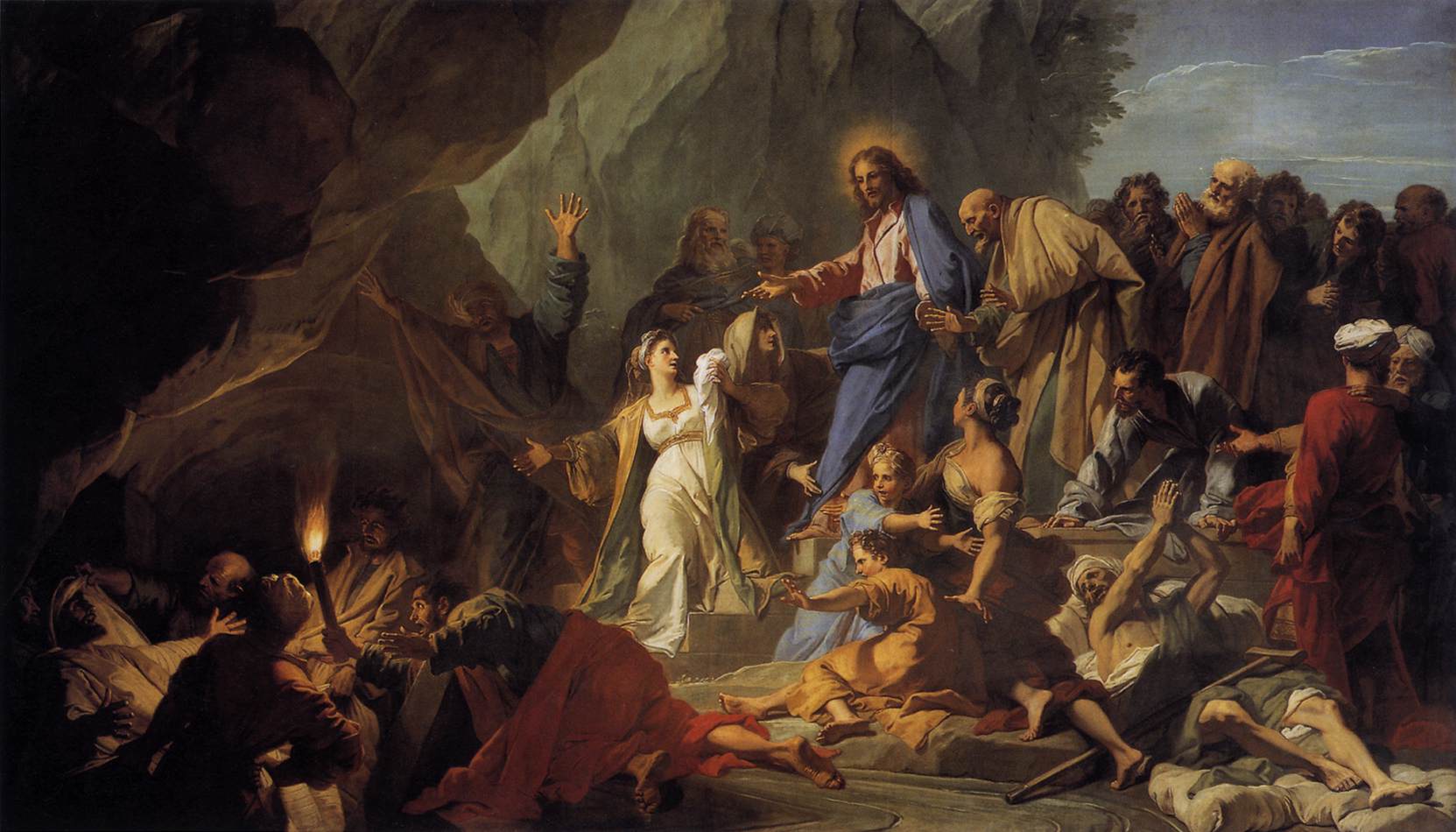
Only one apostle, the mystic John, recounts this extraordinary event in the first forty-five verses of the eleventh chapter of his Gospel. The scene is described with striking precision and vivid detail. Lazarus, dead for four days, had already entered into decay. In spite of this unsettling but realistic and fitting reminder of our mortal, fallen condition, the Lord Jesus Christ acts divinely. Indeed, as Saint Alcuin of York (c. 735–804) tells us, Jesus deliberately delayed His arrival—both for the greater glory of God and so that all would be certain Lazarus was truly dead, buried, and decomposing. Against the prevailing skepticism, the miracle took place, and Lazarus—unlike Eurydice, lost on the way by Orpheus—was truly brought back from the realm of the dead.
Christian tradition has often commented on this monumental miracle. Both the Western Roman Christian world, with its great exegetes such as Saints Jerome, Ambrose, Augustine, and Gregory, and the Eastern Roman Christian world, with its refined interpreters like Justin Martyr and Philosopher, Origen, Saint John Chrysostom, and the Cappadocian Fathers, have left us profound commentaries. The patristic age, followed by the Middle Ages, was enriched by both Byzantine and Gothic Western exegesis. Even the more “exotic” Syrian authors, such as Saint Ephrem, did not fail to contribute.
To highlight the significance of this exceptional miracle, I will cite the interpretations of two emblematic authors of classical Christianity from the two hemispheres of the Roman Empire: Origen of Alexandria (c.185–c.253) and Ambrose of Milan (c.339–397). The reason I have chosen these two is twofold. As unrivaled masters of traditional biblical exegesis, both shared a hierarchical vision in which the highest levels of interpretation belong to the spiritual—symbolic and mystical—understanding of the sacred texts. We have much to learn from such teachers. At the same time, their interpretations were not inspired merely by a desire to provide the best explanations of difficult biblical passages, but also by a deep intention to relate those events to us, the readers. In other words, both authors believed there exists a connection, as subtle as it is powerful, between Lazarus and each one of us who read the biblical account. This conviction, as we shall see, is possible only by accepting the universal human meanings embodied in Lazarus and his resurrection.
For the legendary bishop of Milan, the resurrection at Bethany symbolizes the spiritual rebirth of those who receive supernatural faith. Through his interpretation, he reflects—at least in part—the allegorical reading developed by Origen. One of the bishop’s most profound statements appears in his funeral oration at the death of his brother Satyrus:
The Lord also shows us in the Gospel, to come now to instances, after what manner we shall rise again. For He raised not Lazarus alone, but the faith of all; and if you believe, as you read, your spirit also, which was dead, revives with Lazarus.[1]
Since the term “spirit” seemed to me a bit vague, I also cite the Latin version, where it is clear that the saint speaks specifically of the mind (mens) that is revived through the acceptance of supernatural faith in Jesus Christ:
Ostendit tibi Dominus etiam in Evangelio, ut jam ad exempla veniamus, quemadmodum resurgas. Non enim unum Lazarum, sed fidem omnium suscitavit: quod tu si credas, cum legis, mens quoque tua, quae mortua fuerat, in illo Lazaro reviviscit.[2]
Here we recognize the style of spiritual-anagogical exegesis, allegorical in form, to which Origen had given a brilliance that would later reach its height in the commentaries of Saint Maximus the Confessor. As mentioned, the essence of this interpretive approach lies in the direct connection it establishes between us, the readers, and the Gospel episode itself. For what the great commentators seek is not archaeology, but our awakening—from the death of sin.
In this sense, Saint Ambrose’s link between Lazarus, raised from the dead by Our Lord Jesus Christ over two thousand years ago, and our own minds as readers of the Gospel of John, is most interesting. What, then, is the nature of this connection between us and something that happened two millennia ago? As we all know from the ritual of Holy Baptism and its preparation, Christian religious life begins with the acceptance of the supernatural gift of Faith. Faith, as defined by Saint Thomas Aquinas, is:
The act of believing is an act of the intellect adhering to the Divine truth at the command of the will moved by the grace of God (Latin: Credere est actus intellectus assentientis veritati divinae ex imperio voluntatis a Deo motae per gratiam).[3]
Thus, when our mind gives assent to the supernatural truths contained in Holy Scripture—summarized in the Creed—our soul, whose “eye” is the intellect itself, awakens to the supernatural life of grace. Concretely, when we read in chapter 11 of the Gospel of John the episode of Lazarus’s resurrection, we may accept it by recognizing the divine power of Jesus of Nazareth—thereby placing ourselves among the believers. According to Saint Ambrose’s interpretation, this constitutes a true resurrection for us who believe.
Modern scholars of the Church Fathers maintain that the Milanese saint’s interpretation may have been influenced by Origen’s commentary—a likely possibility. Here is Origen’s spiritual interpretation, preserved in fragments of his commentary:
Even today there are Lazaruses who have fallen ill and died after having been friends of Jesus, lying in the tomb and the land of the dead, dead among the dead, but who are raised again through the prayer of Jesus, called by Him in a loud voice to come forth from the tomb![4]
Here, although Origen does not speak as explicitly about the mind being revived, he refers to those who, after receiving faith, have sinned and lost friendship with God. Despite these grave falls, God continually calls them to awaken (i.e., to be “resurrected”) through conversion and penance. According to this interpretation—focused more intensely on already baptized Christians—not only Lazarus rose, but all who are called to faith by Christ the Savior, from any place, time, or culture. For the soul in a state of spiritual death, imprisoned in the corruptible body, needs the word of Christ, who alone can revive it and, at the Final Judgment, transform even the body into a heavenly one.
Through his spiritual interpretation, Origen implies that being a friend of God means conversion through the acceptance of the divine, supernatural revelation. Once faith is received, the convert partakes of divine gifts through participation in the sacramental life of the Church. Subtly, this is an invitation to make use of the Sacrament of Holy Confession with confidence, knowing that if we have sinned gravely—“dying” spiritually—we may be raised again through God’s grace. Origen’s commentary thus concerns, above all, the baptized who have been unfaithful to their baptismal vows.
A very similar idea appears in the interpretation of Saint Ambrose. For the Doctor of Milan, the resurrection of any person in the Christian era first occurs through the resurrection of the mind, illuminated by the supernatural gift of faith. This first resurrection is followed by the penitential-sacramental one—through Holy Confession. Thus God fully liberates the sinner, drawing him out of the darkness of guilt as from a tenebrous prison. In this sense, perhaps the most concrete sign of resurrection is the sinner’s desire to confess, thereby obtaining God’s forgiveness and sacramental absolution. Yet, as Saint Ambrose teaches, this powerful act of repentance is only possible once our mind has already been raised to life by Christ through acceptance of the supernatural truths of Faith. Thus, we can understand that the biblical episode of the resurrection of Lazarus is not merely a wondrous event that took place two thousand years ago, but is in fact the very story of our own resurrection from the death of sin.
[1] I have extracted the quote from the English translation available here: https://www.newadvent.org/fathers/34032.htm [Accessed: 17 October 2025].
[2] Patrologiae Latinae, Tomus XVI, S. Ambrosius, Parisiis, 1880, col. 1395.
[3] Summa Theologiae, II-II, Quaestio 2, Articulus 9.
[4] I have not found any English edition of Origen’s commentary that also contains the few surviving fragments of his commentary on chapter XI of the Gospel of John. The translation provided here is based on the French version in the prestigious Sources Chrétienne collection (vol. 385): Origène, Commentaire sur saint Jean, Greek Text, Introduction, Translation and Notes by Cécile Blanc, Volume V: Books XXVIII and XXXII, Paris, 1992, pp. 86-87.