
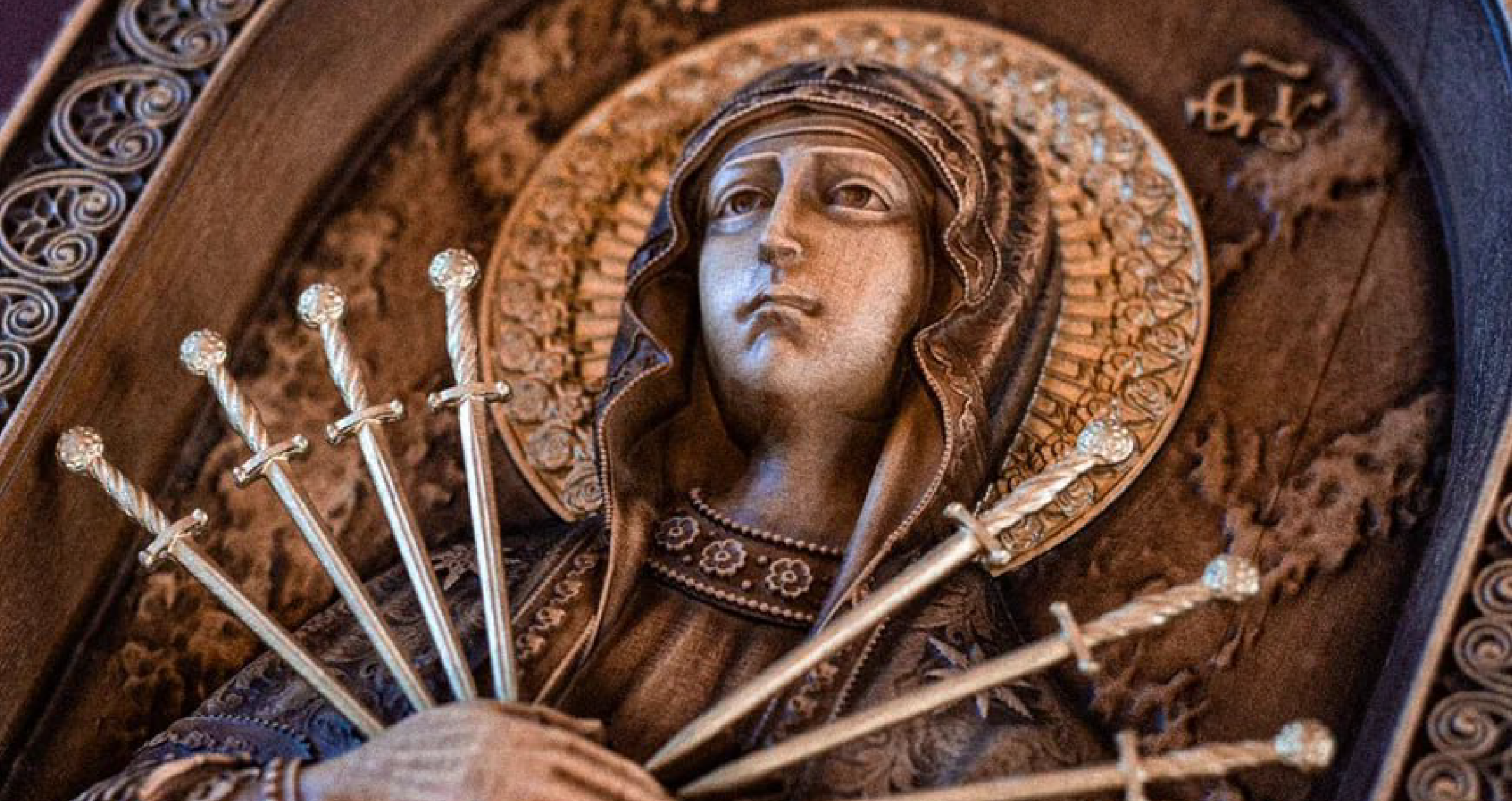
Part I: the ‘Seven Arrows’ icon
Part II: the ‘Softener of Evil Hearts’ icon
This is the concluding part of an essay on the wonder-working icons of the Sorrowful Mother of God who has manifested herself more than once in the most difficult periods of Russian history, always appearing as a guide and point of reference, a helper leading Christians towards a practical, filial unity.
In the previous section of this final part we arrived at the year 1999, when the Russian Church encountered a surge of unhealthy, superstitious religiosity—traces of which can still be heard even in the words of the Patriarch, but above all in the widespread veneration of St Matrona of Moscow. With her canonisation is connected the appearance of a new wonder-working image: a simple printed cardboard copy of the original Seven-Arrows icon, now even more markedly Latin in character, which began to manifest the miracle of myrrh-streaming. Yet this is not the only thing that gives cause for astonishment.
Later, witnesses reported other miracles. At times the icon would exude myrrh, and on several occasions drops of red liquid appeared that resembled blood.
Warnings in Blood Tears
One of the most often mentioned episodes occurred on 12 August 2000, the day of the tragedy of the Russian submarine Kursk, when such drops were said to have appeared on the icon. The icon’s guardian, Sergei Fomin, maintains that believers understand these signs as a reminder that the Mother of God shares in the suffering of the world and intercedes for people in their troubles. At the same time, bleeding icons in Christian symbolism have always been associated with a forewarning of misfortune and a call to repentance.
The nuclear submarine Kursk sank after an explosion during exercises in the Barents Sea on 12 August 2000. There were 118 people on board, and none survived. The authorities officially acknowledged the sailors’ deaths only on 22 August. These dates are significant, since the sinking occurred just before the Dormition Fast began for Russia (on August 14), when the Russian faithful fast for two weeks ahead of the greatest Marian Feast of the Year (and a universal Marian Feast, east and west), the Dormition of the Theotokos (known among the Latins as “the Assumption of Mary”).[1]
I do not wish to comment on Russian politics, yet it is no secret that the tragedy of the submarine Kursk had a deeply negative effect on public trust in both the media and the authorities. As some commentators have observed, this distrust soon became mutual, and what followed was the process commonly described as the tightening of control over the information sphere and the ‘strengthening of the vertical of power.’
On another occasion the icon gave forth myrrh in 2009 in Crimea, during a worship service for a military unit in Sevastopol (and, by a curious coincidence, at the very time when the aircraft of the newly elected Patriarch Kirill, by order of the Ukrainian authorities, was not permitted to land in the city of Rivne). At this same time the holy icon began to stream myrrh mingled with blood, as reported by the news agency Russkaya Narodnaya Liniya.
(I would only remind the reader that the confrontation between the pro-Russian and anti-Russian parts of Ukrainian society, as well as between our Churches and our nations, is a long and complex process. Five years ago, it assumed its most bloody form, not without the guilt of many hardened hearts on both sides. For war, in the broadest sense of the word, is a punishment for sin — just as Cain’s fratricide was the inner consequence of his envy.)
Modern Veneration and the Russian Martyrs
Today the icon is usually kept in the village of Bachurino near Moscow, where a chapel has been built to house it (pictured above). At the same time, the icon still frequently travels so that believers in different places may venerate it. People commonly pray before this ‘Latin’ icon for reconciliation between those in conflict, for peace, and for healing from illness. Thousands of pilgrims come to venerate it, and the myrrh that appears on the icon is sometimes collected and used for the anointing of the faithful.
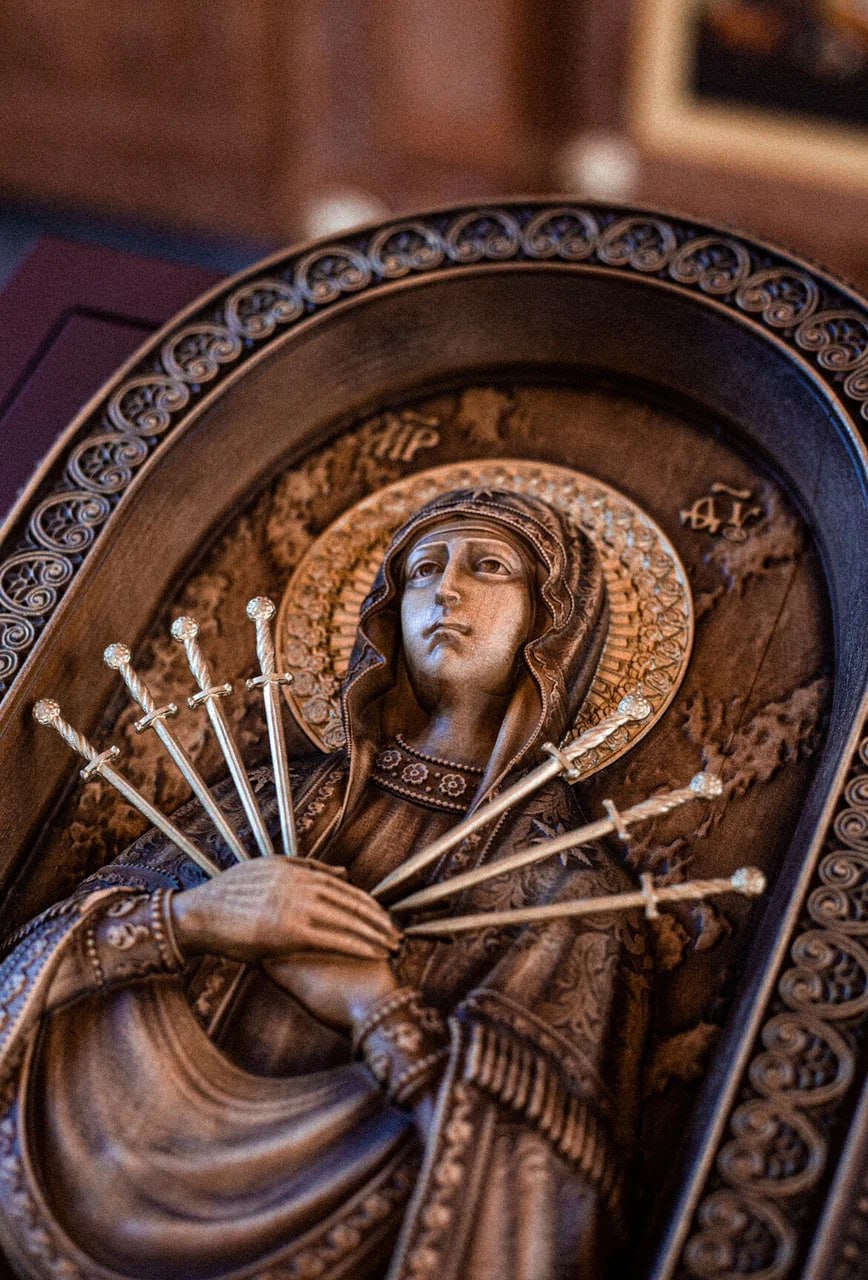
New churches are being opened in honour of icons of both variations. For example, there is a small church dedicated to the Mother of God “Seven-Arrows” in a little town near Pyatigorsk, in the Caucasus—a deeply conservative region of southern Russia, long associated with the strongly anti-Latin and anti-Uniate culture of the Cossacks. Here, the icon is no longer just a painting; it takes the form of a bas-relief, a half-sculpture, venerated as the main icon of the church.
Across Russia, many churches and charitable organisations are dedicated to the Sorrowful Mother of God. Among these, the ‘Softening of Evil Hearts’ icon is now the most widespread, according to public sources, including the state register of legal entities. This is likely due not only to its relative novelty and historical significance, but also to the way it has come to be associated in popular consciousness with the New Martyrs and Confessors of Russia—softening the hearts of the Church’s persecutors.
A notable example is the church devoted to the Softening of Evil Hearts icon in Staropyshminsk, in the Urals.
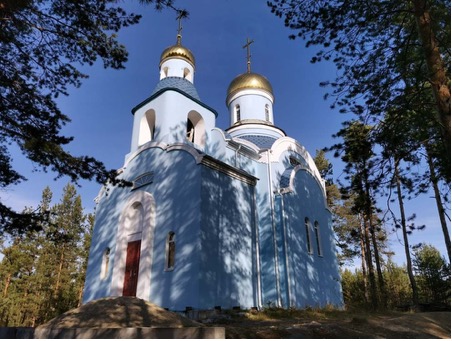
In July 1918, on a nearby hill called Vysokaya, the deacon of the local Sretenskaya Church, Ioann Plotnikov, was brutally murdered. He was canonised by the Russian Orthodox Church in 2000 together with all the New Martyrs, a year after Matrona of Moscow became a local saint.
Thus, I believe, the Mother of God, gently guiding human hearts, has taken under Her own protection one of the healthiest and most authentically Christian devotions in Russian Orthodoxy — the veneration of martyrs — which serves as a safeguard against any form ‘Orthodox Stalinism’ and remains entirely distinct from chthonic practices spread among the people who seek for miracles.
Moreover, the theme of the New Martyrs of Russia is one of the most powerful bonds uniting us — Catholics of the Byzantine Rite in Russia —with our Russian Orthodox brethren. Our fathers in the faith sat together in the camps of the Gulag, lived in the same barracks, and witnessed one another’s prayer and spiritual struggle. This is a subject upon which a separate article could — and indeed should — be written.
Thus our shared remembrance of the martyrdoms of the past is gathered into a single procession beneath the banner of the icon of the Sorrowful Mother of God, known as ‘Softening of Evil Hearts.’
Epilogue
Have the lessons of this icon’s myrrh and blood been truly received? Does the Russian people realise that this much-loved icon is in fact of Catholic — indeed, plainly Latin — origin, and yet has nevertheless become our own?
The answer to this question depends upon the disposition of each individual heart, for the official discourse remains deaf and silent concerning these ‘accursed’ questions.
An honest answer would lead one step closer to the fullness of unity within the Christian Catholic Church; no one wishes to give false answers, however, lest they sin against the Most Pure One.
For this very reason, overt condemnation of the Fatima apparitions and other Marian manifestations in the West is scarcely found within Russian ecclesiastical discourse. Likewise, the diffusion of Latin Catholic spiritual practices — though rapid and often received with heartfelt enthusiasm — unfolds with quiet subtlety: from the body to the dislocated limb and back again, safeguarding the latter from stagnation and decay, the former from amputation, while imbuing both with the enduring promise of eventual restoration and healing.
And we have a fine example of a worthy answer to this question, acceptance of the vocation — an answer given with the full authority of the Russian Orthodox Church. It is an answer that, in a sense, ‘rehabilitates’ the canonisation of St Matrona of Moscow, with all the burdens of Stalinism and occult elements present in her earliest Life, and much besides. This answer is the Akathist to the Theotokos, Softener of Evil Hearts, dedicated to the Sorrowful Mother in both of her images. It is the prayer of the Russian Church, bringing consoling grace to her faithful, wounded by schism and by its consequences, through the openly Latin spirituality of the Seven Sorrows of the Mother of God.
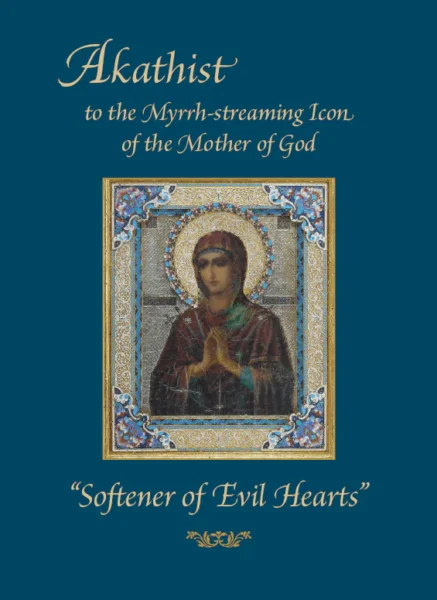
The Akathist
The official church document notes that this Akathist honours two icons — the Seven‑Arrow and the Softener of Evil Hearts. This needn’t confuse the reader, for the Seven‑Arrow icon, once a Latin ‘foreigner’ lying forgotten on the bell tower floor, became a recognised model in Russian church tradition. From it, numerous copies and variations arose, now known as Softener of Evil Hearts, as we have discussed in previous parts of the essay.
Even here, in the second name of the image, the link to the Latin tradition remains alive, carried through the prayers of ordinary Orthodox people seeking reconciliation in conflicts and the strengthening of family life.
—
This Akathist, promulgated by the Russian Orthodox Church at the Holy Synod on the 25th of August, 2022, merits particular reverence. For herein the honouring of the Seven Sorrows of the Most Holy Mother of God is made manifest. Not merely in traditional images, but now officially, through prayers duly sanctioned, the Russian Church joins with the Catholic Church in devotion to our common Mother, sharing in her sorrows and our consolations. Each repeated ‘Rejoice’ serves to comfort the Immaculate One as the faithful chant the Akathist, even as the angelic salutation, and our own, brings solace to her during the meditation on the Sorrowful Mysteries of the Rosary. Whereas the Latin Rosary greets the Virgin with the word hail (Latin Ave), the Greek culture of the Akathist (preserved also in its Church Slavonic translation) addresses the Mother of God with the greeting Rejoice (χαῖρε, Радуйся).[3]
In this Akathist, thirteen groups of invocations to joy, each proclaiming a reason for rejoicing, accompany a historical narrative rich in theological reflection. In the end, this Russian Orthodox Akathist follows quite clearly and consistently the structure of the Latin devotion to the Seven Sorrows of the Mother of God, something that can be traced directly in the text itself:
| Sorrow of the Mother of God | Quote from the Akathist |
| 1. Simeon’s Prophecy | “Hearing the words of the righteous Simeon: ‘Behold, this Child is set for the fall and rising of many in Israel… and a sword shall pierce through thy own soul also…’ Great sorrow pierced the heart of the Most Holy Mother of God…” |
| 2. Flight into Egypt | “Fearing Her Child might be slain by Herod… Joseph was warned in a dream, and took the Mother and Child by night into Egypt, remaining there until the death of Herod. We recall this arduous journey with devotion and hymn Thee, Most Holy Mother of God.” |
| 3. Loss of the Child Jesus in Jerusalem | “Great sorrow held the Pure Mother when She could not find the Child among Her company… and She said to Him: ‘Child, why hast Thou dealt thus with us? Behold, Thy Father and I sought Thee with grief.’” |
| 4. Meeting Jesus on the Way to Calvary | “Beholding Her beloved Son given over to judgement… enduring all His pains and witnessing the unbearable sufferings of Him.” |
| 5. The Crucifixion of Christ | “The Mother of God, seeing Her Son dishonoured, naked upon the tree, cried: ‘Alas for me, my Child… a sword shall pierce through My soul, as was foretold by the righteous Simeon.’” |
| 6. The Taking Down from the Cross (Pietà) | “Beholding the lifeless and wounded body of Her beloved Son… and kissing His dear Body.” |
| 7. The Burial of Christ | “Delivering Her Son to the tomb… enduring all sorrow upon earth.” |
These seven sorrows are the seven points of meditation in the Latin tradition to the seven sorrows of Mary, which is also confirmed by heaven. In the 14th century, Our Blessed Mother revealed seven promises to St. Bridget of Sweden. She said she would bestow seven graces to those souls honouring her daily by saying seven Hail Marys while meditating on her tears and sorrows:
- “I will grant peace to their families.”
- “They will be enlightened about the divine Mysteries.”
- “I will console them in their pains and I will accompany them in their work.”
- “I will give them as much as they ask for as long as it does not oppose the adorable will of my divine Son or the sanctification of their souls.”
- “I will defend them in their spiritual battles with the infernal enemy and I will protect them at every instant of their lives.”
- “I will visibly help them at the moment of their death—they will see the face of their mother.”
- “I have obtained this grace from my divine Son, that those who propagate this devotion to my tears and dolors will be taken directly from this earthly life to eternal happiness, since all their sins will be forgiven and my Son will be their eternal consolation and joy.”[4]
Two further points should be mentioned here which characteristically bring the Russian Church closer to the Catholic tradition.
1. The Akathist particularly strengthens devotion to the Eucharist
Kontakion 6. The Teacher, washing the feet of the divine disciples at the Mystical Supper, enlightened their minds and showed them the saving example of humility. Revealing His love for the human race, He blessed and broke the bread and gave it to them, saying: “Take, eat: this is My Body.” And taking the cup and giving thanks, He gave it to them, saying: “This is My Blood of the New Covenant, which is poured out for many for the forgiveness of sins.” Giving thanks to the Merciful God for His ineffable mercy towards us, made manifest in the mystery of the Divine Eucharist, we sing to Him: Alleluia.
2. The Akathist also contains repentance for the fact that the Seven-Arrows Icon had not been honoured before its miraculous discovery
Kontakion 12. Grant us grace, O Most Holy Mother of God, who venerate thy precious icons. For thy icon, called the Seven-Arrows, was copied from an ancient prototype, in which the depth of thy suffering is depicted by the seven arrows piercing thy heart. Yet, through the negligence of thy servants, it was neglected and even trodden underfoot by those who passed along the bell-tower in the village of Tóshen in the region of Vologda. But when a certain servant of God, grievously afflicted, was granted a revelation of the healing grace of this image, it was found again and placed in the holy church, that all the faithful might cry out to God: Alleluia.
We can only say: Amen.
An ancient Latin image, reaching back to the Middle Ages, now teaches the Russian people to venerate the sufferings of the Mother of God and of Christ in His Eucharistic sacrifice.
And I would argue, this is how unity is quietly fulfilled. While embittered apologists argue, bishops fear for their authority, and the intelligentsia trembles over national identity (and even the ecumenical dialogue with the Russian Orthodox Church seems stalled), the Queen of Heaven works in her own way. She prepares what is most essential — our Christian hearts — for full unity in Christ, mutual understanding and welcome within the one family of Christian peoples, all glorifying the Lord and comforting the heart of the Mother of God. She is the one who softens evil hearts by bringing them to the Light, as at Fatima — ‘the Light that is God.’
[1] The Russian Orthodox Church follows the old liturgical calendar which is 13 days behind the current civil calendar used worldwide. Therefore Russian “liturgical August 15” takes place on the same day as August 28 in the civil calendar, used by Roman Catholics outside Russia.
[2]“Старопышминск: храм иконы Божией Матери ‘Умягчение злых сердец’,” in a blog named По святым Местам Урала, URL: https://svyatural.com/staropyshminsk-hram-ikony-bozhiej-materi-umyagchenie-zlyh-serdecz/
[3] The original Angelic salutation was “χαῖρε, κεχαριτωμένη” (Luke 1:28) which translates literally as “Rejoice, O Full of Grace.” But whereas “χαῖρε” was a greeting in Greek, an equivalent Latin greeting is “Ave” and thus the Latin New Testament reads “Ave, Gratia Plena” (“Hail, O Full of Grace”).
[4] Cited from: Joseph Pronechen, ‘Our Lady’s Seven Sorrows, Seven Promises, and Fatima’s Connection’ at National Catholic Register, URL: https://www.ncregister.com/blog/our-lady-s-seven-sorrows-seven-promises-and-fatima-s-connection