
In the previous article, we began to look at the scholarship of Sister Lucy Truth (SLT), specifically concerning the egregious error it made in its video about Fr. Alonso in relation to the Fake Lúcia Hypothesis (FLH). Presently, we will discuss developments concerning the tradition of grilles and veils within the Carmelite Order, and how such a custom has been brought to bear within the ambit of the FLH.
In the first article of this series, we referenced Fr. Nicholas Gruner, his organization “The Fatima Center,” and Dr. Peter Chojnowski’s association with it. On October 11, 1990, Fr. Gruner, accompanied by his trusted associate Fr. Paul Kramer, visited with Sr. Lúcia’s last surviving sibling, Carolina. According to Fatima Center literature, Carolina is reputed to have commented upon how (in Gruner/Kramer’s words) “never had she been able to speak alone with her sister in the same room. They were always separated by a grill and many other sisters of the convent were in attendance at all visits.”[1] Additionally, Sister Lucy Truth later referenced the custom of traditional large Carmelite veils (in addition to that of the Carmelite habit) that obstruct the faces of the sisters when visiting with outsiders beyond one’s family.[2]
Between the two points of the grille and the veil, there are some questions:
- What was the visibility of Sr. Lúcia during visits of people, especially family, to her at the Carmel of Coimbra?
- If Lúcia was shielded by a grille, could people get a good look at her?
- If Lúcia’s face was obstructed by a veil, could one even get a good look at her?
The visibility being in question, it warrants a discussion of the available facts.
First, to be clear, the grille refers to the metal grate in the guestroom of the Carmel of Coimbra. Here, the sisters received guests but separated by a metal grate. It is customary for contemplative Carmelites (and other similar orders of female religious) to visit with outsiders while separated by a metal grate or “grille” which symbolizes the division of the cloister from the world.
Let us ask a question: what does the actual grille look like at the Carmel of Coimbra? In 2004, the famous Hollywood actor Mel Gibson visited Lúcia and spoke with her. The visit was kept quiet for about a year until photos were published on the Internet in early 2005.[3] The Carmel of Coimbra’s grille is quite prominently featured in the photos. In some more recent media, there are videos on YouTube that show the visibility through the grille.[4] It is clear by all indications that the wideness of the grille permitted good visibility to any nun on their side. So, there is no question about the grille itself and what it permits people to see.
Moving along, there is still the question of the Carmelite custom of veiling one’s face. This custom was taken up by Dr. Peter Chojnowski of SLT in his own argumentation for the FLH. As recent as April of 2024, he presented the matter of the veil (and grille) in an appearance he made with podcaster Kevin Davis:
But if you know anything about the Carmel, and I’m sure you do, and many of our viewers would know it also, you have to meet behind a screen with the Carmelites. The Carmelite is behind a screen. And every account that I’ve heard, because we have some accounts on tape, and every account I’ve seen in pictures, always Sr. Lúcia is behind a screen. Because that’s what Carmelites do. And not only do they meet behind the screen, but they cover their face behind the screen. Even if they’re behind the screen, they cover part of their face. And also, every time, every account I’ve seen about a meeting with Sr. Lucy, she’s surrounded by other nuns from that convent. So, let’s just say it’s the easiest way to fake an individual is to put them in a Carmelite convent where you have limited access and you’re meeting with someone behind a screen, surrounded by others, who have a veil on their face.[5]
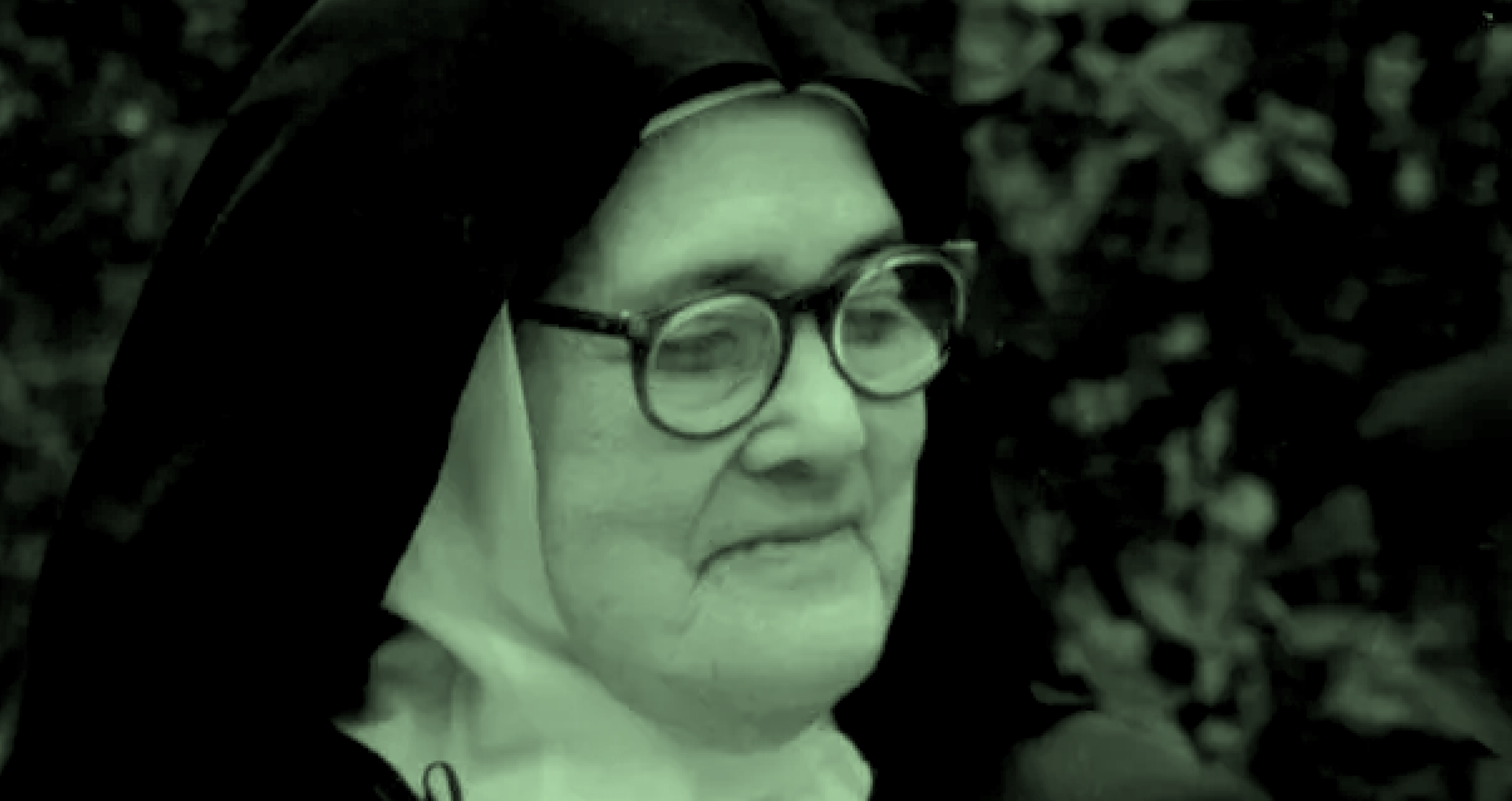
Why the grille (“screen”) would matter to Chojnowski is not clear, especially when he reproduced one of the Gibson photos on his personal blog RadTrad Thomist.[6] The grille was not narrow enough to restrict visibility inside the cloister parlor. Moreover, Sr. Lúcia was not wearing a veil that covered her face. One might note Gibson’s visit was in the mid-2000s, what about previous years? Has the veiling custom ever been observed by the Carmel of Coimbra in its past? We can answer this question in the affirmative.
April and Martin Armstrong, in their 1954 book Fátima: Pilgrimage to Peace, visited personally with Sr. Lúcia[7], and made some very important notes about the visit. First, they mention the grille: “The focal point of the room was a grille of the same blunt iron spikes [as found in the chapel], spaced widely enough to permit conversation and a fair view.”[8] So, as of 1954, there was no question about the view to the nuns’ side of the grille. The authors next write that “At first we could see only a dark space ahead of us.” This description of a “dark space” might be jarring at first. In June 2017, I was at the Carmel of Coimbra and in the visiting area. There is a curtain on the nuns’ side of the grille that is pulled back during a visit and one can see the space ahead into the nuns’ side. Without a light on, it is dark, but not necessarily dark at the grille itself. There is a window on the visitors’ side to the right of the grille which lets in a lot of natural light. I took footage of the visiting room and placed it on my YouTube channel.[9] I even took a photo of the grille up close and one can see that the natural light shines brightly onto the grille.
While the Armstrongs do not say that a light was turned on the nuns’ side of the grille (as is what happens today),[10] they do relay that gradually “our eyes made out the figures of two nuns seated facing us.” This came after one of the nuns, Mother Mary in Christ, opened up the conversation in English (Sr. Lúcia never learned English). Based upon my experience, if the window on the guest side was letting in the light, it was likely shining over to the nuns’ side of the grille and that is how the Armstrongs were able to see.
The authors also remark that both nuns “wore black veils covering the top part of their faces down to the nose.”[11] From this text, it appears as though at least for some time, the Carmel of Coimbra observed the custom of sisters veiling their faces when interacting with certain guests.[12] (I say “certain guests” because the Armstrongs immediately follow up this remark with another: “It is not a normal part of their habit, and when they receive the clergy or their own families they do not wear it.”)
If the custom did not apply when clergy or family members were visiting, then there was nothing obstructing either group from seeing Lúcia. One of Lúcia’s nephews was a Salesian priest, Fr. José Valinho (the son of her sister Maria dos Anjos). He was allowed to visit her once a month in Coimbra and he also knew Lúcia prior to her entrance there. He even once brought along two Italian journalists, Renzo and Roberto Allegri, to one of his visits.[13] As of 2001, Fr. Valinho presented everything in the context of visiting his actual aunt, not a fraud, even though the journalists were not permitted to join the visit itself—since they were not family or clergy and did not possess an exemption to the rule).[14]
In the end, as it concerns the Armstrongs’ account, they did not question anyone’s identity, nor did the lighting or wideness of the grille bars pose a problem for them. It was Mother Mary in Christ and Sr. Lúcia with whom they were speaking.[15] This understanding is confirmed a few pages later when the Armstrongs did, in fact, get to see Lúcia’s eyes. They were showing her a gift and Lúcia couldn’t see it too well. “Ah! It is too dark,” Lúcia said, “I cannot see it well. Could you hold it up to the light from that window?” The Armstrongs obliged and described what happened next: “As we held it up the veil fell back a bit from Lucy’s face as she stared at the leaf. Her eyes, deep and dark, fastened on the leaf, and her smile was tremulous as bird song.”[16]
Lastly, further contradicting the grille and veil arguments, is the fact that Lúcia was not always behind the grille. In the “disputed” period of her life (ca. 1958-2005), on the occasions where Lúcia was allowed to visit Fátima (1967, 1981, 1982, 1991 and 2000), there were opportunities for her relatives to visit her. During the 1981 visit, a photo was taken that was published in the Fifth and Sixth Memoirs of Sr. Lúcia.[17] In it, she is hugging her sister Maria dos Anjos who is clearly happy in the embrace. Another sister, Carolina, is in the foreground of the photo, herself smiling and enjoying the visit with Lúcia.
In the end, the grille and veil arguments do not provide sufficient evidence in support of the FLH. Its proponents, such as The Fatima Center and its former associate Dr. Chojnowski, appear not to have done a deep dive into the matter, creating harm to their argument. That said, such matters might be considered secondary in the order of the arguments put forth in favor of the FLH. In the next installment, we will move into a discussion of the expertise upon which Sister Lucy Truth has relied for the organization’s more substantial arguments.
[1] Francis Alban, Fatima Priest: Priest, Prophecy and Peril . . . The Vatican Key to Peace or Terror (Pound Ridge, New York: Good Counsel Publications, 1997), page 16 of the beginning images. In later editions, the photo is placed elsewhere in the book. For example, in the third edition published in 1999, the photo and caption are opposite page 173. In the edition published in the year 2000, they are adjacent to page 229.
[2] Cf. Dr. Peter Chojnowski. “What was Carmelite Life Like in 1959?.” RadTrad Thomist (March 8, 2023). Link to YouTube video here; “Sister Lucy Truth News: Examples of Traditional Carmalite Veils.” Sister Lucy Truth (2022-2023). Image here.
[3] Richard Salbato. “Mel Gibson Visits Lucia of Fatima.” Unity Publishing (2005); “Fatima Bulletin reveals Gibson visited Fatima visionary and showed her ‘The Passion’.” Catholic News Agency (January 11, 2005).
[4] “Documentário sobre a Irmã Lúcia – ‘A Santa do povo!’.” CM especial (October 2, 2018); Dr. Marco Daniel Duarte. “A Irmã Lúcia entre nós: testemunho do Carmelo de Santa Teresa.” Santuário de Fátima YouTube Channel (July 5, 2024).
[5] Dr. Peter Chojnowski and Kevin Davis. “Dr. Chojnowski – A Response to the Fatima Center.” Catholic Family Podcast YouTube Channel (April 26, 2024). See also Dr. Peter Chojnowski. “Objections and Responses #9.” Sister Lucy Truth (date unknown).
[6] Cf. Dr. Peter Chojnowski. “Keep Reaching, Mel!” RadTrad Thomist (March 2, 2018).
[7] April and Martin Armstrong, Fátima: Pilgrimage to Peace (Garden City, New York: Hanover House, 1954), 157-176.
[8] Ibid., 166-167.
[9] Kevin J. Symonds. “Coimbra Carmel Grille.” Kevin Symonds YouTube Channel (August 2, 2026).
[10] I do not know why a light might not have been turned on, but we do know that the Carmel of Coimbra was in its early stages of rebuilding. It had served as a barracks for soldiers and returned to the nuns in 1946. There was a lot of damage. It is possible that there was no lighting available yet to the nuns’ side and so there was a need to rely upon natural light. For more information, see Fr. Robert J. Fox and Fr. António María Martins, The Intimate Life of Sr. Lucia (Alexandria, South Dakota: Fatima Family Apostolate, 2001), 308ff; Carmelo de Santa Teresa – Coimbra, Um caminho sob o olhar de Maria (Coimbra, Portugal: Edições Carmelo, 2013), 334-337, 347, 363-364.
[11] Armstrong and Armstrong, Fátima, Pilgrimage to Peace, 167.
[12] This practice does not seem to be observed today at the Carmel of Coimbra.
[13] Renzo and Roberto Allegri, Fatima: The Story Behind the Miracles (Ann Arbor, Michigan: Servant Books, 2001).
[14] Ibid., 257.
[15] Even the Armstrong’s description of Lúcia’s voice, personality, and laughter agrees with what is known about her (cf. Armstrong and Armstrong, Fátima, Pilgrimage to Peace, 170, compared with Fox and Martins, The Intimate Life of Sister Lucia). Moreover, based upon the timeline alone, there can be no question of Lúcia’s identity here. 1954 is well within the time frame maintained by most proponents of the FLH when the alleged “Lucy I” was still around (i.e., before the alleged imposture of “Lucy II”).
[16] Armstrong and Armstrong, Fátima, Pilgrimage to Peace, 176.
[17] Fr. Luis Kondor, SVD (edit.), Fatima In Lucia’s Own Words II (Fátima: Santuário de Fátima, 2004), 203. See also Berta de Freitas. “Maria, de Fátima.” RTP Arquivos (May 6, 2017) at the 9:12 mark.