
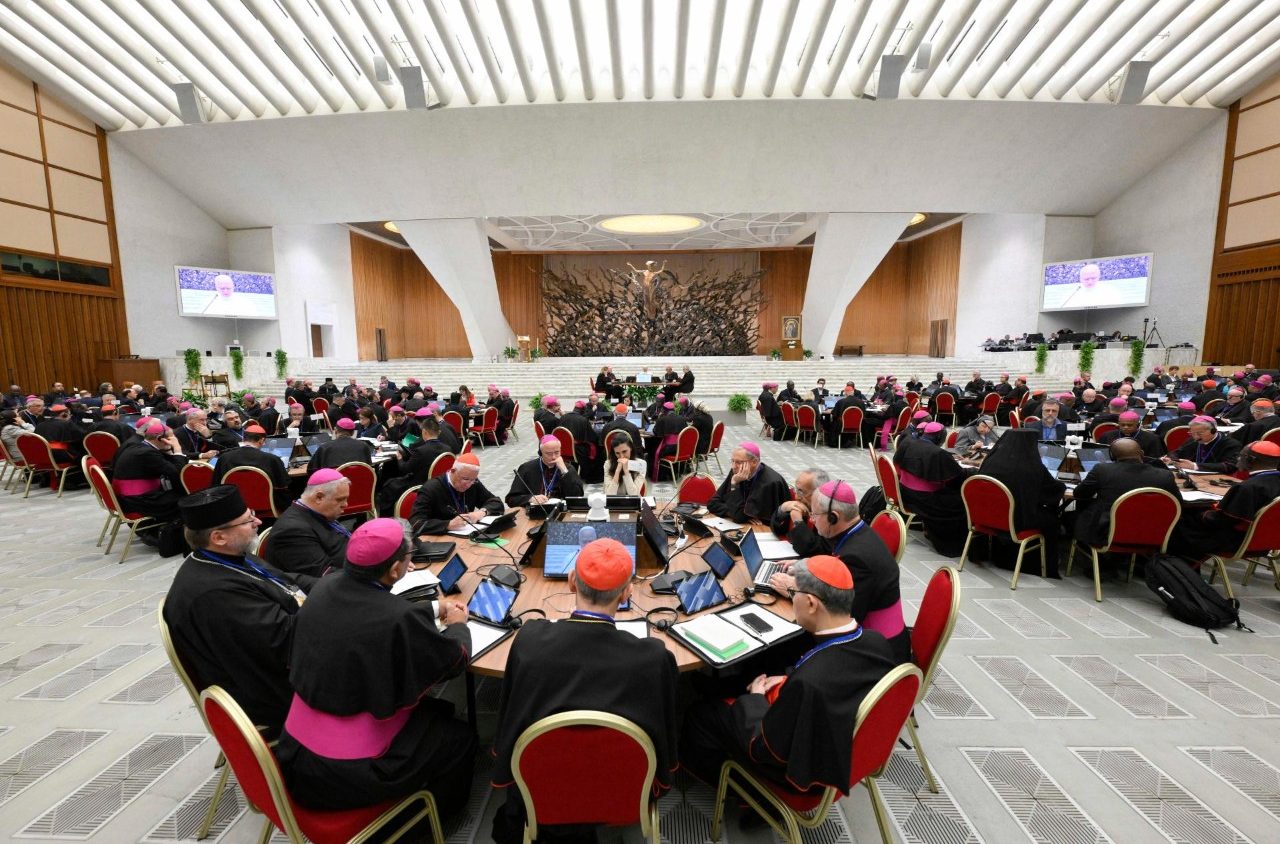
Above: Participants gathered in the Paul VI Hall for the Amoris laetitia encounter (VATICAN MEDIA).
Early this month, before the latest document arose today, Father Stan Chu Ilo commented with favor on the change in approach that is taking place in the Church of Rome. Father Ilo, a native of Nigeria, is Professor of Catholic Studies at DePaul University. He was attending the meeting of the Heads of Eastern Churches and the Presidents of Episcopal Conferences, held in Vatican City October 7 – 14, to commemorate the tenth anniversary of Pope Francis’s post-synodal apostolic exhortation, Amoris Laetitia.
Father Ilo said, “There is a paradigm shift or a methodological shift that we see now of theology – listening, and emerging from the experiences of people.” He saw this as a matter of great hope for African cultures.
This sounded familiar. Where had I heard something like it recently? Then I remembered. It was the Final Report of Study Group 9, released May 5, 2026. That is the working group on “synodal methodologies” for dealing with “emerging doctrinal, pastoral and ethical” issues in advance of the “Ecclesial Assembly” to be held at the Vatican in October, 2028. Regarding same-sex attraction, Study Group 9 concluded that “…sin, at its root, does not consist in the (same-sex) couple relationship, but in a lack of faith in a God who desires our fulfillment.” (§III, 2.1).
To the matter here, Study Group 9 stated that there must be a “paradigm shift” from the paradigms of past centuries (§ I, 1.1) by which the Church will foster “a living encounter with the person of the risen Lord Jesus, by engaging with the lived experience of faith of the People of God in its personal and social relevance, in relation to the diverse situations of life and the many cultural contexts.” (§I, 1.1). I wrote about it in these pages on May 12, 2026.
So that is the playbook: do not say that the Church of Rome is “changing” in any way. Rather, say that its theology is undergoing a “paradigm shift.” So for the neo-Modernists, the recorded sum of all the lived experiences of the apostles, martyrs and popes that has been handed down over the centuries is no longer relevant to contemporary life. Henceforth, contemporary faith and morals will derive from the lived experiences of the “People of God.” The playbook was announced in May. We saw it in action in October.
How would “The Church of Lived Experience” work in practice? When all that matters is the experience of the living, doesn’t their experience cease to be relevant when a new generation has taken their place? A church that is continually engaging with Jesus Christ in relation to the diverse situations of life and culture, by definition, can have no permanence in doctrine and no predictability in morality.
How would the faithful know what this church teaches? Any conclusion as to a doctrinal, pastoral or ethical issue could not be written down today by some assembly, group or synod of the People of God, lest some future assembly, group or synod of the People of God tomorrow come to a different conclusion. The best we could hope for is promulgation of the Church’s fixed and firm policy of the day.
This is not a new religion. It is not a religion at all if, by “religion” you mean an organized system of beliefs and practices which is passed down to the next generation. The declared sole mark of the Church of Lived Experience is “paradigm shift,” meaning that nothing is certain; everything is relative; and everything is subject to change. The Church of Lived Experience would be, as Ross Douthat has observed, merely “a religious tribe with constantly evolving views…a high-minded fraud…”
There is word that a revised Code of Canon Law is in the works. No doubt a revised Catechism will follow. The hubris is breathtaking.
Who would join such a church? Or more to the point, who would remain in a church whose precepts are sketched in sand? I do not think that the apostates-in-charge are unaware of these questions. I think they are counting on the obvious answers.
The way to destroy the Church of Rome is to transform it into the Church of Lived Experience. On the other hand, the proven solution for every bishop is available for each diocese now: the charitable anathema. This solution avoids the dangers of neo-Modernism but also, since it comes from the local bishop, has the pastoral power to handle that lived experience which actually matters.