
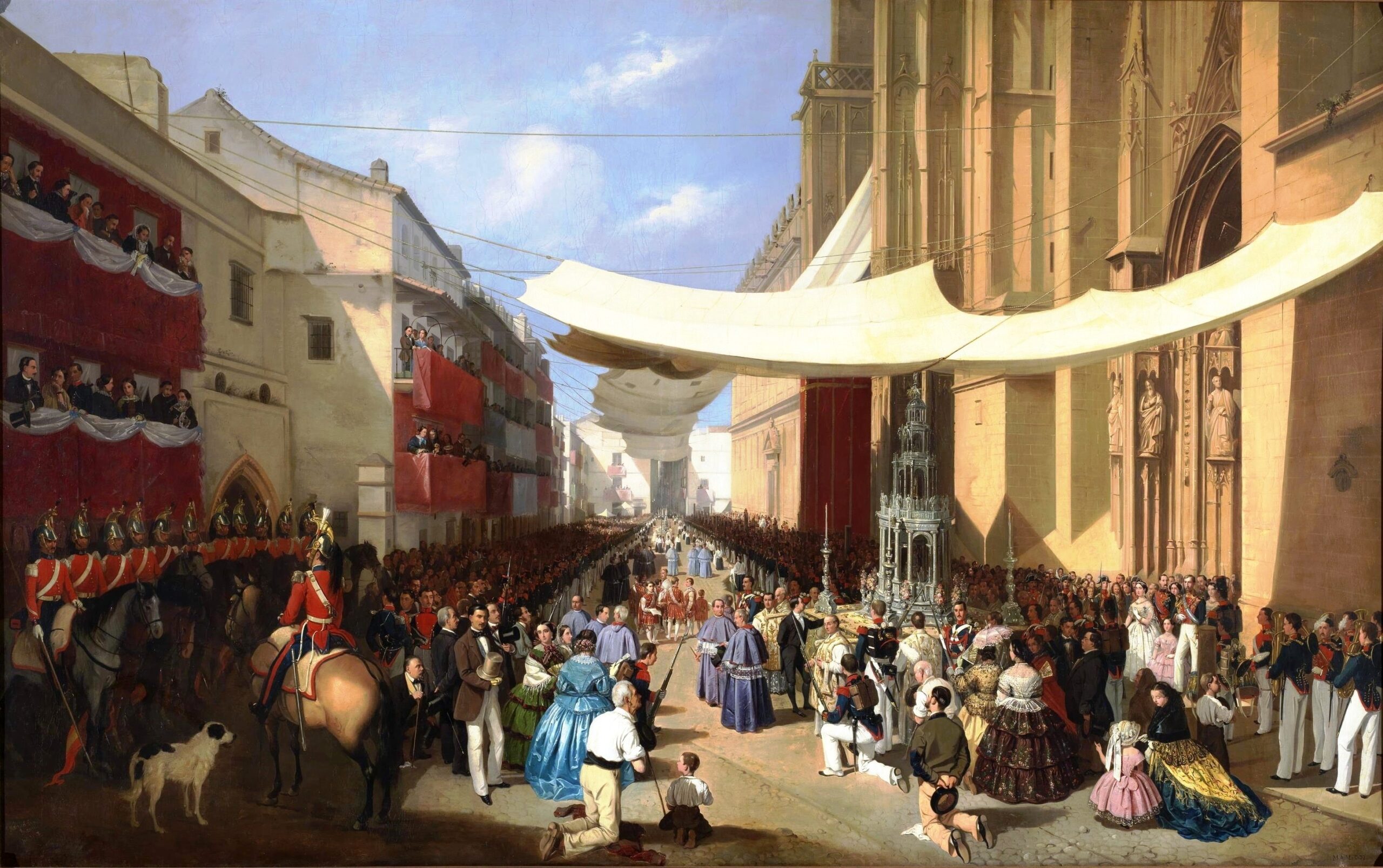
Above: Corpus Christi procession in Seville in the 19th century by Manuel Cabral Aguado-Bejarano.
I – Europe
Sweet Heart, Lovable Heart,
wounded by love for us,
faint with love for us,
make Thyself favorable to me.
Heart of Jesus, sweeter than honey,
Heart, purer than the pure sun,
tabernacle of the Word of God,
compendium of the riches of God.
You are a harbor to the shipwrecked world,
a secure place for the faithful,
an asylum for guilty minds,
a retreat for pious hearts.
The Feast of the Eucharistic Heart of Jesus was both an early casualty of liturgical unrest, and – as far as the Universal Church goes – a singularly short-lived one. It is, however, still observed by the Redemptorists, whose Irish Province offer this admirable introduction to the feast: “On 9 November 1921, Pope Benedict XV instituted the feast of the Eucharistic Heart of Jesus to be celebrated on the Thursday within the Octave of the Sacred Heart with a Proper Mass and Office. The feast continues to be celebrated in some places and by some communities, notably by the Redemptorists who maintain it in their Proper Calendar.” Thus this feast will fall this week on Thursday. In instituting the feast, Pope Benedict XV wrote:
The chief reason of this feast is to commemorate the love of Our Lord Jesus Christ in the mystery of the Eucharist. By this means the Church wishes more and more to excite the faithful to approach this sacred mystery with confidence, and to inflame their hearts with that divine charity which consumed the Sacred Heart of Jesus when in His infinite love He instituted the Most Holy Eucharist, wherein the Divine Heart guards and loves them by living with them, as they live and abide in Him. For in the sacrament of the Holy Eucharist He offers and gives Himself to us as victim, companion, nourishment, viaticum, and pledge of our future glory.
Despite both its novelty and short lifespan the feast goes to the very heart (literally) of Catholic life and history. To understand this, it is first important to remember that every element of Sacramental and devotional life in the Catholic Church is bound up with every other – honour paid to Our Lady of Knock does not diminish that offered Our Lady of Guadalupe, since it is the same Immaculately Conceived and Gloriously Assumed person who has appeared in both places among many others. Honour paid to her in one place is paid to her in all. Neither is veneration given her taken away from her Divine Son. Her Queenship derives from His Kingship; the devotion due her Immaculate Heart does not take away from that to be given to His Sacred Heart. It works also in reverse; she was the very first Tabernacle to contain His Sacred Body and Precious Blood.
As the name will indicate, the name Eucharistic Heart of Jesus encompasses two foci of worship toward Christ: His Most Blessed Sacrament, and His Most Sacred Heart. But it would be a mistake to think that that linkage is only one hundred and fiveyears old. Indeed, these two devotions, and a great many others – go back to the beginnings of the Church – to the very first Maundy Thursday and Good Friday.
On that Thursday, the Last Supper encompassed a number of key events for the subsequent history of the Church. Our Lord united His Davidic Kingship with the Communio of the Church, as symbolised by the Washing of the Feet; thenceforth, Catholic Monarchs aspired to participate in His Kingship (which is why the Maundy Thursday Footwashing was a regular feature of Imperial and Royal Court Calendars). He also began the Mass with the First Transubstantiation; the vessel in which He made the wine His Precious Blood was ever after identified as the Holy Grail of song and story. He then created the Catholic Priesthood to continue this ever after.
The next day, the creation of the Mass was consummated with His death on the Cross; Christian Chivalry dated its own origins to that Sacrifice, seeing Christ as the first Knight. Our Redemption accomplished, St. Longinus stabbed Our Lord in the side, into His Sacred Heart – from whence poured Blood and Water – seen ever since as symbolic as of the two most essential Sacraments – the Holy Eucharist, which worthily and frequently received over a lifetime makes us ever more a part of Him, and Holy Baptism, which incorporates us into His Mystical Body, and makes it possible to receive His Body and Blood. In all of this we see the close connexion between the Blessed Sacrament and the Sacred Heart. The many early Saints who had visions of drinking from His Side Wound underscore this – as does the first Eucharistic Miracle, at Lanciano, taking place at the Shrine of St. Longinus.
Starting in the 12th century, there began what I like to call the Eucharistic Revolution. It began with Hildebert of Lavardin coining the word “Transubstantiation.” Then began the penning of stories about the Holy Grail; not very reliable as a source of history, they nevertheless incorporate stories of Eucharistic Miracles that would repeatedly occur in real life down to – especially in – our time. During the period they grew in popularity in the 13th century, Transubstantiation was defined as the best way to describe what happens at the Mass, and St. Juliana of Cornillon had her visions which led to the great feast of Corpus Christi. This turn led to the growth of Eucharistic processions, adoration, and much more. But in 1199, Christ appeared to St. Lutgarde of Saint-Trond. This is the first medieval apparition of the Sacred Heart passed down to us through Tradition.
At the same time, devotion grew to Our Lord’s Five Wounds, and their connection to the Eucharist was not unnoticed – after all, it was the same blood that came down daily upon each Altar, was reappearing in miracles (sometimes bleeding from hosts and at others from images of Our Lord), and relics of which were being brought back along a great many others from the Holy Land and Constantinople, thanks to the Crusades. Ss. Gertrude the Great and Mechtilde – both in the Abbey of Helfta, received visions of the Sacred Heart, and St. Bonaventure, and a great many other preached about this Heart and the Blood that flowed from it.
When the Protestant Revolt broke out, the Pilgrims of Grace in England marched against the King’s men under the banner of the Five Wounds. St. Ignatius of Loyola in his Anima Christi Prayer united all elements of devotion to Christ – and St. Peter Canisius spoke frequently of Christ’s Heart and Blood in defence of His Real Presence in the Eucharist; a theme taken up by many Catholic preachers fighting the new heresies.
It was of course in the 17th century that Our Lord appeared to St. Margaret Mary Alacoque with the revelations we know. But the 17th century saw an explosion of such devotion independently. Sr. Marie des Vallees had vision explicitly linking the Sacred Heart to the Eucharist, and the devotion was already in the hearts of Ss. Claude de la Colombiere and St. John Eudes before they became the foremost supporters and propagators of St. Margaret Mary’s work.
Another interesting element of this rising tide was the interest taken in the Sacred Hear by Crowned Heads. Of course, this was not a one-way street. On June 17, 1689, St. Margaret Mary Alacoque received another revelation from Our Lord, which she quoted:
so He wants, it seems, to come with pomp and magnificence into the houses of princes and kings, to be honored as there as He has been outraged, despised and humiliated by His passion; He would receive much pleasure by seeing the great men of the earth lowered and humbled before Him, as He felt the bitterness of being abased by them. And these are the words that I heard on this subject: ‘Make it known to the eldest son of my Sacred Heart, that as his temporal birth was obtained by devotion to the merits of My Holy Childhood, so he will get his birth to eternal glory by the consecration which he will make of himself to my adorable Heart, which means his triumph, and through it, to the great of the earth. I want My Heart to reign in his palace, to be painted on his standard and engraved in his arms, to make him victorious over all his enemies, and by placing at his feet these proud foes, to make him victorious over all enemies of the Holy Church.’
Although neither Louis XIV nor Louis XV complied with this request, others did. Mary of Modena, Queen of the deposed King James II; Queen Henriette Marie of England (widow of the murdered Charles I); Augustus II “the Strong,” Elector of Saxony, King of Poland, and Grand Duke of Lithuania; King Felipe V of Spain; Stanisław Leszczyński, sometime King of Poland and Duke of Lorraine; Augustus III, King of Poland; Marie Leszczynska, Queen of Louis XV of France; Queen Maria I of Portugal; and Maximilian III Joseph, Elector of Bavaria; all became active propagators of the devotion.
When the French Revolution broke out in 1789, and drowned that word in fire and blood, the imprisoned Louis XVI privately consecrated the country to the Sacred Heart and vowed to do so publicly if restored to power. This did not happen, as we know. But from the Vendée to Spain to Tyrol, the Sacred Heart became the symbol of Catholic resistance to the revolution. Afterwards, it was a big part of the Catholic Restoration. On December 22, 1822,
Pope Pius VIII approved the Confraternity of the Holy Hour, founded that same year by Father Debrosse, SJ, in the Jesuit church of Paray-le-Monial, with the approval of Bishop d’Héricourt of Autun. A mental or vocal prayer focused on the agony of Our Lord in the Garden of Olives, the Holy Hour is observed with the aim of appeasing God’s wrath, asking for grace for sinners, and consoling the Heart of Jesus for one hour. Initially, the adoration took place in the chapel of the Jesuit Fathers in Paray, between eleven o’clock and midnight, and was limited to men.
From there it has spread throughout the world, and to both sexes. Here we see an obvious unifying of the two devotions.
Unhappily, the Restoration only lasted fifteen years, before Liberalism renewed its assault. The Sacred Heart and the Blessed Sacrament were the two weapons used against it by its Catholic military and political opponents. The French Legitimists, the Spanish Carlists, the Portuguese Miguelists – all used the Sacred heart as their symbol – as did the Papal Zouaves, those young men from so many countries, who rallied to defend the Pope against his enemies. After he lost in 1870, these last returned home, and became great propagators of the Sacred Heart in their home countries.
Some of these in France created the “National Vow,” which called for the National Consecration of France to the Sacred Heart, and the building of a Basilica in His honour; once accomplished, Perpetual Adoration would be established therein. The first result was the Basilica of the Sacred Heart at Montmartre. Soon, a number of similar buildings were built around Europe and the World. So too did the idea of National Consecrations, which in their fullness would include both the country’s bishops and its Head of State. In the meantime, the 19th century saw a great many religious orders arise, dedicated to either or both Blessed Sacrament and the Sacred Heart.
On May 25, 1899, in the Encyclical Annum Sacrum, Leo XIII ordered the consecration of all Mankind to the Sacred Heart for the following June 11. In Vienna, the entire Habsburg Clan, with one memorable exception, gathered in Vienna at St. Stephen’s Cathedral on the appointed day to make the Consecration in front of the Blessed Sacrament. But the young Archduke Karl – one day to be Emperor and eventually a Blessed of the Church – made it privately at the Chapel of his parents’ home the Villa Wartholz. As with his uncle Franz Ferdinand, he was deeply devoted to the Sacred Heart.
The First World War did at least as much damage to the Catholic World as the French Revolution. This is why Benedict XV made the relationship between the two devotions clear when he established the feast – and why Pius XI made the Octave of the Sacred Heart equal to that of Christmas. In times of difficulty, we should never forget that the Blessed Sacrament and the Sacred Heart – and for that matter, the Precious Blood – are the refuges that will lead us from this embattled vale of tears to Paradise.
Editor’s note: see Kwasniewski’s discussion of this feast here.