
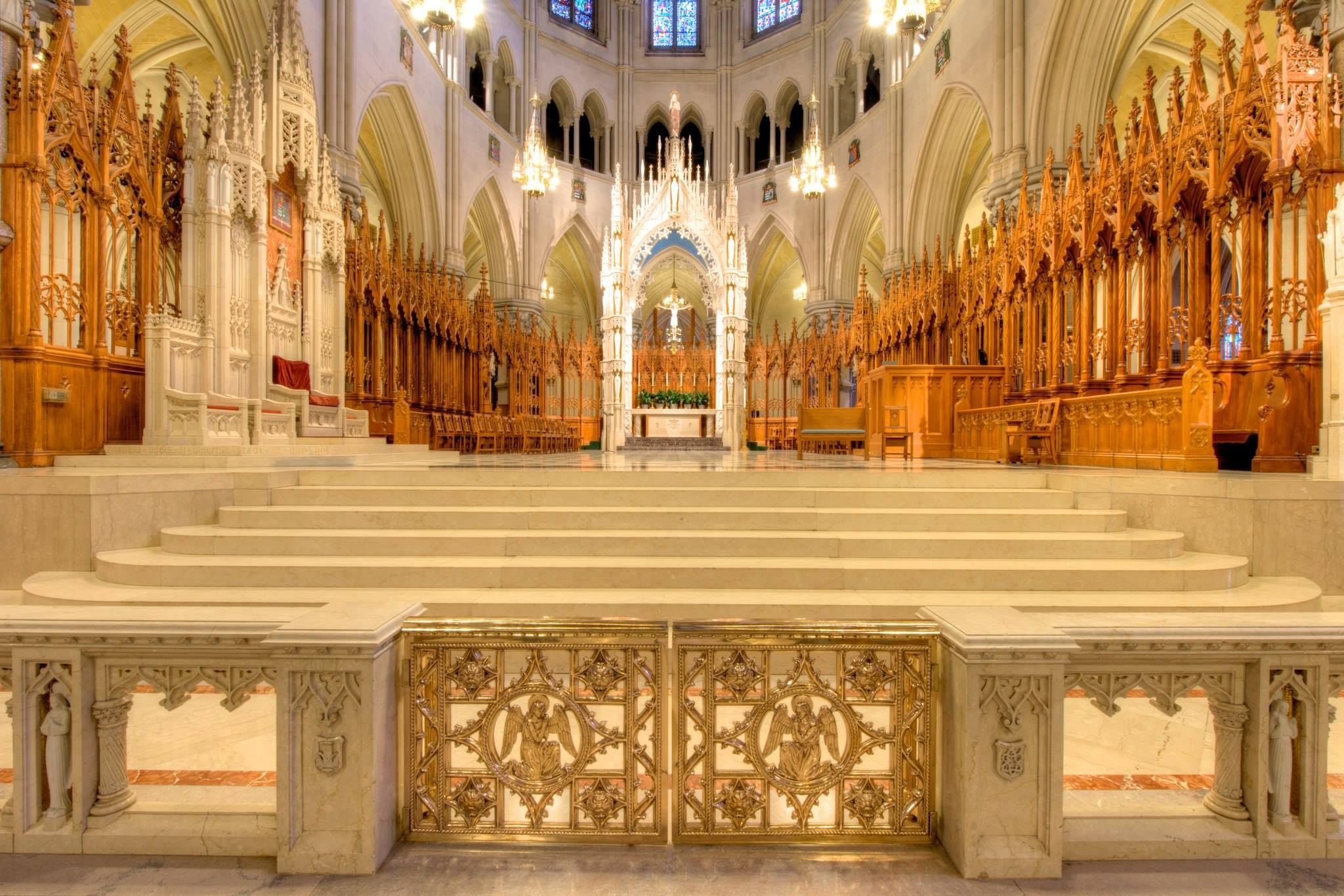
Above: the Cathedral Basilica of the Sacred Heart (Newark, NJ).
To Jesus’ Heart all burning
With fervent love for men,
My heart with fondest yearning
Shall raise its joyful strain.
Chorus:
While ages course along,
Blest be with loudest song,
The Sacred Heart of Jesus,
By every heart and tongue.
O Heart for sinners riven
By sheer excess of love,
The spear thro’ Thee was driven,
‘Twas sin of mine that drove.
Chorus
This hymn to the Sacred Heart of Jesus is often attacked, and even mocked by musical experts of all ideologies in the Church. But whatever its defects, it certainly has deep place in American devotion to the Sacred Heart. Of course, as with most things in these Unites States, it comes from elsewhere. Originally written in German by Fr. Aloys Schlor (1805-52), shortly before his death in 1852. Bearing the title Dem Herzen Jesu Singe, it had 11 stanzas. Translated to English by English academic, playwright, and Jesuit priest, Albany James Christie (1817-91), it was first published in 1876 in his The First Christmas: A Mystery Play.
But as with everything Catholic in the Americas, devotion to the Sacred Heart long predates the United States. Although Spain opened up the Evangelisation of the Western Hemisphere, it was in New France that this devotion took root, with the arrival of St. Marie de l’Incarnation, who founded the Ursuline Order in Canada in 1632, half a century before Our Lord began appearing to St. Margaret Mary Alacoque. Nine years later, Catherine Symon de Longpré, Mother Catherine of Saint Augustine in religion, brought devotion to the Sacred Hearts of Jesus and Mary to Canada, along with her veneration for Marie des Vallées, with whom she was in contact.
On March 17, 1727, King Philip V of Spain, grandson of Louis XIV, wrote to Benedict XIII, asking him to approve the Office and Mass of the Sacred Heart for the kingdoms and states of the Spanish Crown – the bulk of these were of course Spanish America and the Philippines; from this time on, the cultus of the Sacred Heart had official approbation in the Viceroyalties of the Americas.
In the newly independent United States, the Jesuit Mission at Conewago, Pennsylvania was renamed in honour of the Sacred Heart in 1787, when a new church was built. A minor Basilica to-day, it was the first parish church named after the Sacred Heart in the United States – and possibly in the Western Hemisphere.
Inspired by the French Voeu Nationale, Gabriel García Moreno (1821-1875), President of the Republic of Ecuador, consecrated his country to the Sacred Heart of Jesus. He was assassinated two years later, as he left the cathedral of Quito where he had just completed his customary adoration. But he established what became the template for National Consecrations to the Sacred Heart across the globe. In keeping with St. Margaret Mary Alacoque’s request to Louis XIV, it was done by both the Head of State, the Legislature, and the Bishops of the Country. This emphasises that the Faith ought to encompass both Church and State. Following Ecuador’s example, several Central and South American countries undertook this national consecration in the following years – the first being the Republic of El Salvador in 1874.
But the Americas were not the only area where the Sacred Heart was making inroads. On December 8, 1875 St. Daniele Comboni, Vicar Apostolic of Central Africa, consecrated his vicariate to Our Lady of the Sacred Heart.
January of 1892 saw the publication of the first issue of the Canadian Messenger of the Sacred Heart of Jesus. Under the direction of Father J.R.B. Nolin SJ, Senior Director of the League of the Sacred Heart and of Reparative Communion at the Sacred Heart offices in the Gesù, Montreal. The Papal Zouaves of Quebec, after fighting for Bl. Pius IX, 1860-70, became as instrumental in spreading devotion to the Sacred Heart in Quebec and Canada as their brethren were throughout Europe.
In 1896, Marie de la Rousselière (1840-1924), who had joined her sister’s family in Canada, founded the Sanctuary of “La Réparation” at Pointe-aux-Trembles, Montreal. She had the first chapel built at her own expense. It quickly became a place of pilgrimage dedicated to the Sacred Heart, where the Holy Face and the Virgin of Pellevoisin were particularly venerated. She returned to France in 1901 and entered the Carmelite convent in Angers the following year, taking the name Marie-Clémentine of Jesus in the Eucharist.
Newark, New Jersey, was the scene in 1899 of the laying of the cornerstone of what is now the extraordinarily beautiful Cathedral-Basilica of the Sacred Heart. Any number of churches were dedicated to the Sacred Heart throughout the United States during this era.
The Republic of Venezuela was consecrated to the Blessed Sacrament on Sunday, July 2, 1899, three weeks after the Consecration of humankind to the Sacred Heart of Jesus by Pope Leo XIII—on Sunday, June 11, 1899—and one week before the closing of the Plenary Council of Latin America—on Sunday, July 9, 1899. The Consecration of Venezuela to the Blessed Sacrament was like an echo of the Consecration of humankind to the Sacred Heart of Jesus, except that the Consecration of the Republic of Venezuela was not to the Sacred Heart of Jesus, but to the Blessed Sacrament. Nevertheless, it was very much an expression of the ideal of the Eucharistic Heart of Jesus. It was however a strictly ecclesiastical act, without participation of the secular authorities.
In Colombia, on the other hand, things were very different. For a decade impetus had been gathering for such a consecration – to include civil authorities. In 1881, the building of the Basilica of the National Vow began in Bogota. At last, on June 22, 1902, during the midst of a civil war, the action was accomplished. The president being away directing the fighting, his place was taken by the vice president. But in addition, there were the Ministers of the Executive Cabinet, the Supreme Court of Justice, the Council of State, the Attorney General of the Nation, the Court of Accounts, the Governor of the Department with his Secretaries, the Mayor of the city with the Municipal Council, and the General Staff of the Army. As in France and Ecuador, the cornerstone was laid for a national church dedicated to reparation to the Sacred Heart.
On August 24, 1907, while on pilgrimage in Paray-le-Monial, the Peruvian priest Father Mateo Crawley-Boevey was inspired to found the Enthronement of the Sacred Heart in Families, inspired during a night of adoration. In Rome, where he was received in private audience that same year, Pius X encouraged him in this apostolate and asked him to dedicate his life to it. The aim was to introduce the Sacred Heart into every family, “so that, with its image placed in the most prominent place in the home, as if on a throne, Jesus Christ Our Lord might visibly reign in Catholic homes.” This devotion first spread through Latin America, than the North, and finally has become World-wide. In Valparaiso, while giving numerous lectures and retreats, Father Mateo inaugurated the preaching of the Holy Hour. It is a call to an hour of public adoration before the Sacred Heart. In 1914, he published Twelve Exercises for the Holy Hour. The Archconfraternity of the Holy Hour, affiliated with Paray-le-Monial, was established in the Church of the Sacred Hearts of Valparaiso, and he was appointed its director.
In 1911, the Basilica of the Sacred Heart in Tismaru, on the South Island of New Zealand was and is a testimony to the poor Irish parishioners of the area, who raised the money to build and furnish this amazing structure.
On October 24, 1920, Bishop Larocque blessed a small chapel dedicated to the Sacred Heart, built according to the wishes of Father Joseph-Arthur Laporte (1857-1921), a priest of the Clerics of Saint Viator. He had acquired land for this purpose on Beauvoir Hill in the Diocese of Sherbrooke as early as 1915. A statue of the Sacred Heart, erected in 1916, preceded the construction of the chapel, attracting the first pilgrims. Managed first by the secular clergy of Sherbrooke, then by the Daughters of Charity of the Sacred Heart of Jesus, the Shrine was expanded in 1945 with a new church, intended to accommodate the growing number of pilgrims. The Sacred Heart Sanctuary of Beauvoir was entrusted to the Assumptionist religious order from 1948 to 1996; it’s now looked after by the Marists.
In Mexico, thanks to the power of the anticlericals, consecration ceremonies were limited to the interior of churches, but they gained greater momentum during the post-revolutionary period of the 1920s. There the monument dedicated to the Sacred Heart is located in the traditionally Catholic region of Guanajuato. Cubilete Hill, a rugged mountain, first witnessed “consecration of the nation to the ‘King of Heaven” began to be celebrated in late 1919. In 1923 a monument was erected, with numerous bishops supporting its consecration. So far from any government official collaborating, the then-apostolic delegate, the Italian Ernesto Filippi was expelled from the country for presiding over the event. This was the beginning of the Cristero Rebellion against the anti-clerical governments of the post-revolution, with the battle cry “Long live Christ the King!” The statue, erected at the beginning of the decade and of small proportions, was dynamited on the orders of the government of Plutarco Elías Calles in January 1928. A group of militiamen allegedly “executed” the statue, but the preservation of the remains of Christ’s head and heart on the Mexican hill was considered miraculous. A new, more imposing monument was later built around these ruins.
Over the next few years, Nicaragua (1920), Costa Rica (1921), Brazil (1922), and Bolivia (1925) were all consecrated to the Sacred Heart. Each was done with either the cooperation or the enmity of the civil authorities. In the former case, it was because those in power at the moment were committed to retaining some elements of the Catholic order with their respective countries had been founded by the Spanish or (in the case of Brazil) the Portuguese.
In 1925, French Canada, thanks to Father Marie-Clément Staub AA (†1936), would see another Shrine dedicated to the Sacred Heart in Sillery, Quebec. Linked to the “Montmartre” founded by the Augustinians of the Assumption in 1917, the Shrine became the centre of the Archconfraternity of Prayer and Penance in Canada. The Canadian Montmartre is a place of pilgrimage and worship, affiliated with the Montmartre of Paris since 1953. A magazine, L’Appel du Sacré-Cœur has been published since 1948. Three years later, another such small Montmartre would be erected in Balata, near Fort-de-France in Martinique.
The “Sacred Heart Programme,” founded by Father Eugene Murphy SJ (1892-1973), began broadcasting on radio station WEW in St. Louis, USA in 1939. It was an immediate success. On June 17, 1955, the programme made its television debut. By the time of Father Murphy’s death, the radio programme was being broadcast by 985 stations worldwide, and by nearly 2,000 when it was shut down by the Missouri Jesuits in 2005.
On January 11, 1998, renewing the consecration performed by García Moreno in 1874, the President of the Republic of Ecuador publicly consecrated his country to the Sacred Heart in the Quito Cathedral, in the presence of all the country’s bishops.
November 1, All Saints’ Day, 2020, saw church bells ring out on the day the nation and people of Paraguay were once again consecrated to the Sacred Heart of Jesus and the Immaculate Heart of Mary, the Virgin of Caacupé, in the Basilica of the same name, during a solemn religious ceremony attended by President Mario Abdo Benítez, accompanied by his family.
In addition to Conewago and Newark, there are basilicas and shrines dedicated to the Sacred Heart in places like Syracuse, Washington, DC, South Bend, Norfolk, Virginia, Atlanta, and elsewhere. In this year of 2026, the Bishops of the United States of America consecrated their country to the Sacred Heart. But of course, it was only the Bishops; the idea of the president, Congress, and the Supreme Court taking part was unthinkable. Indeed, this has been a sticking point in Europe and around the world. The Sacred Heart, the Blessed Sacrament, and the Kingship of Christ are all bound up together – and as we saw during COVID.
The truth is that while devotion to Our Eucharistic Lord, in His Holy Eucharist, His Sacred Heart, His Precious Blood, and His Kingship are seen as purely interior devotions, with little relevance to the external world, they are in reality quite different. They are reminders that all earthly power that sets itself against the Social Reign of Jesus Christ is itself doomed. As Pope John Paul II declared on Oct. 27, 1986, at the convent of the Sisters of the Visitation in Paray-le-Monial: “The true reparation asked by the Heart of the Saviour will come when the civilisation of the Heart of Christ can be built upon the ruins heaped up by hatred and violence.”