
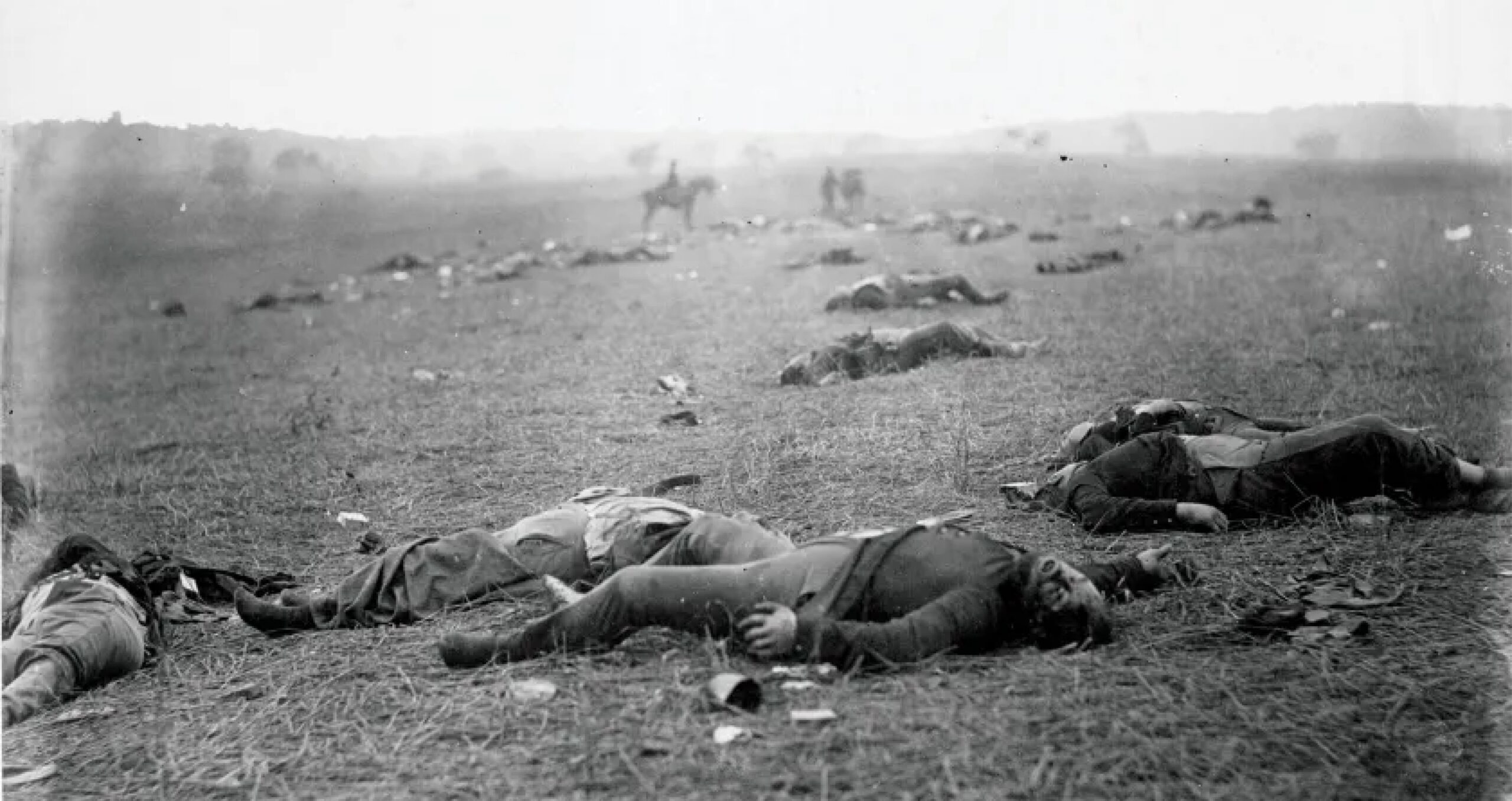
Above: Union dead after the Battle of Gettysburg, Gettysburg, PA, 1863. Photo by Alexander Gardner (Library of Congress).
IN MEMORIAM: CHARLIE KIRK
The past week or two has been filled with horrible news in America. On August 22, 2025, in Charlotte, North Carolina, twenty-three year old Ukrainian refugee Iryna Zarutska was stabbed to death on the public transit; it was widely noticed that media outrage in response to a black-on-white killing was muted as opposed to the opposite; nor did Charlotte experience white, “mostly peaceful” protesters looting and burning – which in itself was a relief. Then, August 27, 2025, a mass shooting occurred at the Church of the Annunciation in Minneapolis, Minnesota. The attack took place during a scheduled school-wide Mass attended by the students and faculty of Annunciation Catholic School and was conducted by a transgender alumnus of the institution. The unholy trinity of mayhem concluded on September 10, with the murder of Charlie Kirk on stage by a young radical who had a “transgender” partner. In the few days since, media – both social and antique – has exploded with opinions.
Now, to be honest, apart from his name and vague awareness that he was a young pro-Trump activist, I really did not know much about him at his untimely death. In the torrent of opinion that followed, I learned a lot more. He had been a huge influence on a great many young people, especially young men. He promoted “traditional values,” for which he was hated by and beloved of many. A great many young people, especially of the male variety, have taken the time to praise him to me and his influence on them, making me sad in retrospect that I did not now him. Although an Evangelical, he was married to a Catholic lady and his children were Catholic – and lately, he had begun promoting devotion to Our Lady among his co-religionists (which personal experience shows is often a sign of ongoing conversion). To his supporters he was a saint and martyr, to some of his opponents he was the devil incarnate. Others are trying to pursue a more moderate course, for which they are roundly condemned by both sides.
Now, reactions to all three of these horrific incidents showed quite clearly something that most of us are aware of: there are two countries sharing the territories of these United States. Of course, the boundaries are not as clear as mourners and detractors of Charlie Kirk. He had his opponents on the Right; some on the Left – most notably Bernie Sanders – have been amazingly civilised. But the fact remains that at bottom, one America believes that God exists and that countries and individuals are accountable to Him; that He has created Man, and bestowed rights and obligations upon him from Conception until Death; that He has created Man as both male and female, and ordained marriage between them solely; and a great many other things stemming from those first principles. The other America denies the lot, and has very different ideas stemming from those denials. Even among longtime friends “there’s battlelines being drawn,” in the immortal words of the Buffalo Springfield. Of course, the next line follows, “and nobody’s right, if everybody’s wrong.”
Now, on the day of Mr. Kirk’s murder, I put out what I hoped were pacificatory notes about the need to behave in a civilised manner in times like these. I was immediately informed by several young Facebook friends that I was old and out of touch, did not understand how horrible things really are – especially for men with families and single white males, and that they welcomed the coming conflict. Would I have told the Cristeros and the Vendée to stand down? I was asked. There was a great deal more to the same effect, to the point that I took down the threads. There can be no arguing with ad hominems.
But I bear my young interlocutors no ill will. They have been handed an increasingly poisonous environment, where reality is reduced to the views of one side or another. Their understandable anger at the failures of my generation (I was born in 1960, and so am a junior Boomer) as parents and as stewards of the land, of culture, and of society is correctly aimed at the ideology formed thereby and being pressed upon them. But our very failure to teach them history makes it difficult for them to see reality beyond their own experience; moreover, everything is personalized – one particularly annoying trait we did succeed in passing on to them. So it is that my young friends appear to be chomping at the bit for a Third American Civil War.[1]
Before Pontificating further, let me point out a few realities about the first two civil wars (although we might even say there were four, given that both the 1639-53 Wars of the Three Kingdoms and the so-called “Glorious Revolution” of 1688-92 led to battles on this side of the pond). The first, which we call most often the American Revolution, was fought not only in the Thirteen Colonies, but in Asia, Africa, on the High Seas, and at Westminster in terms of Parliamentary debate and eventual ministerial overthrow. Cleared of hagiography, in a domestic sense it pitted Great Britain’s Whig Oligarchy and the thirteen little colonial oligarchies and their supporters against the King and his.
What this meant concretely on our side of the water in the immediate was that in each colony those who had the preponderance of the wealth and had dominated the colonial assemblies before now created new governments, to which everyone had to swear allegiance on pain of tar-and-feathers, loss of property, or even loss of life. Nathaniel Hawthorne, in his piece, “The Old Tory,” conjured up the reaction of one such person:
Well, then, here we sit, an old, gray, withered, sour-visaged, threadbare sort of gentleman, erect enough, here in our solitude, but marked out by a depressed and distrustful mien abroad, as one conscious of a stigma upon his forehead, though for no crime. We were already in the decline of life when the first tremors of the earthquake that has convulsed the continent were felt. Our mind had grown too rigid to change any of its opinions, when the voice of the people demanded that all should be changed. We are an Episcopalian, and sat under the High-Church doctrines of Dr. Caner; we have been a captain of the provincial forces, and love our king the better for the blood that we shed in his cause on the Plains of Abraham. Among all the refugees, there is not one more loyal to the backbone than we. Still we lingered behind when the British army evacuated Boston, sweeping in its train most of those with whom we held communion; the old, loyal gentlemen, the aristocracy of the colonies, the hereditary Englishman, imbued with more than native zeal and admiration for the glorious island and its monarch, because the far-intervening ocean threw a dim reverence around them. When our brethren departed, we could not tear our aged roots out of the soil. We have remained, therefore, enduring to be outwardly a free-man, but idolizing King George in secrecy and silence–one true old heart amongst a host of enemies. We watch, with a weary hope, for the moment when all this turmoil shall subside, and the impious novelty that has distracted our latter years, like a wild dream, give place to the blessed quietude of royal sway, with the king’s name in every ordinance, his prayer in the church, his health at the board, and his love in the people’s heart.
(Frankly, he reminds me very much of an elderly gentleman of my acquaintance, who after thirty years in the Army Reserve and then attaining the rank of Brigadier General in his State’s defence forces, was cashiered a few years ago for refusing to march in the gay pride parade in his State’s capital.)
When the war ended in 1783, at least 100,000 rebels, Loyalists, British, French, Spanish, Indians, and Hessians were dead as a result, and another 100,000 Loyalists had to leave for Canada, the Bahamas, Great Britain, and Sierra Leone. A few New York Dutch Loyalists even ended up at the Cape of Good Hope twenty years later. The King had his wings severely clipped, and the way prepared for the completely ineffective Monarchy Britain and the Commonwealth Realms we share to-day, with the King unable to “protect his people from their politicians.” Instead of slavery and the American Indian issues being solved primarily peacefully, as they were in the British Empire, they would be dealt with in the American Way – the latter of which brought us to the Little Big Horn and Wounded Knee, and the former contributing mightily to our Second Civil War.
It may well indeed be said that the ingredients for our second Civil War were a result of the solutions to the first. Apart from the Slavery issue, who had succeeded to the Sovereignty of Parliament (the burning issue in the English Civil Wars of the 17th century)? The newly independent States, or their creature, the Federal Government? What right had a regime whose origin was based upon secession (from the British Empire) to impede those of its constituents who wished to do likewise? Moreover, just as whole sections of the Thirteen Colonies had been Loyalist during the first civil war, those very areas in the North tended to be Copperhead, but in the South they became Unionist. It was indeed a confusing struggle. When it was over, says the American Battlefield Trust’ website,
Roughly 2% of the population, an estimated 620,000 men, lost their lives in the line of duty. Taken as a percentage of today’s population, the toll would have risen as high as 6 million souls.
Not only was the South devastated, but the Reconstruction regime that followed in turn created the reaction of Jim Crow. The two together created that racial hatred that has plagued our country ever since. Indeed, it may be said that Iryna Zarutska’s murder – and more especially the indifference of her fellow travellers as she bled out – was one of the latter day fruits of those two unpleasant phenomena.
But what makes the current Civil War under contemplation different is that Loyalists and rebels, Unionists and Confederates, for the most part had a shared moral consensus, to which they all appealed on their own behalf. Both sides in either war claimed that the God they all believed in was on their side, and their cause provable by appeal to unquestioned values they all accepted. Even with all of that going for them, the carnage and mayhem was horrible. To-day the two sides do not have even that going for them, so the opposition becomes incomprehensible and so all the more to be feared.
In contemplating the whole sad business, and before one gets excited about going into battle, let us contemplate what it would actually mean. Two years ago, a brilliant film came out called “Civil War,” exploring what such a conflict in modern America might look like. What I liked most about it was that it was apolitical. The two States whose secession caused the president to take an illegal third term were California and Texas – thus immediately removing any current issues from the question – and indeed, we never do find out what the political issues are. What we do see in graphic detail is what happens in most civil wars, transferred to a modern American setting. It makes for a most thought-provoking picture. I would recommend that everyone on either side who is the most vocal watch this film.
“That’s all well and good, Mr. Coulombe,” I can imagine one of my young interlocutors saying, “but what if they force us into it? A fat old man like you wouldn’t be expected to fight anyway! If you can’t cheer us on, old man, then at least stay out of the way.” I can imagine this because I have received such notes. Well, if it came to it, of course, there can be no question of where my loyalties would lie. But I have seen my share of war, albeit not one Americans were or are involved in. If such a war comes to our country in my time – which God forbid! – than I must agree with the sentiments that J.R.R. Tolkien, himself a veteran of the horrors of the First World War, put in the mouth of Faramir:
War must be, while we defend our lives against a destroyer who would devour all; but I do not love the bright sword for its sharpness, nor the arrow for its swiftness, nor the warrior for his glory. I love only that which they defend.
But so long as decent behaviour, civility, and kindness can fend off or even avoid entirely such a conflict, we have an obligation to try – although of course our sacred principles cannot be compromised. If the feared conflict should come, then like Bl. Karl whose skill in warfare no one questioned, we must fulfil our tasks as effectively but as chivalrously as we can, remembering that our opponents are human beings like ourselves, for whom Christ poured His Precious Blood just as much as He did for us. He shall not forget this, even if we do, and our opponents do not believe it. That is something Charlie Kirk was most assuredly aware of.
Editor’s note: see also the comments of our other contributing editor, Mr. Eric Sammons here:
[1] Editor’s note: the author’s book Puritan’s Empire details the fact that the so-called “American Revolution” was in fact the first Civil War.