

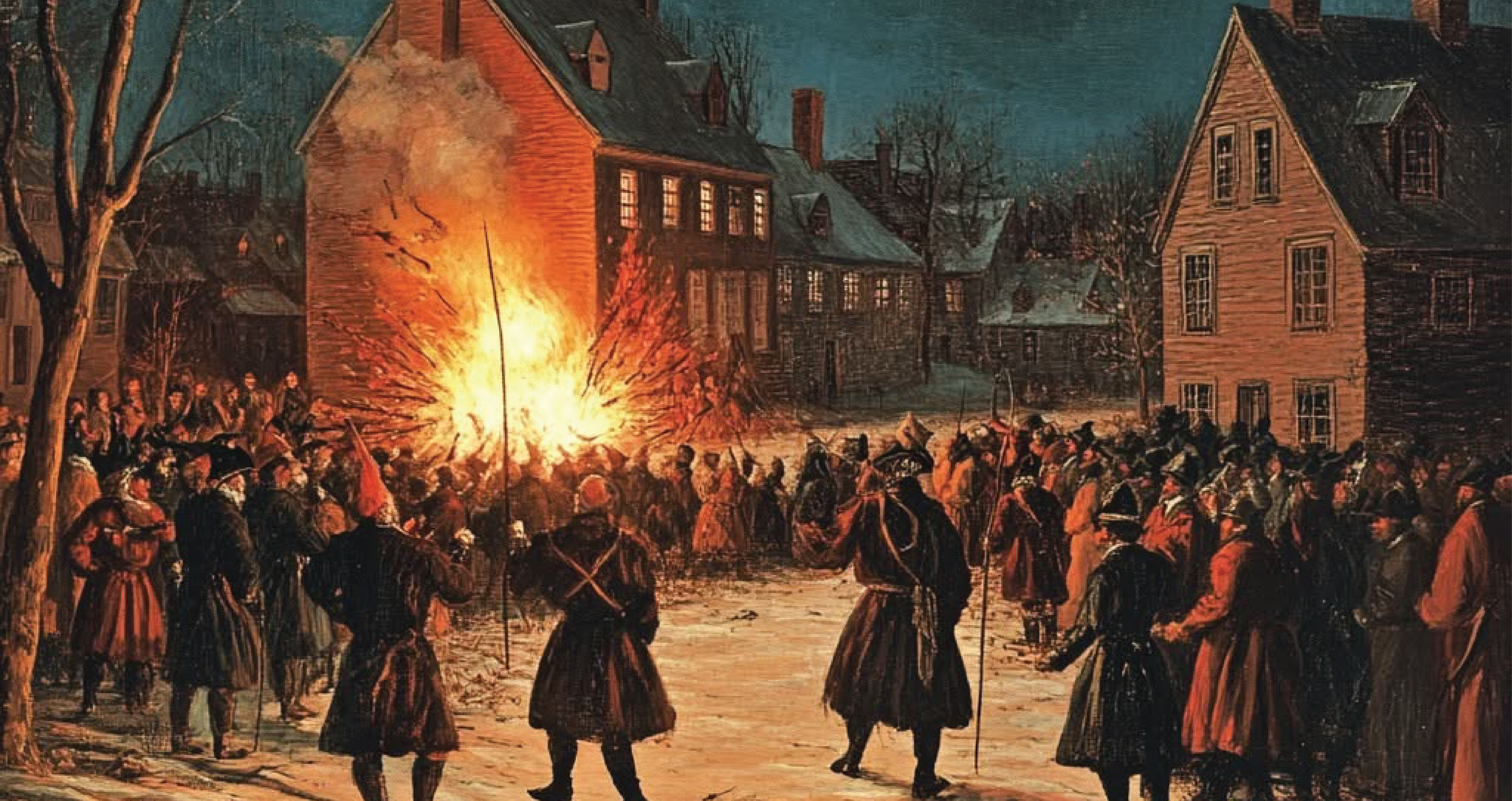
Above: “Pope Night” in the American colonies, burning the effigy of the Pope for the 5th of November.
Editor’s note, subscribe to the author’s Substack here.
“Remember, remember, the 5th of November.” But, does anyone know which events to remember? The event which King James’ government hoped his subjects would “never forget” has echoed through history, even down to the American Revolution, where the day was remembered as “Pope day” from the burning of the Pope in effigy. What exactly do men – then, as well as now – remember about the 5th November?
The Official Narrative
According to official history,[1] a group of Catholic conspirators, instigated by the Jesuits, and led by Robert Catesby and Thomas Percy, Thomas Winter and Francis Tresham, and others, were angry that King James I had reneged on his promises of Catholic toleration. They formed a secret plot to assassinate James and all the great men of the realm (including Catholic lords) by blowing up parliament with gunpowder when it would meet in 1605. The first five formed their evil pact and swore themselves to secrecy before Fr. John Gerard of the Jesuits, and gradually brought others into it with secret oaths. To accomplish this purpose, they had enlisted an English mercenary in Spanish service named Guy Fawkes to help them deliver the great blow. After failing to dig a mine underneath parliament, in a public place, where everyone could see them, they decided it would be easier to rent a cellar underneath parliament to store the gunpowder, which had to be stored across the river in Lambeth and transferred over a few barrels at a time, arousing no notice from the same government spy service (which infiltrated Catholic institutions across Europe even though each of the plotters was constantly watched for their involvement in former plots).
As the time approached for the explosive day, one or some of the plotters decided to warn Lord Monteagle, a Catholic member of the peerage so that he would not be present. As luck would have it, Monteagle unexpectedly appeared at his house in Hoxton, and on the same day an unknown man approached one of his servants in the street with a letter, warning him not to attend the upcoming parliament for, it would “receive a terrible blow.” Monteagle, quite disturbed, rode to London where he provided the letter to the Secretary of State, Robert Cecil the Earl of Salisbury. Cecil (though he waited a week), presented the letter to King James, unaware of what it could mean. The king miraculously divined the meaning and had the cellars of the parliament searched, where Fawkes was discovered with 36 barrels of gunpowder, a lantern and a match[2] ready to set the powder alight. He was arrested by Sir Thomas Knyvett, the warden for the parliament buildings (who would have seen both Thomas Percy and Fawkes frequently about but never thought to ask what they were up to), along with other conspirators who were arrested and tortured in the tower until they confessed, and are the source for most of this narrative.
The leaders, Catesby and Percy, and others escaped to Stratford and held up in a house at Holbeche. There, amidst experienced soldiers, Percy lit a brazier for heat on top of a barrel of gunpowder, which then exploded, injured most of them, and rendered them defenseless. It also lit a veritable bat signal for the sheriff of Worcester and his posse who were sent to arrest the remaining plotters. Catesby and Percy, the leaders of the plot (though they knew everything about it and were the best source of intel on those dastardly Catholics in England), were shot by an allegedly overactive sheriff’s deputy (who was punished with an annual pension for so doing). After being tortured in the tower, the men made their confessions, and were hanged, drawn and quartered as traitors. The Jesuit superior Henry Garnet and associates were smoked out of their priest-hole, and confessed to knowledge of the plot, though the Attorney General delayed the execution for a month and then had it commuted to hanging. Forever after, 5 November was a day of celebration: By the king’s swift deliverance (and an insane amount of luck!) England remained free from the tyranny of the Pope and the Jesuits, and if you doubt this story, you are a treasonous popish slave unworthy of the English name!
Historical Context
But is this really so? There have always been questions as to what the English government knew, and when it knew it. Fr. John Gerard, S.J., in his 19th century work, What was the Gunpowder Plot, suggests it not only knew, but manufactured the plot. This view would begin to attract even non-Catholics in the 20th century, but its ablest proponent is Fr. Francis Edwards, S.J., who compiled a tremendous amount of evidence in his work The Enigma of the Gunpowder Plot, 1605: The Third Solution. Other historians disagree with this hypothesis, and some vehemently defend the original government story. It is not possible with the existing evidence to prove the entire plot was a false flag beyond a reasonable doubt. Our purpose here is to prove the plausibility of its manufacture. Thus, let us reconsider the 5th of November.
In the first place, we need to recall that England in the 16th and 17th century was a police state. From the time of Elizabeth’s accession in 1558, and the reimposition of Protestantism in England, laws were enacted against the saying of Mass. Priests were proscribed, selling Catholic books was misprision of treason, Jesuits explicitly forbidden, and for an Englishman to become a priest abroad was high treason. All of this twenty years before the Spanish Armada. The reason is simple, the majority of the country was Catholic, and Elizabeth’s rule depended on a small but wealthy Protestant clique in London. On top of that, Mary Queen of Scot’s arrival in England kicked off rebellions against the reimposition of Protestantism. In the state of fear, the government utilized Francis Walsingham to institute a spy service. Walsingham had become expert in cryptography and espionage when he was abroad during the reign of Queen Mary, and he learned much about human psychology. He often mixed with servants, couriers, and the rougher sort of men, of whom he said, “They have no water, but they are the conduit pipes for the affairs of state.”[3] Men ruined by crushing recusancy fines, whose relatives were locked up in prisons, who themselves had been arrested in some plot or other, were easy to turn into informants, even unwittingly at times. With such techniques he infiltrated Mary Queen of Scots’ network and their rather advanced encryptions, and had infiltrated English Catholic seminaries in Douay and Rome. They knew about St. Edmund Campion’s mission even before he crossed the channel, and had eyes on every house suspected of harboring priests. This spy service did not disappear at Walsingham’s death or after Elizabeth’s, it was maintained and increased by Robert Cecil, the son of Elizabeth’s brilliant chief minister Lord Burghley. Cecil showed that he was an excellent pupil of his father and Walsingham, and he is the main player in the plot. He had negotiated heavily to cement James VI of Scotland’s accession to the throne after Elizabeth, and convinced him of his importance.
Cecil also had a number of rivals, chiefly Robert Devereaux, the earl of Essex, and Henry Percy, the Earl of Northumberland. Essex was no friend of Catholics, but he had fought against Cecil for James’ influence, and lost. In the waning days of Elizabeth, he now sought to oust Cecil.
The Essex Plot, and the Plotters
Essex was a career soldier, his godfather was Robert Dudley, one of Elizabeth’s favorites, and he had been part of a circle increasingly at odds with Robert Cecil. While Elizabeth’s popularity waned, the view of Essex and others were the old counsellors had to go. That appears to be the aim of the plot. Essex paid Shakespeare’s company to stage the play Richard II, which has a scene which had been censored by Elizabethan authorities, the uncrowning from Act 4, scene 1. Essex paid Shakespeare’s company to leave that bit in throughout the weekend of 1598, just before the plot was to be carried out on the following Monday. Essex had arranged for his supporters to line the streets demanding change, Cecil had him publicly declared a traitor, and his supporters were stopped at Ludgate Hill. Essex retreated to his estate where he was arrested, and subsequently executed.
The importance of this event isn’t so much the event itself, but the who’s who of those involved. We find the following names “reserved to her Majesty’s use”, i.e., they turned state’s evidence lest they should suffer a traitor’s death or the rest of their lives in the tower: William Parker (the 4th Baron Monteagle), Robert Catesby, Francis Tresham. Among names of those “fined and forgiven” are Christopher and John Wright, John Grant, nearly the core of those who, as we saw from the official account in the beginning, would soon fix their appointment for 5th November. Thomas Percy, who had been heavily involved with Essex, is one of two of the Gunpowder plotters who were not directly involved in the plot. All of these men were watched, known to the state, and had further dealings with it. Given the extent of state espionage, it strains credulity not only that these men would chance so daring a plot, but that the government would know nothing about it until a week prior.
The fact that all of these men would wind up in the Gunpowder treason in one way or another is striking. As Fr. Edwards puts it:
It must be evident that many if not most of those named had a sword of Damocles hanging over them which might be allowed to fall if Cecil, in effect, wished it to be so. It is difficult to believe without the serious evidence which does not exist, but rather the contrary, that so many of the above-named, who afterwards appeared in the gunpowder plot, after so chilling a warning, would have plunged themselves almost immediately into the threat of a retribution inescapable if they failed. A madman will do anything, but it is hard to believe they all went mad together.[4]
The men behind the Gunpowder Treason
The first thing that should strike us about the plot is it is largely a family affair, and all were well to do gentry. Most had been former Protestants. Robert Catesby as we saw was an Essex plotter, and he was financially ruined. Moreover, in his communications with William Cope, Robert Cecil’s servant, we learn that he had certain favors to do for his master to guarantee his liberty. He promptly came at the center of the Catholic network of middle-England, and wherever he went English authorities were not far behind. He was also the first cousin of Francis Tresham.
Francis Tresham was raised Protestant and had become Catholic when his father, Sir Thomas Tresham, converted to Catholicism. He was imprisoned several times for recusancy, and likewise saw his estates and fortunes dwindle. His sister Elizabeth married William Parker, the 4th Baron Monteagle. He turned informant in 1591, after a meeting with Robert Cecil in Star Chamber. He had been involved in a shady lawsuit, and informing on other Catholics was an easy way out. In 1601 he wrote again to Cecil asking for money, and arranging payments from his brother in law, Lord Monteagle.
William Parker, the 4th Baron Monteagle, was a shifty person. He claimed the barony through his mother, and was raised a Protestant, yet he became a Catholic upon his marriage to Elizabeth Tresham. He was fined £8,000 in the Essex affair, and had continued dealings with Cecil. Almost to the eve of the plot he appears again and again with the plotters, though this is largely whitewashed from the official account.
John and Christopher Wright were brothers from Ploughland Hill in York. Like many of the others, they were Protestants who had converted to Catholicism. In their school days they had gone to school with Guy Fawkes. Their sister had married Thomas Percy.
Thomas Percy hailed from the Percys of Scotton, which would put him very close to the family of Guy Fawkes, and like the Wright brothers Percy is alleged to have known him as well. Just the same, he passed himself off as a relation of Henry Percy, the Earl of Northumberland, and had a position with him collecting rents and running messages. Eventually, he had convinced the earl to make him the lieutenant of the band of Gentlemen Pensioners of the Royal Bodyguard. This put him in a position to demand anything he might like in Westminster, and to arrange everything necessary for the plot. While the earl recommended him in the post, it was the job of the Secretary of State to vet such candidates. For whatever reason, Cecil did not see that Percy’s credentials were lacking, as a Catholic he had not taken the oath of supremacy, and had no right to be near the king’s person.
Robert and Thomas Wintour were 2nd cousins of Robert Catesby and Francis Tresham. Robert inherited his father’s estates while Thomas served in the English regiment with Guy Fawkes. Thomas was employed as Lord Monteagle’s secretary.
John Grant was a Catholic from Worcestershire. He had suffered terribly for recusancy, and was married to the sister of the Wintours brothers, as well as a close friend of Catesby.
Ambrose Rookwood, though not related, was a very close friend of Robert Catesby. His family, from Suffolk, was among the more ancient landed families in England. They had never wavered in their Catholicism, and had fled to Flanders where Ambrose was educated. He succeeded his family’s estates in 1600, and was indicted for recusancy in 1604.
Guy Fawkes and the English Regiment at Flanders
Passing over several other minor plotters, whose roles were not significant (e.g. Digby, Keyes, Baynhard), we come to Guy Fawkes, whose name has stuck to the plot more than the others. His father Edward was an ecclesiastical lawyer in York, and Guy was raised a Protestant. But Edward’s death in 1579 brought a change to his destiny. His mother married Dionis Baynbrigge, a gentleman of Scotton. He was a Catholic, and mother and son followed him in religion. From there, Guy became a very passionate Catholic. In 1591, despairing of making a living in Elizabeth’s England, he entered military service with the Spanish in Flanders, under the command of Sir William Stanely, who had established a regiment for English Catholic exiles. He changed his name to “Guido” to make it easier for the Spanish, and he was the ensign bearer, “alferes” which made him third after the captain and his lieutenant. This position does not involve expertise in powder, or mining and sapping, though certainly Fawkes would have been used to gunpowder. In 1603 Fawkes was in Percy’s employ, bearing letters into Spain begging for intervention in England, which the Spanish refused. Could this have been an early plot? Just the same, it establishes connections older than the official account.
The English regiment was a terrifying thing for the English government, because it became a harbor for English Catholics such as Fawkes, and meant a large contingent of well-armed veterans but a channel crossing away. James making peace with Spain meant that English Catholics were perfectly free to join this regiment. The official account mentions nothing about it, but Cecil was actively involved in negotiations with the Spanish to have some measure of control over the unit. The net effect of the gunpowder plot was to make it illegal for anyone, especially a Catholic, to serve in the Spanish army.
What is more, the cover for Catesby and Percy’s actions raising troops in the midlands was that they were raising troops for the English regiment in Flanders, their purchases of gunpowder was also for that purpose. In his discussions with Fr. Henry Garnet, Catesby gave out that he was assembling men and horses for Flanders, and Garnet could not have helped but notice he was suddenly loaded with money, in spite of being ruined in the Essex plot. Where did the money come from?
According to the official narrative, Thomas Wintour comes back with Fawkes in 1604. Wintour had served with Fawkes in the English regiment. The only evidence we are given to say Fawkes was knowledgeable about or committed to any plot is the tortured confessions. The actual evidence suggests an alternative: Fawkes believed he was recruiting for the English regiment, and Catesby and Percy are the controllers who keep him in the dark about its purpose.
Holes in the narrative
The official history of the plot suggests that Thomas Percy rented a house next to parliament owned by Mr. Whynniard, the keeper of the robes. Percy, through his position with the Earl of Northumberland, was able to turn out the tenant and acquire the house, in May of 1604. This required the aid of Dudley Carleton, the secretary for the earl of Northumberland, to add to Percy’s bona fides. Conveniently, Whynniard died on the very day of 5th November, whereas Carleton for his role was promoted to ambassador and given a pension. A continuing theme in the plot is figures who fail significantly are promoted rather than punished.
Just the same, the official story suggests that six months after acquiring the house, seven men pile into a house made for one or two, and begin digging a mine underneath parliament in full view of the street. The palace of Westminster was destroyed in a fire in the 19th century, but we still have a good idea of what it was like from contemporary reports and drawings. There was business conducted there all around. Sir Thomas Knyvett, the keeper of Westminster Palace and the garden, could not have overlooked the sudden appearance of Thomas Percy and his servant, John Johnston (aka Fawkes). If it was the case that they were really digging a mine, how could he not investigate such a thing? How could the workman around the palace not notice the sound of shovels and picks striking the earthworks of the palace? In other words, the story is bunk. More than likely some kind of digging project was visible, and Cecil had it included in the confession statements because it was a tangible sign of a plot so insane contemporaries questioned its veracity. Fawkes himself, if he knew anything about mining or sapping, would have seen the logistical impossibility from the beginning. It is more likely that they had always rented the room, and Percy, in his exalted position, was able to turn tenants out and prepare the way. He had also rented a house across the river at Lambeth for storing the gunpowder, and for this they had brought another fellow into the conspiracy, Robert Keyes. He was Catholic, but penniless, and his wife worked as a governess for Lord Mordaunt. Keyes’ position also did not require him to know anything about any conspiracy.
The official story runs into trouble again in 1605, when Fawkes goes back to Flanders. If he was the point-man for carrying out the mother of all terrorist attacks, why is he back in the Netherlands, except that he is attending to the business of the regiment that he is actually recruiting for? In the summer, Fawkes would return, but they were behind schedule. Fortuitously, Parliament was prorogued from October to 5 November by: Robert Cecil, the secretary of state. Proroguing parliament was a common enough occurrence, but whenever the plotters are behind, by some marvelous coincidence, Cecil gave them more time.
The Terrible Blow
Percy, rejoined by Fawkes under his alias, continued to manage the careful placing of the gunpowder into Westminster throughout the summer of 1605, under the watchful eye of Sir. Thomas Knyvett. According to the official story, it is at this point that someone squawks.
We have mentioned Lord Monteagle at various points. He appears in various relations of the conspiracy, though he is carefully whitewashed out of the official account until this moment. He was supposed to be away from his residence in Hoxton until after parliament, but on 26 October he unexpectedly returned and asked for supper to be made ready. A servant came in with a letter handed to him by a tall man in the street, begging him not to attend parliament because “they shall receyve a terrible blowe this parleament and yet they shall not seie who hurts them.”
No one knows for sure who wrote the letter; according to the government account, the conspirators believed Francis Tresham is the one who warned him, since Monteagle was his brother-in-law. Fr. Edwards, however, argues and provides evidence of a professional graphologist, that Cecil is the one who wrote the letter.[5] The timing of the letter, Monteagle’s unexpected appearance at home, and his other involvement with the plotters gives credence to this possibility. Through whatever arrangement, he became favored by Cecil, and would be allowed to survive. The contrivance was to give the story to the public that Monteagle rode in haste with the letter to Cecil’s house a few days later, and on 31 October he showed it with a relation of events to James. If it is true that Cecil wrote the letter, then the contrivance was to pretend to be confused by the contents, which are worded in such a way for someone like James could figure it out. Thus the contrivance would reinforce James’ notions of the power of monarchy. As Edward Coke, the secretary of state expressed,
the king was divinely illuminated by Almighty God, the only ruler of princes, like an angel of God, to direct and point, as it were, to the very place, to cause a search to be made there, out of those dark words of the letter concerning a terrible blow.[6]
While Cecil maintained that he sat on it for almost week because he attached no importance to it, in private he says he saw what it meant right away, but delayed action to the last moment.[7] The Monteagle letter is a contrivance; it was to ratchet up the tension in the drama for the public, no more.
After much delay, the king ordered a search to be made, and during the day of 4 November, Sir Thomas Knyvett conducted a search of the parliament cellars, where Fawkes was found (under his alias John Johnson), and Knyvett left. He came back with an armed guard at night, where he found Fawkes, with the lantern and the match, allegedly. The match was never logged in evidence, but the powder was.
The Powder
Gunpowder was not a rare commodity in this time, nor difficult to obtain. There was in fact a glut on the market as a result of the peace treaty between England and Spain, and it could be easily—though discreetly—purchased. Now, the average life of gunpowder was around two years, as the technology did not exist to seal it in a vacuum. This meant that it had a sell by date, and poor, damp conditions could accelerate that decay, such as found in the vault under Westminster, or across the river in Lambeth, where the conspirators’ powder had been stored. After Fawkes’ arrest, the powder was catalogued in the tower, where the warden made the following report:
Received into his Majesty’s store within Thoffice of Thordenaunce from out of the vault undernethe the Parliament house corne powder XVIII hundred weighte decaied which was there laide and placed for the blowinge up of the said howse and destruction of the Kings Maiestie the nobilitie and commonaltie there assembled. Received as aforesaid Corne powder decayed, etc..[8] (My emphasis).
Now, decayed gunpowder doesn’t actually blow up. In other words, unlike the FBI in 1993, Cecil’s agents gave the plotters a bomb that wouldn’t work.[9]
Now, it is hardly plausible that if Guy Fawkes was utterly intent on blowing up parliament, and was an expert in powder as a soldier, that he would be inspecting it constantly. On the other hand, if he thinks the powder is destined for Flanders, and has been arranging matters with his regiment in the earlier part of the year, it is plausible he trusted Percy that all would be taken care of. If one were examining this from the standpoint that Cecil caught wind of the plot and was letting it widen, or from what we propound here, this reveals a strong complicity which is consistent with him managing a plot but minimizing actual danger.
The Men who knew too much
The other conspirators, on news of Fawkes’ arrest, assembled in Stratford, as we related in the beginning in the official account. Robert Walsh, the sheriff, had put together a posse comitatus to apprehend them, and Percy, rather inexplicably, blows them up. The matter is rather comical, and again strains credulity. Is it rather that Percy and/or Catesby were playing their parts? Several nights before Fawkes was arrested, Catesby had been present at Cecil’s house, allowed in privately from the back door.[10] Percy had seen him in the summer. If anything it shows that Cecil kept regularly informed about the progress of the plot, what I would maintain was his plot.
Either way, according to the testimony, they were both shot with one bullet. Now, it is difficult to imagine this tactically if they were actively resisting or evading the sheriff. Round balls had the force to go straight through the body, but in an actual situation where people move, shirts and bones absorb the kinetic energy of the bullet, etc., the most likely position in which the two would have been together so that a bullet could pierce both is that they were in a position of surrender. Moreover, at this time it was known to the government that Percy and Catesby were the ringleaders; yet the man who shot them received a pension for life, instead of punishment for his failure to capture them. The Wright brothers were also killed, but Grant, Rookwood, and others were arrested and brought to the tower where they would also have confessions tortured out of them.
Aftermath
Cui bono? In the first place, the government. Robert Cecil accomplished three things: He destroyed the English Regiment in Flanders; he blackened the name of Catholics and the Jesuits in particular. We had not time to discuss the fate of poor Henry Garnet, but in spite of the fact that there was no evidence of any complicity in the plot, and the plotters had taken pains to give the Jesuits knowledge under the seal of confession, when he was arrested he was found guilty of high treason, and sentenced to be hanged. The official account, however, was able to make out that the Jesuits inspired the whole plot, even though none of the other plotters confessions mention it. Propaganda depicts the Pope as having commissioned it, even though the government was in possession of letters written by the Jesuit Superior Acquaviva, and Pope Paul V forbidding any violence.
The third thing Cecil accomplished was that he blackened the name of his rival, Henry Percy the earl of Northumberland, who would spend time in the tower for employing Thomas Percy. He also affectively struck his target: James. There is no evidence that James was remotely aware of the plot, such as it was alleged to be, until a few days before the end. As a foreign king, James would now be convinced of Cecil’s usefulness; he would be in a position to demand more money out of parliament, which he did when it finally met, and which, contrary to its normal stinginess, granted James all the money he asked for as happily as liberty-minded Republicans voted for the Patriot Act in 2001. Recusancy fines would not be decreased, and more importantly, all Catholics would be subjected to the Oath of Allegiance, which is a controversy all in on its own.
Thus, the 5th of November was a political masterstroke by the government, and a disaster for Catholics. But above all, it was a work of the government (either in its origin or at least in connivance) to entrap desperate men and use them to implicate the innocent for their purposes.
[1] The substance is laid out in the True and Perfect Relation (which is anything but true and perfect) and though attributed to King James, was in fact written by an official. See Carswell, Trial of Guy Fawkes and Others (London and Edinburgh, 1934), p. 105.
[2] For context, a “match” in the 16th century was a bit of rope soaked in saltpeter.
[3] Stephen Budiansky, Her Majesty’s Spymaster (Plume, 2005), p. 36.
[4] The Enigma of the Gunpowder Plot, p. 27.
[5] The Enigma of the Gunpowder Plot, p. 138.
[6] Edward Coke, “The Trial of Henry Garnet,” in A True and Perfect Relation of the Proceedings at the Severall Arraignments of the Late Most Barbarous Traitors (London: Robert Barker, 1606), section “The Observations,” no. 2.
[7] Carswell, Trial of Guy Fawkes and Others (London and Edinburgh, 1934), pp. 51-52.
[8] Gerald Bartlett, “Receipt for the 1,800lb of Guy Fawkes’ gunpowder found,” The Daily Telegraph (May 4, 1978).
[9] In the event that anyone thinks I am making an absurd joke, the FBI did in fact tell their informant, Emad al Salem, that the bomb must be real.
[10] Edwards, The Enigma of the Gunpowder Plot, p. 116.