
The year decays, November’s blast
Through leafless boughs pipes shrill and drear;
With warmer love the home clasps fast
The hands, the hearts, the friends most dear.On many seas men sail the fleet
Of hopes as fruitless as the foam;
They roam the world with restless feet,
But find no sweeter spot than home.To-day with quickened hearts they hear
Old times, old voices chime and call;
The dreams of many a vanished year
Sit by them at this festival.Though hearts that warmed them once are cold.
Though heads are hoar with winter frost
That once were bright with tangled gold —
Thanks for the blessings kept or lost.—Anon., “Thanksgiving Day.”
Another Thanksgiving Day has come. For me it is a bittersweet holiday, in a way that Christmas never is. At first bush, that does not make a great deal of sense, given that both observances share the same memories of now-deceased loved ones. But I suppose it is because Christmas has a transcendent meaning and life all of its own, to which anyone’s fond memories are necessarily secondary. Of course, the Ghost of Christmas Past lingers in one’s mind, with persons, places, and things that have ceased to be. But the birth of Christ itself, the liturgies attached thereto, and the sheer variety of customs wherewith the whole planet stops and acknowledges however grudgingly the Nativity of its Saviour far outweigh, for me anyway, the pangs of loss.
But Thanksgiving is decidedly different. Growing up, it was decidedly a lesser feast – primarily renowned for its turkey, for which my brother and I hungered for at least a week in advance. Dad would say grace in French over the elaborate meal, and the four of us would greedily tuck in – my brother and I thankful to be home from school for a four-day weekend. Dad always presumed there would be days of leftovers from the enormous turkeys he inevitably bought – and every year Andre and I would frustrate these hopes by staging a raid on the turkey carcass the following day and consuming as much if it as we could. The Sunday following, after we moved to Hollywood, California, featured the Santa Claus Lane Parade. As with New York’s Macy’s Thanksgiving Day parade, Santa would arrive in his sleigh at the very end of the parade, signalling the opening of the Christmas shopping season. A later additional custom was watching the Twilight Zone marathon, which all four of us enjoyed far more than any sports game.
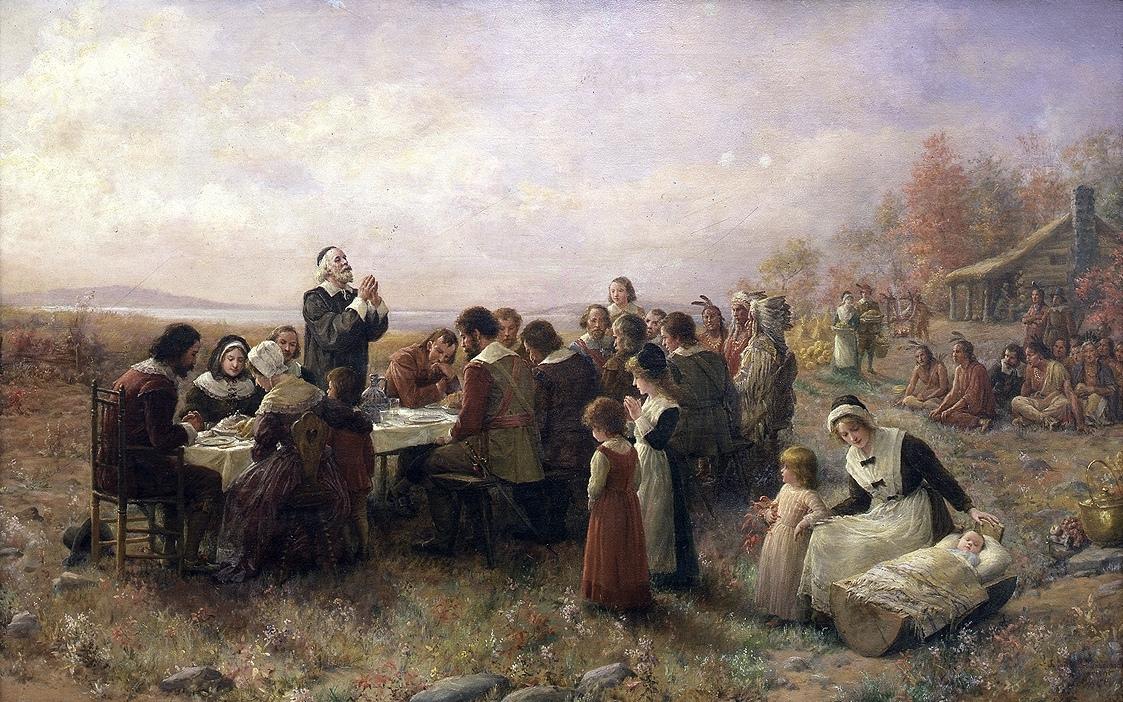
Of course, Thanksgiving Day had very little religious significance for us, apart from the general theme; it was, after all, a celebration of America’s Puritan heritage, and that was something my acutely Catholic parents had little use for. Despite various alternative “First Thanksgivings” which pointed to Catholic Florida and New Mexico and Anglican Virginia, it was definitely Plymouth’s Pilgrim Fathers’ dinner party that was referred to as “first.” All the standard sources for Thanksgiving celebrations – such as Schauffler’s memorable book – referenced Myles Standish, William Brewster, and the rest of the Mayflower gang. As the latter authority related, “Thus the first thanksgiving festival was celebrated in America and by little and little the custom spread, and its influence deepened until it has become a national holiday, proclaimed by the President, reproclaimed by the Governor of each State, and observed on the third Thursday in November by every good American and true.” But where the Canadian Thanksgiving was basically a European harvest festival, that of the United States in origin was a substitute for the Christmas banned in Old and New England by the followers of Oliver Cromwell. Dad being of French-Canadian descent, albeit born in Massachusetts, the Puritans had been our hereditary enemies. Our view of their legacy was decidedly ambiguous.
Yet New England is without a doubt the ideological active ingredient of the United States. There are reasons for this, despite Jamestown, Virginia being founded in 1607, as opposed to late-coming Plymouth’s 1621 origin. The fact that we look to Plymouth Rock as our national shrine of original settlement rather than Jamestown’s Memorial Church speaks volumes. But there are a number of reasons for New England’s hold on the national imagination.
The first is that while the Puritans’ Calvinism made them rather dour, their self-image of themselves as the Chosen People of the New Testament filled them with self-confidence – even as their determination to prove themselves among the Elect through material blessings, drove them to pursue both education and financial success. Thus, our first university, Harvard, was founded in Boston, and four of the seven or eight Ivy League Schools are located in New England – and the Public Schools originated there. American shipping, banking, insurance, and industry all got their starts there.
The part the region would play in the beginning of the Revolution is a testimony to the key role the New England colonies already played in the National life – as a visit to Boston’s Freedom Trail and the Minuteman and Boston National Historic Parks shall show you. The roles played by New Englanders John and Samuel Adams, John Hancock, Paul Revere, and Ben Franklin (a Boston native, despite his later association with Philadelphia) in the creation of the new country was pivotal.
Once independence was achieved, New England came to dominate the new nation’s intellectual life, despite the resistance of such figures as New York’s redoubtable Washington Irving. Nathaniel Hawthorne, Henry Wadsworth Longfellow, and many other came to dominate national literature. Even resolutely self-proclaimed Southerner Edgar Allan Poe was born in Boston. The breakdown of Calvinism resulted in the birth of American Unitarianism, which – with its non-doctrinal “churchiness” came to hold an important place in the American psyche – not least because it captured Harvard. An even less dogmatic movement – Transcendentalism – spun off of that earlier movement, and gave us such influential figures as Ralph Waldo Emerson, Henry David Thoreau, Bronson Alcott, Margaret Fuller, John Greenleaf Whittier, and the Brook Farmers. All the while, New England Yankees abandoned their stoney fields in droves, moving ever westward and deeply affecting the culture of the nascent great American Midwest. When the Slave Trade – heretofore carried out by New England ships bringing their human cargo to the Southern ports and selling it there – became illegal in 1808, New England’s abolitionist movement grew in proportion as profits dwindled. New England played a pivotal role in the ensuing War Between the States.
That gruesome conflict concluded, New England continued to occupy a preeminent place in American life. For all that it led the way in the nation-wide Colonial Revival Movement, it also produced intellectual figures like Henry Adams, Ralph Adams Cram, Imogene Louise Guiney, and T.S. Eliot who were decidedly critical of the Puritan basis the American mind. At the same time, hordes of foreigners – Irish, French-Canadians, Italians, and still others – changed the ethnic face of the region completely, even while attempting in various ways to assimilate. From this era, Catholicism in New England came to dominate numerically, even while it carefully refused to evangelise the natives to any great degree. In one area, however, the Irish did cone to dominate, via that Democratic Party – politically. The Two World Wars rapidly pushed their cultural assimilation, as the post-Vatican II era did their religious. As a result, although the rural areas dominated by the Yankee descendants of the original settlers tend to be more Conservative, the rural centres inhabited by the post-Catholic descendants of the immigrants are very Liberal indeed – as are the surviving WASP institutions, such as the universities, learned societies, and boarding schools.
Despite all of the changes, however, New England retains a kind of strange timelessness, both in its self-image, and that held of it by the rest of the country. Robert Frost’s poetry and Norman Rockwell’s art come to mind as strong examples not only of regional art but of Americana as a whole – as does the eerie work of H.P. Lovecraft. Tourists flock to open air museums like Plimoth Plantation, Old Sturbridge Village, Mystic Seaport, and Historic Deerfield – to say nothing of the annual droves of “Leaf-Peepers.” Such historic inns and eateries as Sudbury’s Wayside Inn, Shirley’s Old Mill, and Concord’s Colonial Inn draw huge numbers of outsiders, as do the countless covered bridges. The Weird and Wiccan gravitate toward Salem’s memories of witchcraft. Both Yankee Magazine and its affiliated Old Farmer’s Almanac are nationwide favourites. Most ironic of all, considering its being banned in colonial times, for many Americans there is no more poignant image of Christmas – as shown on innumerable Christmas cards – than a snow-covered Congregational Church decorated with seasonal greens.
Not too surprisingly, however, Thanksgiving becomes a sacred rite in the Plymouth area. Pilgrim Hall Museum, the Old Colony Club, and the local detachment of the Mayflower Society all offer extraordinary events. It is a major observance, with many events covering the entire weekend. The First Parish Church of Plymouth, the church the Pilgrims constituted upon their arrival, is now Unitarian. Nearby is the Church of the Pilgrimage, established in the early 19th century by Trinitarian dissidents. But, as with all New England institutions, there is a feeling of genteel decay about the whole affair.
Indeed, that air of decay eventually became part of Catholic institutions in the six New England States. The many closed Catholic churches that once boasted thriving congregations is only the most obvious sign of this decline, which was hastened but not begun by the sexual abuse scandals which rocked the area in the 1990s.
All if that having been said, both sides of my family have been connected to the region – although, as we thought, extending back no earlier than the 19th century. But in the past two years, a series of genealogical discoveries has revealed that my French-Canadian forbears were far more closely connected to the Puritans then we ever knew. It turns out that one of my remote ancestors, Jacques Desnoyons, was a voyageur who discovered Minnesota’s Lake of the Woods. But in 1704 he visited Deerfield, Massachusetts, and married one Abigail Stebbins, daughter of a hero of King Philip’s War, and a pillar of the Puritan colony. A few weeks later, the French staged the Great Deerfield Raid, and took a great number of the locals, including Jacques and his new wife, back to Quebec. From them do we descend.
I cannot say this discovery has made me friendlier toward Calvinism, Unitarianism, Transcendentalism, Spiritualism, Mormonism, or any of the other strange faiths New Englanders have either created or embraced. But its does reveal that when I stood in several of the Stebbins houses in Deerfield, I was unconsciously returned to the local home of some of my family – and that my love of the region has far deeper roots than I ever knew.
In any case, the whole region remains one which I enjoy immensely whenever I visit. For all of its decay and insane edges, it remains a place of Autumnal beauty, or venerable customs, and mellow atmosphere. When I contemplate my father’s hometown of New Bedford, or our family plot in Fall River where I shall, Deo volente, one day be buried myself, I feel a great love of the place. Indeed, I give thanks for all of my connexions to and travel about the place. Indeed, Lovecraft caught well its allure in his poem, “Background”:
I never can be tied to raw, new things,
For I first saw the light in an old town,
Where from my window huddled roofs sloped down
To a quaint harbour rich with visionings.Streets with carved doorways where the sunset beams
Flooded old fanlights and small window-panes,
And Georgian steeples topped with gilded vanes—
These were the sights that shaped my childhood dreams.Such treasures, left from times of cautious leaven,
Cannot but loose the hold of flimsier wraiths
That flit with shifting ways and muddled faiths
Across the changeless walls of earth and heaven.They cut the moment’s thongs and leave me free
To stand alone before eternity.
It is a feeling that any one with experience of the region cannot help but share. But for the believing Catholic it brings the added sting of opportunities lost – at least thus far!