
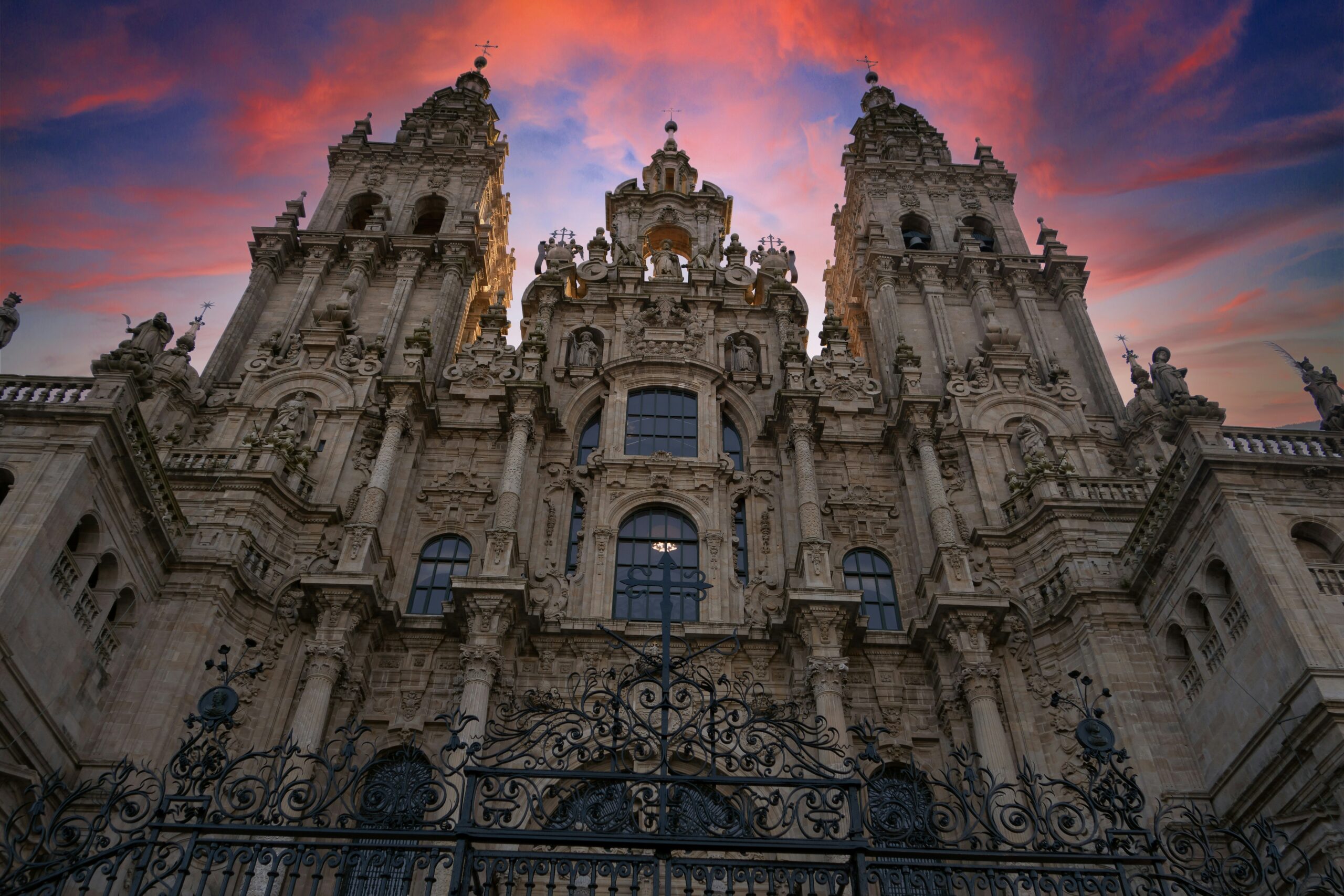
Above: Catedral Basílica de Santiago de Compostela.
The pilgrimage to Santiago de Compostela is one of the very best known in the Catholic world – and indeed, a great many non-Catholics take part in it. The many “routes of St. James” which bring pilgrims from every corner of the Continent to the green and Celtic hills of Spanish Galicia are such an important part of European culture that they been collectively dubbed “heritage routes” under the Council of Europe’s preservation program of that name. But all of that apparatus finds its origin in the life of St. James the Great – one of the Twelve, and brother of “the Disciple that Jesus loved.”
St. James the Great (died c. 44) was one of the Twelve Apostles of Jesus. He was the second of the apostles to die, after Judas, and the first martyred. Son with St. John of Zebedee and Salome, a sister of Mary (mother of Jesus), he and St. John were thus cousins of Jesus. James is called the “Great” or “Greater” to distinguish him from St. James the “Less” or “Lesser,” with “great” meaning older or taller, rather than more important. He was one of the first Apostles to join Jesus. The Synoptic Gospels show James and John getting ready to fish with their father by the seashore when called by Jesus to follow Him.
St. James, along with Ss. John and Peter, were the only apostles present at the raising of Jairus’ daughter, the Transfiguration of Jesus, and the Agony in the Garden. Their mother asked Jesus to grant them seats on His right and left when He came into His glory. Jesus asked if they were ready to drink from the cup he was going to drink from, saying the honour was not His to grant. The “Sons of Thunder” wanted to call down fire on a Samaritan town, but Jesus rebuked them.
After Pentecost, St. James first went to Sardinia. He then disembarked at Cartagena and began his mission in Spain. Passing through different places in the province of Hispania Tarraconensis, he stopped in Braga. There he preached and a Jewish disciple, Peter of Brates, to continue his work. But despite covering most of the country, very few responded to his preaching. Dejected, he was about ready to give up.
But on January 2, 40 A.D., the still-living Virgin Mary appeared to James upon a pillar on the bank of the Ebro River at Zaragoza. This was not only the first Marian apparition in the history of the Church; it was the first example of that rare but far from unknown phenomenon which has continued down to our own time: bilocation of a living person. While living with James’ brother John in Ephesus, she nevertheless was able to appear to James and assure his that his work would eventually bear fruit after his time, and that Spain would be a great Catholic nation. The pillar is venerated in the present Basilica of Our Lady of the Pillar. She is considered the patroness of all the Hispanic Nations under that title – and “Pilar” is still a popular girl’s name in those countries. October 12 was chosen as the feast day commemorating the miracle. As it was also the day that Columbus promised his crew that they would return to Spain if they did not find land by, it is also Columbus Day (“Why Columbus Day Matters to the Blessed Virgin Mary“).
In any case, the following year, St James returned to Judaea as did all the other Apostles to attend the death of the Blessed Virgin Mary, whom St. John had brought back to Jerusalem at her wish. All had arrived save St. Thomas, who had to return from India. When he finally arrived, he asked that her tomb be opened, so he could see her one last time. It was empty. They realised that she had been bodily assumed into Heaven.
But this last brush with the miraculous was the prelude to St. James’ own martyrdom. In the Acts of the Apostles, we see that “Herod the king” (Herod Agrippa) had him executed “by the sword.” The site of this martyrdom is within the Armenian Apostolic Cathedral of St. James in Jerusalem’s Armenian Quarter. The Chapel of Saint James the Great, located to the left of the sanctuary, is where the deed was done; his head is buried under the altar, marked by a piece of red marble and surrounded by six votive lamps.
The translation of his relics from Judaea to Galicia in the northwest of Hispania happened through a number of miraculous events. First, his decapitated body was taken up by angels; it sailed in a rudderless, crewless boat to Iria Flavia in Spain. There a massive rock closed around his body. His disciples from his previous trip to Spain, Theodore and Athanasius, arrived there. Approaching the local native Queen, Lupa, they asked her to give them a place to St. James’ body. She decided to trick the disciples and sent them to the governor of Duio – intending to have them killed. Sensing a trap, they eluded the governor and returned to the queen. Lupa tried deceiving them once more, sending them to Pico Sacro (the Sacred Peak) to collect two of her oxen. These she claimed were essential, as they would carry the necessary material to build the tomb. The queen left out the fact that the mountain had a cave which was the entrance to hell, being guarded by a dragon. But the presence of the holy cross protected the disciples from harm, taming the bulls. Seeing all of this, Lupa converts to Christianity, helping the two disciples build the apostle’s tomb in the forest of Libredon. This was located at what is now the Oak grove of Santa Susana, now part of the Parque da Alameda de Santiago de Compostela. When Theodore and Athanasius died in their turn, they were laid beside their master.
But the subsequent Suevian, Visigothic, and Muslim invasions led to the location of the tomb of St. James being forgotten. It was not rediscovered until the 9th century. Pelagius (Pelayo) the Hermit saw mysterious lights illuminating the forest. He advised Theodemir, bishop of Iria Flavia, who returned with him to investigate. They discovered small chapel with an altar and a crypt. Therein were three tombs, that of St. James and his two disciples. The bishop in turn informed Alfonso II, “the Chaste,” the King of Galicia. He in turn travelled from Oviedo along the Camino Primitivo, to verify that the bones were those of the Apostle were those of the apostle; he then ordered the construction of a chapel on the site.
But the Moors surrounded the little Kingdom of Galica and Asturias, cutting it – and the tomb of “Santiago” (Iago is an old Spanish version of James from the Latin Jacobus; in modern Spanish it is Jaime) – off from the rest of Christendom. But help was en route. Alfonso was acknowledged as king by Charlemagne and the Pope, and Asturias as a kingdom for the first time in the Royal Frankish Annals. Then Alfonso showed an interest in the cult of St. Martin of Tours, and he encouraged Carolingian Church influence in Asturias. For his part Charlemagne was visited in a dream by St. James. His nocturnal visitant urged him to free the tomb from the Saracens who held the road to his tomb. St. James advised the Emperor to follow the course of the stars of the Milky Way to its end in Galicia. There he would find the tomb. Charlemagne set out for Spain. The army took the road over the Pyrenees and besieged the Moorish town of Pamplona. The thunder of Frankish trumpets caused the walls of the city to crumble. The Emperor, his twelve Paladins, and his army liberated the road to the tomb, and Bl. Charlemagne constructed another, more elaborate church above it. But because of Charlemagne’s dream regarding the Milky Way, the place has been called Compostela, – “Field of Stars,” ever since.
But the native Christians were not idle. On May of 844, Christian forces led by King Ramiro I of Asturias and Galicia and General Sancho Fernández de Tejada went in search of the Muslims commanded by Abd ar-Rahman II. Reaching Nájera and Albelda they were surrounded by a large Arab army made up of troops from the peninsula and Morocco. Ramiro, Tejada, and their men took refuge in the Clavijo castle at Monte Laturce. The King had a dream in which the apostle appeared, promising victory. The next day, May 23, 844, the armies of Ramiro I faced the Muslim army. St. James appeared on a white charger in the sky; the Muslims fled. After the victory, in honour of Santiago Matamoros (“Santiago the Moor Killer”), Ramiro ordered the construction of the Church of the Blessed Santiago. He granted Sancho certain privileges in addition to the surname Tejada in memory of the branch of a yew tree that he used as a weapon after his spear was broken in combat.
On May 25 in the city of Calahorra, Ramiro dictated the vow of Santiago, committing all Spanish to make a pilgrimage to Santiago de Compostela on the way of Saint James. ¡Santiago, y cierra, España! (“St. James and strike for Spain”) was the traditional battle cry of medieval Spanish armies, like the French Montjoie Saint Denis! He became the patron first of the Reconquista against the Moors, and then of the battles with pagan Indians in the Spanish Americas – although Christianised Indians enthusiastically embraced him after their conversion. Not too surprisingly, a Military Order of Knights, the Order of Santiago, was founded to prosecute the war – and survives to-day in two branches – Spanish and Portuguese.
Dom Guéranger describes St. James in his usual eloquent manner:
Nearly eight centuries, which to the heavenly citizens are but as a day, had passed over that tomb in the North of Spain, where two disciples had secretly laid the Apostle’s body. During that time, the land of his inheritance, which he had so rapidly traversed, had been overrun first by Roman idolaters, then by Arian barbarians, and when the day of hope seemed about to dawn, a deeper night was ushered in by the Crescent. One day lights were seen glimmering over the briars that covered the neglected monument; attention was drawn to the spot, which henceforth went by the name of the field of stars. But what are those sudden shouts coming down from the mountains and echoing through the valleys? Who is this unknown chief rallying against an immense army the little worn-out troop whose heroic valor could not yesterday save it from defeat? Swift as lightning, and bearing in one hand a white standard with a red cross, he rushes with drawn sword upon the panic-stricken foe, and dyes the feet of his charger in the blood of 70,000 slain. Hail to the chief of the holy war, of which we have so often made mention! Saint James! Saint James! Forward, Spain! It is the reappearance of the Galilæan Fisherman, whom the Man-God once called from the barque where he was mending his nets; of the elder son of thunder, now free to hurl the thunderbolt upon these new Samaritans, who pretend to honor the unity of God by making Christ no more than a prophet. Henceforth, James shall be to Christian Spain the firebrand which the Prophet saw, devouring all the people round about, to the right hand and to the left, until Jerusalem shall be inhabited again in her own place in Jerusalem.
And when, after six centuries and a half of struggle, his standard bearers, the Catholic kings, had succeeded in driving the infidel hordes beyond the seas, the valiant leader of the Spanish armies laid aside his bright armor, and the slayer of Moors became once more a messenger of the faith. As fisher of men, he entered his barque, and gathering around it the gallant fleets of a Christopher Columbus, a Vasco di Gama, an Albuquerque, he led them over unknown seas to lands that had never yet heard the name of the Lord. For his contribution to the labors of the twelve, James drew ashore his well-filled nets from West and East and South, from new worlds, renewing Peter’s astonishment at the sight of such captures. He, whose apostolate seemed at the time of Herod III, to have been crushed in the bud before bearing any fruit, may say with St. Paul: I have no way come short of them that are above measure Apostles, for by the grace of God I have labored more abundantly than all they.
He concludes his consideration of St. James with this prayer:
Patron of Spain, forget not the grand nation which owes to thee both its heavenly nobility and its earthly prosperity; preserve it from ever diminishing those truths which made it, in its bright days, the salt of the earth; keep it in mind of the terrible warning that if the salt lose its savor, it is good for nothing any more but to be cast out and to be trodden on by men. At the same time remember, O Apostle, the special cultus wherewith the whole Church honors thee. Does she not to this very day keep under the immediate protection of the Roman Pontiff both thy sacred body, so happily rediscovered, and the vow of going on pilgrimage to venerate those precious relics?
Where now are the days when thy wonderful energy of expansion abroad was surpassed by thy power of drawing all to thyself? Who but he that numbers the stars of the firmament could count the Saints, the penitents, the kings, the warriors, the unknown of every grade, the ever-renewed multitude, ceaselessly moving to and from that field of stars, whence thou didst shed thy light upon the world? Our ancient legends tell us of a mysterious vision granted to the founder of Christian Europe. One evening after a day of toil, Charlemagne, standing on the shore of the Frisian Sea, beheld a long belt of stars, which seemed to divide the sky between Gaul, Germany, and Italy, and crossing over Gascony, the Basque territory, and Navarre, stretched away to the far-off Province of Galicia. Then thou didst appear to him and say: ‘This starry path marks out the road for thee to go and delivery my tomb; and all nations shall follow after thee.’ And Charles, crossing the mountains, gave the signal to all Christendom to undertake those great Crusades, which were both the salvation and the glory of the Latin races, by driving back the Mussulman plague to the land of its birth.
Watching the scenes in recent weeks of Muslins pouring into Spain should cause us all to redouble our prayers to St. James – both for Spain, and for all her daughter countries, among which are some of our own United States, most notably Florida, Texas, New Mexico, Colorado, Arizona, and California. As with the secularising Socialist government that currently misrules Spain, we must be careful not to be salt that has lost its savour.
Photo by Snap Wander on Unsplash