When Archbishop Marcel Lefebvre, founder of the Society of St. Pius X (SSPX), consecrated four bishops in 1988 against the will of Pope John Paul II, he famously referred to his act as “Operation Survival” during his sermon for the occasion:
It is not for me to know when Tradition will regain its rights at Rome, but I think it is my duty to provide the means of doing that which I shall call ‘Operation Survival,’ operation survival for Tradition. Today, this day, is ‘Operation Survival.’ If I had made this deal with Rome, by continuing with the agreements we had signed [see here for context], and by putting them into practice, I would have performed ‘Operation Suicide.’ There was no choice, we must live!
This past February, current SSPX Superior General Fr. Davide Pagliarani decided that the time has come for the SSPX to consecrate more bishops, after writing to Pope Leo XIV and receiving no answer: “We believe that the time has come to think about the future of the Society of Saint Pius X, the future of all souls, whom we cannot forget, whom we cannot abandon, and above all, the good we can do for Holy Mother Church.”
Ten days after his announcement, I had the honor of interviewing Marc Balestrieri, JCL, founder and president of Canonical Aid, to assess the situation from a canonical standpoint:
We discussed a wide range of questions and issues related to the upcoming consecration of new SSPX bishops, including:
- Are episcopal consecrations conducted without papal approval intrinsically schismatic?
- Does canon law say anything about cases of “necessity”?
- Could a canonical case could be made that the men involved would not be liable to automatic excommunication due to their sincere belief that they acted out of necessity?
- Will SSPX priests still have the faculties necessary for the sacraments of Penance and Matrimony following the unauthorized consecrations?
What follows is an expanded version of our live video interview, which we hope will be a helpful resource to the faithful.
Let us pray that Pope Leo XIV will ultimately respond positively to Bishop Athanasius Schneider’s respectful appeal: “Most Holy Father, if you grant the Apostolic Mandate for the episcopal consecrations of the SSPX, the Church in our day will lose nothing. You will be a true bridge-builder, and even more, an exemplary bridge-builder, for you are the Supreme Pontiff, Summus Pontifex.”
*****
Matt Gaspers (MG): On February 2, SSPX Superior General Fr. Davide Pagliarani “announced his decision to entrust the bishops of the Society with the task of proceeding with new episcopal consecrations” (source). He made the announcement during his sermon for the day, emphasizing how “we must never forget that the law of laws, the supreme law that takes precedence over all others, is the salvation of souls. … This is the law of laws, and we all have a duty, each in our own place, to observe this law and to devote ourselves totally to defending it.” What was your initial reaction to this news?
Marc Balestrieri, JCL (MB): My initial reaction to the news was sorrow, because such a drastic decision reveals just how bad the SSPX views the situation on the ground to be. The gravest questions are raised by the Society’s decision. Who, exactly, is truly proceeding in the direction of schism? Is it those faithful to Tradition, who have only done what our forefathers have done for centuries? Or, is it those who say that they adhere to the “living tradition,” but which is diametrically opposed to Tradition? Since the abdication of Pope Benedict XVI, we have seen how orthopraxis (“correct action”) is no longer the logical consequent to orthodoxy (“correct belief”). Instead, we see increasingly the reverse spreading everywhere, what one could call haeresopraxis (“heretical practice”).
On the one hand, consecration of a bishop without pontifical mandate is, objectively speaking, a statutory canonical crime. On the other hand, the fact that the SSPX claims to be compelled “out of necessity” to violate a criminal canon of the Code in order to save souls raises serious questions that go far beyond episcopal consecration without mandate itself.
MG: As you just mentioned, canon law explicitly prohibits the consecration of bishops “without a pontifical mandate” and attaches the penalty of “latae sententiae excommunication” to such illicit consecrations (can. 1387, 1983 Code). Many seem to assume that such consecrations are intrinsically schismatic and therefore justly punished with automatic excommunication, but is this really the case?
MB: Your question is twofold: (1) Is the consecration of bishops without pontifical mandate intrinsically schismatic? Per se, no. (2) Are “such” consecrations “justly punished” with automatic excommunication? Yes, but only if exculpating (cf. can. 1323) or mitigating (cf. can. 1324) factors are not applicable. Consecration of a bishop without pontifical mandate simpliciter (without added qualification), as Thomists would say, is presumed by operation of canon 1321 §4 of the 1983 Code to constitute a canonical crime (“delict”). However, just because the act is presumed to be a delict does not mean that it is intrinsically schismatic.
First, canon 1387, the papal statute that forbids consecration of a bishop without pontifical mandate, is situated structurally within Title III of Part II of Book VI of the Code, “Offenses against the Sacraments,” not within Title I, “Offenses against the Faith and Unity of the Church,” where the canon punishing schism (can. 1364) is located. Were episcopal consecration without mandate intrinsically schismatic, it would be located in Title I, repressing offenses “against Unity of the Church,” concretized par excellence by the crime of schism. Likewise, the predecessor canon of the 1917 Code also included the violation as being among “Delicts in the Administration and Reception of Orders and other Sacraments” (Title XVI), not “Delicts against the Faith and Unity of the Church” (Title XI).
Second, on 26 May 1993, Cardinal Rosalio José Castillo Lara, SDB, former President of the Pontifical Commission for Authentic Interpretation of the Code of Canon Law, wrote in a private letter addressed to Mr. John Beaumont regarding the SSPX: “One should keep in mind, however, that the act of consecrating bishops [without pontifical mandate] is not in itself a schismatic act.” Castillo Lara was head of the dicastery of the Holy See with jurisdiction to interpret the laws of the Church. Cardinal Castillo Lara also opined that, based on the placement of can. 1382 (now can. 1387) in Title III of Part II of Book VI of the Code, consecration without pontifical mandate is not per se an act of schism.
Now, Cardinal Castillo Lara, it has to be said, did hold the position that Archbishop Lefebvre committed schism (long before the episcopal consecrations of 1988), but he was firm in his opinion that said consecrations were not per se schismatic in nature. So even those opposed to Archbishop Lefebvre’s position could not affirm that the consecrations he performed in 1988 were intrinsically schismatic.
Third, Pope Benedict XVI, in his letter dated 10 March 2009, wrote: “An episcopal ordination lacking a pontifical mandate raises the danger of a schism, since it jeopardizes the unity of the College of Bishops with the Pope.” Were consecration without pontifical mandate schism pure and simple, the Pope would not have written, “danger” of schism.
MG: Canonically speaking, has the Church historically held that illicit consecrations are intrinsically schismatic and thus automatically sever one from the Church?
MB: No, historically the Church has not held that illicit consecrations are intrinsically schismatic and thus automatically sever one from the Church.
The penalty of excommunication for consecration of a bishop neither appointed nor confirmed by the Apostolic See was only enacted legislatively on 9 April 1951.[1] Up until that time, canon 2370 of the 1917 Code provided that episcopal consecration without pontifical mandate entailed the penalty of suspension, not excommunication. Had it been per se an expression of schism, the Apostolic See would have standardized the penalty of excommunication for consecration without pontifical mandate centuries ago and catalogued it in the Code as an “Offense against the Faith and Unity of the Church,” which it still does not.
One recent example: On 14 July 2011, Fr. Joseph Huang Bingzhang of China was consecrated a bishop without pontifical mandate, despite repeated admonitions of the Holy See that he could not be consecrated due to the Diocese of Shantou (Province of Guangdong, Mainland China) already having a diocesan bishop. On 16 July 2011, the Holy See declared that Fr. Huang incurred automatic excommunication for receiving episcopal consecration without pontifical mandate (cf. Vatican Information Service, Bulletin no. 20110718). Were consecration without pontifical mandate per se an act of schism, Fr. Huang would also have been declared by the Holy See to have been excommunicated for schism pursuant to can. 1364, but he wasn’t.
MG: According to canon law, schism is defined as “the refusal of submission to the Supreme Pontiff or of communion with the members of the Church subject to him” (can. 751, 1983 Code; cf. can. 1325, 1917 Code). Does this imply that any act of disobedience towards the Pope is tantamount to schism?
MB: Absolutely not. Not just “any” act of disobedience towards the Pope is tantamount to schism.
First, disobedience is not per se an act of schism. Disobedience as a crime (cf. can. 1371) is an “Offense against Church Authorities,” whereas schism as a crime (cf. can. 1364) is as an “Offense against the Faith and Unity of the Church.” The Pope himself made this distinction when he enacted the Code of Canon Law.
Criminal disobedience is committed when a person does not obey a lawful command or prohibition of the Apostolic See or the Ordinary or the Superior and, after having been warned, persists in disobedience (cf. can. 1371 §1). Objective elements of the delict are: 1) disobedience; 2) to a legitimate; 3) command or prohibition; 4) issued by the Apostolic See, Ordinary, or religious Superior; 5) by a baptized Catholic; 6) persisting in his misconduct; 7) after receiving a canonical warning. If any of these elements are not met, then no disobedience is punishable or even canonically criminal pursuant to can. 1371 §1.
On the other hand, one can make a distinction between the withholding of obedience (legitimate or legal) and disobedience (illegitimate or illegal).
Examples of a withholding of obedience that are not per se canonically criminal and punishable under canon law include: (1) refusing to obey the command or prohibition issued by one who does not have jurisdiction over you (e.g., a parochial vicar who attempts to exercise authority over his pastor); (2) the act of refusing to execute an illegal command or prohibition (e.g., a bishop commands one of his pastors to bless a homosexual couple in a liturgical setting); (3) a priest refuses to do what his bishop wants prior to or absent his bishop issuing a canonical warning to him. Under any of the above fact patterns, not only is such withholding of obedience on the part of the priest not schism, it also does not constitute the canonical delict of disobedience sanctioned by canon 1371. This analysis prescinds from whether any of the acts might be immoral, which is a different question.
Criminal canonical schism, on the other hand, is committed when one either (a) withdraws submission to the Supreme Pontiff or (b) withdraws communion with members of the Church subject to him (cf. can. 751). The objective elements of the delict are: (1) direct; (2) withdrawal; (3) of submission; (4) to the Supreme Pontiff; (5) either immediately or mediately, viz., refusing communion with the local diocesan bishop or those faithful subject to the Supreme Pontiff inasmuch as they be subject to the Supreme Pontiff.[2]
Examples of conduct that does not per se constitute criminal schism are: (a) the simple transgression of legislation; (b) “those who refuse to obey the Roman Pontiff because they hold his person to be suspect, or doubtfully elected due to widespread rumors, as happened after the election of Urban VI….”[3]
In the above cases of non-schismatic disobedience, there is a grave cause extrinsic to the act of schism that is argued to compel the presumptively violative decision.
In the case of the SSPX bishops consecrating without pontifical mandate, one would be required to prove beyond a reasonable doubt pursuant to can. 1608 §1 that by means of such consecrations they reject submission to the Supreme Pontiff. Not mere obedience, submission. That is a high bar.
If one were to apply the norm of can. 1321 §4, i.e., once an external violation is posited, imputability is presumed, unless it be otherwise evident, the argument can be made that it is evident that the bishops of the SSPX are performing the consecrations for reasons that are extrinsic to a refusal of submission to the Supreme Pontiff. The Superior General of the SSPX, when asked to justify the decision, replied:
…does the official Church today, in a normal parish, provide the means necessary for us to achieve our salvation? Do we find there everything we need? Do we find there a truly Catholic catechism? Is Catholic morality truly taught, that is, how to conduct oneself? Is the truth being taught? Are the sacraments necessary for salvation being administered, in accordance with what the Church has always done? Is there still a sense of sin, a sense of absolution, a sense of moral conversion? Is all of this being taught and practiced in a normal, ordinary parish? It is obvious that it is not. No. Otherwise, you would not be here. Otherwise, the Society of Saint Pius X would not exist. Independently from the episcopal consecrations, we already justify our apostolate precisely because there exists a state of necessity within the Church. Well, it is because of this state of necessity that this decision becomes imperative; it is imperative, once again, for the good of souls. … Hence the need to do everything we can to save souls. This is what is called a state of necessity. It is therefore an extreme situation, but one that demands, that requires, proportionally extreme solutions; we recognize this.
Without receiving the true Faith in Jesus Christ, and being nourished by certainly valid sacraments, one cannot easily (if at all) attain eternal salvation. That is what I see as being especially on the minds of the bishops and priests of the Society of Saint Pius X, not rejection of submission to the Supreme Pontiff. The SSPX bishops, prescinding from whether they are correct or not in their analysis, see revolutionary change in the Catholic Church since Vatican II, coupled with extreme necessity to save souls, as the catalyst for their existence. To me, this belief on their part is evident in the sense envisaged by can. 1321 §4.
MG: When Archbishop Lefebvre consecrated four bishops without papal approval in 1988, he appealed to what he called “a case of necessity” as justification for his actions. Fr. Pagliarani has now done the same, as you mentioned above, and Bishop Bernard Fellay spoke likewise following Fr. Pagliarani’s announcement. Does canon law have anything to say on this topic?
MB: Yes, the 1983 Code of Canon Law references “necessity” 36 times.
As for the SSPX, it invokes “necessity” as a concept especially regarding two fact patterns.
The first inasmuch as an exculpating (cf. can. 1323) or mitigating (cf. can. 1324) factor of subjective responsibility on the part of both those confecting episcopal consecrations without pontifical mandate, and those receiving said consecration (cf. can. 1387).
The second is that of necessity being the cause that activates the supplying of “jurisdiction” (cf. can. 209 CIC 1917) or the executive power of governance (cf. can. 144 CIC 1983) required by canon law for the valid and legitimate confection of the sacraments (cf. can. 144).
The necessity contemplated by the Supreme Legislator in cann. 1323 and 1324 is broader and sometimes different in nature and scope than that envisaged by the norm of cann. 209/144 for the supply of faculties by the law itself.
MG: What is the definition of “necessity,” canonically speaking?
MB: The Code promulgated in 1983 does not provide a strict definition of “necessity,” but approved authors do, for example:
‘A state of necessity’ arises when the situation of conflict between the individual’s right and observance of the law is inculpable, inevitable, grave, certain, and imminent, produced by natural causes — in this it differs from lawful self-defense — and when observance of the law cannot be demanded by reason of a particular obligation freely accepted — for example, that of a parish priest who must attend to a parishioner suffering from a contagious disease.[4]
That definition is specifically provided with reference to the state of necessity mentioned as constituting an exculpating factor in canon 1323, eliminating subjective imputability from being attributed to one who objectively violates a canonical penal norm.
There is a distinction between justification for the commission of an act (e.g., reasons invoked in support of consecration of a bishop without pontifical mandate) and exculpation from imputability for the commission of a crime (e.g., elimination of subjective responsibility for the objective violation of a penal norm such as can. 1387).
Whether any bishops of the SSPX are “justified” in consecrating new bishops without having received pontifical mandate prior in time is a question that is not purely canonical that goes beyond strict analysis as to whether one is criminally guilty for consecrating bishops without pontifical mandate.
MG: In the wake of Fr. Pagliarani’s announcement, some have asserted that “[i]n the case of illicit consecration, there is no plausible defense of ignorance of the law, and the participant’s motives for violating it are not at issue,” whereas canon law itself indicates that motives must be considered in relation to determining culpability (cf. can. 1323 and 1324 §1, 1983 Code). What is your assessment?
MB: The assertion that “there is no plausible defense of ignorance of the law” and that “the participant’s motives for violating it are not at issue” is a personal opinion that requires nuance in order to be reconciled with the law.
In the strict sense, ignorance is the objective lack of knowledge of the law. That being said, even if it be true that the bishops of the SSPX know that the Church’s law provides for latae sententiae excommunication for consecration without pontifical mandate reserved to the Apostolic See, it would be reductionist were one to ignore the other provisions of universal law potentially applicable to those same persons, such as inadvertence and error that are equivalent in legal effect to ignorance (cf. can. 1323, 2° CIC/2021).
Inadvertence and error constitute exculpating (cf. can. 1323) or mitigating (cf. can. 1324) factors of imputability. A number of other factors and motives are also enumerated in the above same canons.
Why did the Supreme Legislator who promulgated the 1983 Code include an entire list of “participant’s motives” to be taken into consideration by the Church when adjudicating a canonical crime? The answer is that said motives are potentially relevant. Such relevance, however, can only be determined after cann. 1323 and 1324 factors are, one-by-one, weighed by those officials tasked by the Church to judge whether the commission of alleged canonical crimes is proven beyond any reasonable doubt.
MG: Ten days after Fr. Pagliarani made his announcement, he met with Cardinal Victor Manuel Fernández, Prefect of the Dicastery for the Doctrine of the Faith (DDF), in Rome. According to the DDF statement released after the meeting, Cardinal Fernandez “proposed a pathway of specifically theological dialogue, following a precise methodology, on issues that have not yet received sufficient clarification,” including “the distinction between an act of faith and the ‘religious submission of mind and will,’ as well as the differing degrees of adherence required by various texts of the Second Vatican Ecumenical Council and their interpretation.” Canon law distinguishes between faith and religious submission (cf. can. 750 and 752, 1983 Code). Can you explain the distinction and why it is important?
MB: The Church’s official doctrine is encapsulated within three categories, each of which require a different degree of adherence on the part of the faithful. According to the Professio Fidei (Profession of Faith) of 1998 and the Doctrinal Note attached to the Motu Proprio Ad Tuendam Fidem (“To Protect the Faith”), these theological notes attributed to these categories are: (1) De Fide Divina et Catholica (“Divine and Catholic Faith”) according to can. 750 §1; (2) Doctrina Catholica (“Catholic Doctrine”) pursuant to can. 750 §2; and (3) Doctrina Authentica (“Authentic Doctrine”) per can. 752.
The first and highest kind of doctrine, De Fide Divina and Catholica, is also known as dogma. Every doctrine of Divine and Catholic Faith requires irrevocable assent on the part of all the faithful based upon the authority of God revealing. That is the essence of the Act of Faith. Dogmas can never be changed, they are immutable, fixed forever in the Deposit of Faith. Another common term for this official teaching is “Revelation,” or that which is revealed by God through Sacred Scripture or Sacred Tradition and proposed as such by the Catholic Church. An example of such a proposition is: “Christ is God.” Pertinacious denial or doubt of a dogma by a baptized Catholic constitutes the mortal sin and canonical crime of heresy (cf. cann. 751 and 1364).
The second category of doctrine is Doctrina Catholica. It requires a definitive, irrevocable assent, but based upon the authority of the Church, not necessarily on the authority of God revealing. Such a doctrine is proposed by the Church as being infallible, irreformable, irrevocable, definitive — but not officially as being revealed. An example of such a teaching is the proposition that only men are able to receive validly the Sacrament of Holy Orders (cf. John Paul II, Apostolic Letter Ordinatio Sacerdotalis).
The third category of official teaching is Authentic Doctrine. It is presumptively binding but formally is non-infallible, such that mere religious submission of will and intellect, not an act of Faith or irrevocable assent, is ordinarily required by every baptized Catholic. Such a doctrine is subject to revision by the Church, especially should it be found to be erroneous.
Authentic non-infallible teaching is that doctrine which is proposed every day in the official documents of the dicasteries of the Roman Curia, especially the Dicastery for the Doctrine of the Faith (DDF). Should a Catholic take issue with, or dissent in conscience from, a specific authentic teaching, normally he is not morally permitted to dissent from it in the external forum, but instead has a duty to raise his objection discreetly upwards through the chain of command of the Church’s hierarchy, all the way to the DDF and above as a well-formed conscience dictates. Hence the expression “religious submission,” because it is out of respect for the Roman Curia and Holy See that one ordinarily should not create scandal in public by criticizing authentic doctrine.
Unfortunately, in recent times, certain documents said to contain authentic and therefore binding teaching (albeit non-infallible) have led to the creation of grave wonderment, distress, and scandal among numerous faithful across the globe, testing the limits of the norm of can. 752 (e.g., Pope Francis, Apostolic Exhortation Amoris Laetitia and the interpretative Criterios Basicos incorporated into the Acta Apostolicae Sedis, regarding the ability of divorced and remarried couples publicly living in sin to receive Holy Communion; DDF, Declaration Fiducia Supplicans, regarding the liceity of blessing couples persisting in sexual vice; DDF, Doctrinal Note Mater Populi Fidelis, which asserts that it is “always inappropriate to use the title Co-redemptrix to define Mary’s cooperation”).
All of the above distinctions are important because officials acting by mandate of the DDF, if not the Cardinal-Prefect himself, appear to have intended to use the tripartite distinction between theological grades of certitude to be attributed to official Church teachings developed since Vatican II as a basis for the Holy See to formulate an entente cordiale or agreement with the leadership of the SSPX regarding the interpretation to be given to Vatican II texts it disagrees with (e.g.,Dignitatis Humanae on religious freedom, etc.).
MG: Following his meeting with Cardinal Fernández, the SSPX published Fr. Pagliarani’s response to the DDF Prefect in which he respectfully declined the Prefect’s offer to dialogue and indicated that the SSPX will proceed as planned on July 1, with or without Rome’s approval — despite being warned that unauthorized episcopal consecrations “would constitute a decisive rupture of ecclesial communion (schism), with serious consequences for the Fraternity as a whole…” (source). Pope Leo XIV could, of course, change his mind in the interim and grant permission, but this seems unlikely, especially in light of Cardinal Fernández’s latest statementon May 13 on the matter.
In the event that Pope Leo does not change his mind, do you think a canonical case could be made that the men involved would not be liable to automatic excommunication due to their sincere belief that they acted out of necessity (cf. can. 1323 and 1324 §1, 1983 Code)?
MB: Yes, positis ponendis (all conditions having been met), because in the event one of the bishops either consecrating or consecrated inculpably believed that he was acting out of necessity, then he could not be excommunicated latae sententiae pursuant to can. 1323, 7°, prescinding from the question as to whether a state of necessity objectively existed or not.
Alternatively, if he culpably and erroneously believed that he was acting out of necessity, then he also would not be subject to excommunication pursuant to can. 1324, 8°.
On the other hand, if he objectively acted out of necessity, then per se he would be exculpated according to can. 1323, 4°, assuming, for the sake of argument, that episcopal consecration without pontifical mandate not be in itself an intrinsically evil act or harmful to souls.
Lastly, if he objectively acted out of necessity, even were episcopal consecration without pontifical mandate in itself an intrinsically evil act or harmful to souls, then he would avoid the incurrence of excommunication pursuant to can. 1324, 5°.
While some might be shocked at the proposal of the above four scenarios, the law of the Church is the law governing the faithful: either we recognize the law and abide by its norms, or the law is changed by the Supreme Legislator — but for now, the above-cited canons are the law.
MG: In his response to Cardinal Fernández, Fr. Pagliarani essentially asked that the SSPX be allowed to continue administering the sacraments to souls who request them: “It asks nothing else of you — no privileges, nor even canonical regularization, which, in the current state of affairs, is impracticable due to doctrinal divergences.”
This raises a crucial question with respect to those sacraments that require “jurisdiction” (can. 209, 1917 Code) or “executive power of governance” (can. 144 §1, 1983 Code) for validity, i.e., Penance and Matrimony. By decree of Pope Francis, all SSPX priests have enjoyed habitual faculties to validly and licitly absolve sins since November of 2016 (cf. Misericordia et Misera, n. 12). The following March, Francis likewise authorized local bishops to grant faculties to SSPX priests for witnessing marriages (cf. Protocol N. 61/2010). Pope Leo XIV has not rescinded these decrees of his predecessor; however, in the event he does not grant the SSPX permission to consecrate bishops and the SSPX proceeds to do so anyway, it seems obvious that the faculties granted by Francis will immediately cease. If such is the case, will SSPX priests then possess what is known as “supplied jurisdiction” for the valid administration of Penance and Matrimony?
MB: Most likely, only in cases of Error of Law or of Fact or Probable and Positive Doubt of Law or of Fact arising from the concrete and specific circumstances of SSPX priests administering the sacraments (cf. can. 144). The answer to your question can only be yes on a “case-by-case” basis, not a general one.
A priest’s faculty to witness the exchange of vows — “executive power of governance” in the 1983 Code, “jurisdiction” in the 1917 Code — is granted either ab homine (“by man”) or a iure (“by the law”).
Supplied faculties are a form of executive power of governance granted a iure, when the law does not otherwise expressly provide for them. Unless otherwise expressly granted, then all supplied faculties are granted by the law of the Church only inasmuch as they can be classified as falling within the legal mechanisms of Common Error or Positive and Probable Doubt referenced in can. 144.
Any “state of necessity” must be proven to activate or coincide with Common Error of Law or of Fact, or Probable and Positive Doubt of Law or of Fact, in order for jurisdiction to be supplied by the Church.
Regarding the Sacrament of Penance, approved authors of canonical doctrine affirm that a priest, dressed in cassock and sitting in a confessional during daytime hours hearing confessions, validly grants absolution from sin, by reason of such a fact per se triggering a common error of law such that the law itself provides to the priest the required faculty to absolve from sin.
On the other hand, classical doctors assert that the law itself does not provide faculties to a priest who, for example, hears the confession of a penitent at an ungodly hour in a private room, because such circumstances of a confession being heard by a priest outside of a common sacred space, place, and time do not constitute a foundation for the triggering of common error on the part of the faithful.
In the case of Holy Matrimony, however, the matter is more complex, and would become even more complicated should the SSPX bishops and priests be declared to have incurred excommunication latae sententiae for violation of cann. 1364 and/or 1387.
In matters pertaining to the validity of the sacraments, one is obligated to follow the safer path in the face of only a probable opinion (cf. Pope Bl. Innocent XI, Decree, 4 March 1679, Prop. Damn. 1; D.H. 2101). Consequently, it would appear that the safer route would be for SSPX fiancés who want to exchange vows to choose from the following three options in order to marry validly:
- Ask the local Ordinary to grant to the SSPX priest celebrant the faculty required for him to witness marriage.
- Petition the local Ordinary for a dispensation from canonical form should he not grant the faculty required for the SSPX priest to witness marriage normally.
- Exchange vows only before two witnesses, but on condition that a state of grave inconvenience to exchange vows before a duly-habilitated priest persists for more than one month. According to can. 1116, said couple would, all other conditions having been duly satisfied, contract marriage validly.
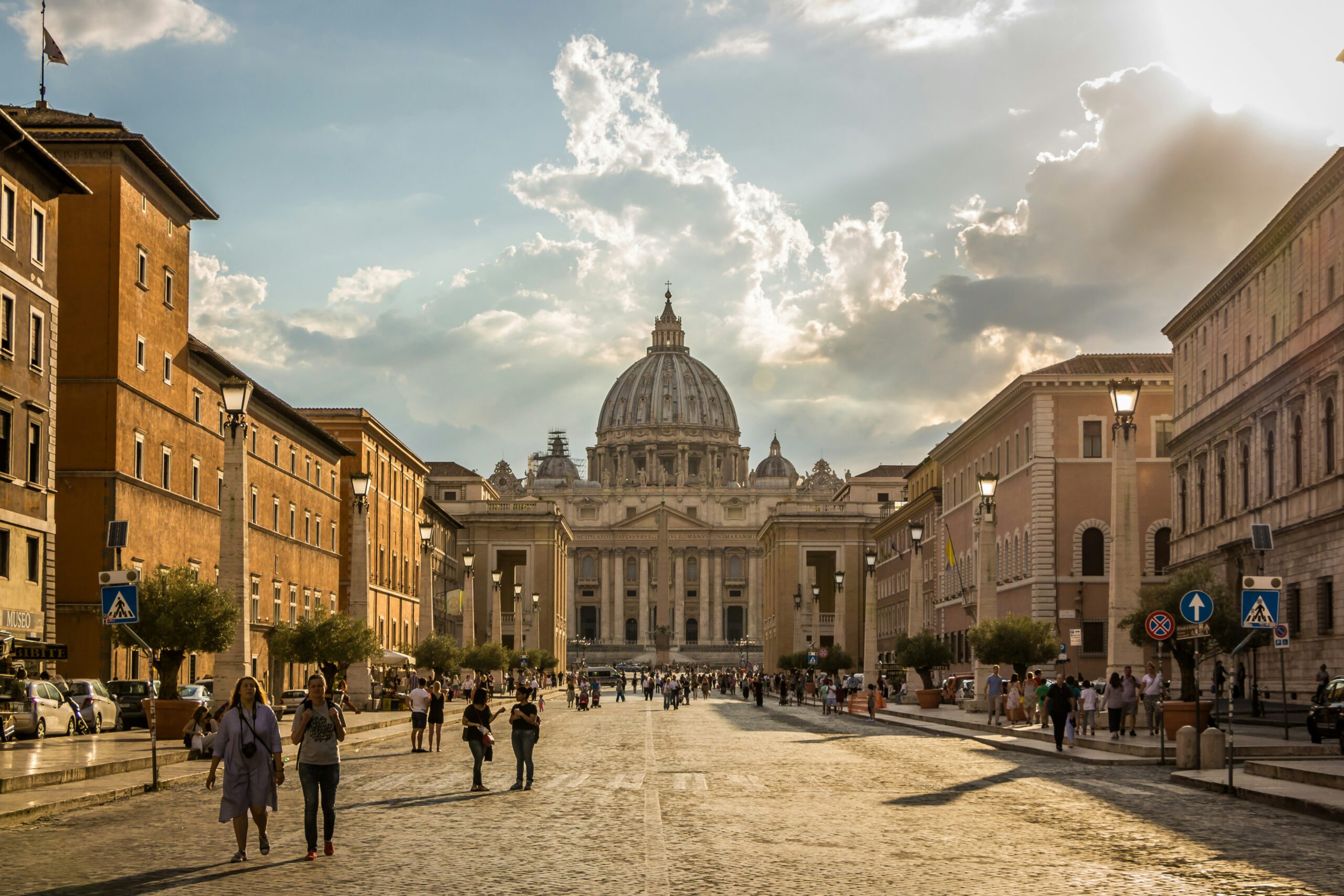
Photo by Matthias Schröder on Unsplash
[1] Decree of the Supreme Sacred Congregation of the Holy Office, AAS 43 (1951), pp. 217-218.
[2] See A. Borras, L’Excommunication dans le Code de Droit Canonique (Paris: Desclée, 1987), p. 48.
[3] Franz Xavier Wernz, S.J., and Pietro Vidal, S.J., Ius Canonicum, Tome VII (Rome: Pontifical Gregorian University, 1937), p. 439, n. 398.
[4] J. Arias and J. Arrieta commenting on can. 1323in Code of Canon Law Annotated,4th Edition (Chambly: Librairie Wilson & Lafleur, Inc., 2022).