
Does Schism Even Matter Anymore?
If Weakland’s in, who could possibly be out?
—John Senior
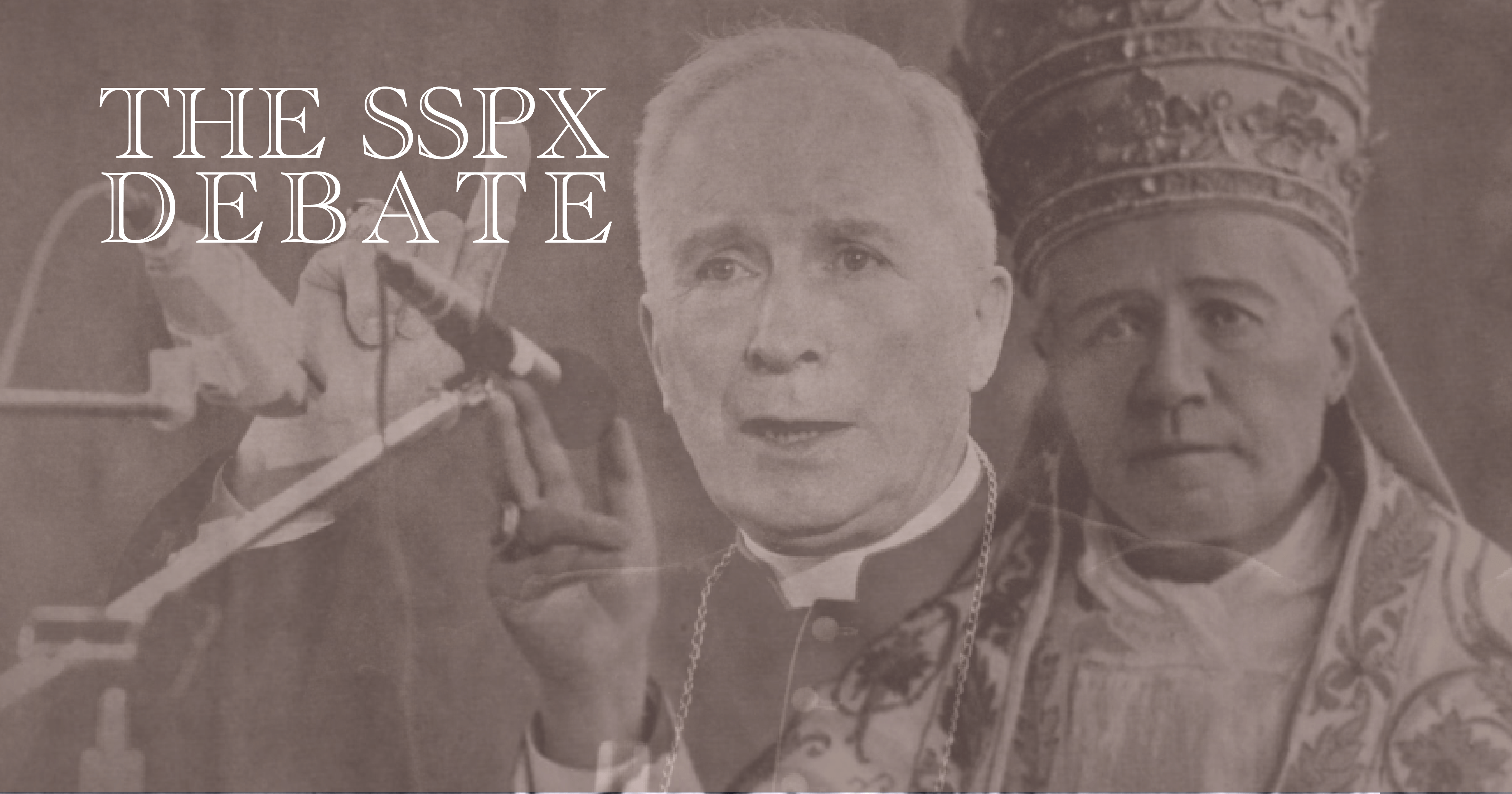
As readers of OnePeterFive are well aware, the SSPX has now been threatened with excommunication. The superior general has rejected the offer of dialogue in exchange for cancelling their planned consecrations.
The Society issued a document explaining why, from their point of view, consecrating bishops without permission of the Pope would not make them schismatics – even if done in defiance of the current Pope. The document begins by conceding that:
The Constitution Lumen gentium on the Church states in chapter III, no. 21, that the power of jurisdiction is conferred by episcopal consecration simultaneously with the power of order. The Decree Christus Dominus on the pastoral charge of bishops affirms the same in its Preface, no. 3. And this affirmation is reiterated in the 1983 Code of Canon Law, c. 375 § 2. In the Church, the reception of the episcopal power of jurisdiction depends by divine right on the will of the Pope, and schism is precisely defined as the act of one who assumes jurisdiction independently and without regard for the Pope’s will. Therefore, according to these documents, an episcopal consecration carried out against the Pope’s will would necessarily be an act of schism.
Having said that, however, the document points out that
This argument, which would conclude that the upcoming episcopal consecrations within the Society would be schismatic, rests entirely on the premise of the Second Vatican Council that episcopal consecration confers both the power of order and the power of jurisdiction.
Having then cited several documents – some quite authoritative ones from Pius XII – the paper goes on to say,
If one objects that the consecration already grants a power of jurisdiction properly speaking, but one which requires the Pope’s intervention to be exercised concretely, we respond that this distinction is contrived, since Pius XII clearly states that it is the power of jurisdiction in its essence which is immediately communicated by the Pope, who therefore does not merely satisfy a condition required for the proper exercise of this power.
Thus, the paper concludes,
The bishops who will be consecrated on 1 July as auxiliaries of the Society will therefore assume no jurisdiction against the will of the Pope, and will in no way be schismatic.
In the non-SSPX Traditionalist community, this move has been and shall no doubt continue to be hotly debated. A very dear friend of mine in Vienna wrote me that:
Consecrating bishops without permission or the explicit denial is definitely an act of schism. There is no discussion about it. There are hundreds of saints, popes and documents stating and clarifying it. I mean even if one states (I don’t) 1988 was correct, this time there is no reason and no argument which stands up.
As against this point of view, there is that offered by a non-SSPX priest, Fr. Charles Murr:
You either are of the opinion that the Catholic Church today, and for a long time, but certainly today, is in a crisis mode. I call it an emergency, a state of emergency, and I believe that. I personally believe that it is. If you don’t believe that it’s in a state of emergency, then you have a problem with all of this. If you don’t think there’s any crisis in the Catholic Church, you would have a problem with the attitude or the answer, the response that the SSPX gave to His Holiness. But if you see that there is an emergency state, a crisis in the church, you understand that whatever we can do to preserve the Catholic faith, we do under those circumstances. Again, what is the supreme law of the church? The salvation of souls.
For myself, I do think it all comes down to the salvation of souls; but first there are questions to be asked. Is schism so very bad? On February 5, Pope Leo XIV declared, “The historic and cultural differences in our Churches represent a wonderful mosaic of our shared Christian heritage, which is something we can all appreciate.” The Vatican News story went on to opine:
Pope Leo XIV made this observation on Thursday in the Vatican, addressing young priests and monks from the Oriental Orthodox Churches participating in a study visit organized by the Dicastery for Promoting Christian Unity.
Greeting those before him representing the Armenian, Coptic, Ethiopian, Eritrean, Malankara, and Syriac Orthodox Churches, the Pope recalled the words of Saint Peter: ‘Peace to all of you who are in Christ.’ Pope Leo praised the shared Christian heritage of the Churches represented at the morning audience, while underscoring the need to work and pray together.
‘We should continue to support one another,’ he said, ‘so that we may grow in our shared faith in Christ, who is the ultimate source of our peace,’ noting that this growth requires learning how to ‘disarm ourselves.’
Pope Leo quoted the late Ecumenical Patriarch of Constantinople, Athenagoras I, a ‘pioneer of the ecumenical movement,’ who said, ‘I am disarmed of the need to be right, to justify myself by judging others.’ Instead, the Ecumenical Patriarch said he was engaging in ‘the hardest war,’ namely ‘the war against myself.’
Pope Leo therefore observed that ‘when we remove the prejudices we carry within ourselves and disarm our hearts, we grow in charity, work more closely together, and strengthen our bonds of unity in Christ,’ thus making Christian unity become ‘a leaven for peace on earth and for the reconciliation of all.’
So one might say that schism is not really all that important. In the modern church we are to treat schismatics as brothers. If the SSPX are in schism, ought we not to offer them all the joy and courtesy we offer schismatics currently – or are the SSPX to be reserved for special abuse? But if the hierarchy intend to abuse them in a special way, one must ask – why?
Of course, if we look at recent declarations and meetings, we see that schismatic or heretical groups are routinely praised by the Holy See. Perhaps if the SSPX will one day be in schism, then they may expect the same sort of treatment – far nicer than what Catholics have received especially since Traditionis Custodes.
On the other hand, of course, one might wonder whether or not any of it matters in the light of current belief among the hierarchy. In a 2016 interview, Pope Benedict XVI made a very cogent observation:
There is no doubt that on this point we are faced with a profound evolution of dogma. While the fathers and theologians of the Middle Ages could still be of the opinion that, essentially, the whole human race had become Catholic and that paganism existed now only on the margins, the discovery of the New World at the beginning of the modern era radically changed perspectives. In the second half of the last century it has been fully affirmed the understanding that God cannot let go to perdition all the unbaptized and that even a purely natural happiness for them does not represent a real answer to the question of human existence. If it is true that the great missionaries of the 16th century were still convinced that those who are not baptized are forever lost – and this explains their missionary commitment – in the Catholic Church after the Second Vatican Council that conviction was finally abandoned.
From this came a deep double crisis. On the one hand this seems to remove any motivation for a future missionary commitment. Why should one try to convince the people to accept the Christian faith when they can be saved even without it? But also for Christians an issue emerged: the obligatory nature of the faith and its way of life began to seem uncertain and problematic. If there are those who can save themselves in other ways, it is not clear, in the final analysis, why the Christian himself is bound by the requirements of the Christian faith and its morals. If faith and salvation are no longer interdependent, faith itself becomes unmotivated.
It is unclear in the English translation given by L’Osservatore Romano whether Benedict is asserting a heretical Modernism himself or describing the history of heretical Modernism among many bishops, as he is wont to do (and indeed, he immediately criticizes Rahner after this passage). But in any event, so far as the managers of the Church are concerned, it is not necessary for salvation. This was underlined during COVID, when most bishops shut their churches with more rigorous rules than the State imposed (although there were honourable exceptions). So many of our parishes advised on their websites to “Make a perfect Act of Contrition” (as though that were easy); “Make a spiritual communion;” and “Donate Here.” In a nutshell, they revealed their deepest belief: we do not need them, save as a place to deposit excess funds.
So if I am to believe a huge chunk of the hierarchy, it doesn’t matter whether I or anyone else am Catholic or not; I do not need them or their wares to save my soul. If that is true, then schism, heresy, and all the rest of it are as meaningless as excommunication – and they’re talking about it and threatening folk with it is simply the worst kind of bullying. I am not in a position to give a definitive answer about the SSPX’s consecrating bishops, given that I have no position of authority within the Church; but if I were to believe the majority of those who do, I would have to say that none of it matters anyway – it’s just a game of dressup they play to raise money and support their lifestyles.
Fortunately, I do not believe them; I believe I need the sacraments, the creeds, and performing the works of mercy to save my soul. I do believe that schism is a grave thing. Just as soon as I hear the hierarchy insisting on entrance into the Church to save oneself, I’ll know they too take schism seriously. But until that day, please do not ask me to care.