
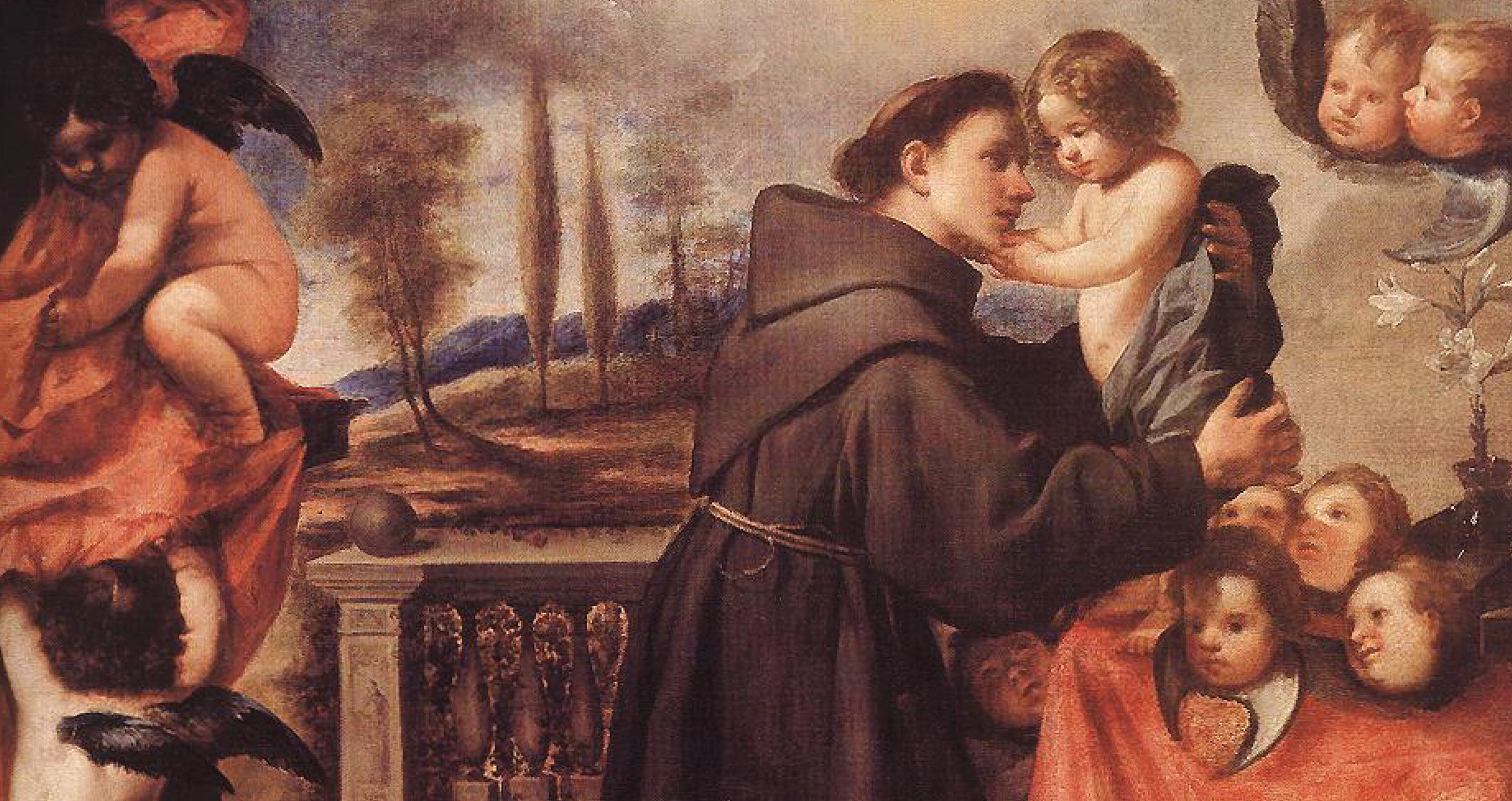
Above: Anthony of Padua with the Infant Jesus by Antonio de Pereda
If, then, thou seekest miracles,
Death, error, all calamities,
The leprosy and demons flee,
The sick, by him made whole, arise.Ant: The sea withdraws and fetters break,
And withered limbs he doth restore,
While treasures lost are found again,
When young or old his help implore.All dangers vanish from our path,
Our direst needs do quickly flee:
Let those who know repeat the theme:
Let Paduans praise St. Anthony.
We come at last to the Seventh of our defenders, St. Anthony of Padua. Now, his position is a bit problematic as Patron of Italy, for several reasons. It is not, of course because he was a native of Portugal: as we have notice, of the Seven, only St. David of Wales was an actual native of the land he defends. Although undoubtably Patron of Padua, and beloved for centuries by most Italians, not least because of his miracles, Italy itself was too divided to have a single patron. It was only in 1939 that the Holy See nominated Ss. Francis and Catherine of Siena as co-holders of the position, which St. Anthony has come to share since.
But really, officialdom was only racing to catch up. Italy has been in love him since he was canonized, less than a year after his death. To understand his powerful if unofficial popularity, we must go back to his early days in Portugal. Born Fernando Martins de Bulhões in Lisbon, Portugal, his parents were Vicente Martins and Teresa Pais Taveira. He was educated at the local cathedral school, and at the age of 15, was received into the Canons Regular of the Order of the Holy Cross at the Abbey of Saint Vincent on the outskirts of Lisbon. Both Order and Abbey were to have a colourful future – long after St. Anthony’s time. After being suppressed in 1834, the Canons were revived for the Opus Angelorum, while the Abbey itself became the Royal burial ground for the Braganza Kings.
In 1212, tired by visits from family and friends, he asked to go to the motherhouse of the order, the Monastery of the Holy Cross in Coimbra. He studied theology and Latin there. After Ordination he was named guestmaster at the age of 19. A party of Franciscans settled at a small hermitage outside Coimbra; it was dedicated to St. Anthony the Abbot. Then news arrived that five Franciscans had been beheaded in Morocco, the the first Franciscan martyrs. Afonso II, King of Portugal, ransomed their bodies. They were buried as martyrs in the Monastery of the Holy Cross. Inspired by them, Fernando left the Canons Regular to join the new Franciscan order. Upon his admission, he joined the small hermitage in Olivais, adopting the name Anthony – thus he carried on the memory of the first martyrs who inspired them. He then set out for Morocco, following in their footsteps. Falling seriously ill in Morocco, Anthony set off for Portugal to recover his health. On that voyage, the ship was blown off course to Sicily.
From thence he went on to Tuscany, and then, thanks to his poor health he was assigned to the hermitage of Montepaolo di Dovadola in Romagna, a there he spent his time in prayer and study. In 1222, in the nearby town of Forlì, several Dominican friars were present for an ordination. The question arose as to who should preach. The Franciscans expected that one of the Dominicans would do so, eloquent preaching being their vocation – and “Preachers” their title. However, they had come unprepared, thinking a Franciscan would have the honour. In this difficulty, the head of the hermitage called upon Anthony and asked him to speak whatever the Holy Ghost might inspire. Anthony objected, was overruled, and his knowledge and eloquence all caught his hearers’ attention.
He was sent by Brother Gratian, the local minister provincial, to the Franciscan province of Romagna, in Bologna. There Anthony came to the attention of St. Francis of Assisi. The Founder strongly distrusted theological studies in the life of the Franciscans, fearing it might lead to an abandonment of the life of poverty and service. But Anthony shared his vision; he could provide the instruction that might be needed by any young members of the order seeking ordination. In 1224, St. Francis made Anthony head of studies for any of his friars who wished to pursue the priesthood.
Praying for St. Anthony’s help in finding lost or stolen things comes from an event that occurred during his time in Bologna. Anthony had a book of psalms that contained his notes and comments for teaching his students. A novice who left stole the psalter. When Anthony realised his psalter was missing, he prayed it would be found or returned. Not only was the thief moved to return the book to Anthony, but also to return to the order. The stolen book is preserved in the Franciscan friary in Bologna.
Anthony took posts from time-to-time teaching at universities like Montpellier and Toulouse in southern France; but it was preaching that was considered to be his supreme gift. His method included allegory and symbolical explanation of scripture. In 1226, after attending the general chapter of his order held at Arles, France, and preaching in the region of Provence, he returned to Italy and was appointed Provincial superior of northern Italy. He chose the city of Padua as his location. Two years later, he served as representative from the general chapter to Pope Gregory IX. At the papal court, his preaching was hailed as a ‘jewel case of the Bible.” He was commissioned to produce his collection of sermons, Sermons for Feast Days. Gregory IX described Anthony as the “Ark of the Testament.”
In 1231, he became sick with ergotism. He was sent to the woodland retreat at Camposampiero with two other friars for a respite. Anthony died on the way back to Padua on 13 June of that year at the Poor Clare monastery at Arcella (to-day part of Padua), at the age of 35.
At his request, he was buried in the small church of Santa Maria Mater Domini near a convent he had founded in 1229. He was canonized the following year; as a result, the construction of a large church, now the Basilica of Saint Anthony of Padua, was begun around 1232 and completed in 1301. When St. Anthony was initially buried his tongue, jaw, and vocal cords were chosen as relics for veneration and displayed in a large reliquary. When his body was exhumed 30 years after his death, it was found turned to dust, but the tongue was observed to have glistened and looked as if it were still part of a live body; a further observation being made that this was a sign of his gift of preaching.
Called the “Hammer of Heretics,” his work was as closely studied by theologians as he was resorted to by the faithful in prayer. Portugal – although already claiming Ss. Michael and George as patrons – also spread devotion to her native son throughout her Empire in the East Indies, India, and South America. As noted, the Italians came to love him as another patron – just as they had adopted him while he lived.
As the sequence with which we opened shows, a large part of St. Anthony’s popularity was due to his miracles. Dom Guéranger encapsulates them with his usual eloquence:
St. Francis had yearned to be himself the bearer of the Gospel of peace through all the fair realm of France, then sorely ravaged by heresy; but in his stead, he sent thither Anthony, his well beloved son, and, as it were, his living portrait. What St. Dominic had been in the first crusade against the Albigenses, Anthony was in the second. At Toulouse was wrought that wondrous miracle of the famished mule turning aside from the proffered grain in order to prostrate in homage before the sacred Host. From the province of Berry, his burning word was heard thundering in various distant provinces; while Heaven lavished delicious favors on his soul, ever childlike amidst the marvelous victories achieved by him, and the intoxicating applause of an admiring crowd. Under the very eyes of his host, at a lonely house in Limousin, the Infant Jesus came to him radiant in beauty; and throwing himself into his arms, covered him with sweetest caresses, pressing the humble Friar to lavish the like on Him.
One feast of the Assumption, Anthony was sad, because of a phrase then to be found in the Office seeming to throw a shade of discredit on the fact of Mary’s body being assumed into heaven together with her soul. Presently, the Mother of God herself came to console her devoted servant, in his lowly cell, assuring him of the truth of the doctrine of her glorious Assumption; and so left him, ravished with the sweet charms of her countenance and the melodious sound of her voice.
Suddenly, as he was preaching at Montpellier, in a church of that city thronged with people, Anthony remembered that he had been appointed to chant the Alleluia at the conventual Mass in his own convent, and he had quite forgotten to get his place supplied. Deeply pained at this involuntary omission, he bent his head upon his breast: whilst standing thus motionless and silent in the pulpit, as though asleep, his brethren saw him enter their choir, sing his verse, and depart; at once his audience beheld him recover his animation, and continue his sermon with the same eloquence as before.
The learned Benedictine certainly loved the wonderworker of Padua, and so we shall enclose his prayer to him:
In return for thy loving submission to God our Father in heaven, the populace obeyed thee, and fiercest tyrants trembled at thy voice. Heresy alone dared once to disobey thee, dared to refuse to hearken to thy word: thereupon, the very fishes of the sea took up thy defense; for they came swimming in shoals, before the eyes of the whole city, to listen to thy preaching which heretics had scorned. Alas! error, having long ago recovered from the vigorous blows dealt by thee, is yet more emboldened in these days, claiming even sole right to speak. The offspring of Manes, whom, under the name of Albigenses, thou didst so successfully combat, would now, under the new appellation of Freemasonry, have all France at its beck; thy native Portugal beholds the same monster stalking in broad daylight almost up to the very Altar; and the whole world is being intoxicated by its poison. O thou who dost daily fly to the aid of thy devoted clients in their private necessities, thou whose power is the same in heaven as heretofore upon earth, succor the Church, aid God’s people, have pity upon society, now more universally and deeply menaced than ever. O thou Ark of the Covenant, bring back our generation, so terribly devoid of love and faith, to the serious study of sacred letters, wherein is so energizing a power. O thou Hammer of heretics, strike once more such blows as will make hell tremble and the heavenly powers thrill with joy.
To that prayer we can only add our own that he will take particular care of Italy as well – for the heartland of the Church is as desolate as any of her other provinces. With him we end our survey of the Seven Defenders of Christendom, each of whom we have covered in turn. May they, their brother and sisters patrons of every nation, province, city, town, hamlet, and parish on Earth, and Our Lady in all her geographical titles aid the Christian people, as they battle to keep the Catholic Faith whole among themselves, bring back to her all the places she has lost, and conquer for her all the rest of the World that she has never held.