
~~ Prologue ~~
Ahead of its threatened excommunication, the SSPX has responded with a “Declaration of Catholic Faith,” which, it says, “correspond(s) to the minimum indispensable to be in communion with the Church.” The Declaration is not a creed, but it lists twenty-two indispensable points of Faith.
Without specifically identifying them, each of the twenty-two points of the Declaration refutes one of the many affronts to the Faith committed by the post-conciliar Church, including, for example:
- The Post-Synodal Exhortation, Amoris Laetitia, on Holy Communion for couples in adulterous relationships.
- The Pan-Amazon Synod and its worship of Pachamama.
- The Abu-Dhabi Declaration and the Encyclical Fratelli Tutti, proclaiming that God wills a plurality of religions.
- Laudato Si’, on care for the planet through sustainable development.
- Mater Populi Fidelis, the Doctrinal Note diminishing the titles of the Mother of God and her role in the salvation of souls.
- The Declaration, Fiducia Supplicans, on the blessing of same-sex couples and the recent denial of their sinful relationship by Synod Study Group 9.
Suddenly, it is no longer about schism and excommunication of a disobedient order of priests. Now it is about the post-conciliar Church’s being called to account for its stewardship. The matter is not formally pending in some canon law forum; it is, however, implicitly pending before every member of the Order of Bishops.
Against this backdrop, the play begins.
⛪︎
The scene: a dimly-lit adoration chapel in a local parish. It is a weekday night, after dark. The sanctuary candle flickers red. The Holy Eucharist is present in the tabernacle that sits in the center of the altar.
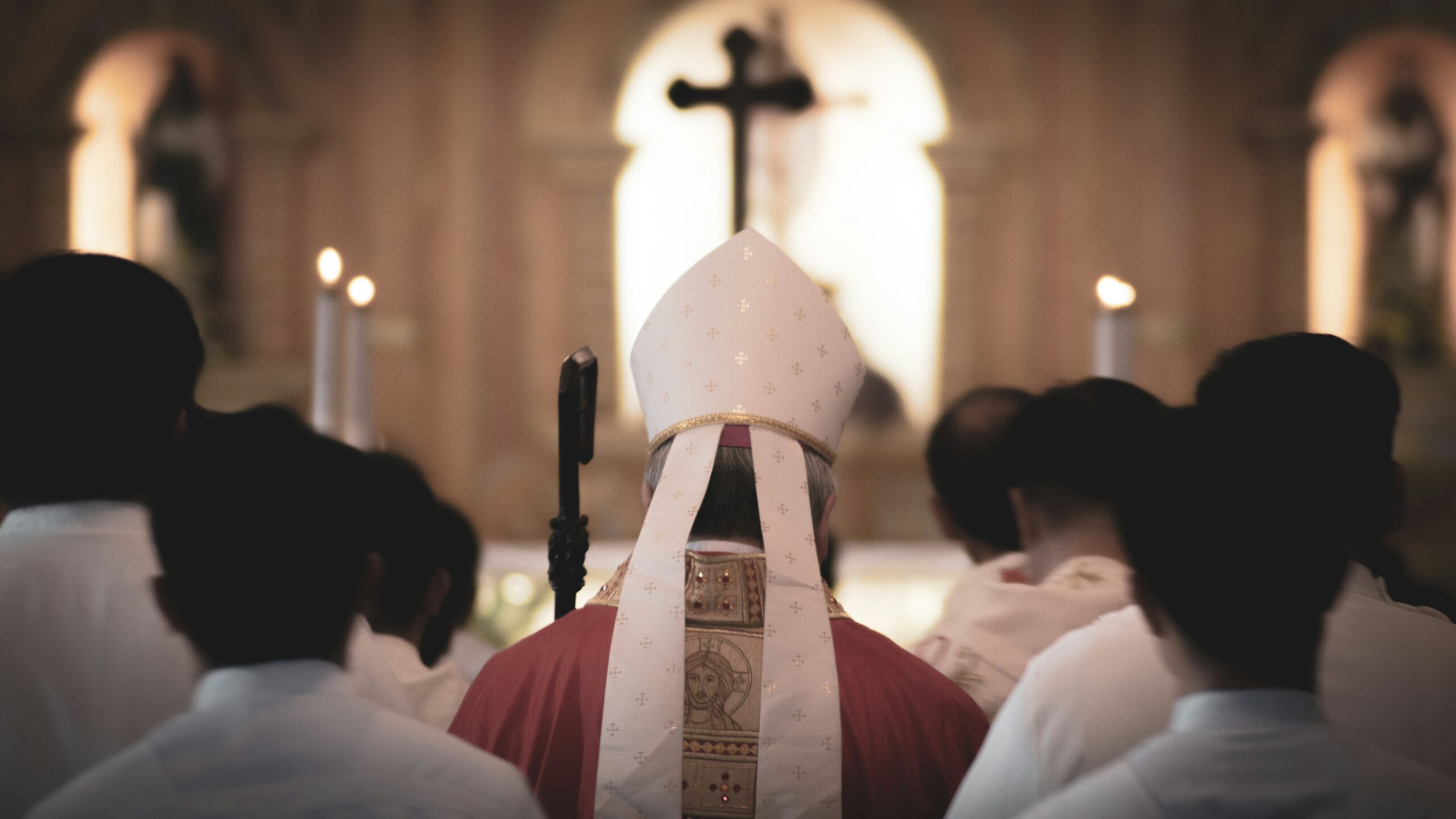
A solitary figure in clerical attire kneels in the front pew. He is an older priest, but his bearing signals his importance. He is, in fact, the bishop of the diocese.
There is a gentle knock on the door of the chapel and a second priest enters. Almost the same age as the bishop, he is the pastor of the parish. He makes his way to the front pew, genuflects, and kneels beside the bishop. After some time in prayer, the two priests sit simultaneously.
The pastor extends his hand. “Good evening, Your Excellency.”
They complete the handshake. “Good evening, Monsignor. Thanks for taking the time.”
There is no need for mutual assurances of confidentiality. These men are old friends and confidants. They have met in private several times before. The last time, it was to find a way for the bishop to comply with Traditionis Custodes while preserving access to the Traditional Latin Mass within the diocese.
They speak without facing each other, looking straight ahead at the tabernacle. This is not so much a conversation as it is a way to think out loud. The pastor has been the bishop’s sounding board for years.
“What is troubling you, Excellency?”
The bishop does not respond immediately. At length, he sighs deeply: “July.”
“Oh,” the pastor replies, “the SSPX consecrations. Everyone seems to have an opinion. Is it something in particular?”
“They’re right,” the bishop responds, almost whispering.
The pastor is taken aback. He instantly perceives the full implication of these words. July 1 has become the modern moment of sifting of the successors of the Apostles; Luke 22:31, playing out all over again. Satan hath desired to have you that he may sift you as wheat.
“Excellency, this is not your fight,” the pastor offers. “You can be silent.”
“Qui tacet consentire,” the bishop replies, quoting Sir Thomas More in A Man for All Seasons. “Silence gives consent.”
The pastor responds, “But, Excellency, More was on trial for his life. There is no trial here. No prosecutor. No transcript of testimony. No verdict. Events will unfold regardless of what you might think or do.”
The bishop turns to face the pastor. “Regardless of what I might think about the Society, what is my duty if I question the Church? There are now so many pebbles on one tray of the scale.”
The pastor responds, “This is not your call. Canon 1404: ‘The First See is judged by no one.’”
“True enough, my old friend. But I am judged.”
After a prolonged silence, the pastor tries a different tack. “Excellency, consider your diocese. The faithful have the best helmsman possible. Despite the buffeting, you have held close to the wind. You cannot abandon them at such a critical moment.”
“What if I am not abandoning them? Perhaps I would be leading them.”
“As things appear at the moment, Excellency, you would be leading them to excommunication.”
They have arrived at the crux of the matter. Personal duty vs. pastoral duty. Most of the faithful are only dimly aware of the gravity of the moment. Should they be left in non-culpable ignorance? Or should they be awakened to what historians will later call the high-water mark of the conciliar Church?
“I had a dream last night, Monsignor. I was standing in judgment before my Lord, Jesus Christ. I was trembling as I recalled that the fourth round of Dante’s ninth circle of hell is the final destination of traitors. As Sir Thomas More said to Richard Rich, the man who betrayed him, ‘it profits a man nothing to give his soul for the whole world.’”
With that, they parted company. The bishop had made up his mind.
The End
Photo by Jomarc Nicolai Cala on Unsplash
