
Editor’s note: this is the first of a series of publications from this year’s Roman Forum in Gardone, Italy.
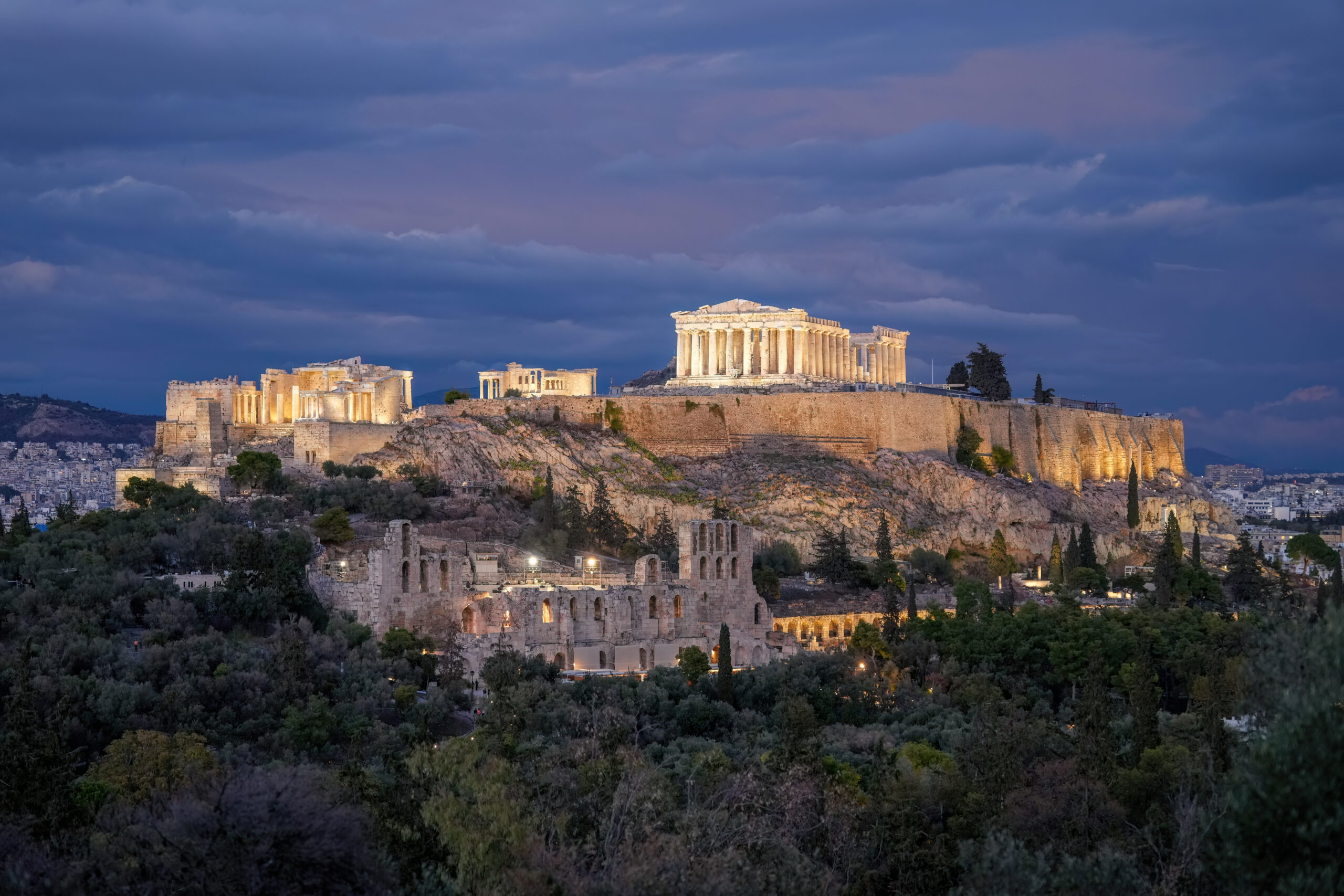
Above: the Acropolis of Athens.


I. The Cult of Domesticity
Susan Sucher describes herself as a “Domestic Empress.” She reigns over two websites, one bearing her imperial title; the other called Return to Sanity. She writes:
The home is the place where most of us, men, women, and children alike have the most freedom. … What many of us have forgotten, and what Chesterton reminds us, is that the home is the normal place for men, women, and children, not the exception. The external focus of the modern age is an aberration, not the norm for human existence. … The pernicious lie that freedom and liberty are to be found in the public sphere contains chains which enslave us even as they are imperceptible. As our cultural focus has drifted more and more outside the home, … we have to ask ourselves––Has this shift increased our liberty?[1]
By the “home,” Sucher means the domestic sphere; by “external focus,” I take her to mean any consideration of the “public sphere” as equal or superior to the domestic sphere. By contrast, let me call your attention to an important passage in Aristotle’s Politics.
[I]t is evident that the polis belongs to the class of things that exist by nature, and that man is by nature an animal intended to live in a polis. He who is without a polis, by reason of his own nature and not of some accident, is either a poor sort of being, or a being higher than man.
Citing Aristotle with approval, St. Thomas Aquinas writes in the Summa Theologica that “the civitas is a perfect community.”[2]
Polis and civitas have been translated a number of ways. For the moment, we will simply call it “political community.”Clearly, Plato, Aristotle and St. Thomas believe that natural happiness is only possible within this political community. St. Thomas writes:
As one man is a part of the household, so a household is a part of the state: and the state is a perfect community. … And therefore, as the good of one man is not the last end, but is ordained to the common good; so too the good of one household is ordained to the good of a single state, which is a perfect community.[3]
This passage leaves a few things to be clarified, including, whether “state” is the best translation of civitas, and exactly what kind of “law” is involved. We will address these questions later on. Nevertheless, it is clear that Aquinas views the civitas as the proper habitat of man qua man.
What are we to make, then, of Sucher’s claim that “the home,” the domestic sphere, “is the normal place for men, women, and children?” Sucher is not alone in adopting this position. Fiona Melton––a self-described “Catholic feminist” and an apologist for rural life––has written an article for Crisis Magazine entitled “Yes, a Woman’s Place is in the Home––But So is Her Husband’s.” She claims that “the ideal should be for both husband and wife, father and mother, to be fully integrated in the domestic sphere,” and she criticizes the Industrial and Post-Industrial culture in which “men are forced to work outside the home.”
As Catholics, … it is our duty to strive for the ideal, not merely what is currently in fashion or economically the easiest option. Perhaps it might look like a return to the land and traditional agrarian models; or perhaps a man could take advantage of technological advances and find a remote job.[4]
We can sympathize with Melton’s concern for the under-appreciated role of the father, and yet her solution, like Sucher’s, is dissonant with Classical and Christian political philosophy. Melton and Sucher’s solution is not to heal the public sphere but to “denature” it: to imply that it was never natural. The result is a false picture of the Pre-Industrial West that resembles either a Little House on the Prairie or a suburban housing development. Christianity, the religion of the basilica, becomes the religion of the living-room.
Ironically, while criticizing the Technological Revolution, Melton proposes a technological solution: remote work. Does remote work really reintegrate men, or does it merely domesticate them? For Melton, it’s the same thing.
Social media is not the only place where these claims are being made. In a 2013 essay published by the National Catholic Bioethics Quarterly, John J. Goyette shows how this disenthronement of the civitas is supported by the philosopher John Finnis, who represents the New Natural Law theory.
According to Finnis, the purpose of human law is not to function as a moral teacher. The function of human law is to maintain public order by exercising the coercive power of the state against the violence of those individuals who threaten the essentially peaceful life of the family. … [According to Finnis] [i]t is within the family and other private associations—not the civitas—that one finds the cultivation of complete virtue and the fulfillment of our natural inclination to live in society.[5]
The New Natural Law theory takes the Classical and medieval view of the family as an “imperfect community” to mean simply that the family requires structural supports like economic stability, safety and civil rights. By contrast, according to the Classical view, the responsibility of the political community is much greater, namely, to cultivate virtues and practices conducive to the good of human nature itself, or the common good. I will argue here that the success of this political task is impossible without the institution of public space: the forum, the agora, the town square, which represent integrated places proper to man qua man. If we take seriously the medieval adage that all things in the mind come to us through the senses, it stands to reason that an accurate conception of the human soul requires a sensory experience of the human soul, in the form of a geographic place.
In a 2014 adaptation of his essay as a lecture for Thomas Aquinas College, Goyette complains of
a growing tendency among conservative Catholics to adopt a quasi-libertarian view of human government: that government should not be concerned with making its citizens morally virtuous, but should instead concern itself with a more limited and instrumental common good.[6]
This “instrumental common good,” he writes “is ordered ultimately to the good of families and individuals who privately pursue their own notion of happiness.”[7]
There is an ambiguity about Finnis’ position that is worth noting. Either the common good is essentially an individual project, which is only instrumentally communal, or it is the project of “family and friends.” If it is the project of “family and friends,” we should wonder why these friends, in particular, can never be the same thing as political community. Classical liberals are emphatic, however, that friends belong to the private, not the public, sphere.
Goyette’s own position is clearly in harmony with Aristotle and Aquinas. He writes:
I will argue that for Aquinas the political common good transcends the private good of individuals and families, that it consists in the virtuous life of the political multitude (what Aquinas calls “communal happiness”) and that the family is insufficient to lead men to virtue apart from law and the civitas.[8]
Sucher, especially, exemplifies this “quasi-libertarian view.” She and many other conservatives are in danger of making the same claims for the domestic sphere that Plato, Aristotle and Aquinas made for the political sphere. I refer to this position as the cult of domesticity, fully aware that this phrase has particular historical connotations. By the “cult of domesticity” I mean simply the position that the domestic sphere, or the life of the nuclear family, is the only society that is an end in itself.
One could object that I am being too hard on a practical solution. We live in a post-Christendom age when Catholic towns and Catholic political life are no longer available (it seems). Surely this is what Pope Leo XIII had in mind when he wrote, in Rerum novarum, that the family “has rights and duties peculiar to itself which are quite independent of the State.” However, to the practical necessity of domestic holiness, the cult of domesticity adds a crucial premise: that the public sphere is by nature secondary and instrumental to the ends of the domestic sphere. Goyette rightfully calls this position “libertarian,” since it mirrors the libertarian conclusion that, if one government is corrupt, all government is corrupt. Thus, the cult of domesticity is not a practical but a theoretical position and, as such, vulnerable to theoretical critique. Fiona Melton, in the Crisis article, described her position as “striving for the ideal.” An “ideal” of domestic supremacy and remote jobs has to be treated as such.
The temptation to view the family as a complete, or perfect, community is one reason for the success of the cult of domesticity. However, I believe that there is a more serious temptation: a temptation that has existed in the United States for a very long time, and arguably from our founding. This temptation has become worldwide through the Industrial and Digital revolutions. It is the temptation to forget what public space is, and why we need it. This temptation results in a failure to understand what political community is. For instance, the widespread translation of polis and civitas as “state” suggests that legal codes, written constitutions and pure economies are sufficient to establish a civitas. This leads to the counter-intuitive conclusion that the one thing a political community does not need is community. As I will argue, this temptation to reduce political community to a constitution or regime arises from a failure to understand the full meaning of law. The remainder of this essay will therefore be divided into the following parts. First, I will review the reasons for maintaining that political community is the perfect community. Second, I will argue that a political community is ordered by custom, or what Alasdair MacIntyre would call practice, which is the most fundamental sense of political “law.” Third, I will show why the perfection of the political community, as a place of custom, is necessarily expressed as public space. My conclusion will be that man, insofar as he is a political animal, is a public animal, which is precisely the claim denied by the cult of domesticity.
II. The Political Community
My arguments for the perfection of the political community are taken largely from Plato’s Republic and Aristotle’s Politics, which I call by the umbrella phrase “Classical political philosophy.” I understand Aquinas to be in agreement with Classical political philosophy on these points.
For the purposes of our conversation, by practical action I will mean any action ordered to a physical outcome for the sake of that physical outcome (such as drinking a glass of water to slake our thirst). We share this kind of action with animals. By intellectual activity I mean any activity ordered by our specially human gaze upon Being itself. It is crucial to my argument that, while men are never wholly practical or wholly intellectual, we can be one or the other to a greater or lesser degree, according to the tendency of our communities.
Man is an embodied intellectual creature, meaning that in all phases of his life, in all his particular actions, he straddles the realms of intellectual and practical life. For instance, when a carpenter hammers a nail into two pieces of wood, he is pursuing several objectives at once: the concrete result of fastening the two pieces of wood, the larger practical objective (say, building a window frame), and the goodness of what he is doing. Unlike a bird building a nest, or a beaver building a dam, a carpenter has a notion that what he is doing is good. Goodness itself does not describe a concrete physical outcome, but, rather, a purpose (what Aristotle calls a telos or final cause), which places the carpenter in direct relation to Being. When we speak of the transcendentals––Truth, Goodness, Beauty––we are speaking of various relations to Being, as Dr. Stark has explained in a previous lecture.
At any given moment, a person can be more or less plugged into the practical or the formal reality. Having posited a good, the carpenter settles into his task, just as a musician or an actor relies on muscle memory to execute what is premeditated. On the other end, somebody who is praying, or formulating an argument, or contemplating a work of art, is concerned with the formal reality. Of course, no human action ever falls completely to one side or the other. The craftsman never completely forgets the goodness of his task, and the contemplative is never completely removed from the practical steps of his contemplation (say, the premises of the argument, or the technical elements of the painting). Thus, for example, Aristotle says that even the most primitive biological instinct to procreate is motivated partly by the desire for immortality.
Social cooperation, or “community,” begins with the biological relation between man and woman, for obvious reasons. There is no more intuitive social bond than the bond between man and woman. Aristotle therefore posits the family, or oikos, as the primordial community, a community that serves as the building block for further communities. This community is a practical community. In other words, it is concerned with survival and the propagation of the species. Even larger communities share this practical orientation. A small nomadic tribe is concerned mostly with procuring food for survival.
Even in these primitive societies, however, man has an intuition of Being. Aristotle argues that this intuition of Being is the cause of language. While brute animals communicate through sound––say, to alert each other of danger or opportunity––man communicates through formal names. When I say the word “wine,” for instance, you will not instinctively look around the room for a bottle of wine, or imagine that I have a bottle of wine in front of me. Rather, you will understand a concept, and with that concept a whole series of connotations, including higher goods: conviviality, conversation, honesty, friendship. Language necessarily introduces notions of goodness, evil, benefit, harm, beauty and ugliness: notions that are not confined to concrete physical results. Brute animals are incapable of communicating this way. Language introduces a theoretical dimension to communication, such that we can understand an idea separately from a particular way of acting. All language removes us from the practical sphere.
As communities grow, from the primitive tribe to more stable societies, a new kind of social bond develops in addition to the biological bond or the economic bond. We could call this bond “intellectual.” When a society has become economically stable enough, intellectual communication assumes greater importance. We begin to classify our communities, not only in terms of practical objectives, but also in terms of visions of human nature and human purpose. We begin to ask what kind of creature a man is, that he desires and needs certain things. We begin to ask, not what is good for me, or good for us, but what is good for human beings. As we begin to organize our lives and habits around this notion of a common good, a culture develops.
This is the origin of the political community: what Aristotle calls the polis and Aquinas calls the civitas. Both Aristotle and Aquinas write that the political community originates from necessity but tends toward perfection; that is, the political community has an economic origin but an intellectual or transcendental purpose. It does not content itself with physical survival but asks what is good for us completely, as human beings with intellectual souls. For this reason, we can distinguish the good of man qua animal from the good of man qua man. Qua animal, man has physical needs. Qua man, he has these plus the need for understanding, which is really the need for a relationship with his Creator.
The fulfillment of this need is only possible in the political community. Why so? If we grant that it takes time for a community to become leisurely enough to contemplate the Good, we should nevertheless wonder why this contemplation of the Good remains, in a crucial way, a social activity. Aristotle’s answer is clear enough. Language. Language is necessary for positing, grasping and developing the formal concepts of the intellectual life, and language is fundamentally social. Concepts are refined by friction of personal encounters. Through this friction, we come to distinguish what is essential from what is accidental, and we do so linguistically. However, there’s a second reason why the contemplation of the Good is naturally social, and this reason is subtler. It has to do with the discipline of the imagination.
The Aristotelian school, continuing into the Middle Ages, developed a theory of animal instinct (what Aquinas calls the vis aestimativa).[9] According to this theory, we cannot reduce all the actions of non-rational animals (or “brutes”) to sensory stimuli. The mother bear doesn’t birth, feed and protect her young because it feels good, nor does the sheep fear the wolf because of some sensation of pain. This non-sensory instinct of brute animals cannot be called intellectual, either, because it is only directed to particular outcomes. The sheep does not fear evil or harm abstractly, but only in the shape of the predator. Human beings have a similar kind of instinct, which has been tied to the phenomenon of “connatural judgment.” Fiona Barker has written an excellent unpublished dissertation on this topic. Connatural judgment is our ability to form certain habits of judgment, without referring every judgment directly to the intellect. Barker cites the example of an art connoisseur who can “sense” that a piece of art is a fraud. Unlike brute animals, humans can and must rationally inform their instincts. Nevertheless, instincts have a distinct mode of operation. Since they are not wholly sensory or intellectual, they must have a special proximity to the imagination, which is in between.
Imagination plays a crucial role in our everyday judgments: what we perceive to be useful, harmful, inspiring, irritating, worthwhile, and a waste of time. When we specifically wish to cultivate certain habits of judgment, we therefore cultivate environments: spaces and other sensory conditions that reinforce the habit. This is obviously a crucial part of childhood formation, but it is just as important when we grow up. An holy life calls for the effort to create holy spaces, holy images and holy relationships, which is to say, an holy imagination. We cannot do this alone, or even in very small groups, because the spaces, images and experiences to be transformed are necessarily common spaces, images and experiences. In other words, to pursue the Good as human beings means to create good environments, a project that is necessarily social.
Plato, Aristotle and Aquinas are all very clear on the point that political community is a primary community, not an instrumental one. What this means is that we cannot opt in and out of political community as it seems to promote or deter our individual happiness. Just as a man cannot opt in and out of family life when he deems it helpful or unhelpful to his individual happiness, so we cannot be “political” only to the extent that it offers us particular services such as education, wealth or security. Nor is it sufficient to a political community that some members pursue the common good privately, because the pursuit of the common good is a communal activity. Everyone has to be involved. We saw this in the case of language and environment. We will also see it in the case of custom and public space, which brings me to the next part of my talk.
III. Law and the Necessity of Custom
Political community is ordered by law, which Aristotle calls nomos and Aquinas calls lex. However, there are different senses of “law.” Aristotle speaks of “written” and “unwritten law,” and Socrates makes the paradoxical claim in the Republic that a societies with too many laws will become unlawful.
“Law” can be understood to mean order itself, which is why the creators in mythology are often characterized as legislators. The Zeus of Hesiod’s Theogony is said to be the father (literally) of Lawfulness and Justice, but also––at the same moment––of the Seasons. Law, justice and the seasons are divers expressions of the same principle: the organization of nature into parts with specific functions. Zeus’ role as co-creator of natural order mirrors his role as the distributor of “titles and privilege” among the other gods.[10] A lawgiver is both one who facilitates the practical function of things, by instituting rules, and one who brings-into-Being by making what is ambiguous more precise.
Law could also be understood as the creation of order through differentiation. This is precisely what Marduk does with the body of Tiamat in the Babylonian Enuma Elish, as Edward S. Casey observes. Casey writes:
Precisely as an amorphous nonobject, that is, as herself the Deep, Tiamat can be conquered in a cosmomachia wherein the architectonic triumphs over the unstructured and the mastery of the matrix is asserted.[11]
Casey has an interesting thesis that order, in this sense of structuring the amorphous, or objectifying the nonobjective, is related to the phenomenon of “place.” Place is to space what architecture is to the Deep, what order is to chaos, and what Marduk is to Tiamat.[12] Wherever a space becomes a place, order has been created, and law––human or divine––is established.
Socrates can refer to the soul of the just man as ennomos (lawful), implying again that “law” has this more foundational sense of order and the living-out of order. What kind of order is specifically political? I argue that the foundational sense of political law is custom, which is simply the social pursuit of the common good in a methodical and practical way. Custom is closer than written law to the Aristotelian notion of happiness as an “activity of the soul,” since a custom––unlike a legal ordinance––can be lived. It can be practiced. Today, the systematic replacement of customs with technologies is symptomatic of the transformation of political communities into “states” or “regimes.” But what arguments can be given for the priority of custom over written law?
Following Aristotle, Aquinas asserts the following.
Every law is imposed on two kinds of men. For it is imposed on certain men that are obstinate and proud, who are restrained and tamed by the law; it is also imposed on good men who, instructed by the law, are helped to accomplish what they aspire to do.[13]
We could refer to these two kinds of law as coercive and cooperative. Coercive law, which is typically (though not always) proscriptive, serves to deter men from actions that are incongruous with the common good. This is the kind of law we associate with legislation, constitutions and political “regimes.” Coercive law concerns acts that are punishable. Cooperative law is “positive” in the sense of being an activity. Cooperative law is more fundamental, in the way that exercise is prior to a single act of strength. Simply, deterrence from evil is not the same thing as pursuit of the Good.
To understand the problem better, let us consider Aquinas’ distinction between concord and peace. Aquinas writes the following in the Summa:
For concord, properly speaking, is between one man and another, in so far as the wills of various hearts agree together in consenting to the same thing. Now the heart of one man may happen to tend to diverse things, and this in two ways. First, in respect of the diverse appetitive powers. … Secondly, in so far as one and the same appetitive power tends to diverse objects of appetite, which it cannot obtain all at the same time: so that there must needs be a clashing of the movements of the appetite.[14]
Basically, Aquinas says that “movements of appetite”––or desires––can conflict with each other either because we have contrary appetites, like hunger and fatigue, or because we can’t make up our minds when we’re called to choose between the same sort of goods. I call the latter “buffet concupiscence.” Aquinas continues:
Now the union of such movements [of our appetites] is essential to peace, because man’s heart is not at peace, so long as he has not what he wants, or if, having what he wants, there still remains something for him to want, and which he cannot have at the same time. On the other hand this union is not essential to concord: wherefore concord denotes union of appetites among various persons, while peace denotes, in addition to this union, the union of the appetites even in one man.
Concord, then, is simply agreement between people, while peace is agreement between people whose souls are in a condition of self-agreement, or internal harmony. Thus, Aquinas remarks that “[t]here can be concord in evil between wicked men.”[15] Following his distinction, we might say that coercive law––the law of ordinary legislation––promotes concord, while political life in its essence promotes peace.
Concord is not necessarily directed to the common good. Rather, it “denotes union of appetites” between men, and also––I would argue––a union of appetites across space and time. For example, let’s say that Adam is an enterprising sardine salesman who decides to set up shop in the Alfama (the Moorish neighborhood of Lisbon, Portugal), hoping to make a fat profit on the feast of St. Anthony. Athanasius, a Portuguese Catholic, is preparing his grill for the feast and realizes he’s low on sardines. He visits Adam’s sardine emporium, and a commercial transaction occurs. In this scenario, Athanasius and Adam are in a state of concord. Their appetites converge upon the commercial exchange of money for sardines, a particular outcome. This does not entail that both or either of the men is in a state of peace. Concord simply means that their wills have converged upon a practical outcome.
Aquinas does not say this, but it seems clear that even the individual man can experience concord without peace, meaning that his practical actions are consistent across space and time. If Adam swindles a bunch of people by charging an arm and a leg for sardines, and then donates to charity, his soul is disordered, but his actions are not mutually disruptive on the practical level. He may swindle in the market, pray in church, donate in private and repent at leisure. So long as these actions are separated by discrete spheres, each with its own set of practical rules, we may say that Adam’s appetites are in concord but not peaceful.
Applying this distinction to political life, we should see clearly that certain kinds of law promote concord, while others promote peace. A society in which people are coercively deterred from murder, violence, theft, fraud and indolence is not necessarily a society that actively promotes peace. It is merely a society that discourages practical conflict. Thus, a society founded exclusively on coercive or proscriptive law cannot establish peace. It can only establish concord.
From what we have seen so far, however, it is clear that the end of political life and political community is peace. The common good can only be pursued by individuals in a state of peace, internally and with each other. It follows that political life requires a kind of law that is directly ordered to the common good and “cooperates” with the virtuous man.
But is it really possible for a law to be “cooperative” in the sense of imposing positive demands on a group of individuals and expecting these demands to bring about personal goodness? In other words, is it really possible for “laws,” in the plural, to instill, not only a practical fear of evil actions, but also a real desire to pursue the Good? This I argue is the function of custom. Aristotle speaks of “unwritten laws.” Let me give an example of an “unwritten law.” On the feast of St. Anthony, the city of Lisbon becomes largely a place for grilling sardines. The narrow streets of the Alfama, the Moorish hillside neighborhood, are packed and blocked with backdoor grills, and it is sometimes difficult to distinguish a restaurant from a household party. It would be absurd to interpret such an event as an enormous coincidence of private decisions. Rather, such an event––which we call a “custom”––depends upon an unspoken consensus, religious in origin, which manifests itself as a common activity that blurs the lines between private and public will. This capacity to act harmoniously and specifically, in a gesture expressive of a definite character, is what distinguishes a culture.
Alasdair MacIntyre would call this kind of thing a practice. MacIntyre’s definition of practice may be one of the longest sentences in philosophical literature. He writes:
By a ‘practice’ I am going to mean any coherent and complex form of socially established cooperative human activity through which goods internal to that form of activity are realized in the course of trying to achieve those standards of excellence which are appropriate to, and partially definitive of, that form of activity, with the result that human powers to achieve excellence, and human conceptions of the ends and goods involved, are systematically extended.[16]
We can glean a couple of things from this definition. First, a practice involves certain rules of action. Chess, football, architecture and painting are all examples that MacIntyre gives of practices. You cannot engage in the “spirit” of a practice while eschewing the rules and methods. Second, a practice is not taken up exclusively for the sake of a certain practical outcome. For example, if you lose a football game you have not failed to practice football, nor have you failed to benefit from the practice. This is especially obvious in the case of customs like the tradition of grilling sardines on the feast of St. Anthony. The citizens of Lisbon––I imagine––don’t go to bed disappointed that they have failed to grill enough sardines or feed enough people. Rather, the custom is successful by virtue of involving many people and honoring St. Anthony. On the other hand, the custom would cease to exist if everyone prayed privately at home or thought about sardines. Another very good example of a practice or custom is the season of Lent. We cannot participate in the season of Lent without following some very specific rules, and yet the outcome––the “benefit,” for want of a better word––is not reducible to the successful adherence to these rules. Perhaps a better word than “rules,” then, is disciplines. Indeed, Catholics are put in the paradoxical situation of having to follow these disciplines while acknowledging that, if we only care about following the disciplines, they won’t work. This paradox is essential to a practice.
Ultimately, practice does not denote a very specific list of activities but, rather, a way of approaching activities. Some activities are too brief and trivial to be practices; for example, filling up your gas tank. I call these “mere tasks.” Other activities can become either practices or tasks, depending on how we approach them; for example, shopping. Shopping can assume some of the characteristics of a practice when it remains open to formal goods such as friendship, conversation, information. The practical task of acquiring creature comforts serves as a context for placing ourselves in political environments: environments where we are actively at peace with other people, because we are actively contemplating and pursuing the Good. Automated shopping reduces this practice to a task, in effect reducing our political experience to a merely economic task. The distinguishing difference between a practice and a task is whether we are disciplined to relate our practical activity to the common good. We live in a world where practices are turned into tasks whenever possible, a process generally advertised as “labor-saving.” Small as they may be, practices cumulatively achieve the crucial political goal of training our attention on formal reality, on Being itself. A culture that aims to replace these practices with technologies implicitly denies the formal or contemplative orientation that is proper to human work. The problem is not that all tools are evil––although some tools are. Rather, the problem is that a culture without any notion of the common good is in a position to view every human action as exclusively practical, which is to say, technologically replaceable. If shopping can be automated, so can iconography. It is characteristic of Marshall MacLuhan’s “global village” that we have no patience left for customs, either in public or in private. The result is political states without political communities. Relating MacIntyre to St. Thomas, we can say that a society in which all practices are reduced to tasks is a society that promotes concord without peace: practical agreement without harmony of souls.
IV. Custom and Public Space
I will change tempo a bit and focus on the history of urban space. An historical perspective is helpful for several reasons: first, because it shows that physically-speaking the distinction between city and town is not as important as we are lead to believe in the Post-Industrial Age. Aristotle uses the words komé and polis, which are often translated “town” and “city,” respectively. However, the Greek komé could designate anything from a village to a city neighborhood, while the polis physically-speaking had the essential features we would associate today with a “town,” namely, private residences grouped around public spaces designated for commerce, worship, entertainment and intellectual exchange. I argue that the distinguishing feature of the polis is not constitutional autonomy (the “state” part of city-state), but instead public space, which is the physical articulation of the common good. As political community orients individual survival towards human teleology and the Good, so the polis orients private space towards public space, and private practice toward custom.
In the ancient world, as we know, agricultural communities grew along the banks of rivers like the Nile, the Tigris and Euphrates, and the Yangtze. The earliest examples of urban planning are workers’ colonies, residences grouped around construction sites, such as Kahun––built around 2650 B.C. for the construction of the Illahun pyramid in Egypt––and Tel-el-Amarna, which was built in the 14th century for construction projects under Akhenaten. Frederick R. Hiorns writes that the “competently handled, rectilinear lay-out” of Kahun “affords clear evidence of Egyptian capacity to plan cities.”[17] Evidence exists of more permanent urban planning in the residential part of the city of Ur, from 2100 to 2000 B.C. Hiorns writes:
It is interesting to find at Ur, and on an extensive scale, street-planning with house-blocks that, despite congested arrangement and irregularities resulting from site difficulties, were forerunners of the more systematized arrangement of later times.[18]
Ur developed around a sacred quarter, or temenos, an elevated area with temples and public buildings that Hiorns describes as “a prototype of the Acropolis or Citadel,”[19] which featured the characteristic Babylonian ziggurat: a stepped pyramid.
R. E. Wycherley observes that the Mycenean acropolis became the distinguishing core of early Greek city-building and the precursor to the agora. Essentially a raised citadel, the acropolis emerged as a place of feasting, religious worship and political assembly. Wycherley writes that the Greek colonization of Italy and the coast of Asia Minor allowed for the development of “more deliberately planned and more rapidly developed” cities and reflected “the cultural, religious and political evolution of the Greeks.”[20] The 5th century architect Hippodamus redesigned the sacked Ionian city of Miletus according to “a preconceived plan that left nothing to chance in the fundamentals of disposition.”[21] This plan includes a “chess-board” system of “straight streets crossing at right angles”[22] and an agora. “Aristotle … says that, under the influence of Hippodamus, the main crossing became a natural determining point for the agora area.”[23] The agora of Miletus “suggests a plan disposition, dignity, and coherence of arrangement without parallel in that or preceding ages.”[24] Hippodamus designed the rebuilt Piraeus (the port of Athens) and also redesigned the Sicilian city of Selinus, notable for a courtyard-centered housing arrangement.[25] Plans like these gave a deliberate, intellectual flavor to ancient public spaces like the acropolis and embodied what Hiorns calls “the Platonic-Aristotelian principle of the subordination of personal interest to the public good.”[26] Here the “public good,” of course, does not denote the collective economic good, but instead the good of the soul or “the citizen as representing mankind.”[27]
Wycherley considers the agora to be the single “[m]ost important” element of Hellenic town planning.[28] He offers a charming illustration of what the agora signified, both as a focal point of urban life and as an interpretation of human life. He writes:
No clear line was drawn between civic centre and market. The public buildings and shrines were in the agora; meat and fish and the rest were sold in the same agora; and agorazein means to go to market, to buy, though also occasionally to stroll about the agora. At Athens quarters were devoted to the sale (sometimes also the manufacture) of particular wares, and called after these (the fish, the vegetables––including the onions, the garlic and so on––the bronzes, the slaves, and many others). Booksellers, we may infer from Plato’s Apology … , had their stalls by the old orchestra. … The agora was the chief place to which men would drift in moments of leisure to find congenial company, in the stoas, under the plane trees, in the barbers’ shops or the wine-shops or by the smiths’ fires. … A religious element pervaded the agora; the public buildings were dedicated to deities and there were altars and shrines everywhere.[29]
Wycherley also observes a fascinating historical and teleological connection between the agora and the physical theater. He writes:
A certain relation can be detected between the theatre and the agora. … In the agora of Athens was a place called the orchestra, where in early times dances and dramatic performances were given, and probably temporary wooden seating was erected for the spectators. Bulle sees a simple village agora in the ‘theatres’ of certain Attic demes, such as Rhamnus, where, at the foot of a slope below the acropolis wall, there was a row of stone seats for the dignitaries, facing a large flat terrace.[30]
This historic kinship between theater and agora is not surprising. Both theater and agora are places where the unity of the soul is modeled, and cultivated, through an artistic designation of geographic space. Political and dramatic space are thus analogically related, because both are prerequisite settings of the human drama, places where the divers functions of the human soul are brought together into spatiotemporal relief. Just as a dramatic plot cannot unfold without a unifying space, so the unity of the soul cannot be lived without an integrated place that regathers the whole spectrum of human functions.
It is no coincidence that Western philosophy was born in the Greek colonies, where the physical regulation of life was reflected in organic cities with integrated public spaces. A place like the agora––and the grouping of residential life around such a place––is a crucial part of the political “moment,” the genesis of political life. In other words, the transition from private survival and biological survival to ethical and cultural life is incarnated in the transformation of practical and specialized spaces into integrated cultural spaces. A society consisting entirely of private, specialized and domestic spaces will struggle, as a society without language would struggle, to frame and to live out an examination of the common good.
Without properly designed cities that reflect the subordination of private to common good, we will find that our activities retain an individualistic character proper to “mere tasks.” Unsurprisingly, our heavily individualistic age is also a heavily technological age. Marshall McLuhan’s “global village” may be a state of advanced concord––coordination of personal tasks––but it is not a state of peace. Contemporary life is ubiquitously remote. Our biological, economic, recreational, artistic, scholarly and religious activities have become spatially and temporally scattered in a way that can only reinforce an ethical-metaphysical individualism. In other words, the geographic isolation of the individual leads to the view that each individual is his own nature, with his own purpose, his own truth and his own version of happiness.
Alexis De Tocqueville famously noted the peculiar character of American individualism (a word he introduced to the English vocabulary). He describes individualism as
a reflective and peaceable sentiment that disposes each citizen to isolate himself from the mass of those like him and to withdraw to one side with his family and his friends, so that after having thus created a little society for his own use, he willingly abandons society at large to itself.[31]
He continues:
[O]ne finds a great number of individuals [he writes] who, not being wealthy enough or powerful enough to exert a great influence over the fates of those like them, have nevertheless acquired or preserved enough enlightenment and goods to be self-sufficient. These owe nothing to anyone, they expect, so to speak, nothing from anyone; they are in the habit of always considering themselves in isolation, and they willingly fancy that their whole destiny is in their hands.
Thus not only does democracy make each man forget his ancestors, but it hides his descendants from him and separates him from his contemporaries; it constantly leads him back toward himself alone and threatens finally to confine him wholly in the solitude of his own heart.[32]
The tendency “to withdraw to one side with … family and … friends … and willingly [abandon] … society at large to itself” is as good a description as any of the cult of domesticity. This phenomenon is no longer limited to America, but––thanks to the Digital Age––has become global, as Marshall McLuhan predicted.
V. Conclusions
It is important to grasp the spirit in which an activity is performed. In a lecture for the 2025 Roman Forum Summer Symposium, I described the New Urbanist project of Newtown, St. Charles: a somewhat comical image of what happens when urban design becomes just another technology. Well-designed towns, with focal public spaces, are only potential settings of healthy political life. A well-designed stage may turn out to produce Waiting for Godot. Catholics should keep an hopeful eye on projects like Newtown, while recognizing that a sense of the common good does not miraculously take life like Galatea from the clay of urban engineering. On the other hand, I have argued that no political community can exist without appropriate matter. Customs and intellectual communion––and, most importantly, the sacraments––call for a fitting geographic and social orientation to the common good. It follows that anyone who advocates for domestic autonomy, at the expense of public life, has an imperfect grasp of the common good and the political nature of man. It is false to assert that a holy, Catholic domestic life would suffer from an “external orientation” of its members towards the public sphere. Nor is such an “external orientation” to be blamed if Catholics do not form families to begin with. Rather, a truly public orientation to the common good is the greatest antidote to the selfish individualism of modern man that flits, at whim, between remote spheres of personal gratification. Remote jobs are not the answer but the problem. The cult of domesticity presents several threats to a traditional Catholic understanding of family and community.
To begin with, the cult of domesticity posits a dichotomy of public and private life that would not have been recognizable to a Pre-Industrial, much less a Pre-Industrial Catholic, family. It is only with the progressive ease of mobility, of remote homes, remote work, remote shopping, and remote entertainment, that the family can exist––physiologically, at least––in a state of separation from public life. Reciprocally, it is only with the possibility of the remote family that “public life” can become a zone of pure economics, a place of culture-less production and consumption. Even agricultural life, that basis for the much-touted “agrarian escape,” historically has faced only two alternatives: (1) the development of rural towns or (2) a totally self-sufficient state of isolation that is impossible and undesirable for most people.
Second, the cult of domesticity has overly sexualized married life. This is visible in the bloom of conservative social media platforms and publications preoccupied with sex and the marital debt. Titles such as “Wife-Led Rhythms in Marriage: The Three Rhythms of Communication, Fun, and Sex” are common online. The Apostolate for Marital Intimacy is a Missouri-based Catholic non-for-profit featuring articles with titles such as “How Often Should Married Couples Have Sex?” And the answer (no joke) is that “most couples who ask this question aren’t having enough.”[33] Pressure on the family to be a complete community creates pressure for the activities proper to marriage to become activities sufficient for the whole person. Sexual gratification becomes a substitute for a complete social life.
Third, the cult of domesticity makes unreasonable demands of both husband and wife. Men are told to derive all of their spiritual, intellectual, moral and aesthetic fulfillment from home life, while expending most, or a great deal, of their energy as liaisons between home and public. This tension remains even when men are working from home––perhaps even more, in fact, as the man’s role becomes virtual. (Imagine a world where mothers were told to be “virtually domestic.”) Women, on the other hand, are expected to produce a Catholic culture out of whole cloth, a responsibility that calls for incredible intellectual and creative resources. When this domestic culture is planned as a refuge from the public sphere, women are deprived of the traditional social help that would make such a domestic culture achievable. It is one thing to build a Catholic home, and quite another to rebuild Catholic civilization at home.
Finally, and most importantly, the cult of domesticity villainizes the reconstruction of Catholic political communities by presenting public life as a distraction from domestic life. Men who should be building Catholic economies, guilds, neighborhoods and towns are told to work from home; and women who crave traditional social life are admonished to suppress their feminist career-mania. Homeschooling––an imperfect solution to a vanishing education system––is touted as a natural expression of domestic autonomy.
The cult of domesticity is not the only attack on political community in our age. On the contrary, it is the truest and closest to Christianity, striving as it does for holiness in the family, which is a natural community. Precisely this virtue is what makes it the most dangerous error. Catholic families, who are best equipped to build Catholic poleis, are instead influenced to reject the space of the common good, in favor of private spaces informed by private goods. This domestic retreat has a practical dimension. Psychologically speaking, it may be much easier to preach doom––which demands only solidarity with those intimately close––than to preach a social engagement that requires uncertain interactions with hostile people in shared spaces. Let me end on an optimistic note. I have argued that “political” life is not fundamentally the life of legislation, constitutions and regimes, which are instead effects of political life, just as any institution is the effect of a practice. If this is true, then political community can be built on a small scale, from a local starting point. It is not a question of resources so much as a question of relinquishing false cultural and technological notions of independence. If, and only if, we are capable of recognizing that a single musician in an orchestra is freer than a man programming an entire feature film alone in his basement; only then are we ready, and able, to rebuild political community.
[1] Susan Sucher, “On Liberty,” Return to Sanity, last accessed Wednesday, July 22, 2026.
[2] ST I-II, Q. 90, a. 2, respondeo.
[3] ST I-II, Q. 90, a. 3, ad 3.
[4] Fiona Melton, “Yes, a Woman’s Place Is in the Home—But so Is Her Husband’s,” Crisis Magazine, last accessed Wednesday, July 22, 2026.
[5] John Goyette, “On the Transcendence of the Political Common Good: Aquinas versus the New Natural Law Theory,” National Catholic Bioethics Quarterly XIII.1 (Spring 2013), 136.
[6] John Goyette, “Aquinas on the Family and the Political Common Good,” Thomas Aquinas College, last accessed Wednesday, July 22, 2026.
[7] Italics added for emphasis.
[8] John Goyette, “Aquinas on the Family and the Political Common Good.”
[9] Cf. Fr. George Peter Klubertanz, S.J., The Discursive Power: Sources and Doctrine of the Vis Cogitativa According to St. Thomas Aquinas, (St. Louis, MO: The Modern Schoolman; Hassell Street Press).
[10] Hesiod, Theogony, in The Works and Days, Theogony, The Shield of Herakles, trans. by Richmond Lattimore, (Ann Arbor, MI: Ann Arbor Paperbacks, 1991), 176.
[11] Edward S. Casey, The Fate of Place: A Philosophical History, (Berkeley, CA: University of California Press, 1998), 27.
[12] Cf. Ibid., 30-31.
[13] ST I-II, Q. 98, a. 6, respondeo.
[14] ST II-II, Q. 29, a. 1, respondeo.
[15] ibid. sed contra
[16] Alasdair MacIntyre, After Virtue, (Notre Dame, IN: University of Notre Dame Press, 1981), 187.
[17] Frederick R. Hiorns, Town-Building in History, (London, UK: George G. Harrap and Co. LTD, 1956), 12.
[18] Ibid., 19.
[19] Ibid., 17.
[20] R. E. Wycherley, How the Greeks Built Cities, 2nd ed., (London and Basingstoke, UK: The Macmillan Press LTD, 1962), 4-5.
[21] Hiorns, 29.
[22] Wycherley, 16.
[23] Hiorns, 29.
[24] Ibid., 28.
[25] Ibid., 31.
[26] Ibid., 37.
[27] Ibid., 407.
[28] Wycherley, 12.
[29] Ibid., 65-68.
[30] Ibid., 163.
[31] Alexis de Tocqueville, Democracy in America, trans. by Harvey C. Mansfield and Delba Winthrop, (Chicago, IL: The University of Chicago Press, 2002), II.1, chapter 11, 482
[32] ibid. 483-484
[33] James B. Walther, “How Often Should Married Couples Have Sex? A Catholic Guide to Frequency, Desire, and Fulfillment,” Apostolate for Marital Intimacy, last accessed Wednesday, July 22, 2026.