
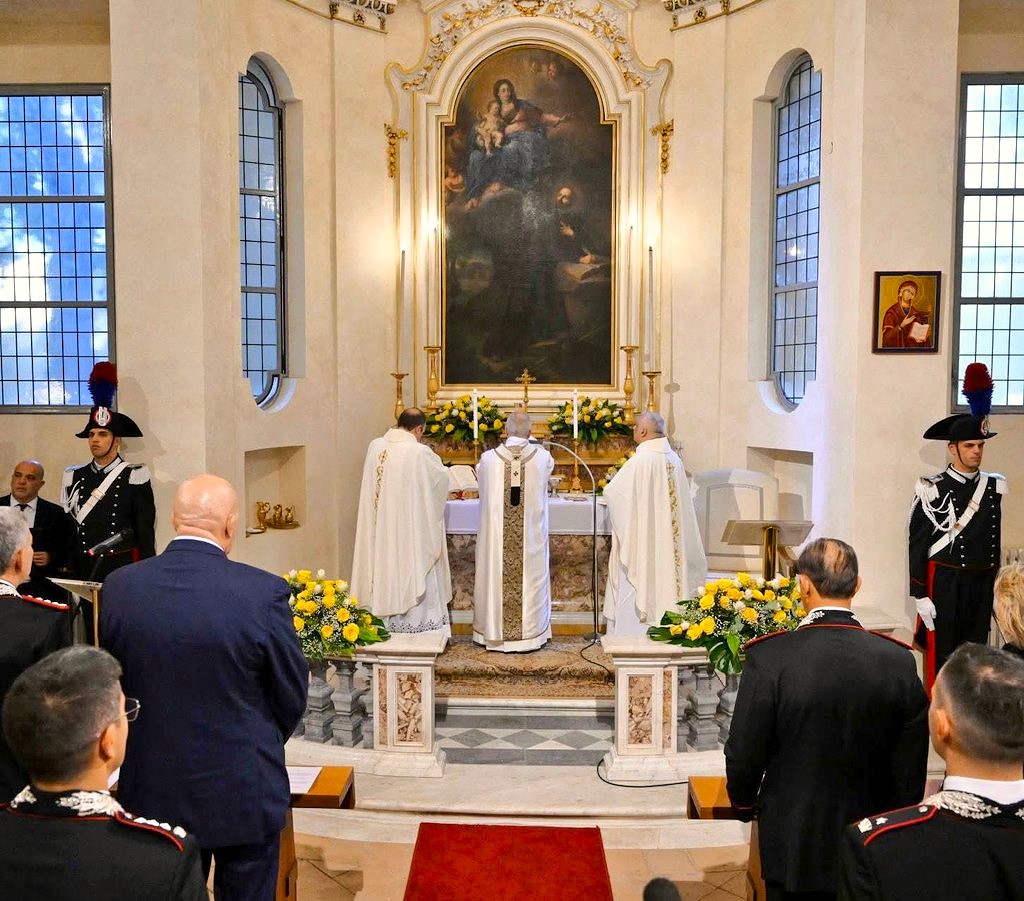
It was consoling to see the image of the Roman Pontiff saying Mass for the Carabinieri in their chapel at the Castel Gandolfo Station last Tuesday. I am aware that the lone ad orientem image that has been circulated and talked about is part of a greater collection of photographs that includes a lot of celebrant-faithful interaction and the watering of a plant. It would be dishonest of me to say that another image – that of the headline, “Pope Authorizes New Mass for the Care of Creation” – didn’t flash through my mind when I saw that ad orientem photo. It did. I say that I was consoled to see that image, not that it persuades me that the end of the liturgical wars might be at hand – nor even the end of a campaign of those wars, nor a battle, nor even an accidental skirmish. It was simply consoling to see. Now this Mass was celebrated for the Carabinieri, who are basically the Italian police force. So let me, as a first responder from America, reflect on what Tradition means to law enforcement, first responders, and the military. This will explain why the image was so consoling for me.
The funerary rites of West Webster, NY FF/EMT Tomasz Kaczowka took place in below-freezing weather on New Year’s Eve 2012. No one in the massive crowd of firefighters and police officers assembled outside of St. Stanislaus Kostka Catholic Church that morning complained. They stood there, at attention, for a very long time. They rendered and held the salute for probably the better part of an half hour, as the procession of emergency vehicles passed by, the final piece of apparatus carrying the precious cargo of the hero in his flag-embraced casket. No one moved until he or she was dismissed.
On 2 June 2025, the 41st Sargeant of the Guard, Sargeant First Class Andrew Jay, 3rd Infantry Regiment, US Army, made his last walk at the Tomb of the Unknown Soldier at Arlington National Cemetery. The order given to fall out, he handed off his weapon, then divested himself of his gloves and his glasses. He picked up four single-stemmed white roses and a small object: perhaps a challenge coin. Bending low to the eye level of his little boy who had been watching his father’s every move, SFC Jay whispered something softly to the child and administered that small object to him. Walking to the Tomb, he saluted, laid a rose at the monument and one at each of the crypts, saluted again, then turned to leave. Taking his son by the hand, SFC Jay recessed with him off the plaza and out of sight. In silence.
Military members and emergency responders are hard-wired for Tradition. I think we joyfully preserve it specifically as outward signs and symbols of a veiled love greater than which no man hath when he lays down his life for a friend (cf: Jn 15:13). Death is sorrowful. The cause for which it is hazarded and endured is glorious.
Embracing and executing Tradition is something we first responders and military men and women know to be the right and just response to the reality of death with which we have had many direct encounters. Particularly when death comes for one of our own.
We also love Tradition as something bequeathed to us. It is not ours to disregard any more than we might disregard a tool or a weapon or a tactic. Sometimes they develop over time, but if and when considerations and orders regarding discontinued use of tools or weapons or tactics occur at a board table in committee, it is not a good thing.
Lastly, I think we love Tradition for what it accomplishes in each of us. Given the opportunity to fully and actually participate in it, we must prepare. Drills must be done. Uniforms cleaned, pressed, inspected. Insignia must be placed. Briefings must be held. What we are about to receive tolerates nothing casual. Actions build habits and habits build virtue. Virtue is transformative.
The firing party and the folding of the National Colors. The tolling of the bell, typically referred to as, “Striking the Fives.” The possession and use of challenge coins. The Pipes and Drums. These are all part of the Tradition. As such, they are not materials from a demolished building that are sometimes used and sometimes not in the construction of a new one (Cf. Joseph Ratzinger). Like every other part of our Tradition of public rites, they fit where they are supposed to fit. They are the outward signs and symbols of a veiled love, not to be discarded or even rearranged, and they accomplish in us the intended purpose when we receive them as we ought.
The parade, the award ceremony, our part of the funerary rites is one thing. Then we enter a Catholic Church.
There may be a few spoken or unspoken rules inside the building. Don’t be rude or obnoxious, show some basic respect and maturity but… that’s basically it. Everyone gets a chance to do something if they like, allowing them to be part of what’s going on in their own way. Nothing needs to be veiled; some ladies arrive barely clothed! Any intention of giving and receiving relates to the joy or the sorrow of this moment and how we perceive them, not to the glory of eternity and what that is in the real. What needs to be accomplished, likewise, often corresponds to the culture of the world; a sense of support and belonging, and a shared sentiment that we ought to keep in touch and not wait till the next funeral.
All the while, Tradition is right in front of us! The Ever Ancient, Ever New presides over the whole affair, largely ignored, at the altar. In the tabernacle. An entire invisible Court of the Theotokos, the angels and the saints is veiled and assembled before Him. The fulfillment of all our joys, the healing of all our sorrows, the glory for which many do not even think to ask. Tradition, for which we are hard-wired, will be encountered outside, apparently, because the people in charge of the church have led us to believe that’s not what they do.
What a deforming experience for military members and first responders, who know what a sacrifice does and does not look like.
The glory of the sacrifice of men – including their supreme sacrifice in the line of duty – should not eclipse the Sacrifice of God to God. The image of the high priest offering Mass ad orientem for the fighting men of Castel Gandolfo was most consoling, indeed. Now, actions build habits, habits build virtue, virtue transforms.