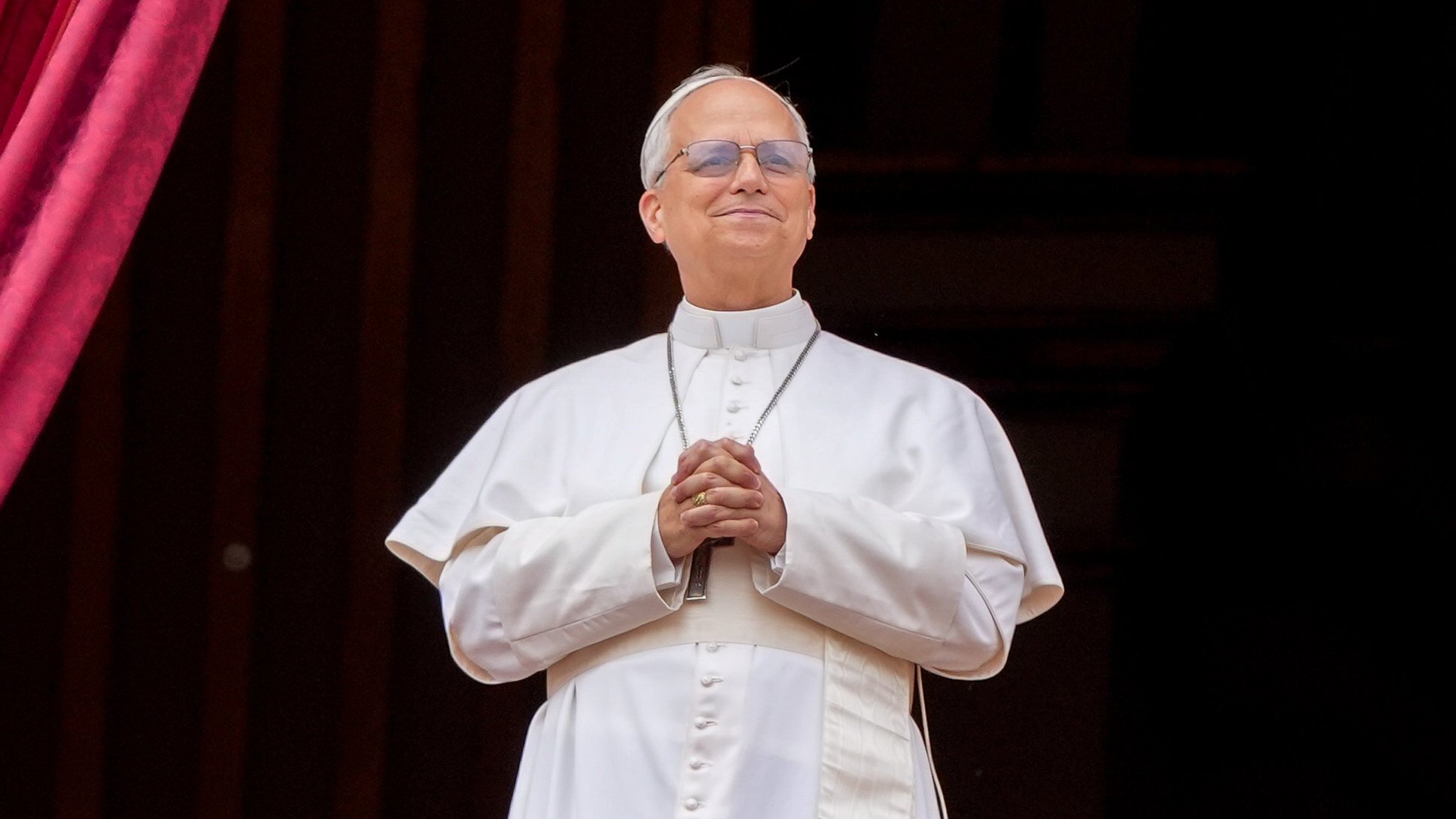
On March 8, 2025, an historic event occurred in Christianity: An American-born citizen of the United States of America was elected pope. Avoiding an address to his fellow citizens in a familial language and warm manner (that is, avoiding English), he greeted his people of Peru in Spanish. In light of Liberation theology’s critique of structural oppression extended in later scholarship to include linguistic domination, global languages—especially English—are alleged to mediate economic power and exclude marginalized communities from full participation. Therefore it is worthwhile investigating the current papacy’s symbolic actions in solidarity with the marginalized of Peru (for real solidarity would have already changed Vatican economic structures by now as I outline in my article: “Liberationist Bishop Reinaldo Nann’s Defense of Pachamama and Pope Leo XIV”).[1]
The Urbi et Orbi address could plausibly be signaling the preferential option for the poor (Spanish-speaking Peruvians) to the exclusion of American citizenry (identified with an elitist language and culture, representing private ownership of much of the means of production privately). Americans are symbolic of the economic system identified as capitalism by Medellín and Puebla (as the Soviet Union and China do). This first papal act and others can serve as cases to be examined under the praxis of Liberation Theology. The decision to address Spanish-speaking Peruvians rather than English-speaking audiences may be read symbolically within a broader theological framework that privileges the historical experience of marginalized communities. The question before us is whether such symbolic gestures reflect deeper methodological commitments rooted in Liberation Theology (e.g., the case of Vatican finances being radically shifted toward an option for the poor)?
The present inquiry, with the background and instrumentalization of Pachamama by Augustinian friars in Peru, considers certain papal actions in the light of a Marxist-laden analysis dominating Peruvian theology from 1968 until the fall of the Soviet Union. It is the opinion of this author that Pachamamais not going away, as minted Vatican coins in her honor presage: Liberation theology remnants – even while Catholic populations shrink and disappear in Peru – still exercise an impressive theoretical and moral pressure in church and political institutions.
The prevalence of Marxist ideology in South America in the 1960s led the South American bishops (CELAM) to publish the 1968 Medellín and 1989 Puebla documents containing a limited amount of Marxist language.Because the published versions of these documents demanded an editorial review (recognitio) and permission to publish (nihil obstat) by Popes Paul VI and John Paul II, the language was toned down and was corrected to meet Vatican requirements of orthodoxy.
Major figures like the father of Liberation Theology, Gustavo Gutiérrez, and later Latin American thinkers believe the following : “Theology must arise from the lived experience and language of the poor (“el pueblo”), not from imported, abstract, or elite systems.” This creates a tension within Marxist analysis (which is non-native and technical, written by a German academic) and local indigenous and Patois Spanish languages of the uneducated. Naturally, seminary-educated clergy are tasked to create a theological language for a local community of marginalized with no dictionaries but is shaped day to day by their experience of injustice and voicelessness within the Catholic Church and South-American political systems of corruption.
Evidence from journalists continues to grow, demonstrating Fr. Prevost’s role in this localized Liberation Theology and Marxist instrumentalization of Pachamama. Leo XIV should ideally encourage transparency where each Catholic journalist, “living in a decisive moment of his historical process” (que vive un momento decisivo de su proceso histórico),[2] in virtue of his “infinite dignity,” needs to responsibly confront the Church’s emergency situation of semantic drift in universal theology. What ought to be treated as supra-cultural or universal is non-negotiable dogma, but it is now being attenuated to emergency praxis that is historically conditioned for the marginalized of a determined area.
The undefined local-lived theology of isolated locales of Peru is being normalized for worldwide Christianity (a theological Procrustean bed). Decades of institutional-gradual drift from scientific principles and definitions of theology in seminary formation (theory) has led to intermediate comprises and ambiguities that are now surfacing in the full implications by “squircle” terminology (e.g., dignitas infinita). This can serve to explain why the Vatican is forced into a series of retroactive-continuity (retconning) documents, viz., magisterial clarifications.
The Post-Conciliar breakdown in teaching scientific, probable, and plausible methods of theological reasoning (ignoring Canon Law) leads to predictable results in liturgy (praxis). Actions like Pachamamamerely betray a conscience formed by malleable principles, outside the hermeneutic of continuity. Even Fr. Gustavo Gutiérrez-Merino Díaz, OP, founder of Liberation theology, clearly admits his shared principles with Thomistic scientific theology, which he reverenced: (1.) Ideas must come before actions, (2.) Faith is more than just a mental assertion “x is true” but it specifies the direction of one’s practical actions, and (3.) Systematic thought about God and creation comes first, and then actions align with theory.[3] Hence, whether Pope Leo XIV were to embrace (as a canon lawyer) Roman law and its theological method (viz., Thomism – technically required in seminaries), or the Father of Liberation theology, Fr. Gustavo’s Thomistic principle, the pope would welcome interpretation of his actions or praxis in light of prior faith commitments, as an adequate gauge.
Journalistic praxis (quick emergency analysis leading to on the spot reports), in Liberationist terms, should result in an emergency conditioned response for a particular locale: Fr. Prevost preformed actions that undergirded his belief, according to the reasoning of both St. Thomas and conceded by Fr. Gustavo. As far as praxis of journalists, they have helpfully led to an interview by a former Augustinian priest with first-hand knowledge of the persons and ecclesial meetings in Peru and Ecuador relevant to the L’affaire de la Pachamama and the person of Fr. Prevost.[4]
Leo XIV’s background in Liberationist Peru, active support of Liberationists priests, and his participation in Pachamama can easily be fact checked, as many of the clergy are still alive and available, as too are their projects. In-depth journalism will be required to fully contextualize Fr. Prevost’s degree of integration into the Marxist milieu. This is a journalistic disideratum and even a duty (kathêkon). Yet, greater geopolitical policy decisions of the Vatican may be explainable: this papal administration’s opposition to the burgeoning free-market economy in the United States (changing direction from the New Deal 2.0) is a case in point. Some study cases include the reform of the Pontifical Council of Life, Migration Policy, and a Moral Moratorium on Mining.
There was a peculiar ire that Leo XIV’s papacy uniquely reserved for the Trump administration (by comparison, the human rights violations in North Korea are unaddressed and there is no Vatican risk to property or faithful in that country with no Catholic population). This animus may not at all be religiously motivated based on the scientific conclusions of Catholic moral theology, but can be profitably explained by Marxist-informed opposition to Trump falling outside the so-called “preferential option for the poor,” which includes opposition to free-markets (even if Liberation theologians in the economic circle of Pachamama tend toward an historically flawed conflation of the US system with post-mercantilist economics in South America; Liberationists misname this as capitalism).[5]
In brief, Spanish bullion-based economy, laws forcing colonies only to trade with Spain, and state sponsorship of monopolies are the very economic principles rejected by the American experiment in its revolution, and by the current administration in Washington. The failure of Marxist analysis, mentioned above in the Medellín documents by the South American bishops in 1968, confused free-market aspirations in post-colonial Latin America with real South American economic praxis (yet another historical error in Liberationist historical-economic analysis; grave for Marxist theology, as its locus theologicus par excellence).
In essence, Liberation theologians of the economic circle of Pachamama (see below) lacked the sophistication of Marxism even though it used Marxist language. For example, post-colonial Latin American governments, almost without exception, continued monopolies, heavy taxation, and agrarian dependency on exports – like Spain – all while failing to develop industry. Peru retained key structural features of the colonial economy—especially export dependency and state-mediated monopolies—while formally abandoning the Spanish mercantilist framework. Here, a sloppy categorical error likely accounts for the Liberation theological odium directed toward the USA on a theoretical analysis.
Given Liberation Theology’s penchant to dismiss definitions before action in an emergency, this haste bleeds into its economic analysis making its free market economic analysis chaotic, and misidentifying what really happened in South America to impoverish millions: state monopolies and tax burdens that prevented industrialization and innovation. This also violates Fr. Gustavo’s critique of Scholasticism, like Marxism, that newer and more practical sciences (economics, sociology, etc.) have developed and are useful for theology.[6] As we will see below, a member of the economic circle of Pachamama makes rudimentary mistakes within the realm of these endorsed sciences (by Fr. Gustavo), by conflating post-colonial Latin American structures with free markets, so that mercantilism is conflated with capitalism.
Liberation Economics of the Pachamama Circle
Fr. Joaquín García Sánchez, who taught at the Pontifical University of Peru (died 2024), explains academically the Pachamama politico-economic circle. Fr. Joaquín published an academic paper nearly contemporary with the 1995 incident and provides explicit Marxist principles that overlap with today’s Vatican positions in opposition to the government and economy of the USA. Fr. Joaquin, Fr. Prevost’s concelebrant in the l’affaire de la Pachamama, argues the following in his Marxist analysis leading to ecological action or praxis:[7]
- The Amazon region is interpreted through what is called a hermeneutical key or controlling idea: Spanish conquest is but a different species of today’s resource and mineral extractors. They are both members of the generic category of oppressor. Fr. Joaquín looks at the historical oppression of colonial conquest as having its successor in capitalism.
- Specifically, the modern development of oil is but a continuation of the colonial search for “Eldorado” and greed. (Fr. Joaquín’s Pachamama circle would thereby view the Trump administration’s “drill, baby, drill” or energy independence policy as among the greatest evils of our time.)
- Fr. Joaquin takes a radical anti-Fr. Gustavo turn, by a total rejection of human reason: “The rigid Cartesian rationality … tending to dominate nature and to destroy it.”[8]
- In undisciplined form, the Liberationist conflates two economic modes into the same system: “capitalism = mercantile extraction” (capitalismo extractivo mercantil).
Notice in #3, above, we can see that a radical form of Liberation theology scoffs at rationality, caricaturing it as Cartesian (avoiding perhaps a direct conflict with Fr. Gustavo’s respect for Aquinas’s rationality). This helps explain why Fr. Joaquin and his circle fell into Pachamama superstition. As Fr. Gustavo warns the practitioners of real Liberation theology:
Theology, insofar as it is critical reflection, thus fulfills a liberating function for both the individual and the Christian community, shielding them from all forms of fetishism and idolatry. It also guards against a pernicious and diminishing narcissism. Theology, understood in this way, plays a necessary and enduring role in liberation from every form of religious alienation—often fostered by the ecclesiastical institution itself—which hinders an authentic approach to the Word of the Lord.[9]
The circle of Pachamama jumped the guardrails that were written to govern a disciplined practice of Liberation Theology. The direction of ecotheology in Fr. Joaquin’s work is open to a Liberationist critique of imposing Fetishism and idolatry.
Conclusion: For Fr. Joaquin, capitalism leads to extravagance and commodities, and is thus destructive. What is violent (destructive), is always morally illegitimate. From here we can glean what the reforms of the Pontifical Academy of Life under Pope Leo XIV may presage:[10] ecology grants life by undermining a capitalist commodity-based productivity. The allowance for pro-abortion membership in the academy by Pope Francis can be interpreted as successful reconciliation of desperate actions of the poor with traditional Catholic morality. Liberationist principle of praxis, then reflection, should not be the ideal under normal conditions, but unjust economic systems create extremes.
The Pachamama Circle and Migration
This framework helps explain Pope Leo XIV’s response, when he was recently asked to give his opinion on Cardinal Cupich giving a lifetime achievement award to a pro-abortion politician. Pope Leo responded. In his remarks in the cited article, Cardinal Cupich defended his position thus:
The recognition of his defense of immigrants at this moment, when they are subjected to terror and harm, is not something to be regretted but a reflection that the Lord stands profoundly with both immigrants who are in danger and those who work to protect them.
Pope Leo XIV’s support of Cupich ran thus: “I think that it is very important to look at the overall work that the senator has done during, if I’m not mistaken, 40 years of service in the United States Senate.”
Understanding Liberation Theology provides us with a key for Pope Leo rationally supporting Cupich. Migrants are the extreme poor, fleeing injustice and oppression. Prolife is, therefore, pro-migrant and is part of the solution to protect life at conception. Pastoral accompaniment of those in dire circumstances or “option for the poor” acknowledges the injustice that constrains the poor who abort. Accompanying the person on the margins provides data on how to formulate a theology for his concrete circumstances.
This process helps account for retcon theology that the Vatican has produced under Pope Francis and Leo. First, a quick analysis is made, as a marginalized group is helped, and then only is a theology formed to provide a framework for understanding what applied in the local context. This theology is adjusted in official policy, as needed, to connect it to foreign, European conclusions of scientific theology.
The economic circle of Pachamama importantly included Fr. John Lydon, who heads now Villanova Cabrini Institute on Immigration at Villanova (Augustinian University). The current calendar of social justice events shows the university prioritizing Liberation Theology and indigenous empowerment in the Amazon. Fr. Prevost’s circle and Vatican political focus on the Trump administration can be rationally explained through the prism of Liberation Theology, whereas these same positions appear to many commentators to be erratic and devoid of a logical unity.
The Pachamama Circle and the Vatican Moral Moratorium on Mining[11]
In Fr. Joaquin’s contemporary publication with the worship of the Pachamama circle, he teaches unabashedly that economics must be theologically-colored. Economic systems for the circle, as for Fr. Joaquin, are moral-spiritual structures. Nature, as such, is sacralized and requires rituals and reverence.
A principal member of Fr. Prevost’s circle of Pachamama, Fr. Joachin, published an academic study that provides us with possible insight into the Vatican’s recent moratorium morally imposed by will of Leo XIV on mining. Ecotheology of the Peruvian sort is completely aligned with the Vatican policy, where more recent scientific studies publish cases of Pachamama rituals and shamanic ethics of mining are a precondition for morally mining in the Andean mountains and Amazon, so that only certain methods of mining and relationships with the earth are permitted.[12] Ritual offerings are required in the local version of ecotheology before morally licit mining can begin. What is more, only certain kinds of mining are permitted among indigenous (who are the poor and oppressed within this framework), and all other forms of mining are akin to an ethical violation of Pachamama or the sacred female land that is being raped.[13]
Again, like Fr. Joaquin’s process: Spanish conquest → capitalism → oil extraction = one continuous oppression. This framework—present in missionary and theological reflections on the Amazon—interprets economic activity through a moral and symbolic lens that closely aligns with indigenous cosmologies in which land is not merely a resource but a sacred reality. In Andean contexts, Pachamama functions as a normative framework governing the moral conditions under which extraction (e.g., mining) is permitted, blessed, or resisted. This indicates that economic activity is not treated as neutral or purely technical, but as embedded within a symbolic and theological order that governs its moral legitimacy. Once we use the answer key of Liberation Theology as the lens in the economic circle of Pachamama of Fr. Prevost, we have a rational system to plausibly explain Vatican policies against modern industry, seen as exploitative in virtue of private greed and ownership of the means of production driving profiteering and impoverishing those on the margins (despite the caveat of their crude economic analysis that does not seriously engage economically-aligned science valued by Fr. Gustavo).
Conclusion: Geopolitical Landscape of Pope Leo XIV’s Circle of Pachamama vis-a-vis “Drill baby drill” and “The Green New Scam”
I now turn to a plausible interpretation of geopolitical interventions of the Holy See based upon the circle of Pachamama: the Vatican would not, through the optic of the circle of Pachamama, participate in the Board of Peace (founded by President Trump). A capitalistic greed-based economy is diametrically opposed to peace, since a seamless-garment pro-life theology includes ecology (viz., ecotheology) and the sacrality of nature and protection of the indigenous. The Trump Board of Peace is chaired, from this perspective, by Trump, whose policy is frontloaded with “extractive mercantilism,” i.e., environmental violence in oil and mineral extraction (exemplified by his recent transformation, e.g., of Venezuela).
By the Trump administration pushing oil exploitation in the Andean and Amazonian locales, it is morally aligned with social sin and is diametrically opposed to the option for the poor. The additional fight against the Trump administration on the free movement of peoples without borders, a hallmark of the circle of Pachamama at Villanova, Trump would be interpreted as inherently anti-life. The seamless-garment approach to pro-life issues led Cardinal Prevost to criticize the 2nd Amendment and Vice-President JD Vance regularly and consistently.
Yet, all this Trump-talk sounds political, not theological. However, I remind the reader: the circle of Pachamama does not distinguish politics, economics, and theology. Economics is sacral and the very conditions under which the necessity of Liberation Theology arises. The approach of the Vatican has and will (if this optic is correct) continuously focus on politico-economic matters under the headlines of “pro-life” and “theology,” because its South American administrators and curial membership (imported from Latin America) has been formed, by and large, through Medellín and Puebla, but without the guardrails of John Paul II being meaningfully observed against Marxism.
So, Fr. Joaquin, a bona fide professor at the Pontifical University of Peru, publishes his ecotheology openly and even goes beyond the strict guardrails first penned by the father of Liberation Theology, Fr. Gustavo (as Pachamama itself incorporates what Fr. Gustavo calls fetishism and idolatry, which is opposed to his version of Liberation Theology).[14] However, Liberation Theology is historical and contextual, not definitional, and is constantly in flux, interpreting new emergencies by new analyses and new praxes.
The innovation of Pope Francis, interpreted here hypothetically as a controlling idea for Pope Leo XIV, would be to universalize a local emergency theology and to impose an ad hoc preference for the poor in Andean Peru to be universally applicable to geopolitics. The New Green Deal, ecology, Global Warming, and Climate Change would all constitute apocalyptic worldwide emergencies. As such, even here, there is space for the Holy See to see the emergency as no longer local but a worldwide cataclysm in fieri.
Under these conditions, Liberation Theology is no longer ad hoc, but a ready action-based response to a cosmic emergency, justifying worldwide application. In Fr. Gustavo’s writings, there is no opt-out clause for small communities from the option for the poor; it is an obligation. The Medellín and Puebla documents of CELAM are not as extreme, applying moral pressure for all communities in their church to participate in the process.
From this, we see how and why the synodality and other practices of the circle of Pachamama ought to affect and include traditionalists, Opus Dei, and other conservative groups in the Church. There is no opt out when the emergency is worldwide, and we are all along for the ride.
The value of this analysis lies in its predictive quality, which is falsifiable. If future actions of the Holy See continue in this direction, politically animated by a rational lens of Liberation theology, then what I have argued here as merely plausible begins to look statistically probable. We should expect the following:
- prioritization of marginalized groups in symbolic acts
- moral critique of extractive economic systems
- integration of ecological concerns into theological language
- expansion of pastoral accommodation grounded in concrete situations
These patterns may manifest in various geopolitical contexts, but the framework that I present operates at the level of interpretation rather than partisan alignment. Study of the writings of the circle of Pachamama may be key to understanding the commitments of Father and Cardinal Prevost and the policies of Pope Leo XIV more deeply and add nuance and even correction to my prima facie reading of the circle. The predictive power in this analysis will help establish its insight when the Vatican systematically intervenes in US and European politics on questions that are traceable to preoccupations of the members of the circle of Pachamama, whose opera completa need to be studied in detail. This is a key moment for traditionalists, as Pachamama and its circle might prove useful to predict what conservative groups’ futures can expect from the current administration in both official statements and praxis, to speak nothing of geopolitics and the policies of the Trump administration (a central focus of Pope Leo XIV perhaps in his convictions of the universal application of ecotheology in his option for the poor).
[1] A true Liberation-Theology is proven by praxis, not by words by the metrics of its own framework, see my linked article.
[2] Taken from the Liberationist flavored Medellín document of CELAM (1968).
[3] Gustavo Gutiérrez-Merino Díaz, OP, Teología de la liberación: perspectivas (Lima: CEP,1971), 5, 8-9: “Es evidente que el pensamiento también es necesario para la acción…”; (“la inteligencia de la fe aparece… no de la simple afirmación… sino de un compromiso… de una postura ante la vida“; “La teología viene después, es acto segundo.“
[4] NB, the priest appears to be a professional canonist and an aggrieved party in canonical disputes with alleged allies to Fr. Prevost.
[5] This involvement in the internal matters of state of a sovereign nation enforcing its own constitutional law is highly inflammatory and has continued.
[6] Gustavo Gutiérrez-Merino Díaz, OP, Teología de la liberación: perspectivas (Lima: CEP,1971), 30.
[7] Joaquin Gracia Sanchez, “V Centenario y amazonia: Historia de un despojo,” Estudios Agustinianos 30 (1995): 517-540.
[8] “La rígida racionalidad cartesiana… tiende a dominar la naturaleza y a destruirla.”
[9] Gustavo Gutiérrez-Merino Díaz, OP, Teología de la liberación: perspectivas (Lima: CEP,1971), 30. Emphasis added.
[10] Sánchez, op. cit., at 521-522
[11] Joshua McElwee, “Vatican launches project encouraging disinvestment from mining sector,” Reuters (March 20, 2026).
[12] Eric Hirsch, ‘Investment’s rituals: “Grassroots” extractivism and the making of an indigenous gold mine in the Peruvian Andes,’ Geoforum (Volume 82, 2017), 259-267.
[13] Guillermo Salas Carreño, “Mining and the living materiality of mountains in Andean societies,” Journal of Material Culture (Dec 2016), volume 22, no. 2.
[14] I speculate that this would be true of accepting the original meaning and culture of the indigenous for Pachamama without qualification. As a totem it must be transvaluated into a symbol of anti-colonialism to escape being a mere cultural relic of an underdeveloped economic system of the indigenous that is presumably not yet capacitated to resist capitalism. Once it becomes a symbol of Liberation, then it is no longer fetishism. The question then, is whether the Pachamama circle was a case of interreligious dialogue (thus, participating in fetishism) or a capacitated group of indigenous who already were inculcated with the value of the Pachamama contra capitalism.