

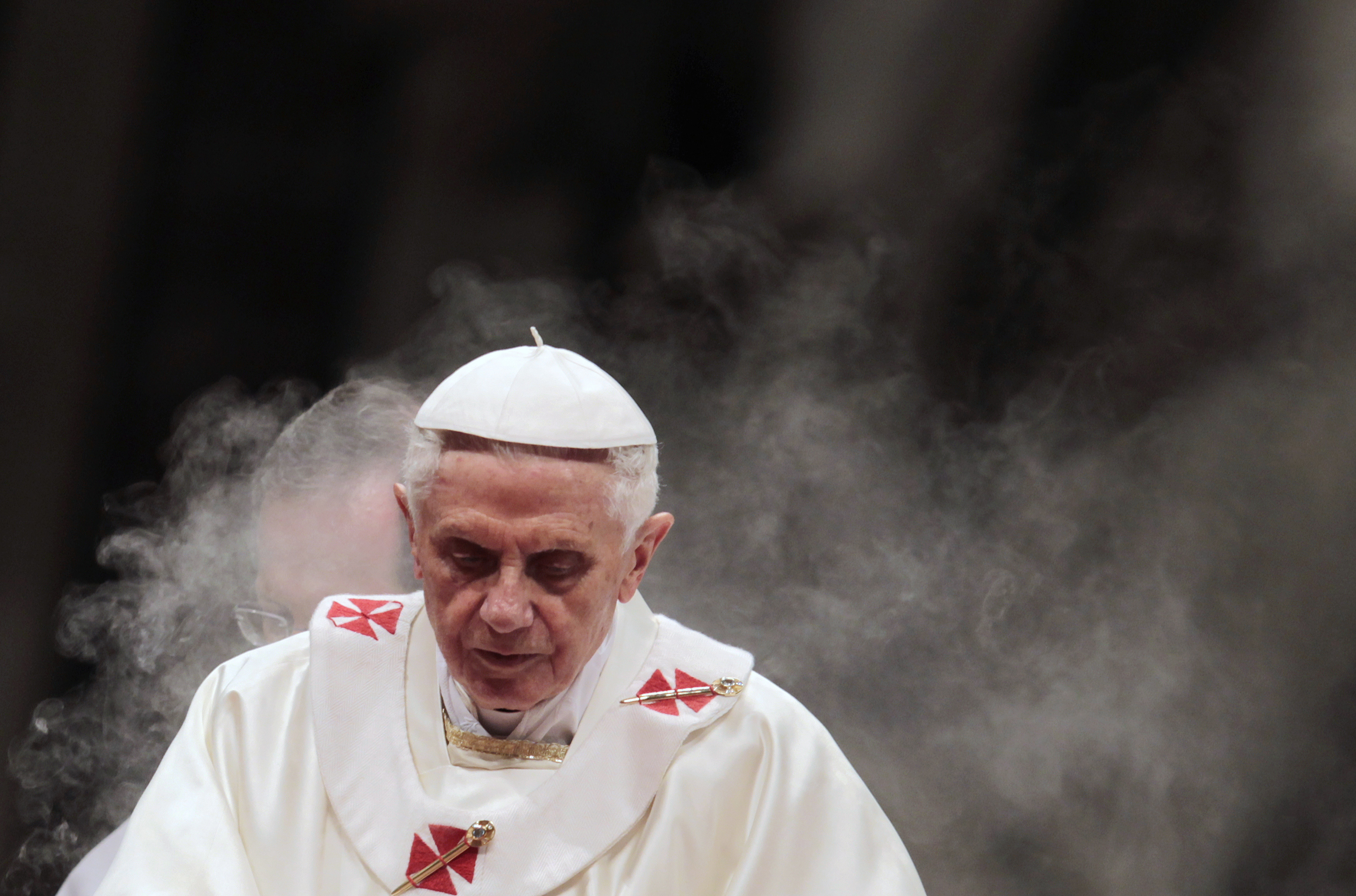
In an interview published in 2023, Slovak mathematician and author Vladimír Palko made public a letter he had received from Pope Benedict XVI in 2015.[1] Although brief, the text of the letter contains an eschatological statement of considerable significance:
We see how the power of the Antichrist is expanding, and we can only pray that the Lord will give us strong shepherds who will defend His church in this hour of need from the power of evil.[2]
Unlike the 1903 encyclical E Supremi of Pope Saint Pius X, in which the Supreme Pontiff wondered whether the Antichrist might already be present in the world,[3] Pope Benedict XVI’s statement refers to “the power of the Antichrist,” an expression vaguely reminiscent of the “spirit of the Antichrist” mentioned by Saint John the Apostle in his First Epistle (chapter 4, verse 3). In any case, this brief statement unmistakably reveals a certain personal interest in one of the most difficult eschatological issues.
Whenever subjects related to eschatology are brought up, and especially those concerning the “signs of the end times,” we realize that a considerable degree of prudence is required. The sensationalism and superficiality with which such matters have been treated, and continue to be treated, often lead even the most serious thinkers to instantly reject any type of eschatological questions. With regard to Pope Benedict XVI, some authors entirely exclude such concerns from the intellectual and spiritual interests of the theologian Joseph Ratzinger.
Nevertheless, taking his writings into account, I believe that such an attitude commits an error of omission that does nothing but leave the field open to sensationalism. This is why I believe that the solution is certainly not to exclude eschatological themes from the discussion, but rather to situate them within the framework of a sober and consistent approach. It was Joseph Ratzinger himself who provided us with the most appropriate example of how such an investigation can be guided and developed. His 1977 work entitled Eschatology: Death and Eternal Life contains an interesting contribution to the most difficult question concerning the “signs of the times:” the manifestation of the Antichrist in history.
As is well known, from Saint Irenaeus of Lyon and Hippolytus of Rome to Saint John Henry Newman, Vladimir Solovyov, and Father Roger-Thomas Calmel, O.P., the Antichrist has most often been understood as the ultimate, individual manifestation of the mysterium iniquitatis in history. In other words, not a collective entity, but a flesh-and-blood person. This is why numerous Christian authors, from different historical periods, have endeavored to produce a kind of composite sketch of him.
Among them, the brilliant Russian philosopher Vladimir Solovyov stands out unmistakably.[4] In the form of a short work of fiction titled Tale of the Antichrist, he proposed a remarkable exploration of the psychology of the eschatological adversary of Our Lord Jesus Christ. Surprisingly, Joseph Ratzinger—who was well acquainted with Solovyov’s interpretation—did not follow the “personalist” line of interpretation. At first glance he seems rather drawn to the hypothesis of a mystical, collective Antichrist: a spiritual entity that manifests itself through “antichrists”—all those who, through their doctrine and their way of life, which is contrary to the evangelical virtues, stand as adversaries of Christ the Savior. And yet, the theory followed by Joseph Ratzinger is that of a collective Antichrist only apparently.
The issue was discussed in the most important treatise ever written on this subject by a Saint and Doctor of the Roman Catholic Church: Chapter IV of the first volume—De Romano Pontifice (1586)—of Saint Robert Bellarmine’s monumental work Disputationes de Controversiis Christianae Fidei adversus hujus temporis Haereticos (Disputations on the Controversies of the Christian Faith against the Heretics of This Time). The second of the nine points systematically discussed by Saint Robert concerns the question of “whether Antichrist might be one man, or a race of men.”[5]
The issue originates in the fact that Saint John the Apostle, the only Evangelist who explicitly names the ultimate enemy of Our Lord Jesus Christ, speaks in chapter 2, verse 18, of his First Epistle, both of the Antichrist as an individual—in the singular—and of the antichrists who appear in the final hour of history. Although Saint Robert insists that the Antichrist will also be an individual person, he emphasizes his support for a mixed solution.
The great Doctor of the Baroque era develops a coherent interpretation, beginning with the assertion that “Antichrist is received properly sometimes for a certain distinct enemy of Christ, on which the Scriptures teach, and sometimes commonly for all who oppose Christ in some way.” Consistently, he goes on to maintain the view that “all Catholics think that Antichrist is one specific man, but all the heretics (…) teach that Antichrist, properly so called, is not a single person but a single throne of a tyrannical kingdom as well as the seat of its apostasy that presides over the Church.”
Even those who have not read Saint Robert’s treatise can probably guess that his principal target is the Calvinist interpretation that identified the papal institution and its representatives with a collective Antichrist manifesting itself from the heights of the See of Rome. But, as so often happens when someone is caught up in the heat of a polemic, Saint Robert overlooked the fact that the theory of the collective Antichrist was not developed by Calvin and his followers, but by a significant Catholic author. It is precisely to this author that Joseph Ratzinger draws our attention.
Although he was a German theologian contemporary with Saint Hildegard of Bingen (c.1098–1179), Blessed Gerhoh of Reichersberg (c.1093–1169) remains very little known. The fact that Joseph Ratzinger makes use of one of his treatises, De investigatione Anti-Christi (1162), which has not yet been translated in its entirety into any modern language, clearly demonstrates his enduring interest in eschatology in general and in the question of the Antichrist in particular. This is yet another reason why we must correct those who claim that Pope Benedict XVI ignored such subjects.
Ratzinger cites Blessed Gerhoh of Reichersberg for a very specific purpose: to provide a foundation for a theory that goes beyond the interpretation of the Antichrist as an individual. Given its extraordinary importance, I shall quote the entire passage in which Joseph Ratzinger reveals the interpretation he follows:
The signs, at any rate as we have considered them so far, do not permit a dating of the End. They do indeed relate the End to history-but by compelling every age to practice watchfulness. They indicate that the time of the End is ever present, for the world never ceases to touch that ‘wholly other’ which, on one occasion, will also put an end to the world as chronos.
This fundamental pattern is maintained by the other signs mentioned above. Even in his own age, Paul believed that he had in fact offered the Gospel to the whole inhabited world. The demand that the Gospel should be preached to all the world seemed thus already fulfilled in the generation of the apostles, what the Markan Jesus calls ‘this generation.’ Nevertheless, that demand remains at the same time an uncompleted task so long as there are human beings left on this earth. As far as the antichrist is concerned, we have seen that in the New Testament he always assumes the lineaments of contemporary history. He cannot be restricted to any single individual. One and the same, he wears many masks in each generation. Gerhoh of Reichersberg, who lived from 1093 (or 1094) to 1169, was right to regard the antichrist as a sort of Church-historical principle which
“is rendered concrete not in one but in many figures… In radical fashion, he sweeps away the traditional image: this image, he insists, must be understood allegorically, not in some literal historical way. What ‘the antichrist’ means is grasped philologically: everyone who is Christo Filio Dei contrarius deserves this name… In other words, anyone who destroys ordo and furthers confusio is an antichrist.”
Although the pessimistic Augustinian provost may have overstepped the mark in this final conclusion, he was basically correct in his theory that the antichrist is one only in the multiplicity of his historical appearances, each of which threatens in its own way the period in which it occurs.[6]
The quotation included by Ratzinger in the passage above is taken from Wolfgang Beinert’s monograph, Die Kirche-Gottes Heil in der Welt. Die Lehre von der Kirche nach den Schriften des Rupert von Deutz, Honorius Augustodunensis und Gerhoh von Reichersberg, published in Münster in 1973 (p. 347). Also referring to Gerhoh’s treatise, De investigatione Anti-Christi, another learned scholar, professor Bernard McGinn, has summarized its essential argument by observing that it “is notable for its highly spiritualistic view of the Antichrist as the collectivity of all who have opposed the Church since the time of Cain.”[7] According to this interpretation, which would later be developed by Abbot Joachim of Fiore (c.1130–1202), the Antichrist is transformed from an individual figure (sometimes downright fantastic) into a mystical, evil entity operating behind the historical events of the fallen world. What particularly interests us is the fact that Blessed Gerhoh is mentioned precisely because, in his (apparently) “collectivist” interpretation, Ratzinger seems to discover all the answers to the most difficult questions raised by the manifestation of the Antichrist in history.
Gerhoh’s interpretation resolves, first and foremost, the problem that had caused Saint Augustine so much difficulty: the date of the end of history cannot be known by anyone, not even approximately. If an individual Antichrist were to appear immediately before the Second Coming, how could this absolute divine prohibition be maintained? For identifying him would obviously entail at least an approximation of the imminence of the Apocalypse—which would directly contradict the statement of Christ the Savior, who clearly declares that “of that day or hour no man knoweth, neither the angels in heaven, nor the Son, but the Father” (Mark 13:32).
Secondly, it explains why so many Saints throughout the history of the Church have identified and denounced the presence of the Antichrist in history: precisely because he is not present through a single person, but through all those who practice iniquity and oppose God. Moreover, eschatological tension is preserved intact and even heightened, for the end of the world may come at any time—even today, at this very moment, as you read these lines.
Furthermore, once we affirm that the Antichrist cannot be confined to a single individual, but wears many masks, any discussion about the degree of wickedness he would have to embody in order to be recognized becomes irrelevant. Such a discussion makes little sense when we consider the terrible atrocities committed by tyrants throughout the ages, from Nero and Domitian to Hitler and Stalin. Anyone who perpetrates evil, on whatever scale, but especially when it is institutionalized (as, for example, through pro-abortion laws), is the Antichrist. Thus, verse 18 of chapter 2 of the First Epistle of Saint John the Apostle must be read in a way that preserves the simultaneity of the individual Antichrist and the antichrists: the former is made present and visible, to those who have eyes to see, through the latter. The Antichrist and the antichrists are inseparable.
There are, however, other aspects that the theory proposed by Blessed Gerhoh and followed by Ratzinger resolves satisfactorily, while the vigilance demanded of Christians by Christ the Savior is rightly observed as an absolute imperative. Since Christians can never be certain of the moment of the Second Coming because of the metamorphic nature of the Antichrist, they have no choice: we must be prepared – especially spiritually and morally – at all times for the end of the world.
Joseph Ratzinger seems to be, as some of his interpreters have observed, a true Augustinian. For Saint Augustine, in his monumental work De Civitate Dei (Book XX, Chapter 19), attempts to elucidate Saint Paul’s statement in his Second Epistle to the Thessalonians (chapter 2, verses 6 and 7) concerning “the one who restrains” the manifestation of the Antichrist (τὸ κατέχον – to katéchon). Commenting on these Pauline verses, Augustine, while acknowledging his ignorance regarding the identity of the katéchon, explains that the mystery of evil may “refer only to the wicked and the hypocrites who are in the Church, until they reach a number so great as to furnish Antichrist with a great people.”[8] In other words, the reference is to false Christians—heretics in disguise or simply individuals who betray the Gospel through their immoral lives.
But Joseph Ratzinger is not merely Augustinian; he is also Hildegardian (and, according to some interpreters, Hildegard herself was Augustinian). For not only did he officially canonize Saint Hildegard of Bingen, but on 7 October 2012 he also proclaimed her a Doctor of the Church—a distinction currently shared by only four female Saints. The German mystic and visionary, moreover, is the author of two treatises—Scivias and Liber Divinorum Operum—which contain her visions and interpretations concerning the end of the world and the manifestation of the Antichrist.
As can be seen in one of the most famous illustrations accompanying her first work, the Antichrist is born within the bosom of the Church. He is represented by a monstrous head, with donkey’s ears and a lion’s mouth, positioned in the genital region of the majestic woman representing the mystical Ecclesia. He will be expelled definitively from her only through divine intervention at the end of history. Can the Hildegardian vision be interpreted through the collectivist lens adopted by Joseph Ratzinger? If read from an Augustinian perspective, it can. I shall demonstrate this in a separate article devoted to the nature and interpretation of eschatological allegories. In any case, the statement made by Pope Benedict XVI in his letter to Vladimír Palko can readily be understood in connection with the interpretations proposed by Saint Augustine, Saint Hildegard, and Blessed Gerhoh.
First and foremost, he does not seem to suggest the manifestation of an individual Antichrist, but rather an increase in the activity of evil, which manifests itself collectively through those pseudo-Christians who follow the ideologies of “this world.” As I stated from the very beginning, however, the Ratzingerian interpretation is not collectivist. It would be so if the Antichrist were completely invisible and impersonal. But he is visible and personal—he is simply identifiable through all those who stand in solidarity with an anti-Gospel, that is, a perverse teaching (doctrina perversa—Saint Hildegard) that denies in practice what Christ the Savior taught us. The sexual scandals that shook the Church represented, for Pope Benedict XVI, a visible sign of the fulfillment of Saint Hildegard’s prophecies and, at the same time, a clear indication of an unprecedented magnitude of evil in history. When Catholic Cardinals and Archbishops not only tolerate such sins but are directly involved in them (one need only recall that infamous American Cardinal), everything Augustine, Hildegard, and Gerhoh teach takes on a painfully immediate relevance.
We should therefore not be surprised that Pope Benedict XVI was almost certainly referring, in his letter to Vladimír Palko, to the crisis within the Church rather than to the crisis of the (post)modern world. In any case, his concern is unmistakable. So, too, are his preoccupations with the questions raised by the “signs of the times” and the imminence of the Second Coming of Our Lord Jesus Christ—which is undoubtedly closer to us today than it was two thousand years ago. Is that a long time or a short one? Only God knows. Whatever the case may be, the path of serious and prudent eschatological reflection must be pursued alongside Pope Benedict XVI and the authors to whom he has drawn our attention.
[1] The original text of the interview in which Palko made this revelation can be found here: https://standard.sk/303875/benedikt-v-liste-napisal-ako-sa-rozsiruje-moc-antikrista-a-co-treba-robit [05 November 2026]. Rod Dreher presented this interview for the English-speaking audience in his article “Benedict XVI: It Is The Time Of Antichrist:” https://www.theamericanconservative.com/benedict-xvi-it-is-the-time-of-antichrist/ [05 November 2026].
[2] Rod Dreher, “Benedict XVI: It Is The Time Of Antichrist,” in The American Conservative: https://www.theamericanconservative.com/benedict-xvi-it-is-the-time-of-antichrist/ [31 October 2026]. Here is the original German text, quoted in Dreher’s article: “Man sieht, wie die Macht des Antichrist sich ausbreitet, und kann nur beten, dass der Herr uns kraftvolle Hirten schenkt, die seine Kirche in dieser Stunde der Not gegen die Macht des Bösen verteidigen.”
[3] See “Saint Pius X and the „Abomination of Desolation:” https://kmitalibrary.substack.com/p/saint-pius-x-and-the-abomination [31 October 2026].
[4] The title of Solovyov’s work is “Short Story of the Antichrist.” Often printed independently, this short story is part of a longer work entitled War, Progress and the End of History: Three Conversations, published in Russian in the very year of the author’s death, 1900. The first English translation was published in 1915 by the University of London Press.
[5] I quote Ryan Grant’s translation, Saint Robert Bellarmine S.J., Antichrist, With a Foreword by Fr. Philip Wolfe, Mediatrix Press, 2016.
[6] Joseph Ratzinger, Eschatology: Death and Eternal Life, Translated by Michael Waldstein, Translation Edited by Aidan Nichols, O.P., Second Edition, Washington D.C., The Catholic University of America Press: 2007, pp. 199-200.
[7] Bernard McGinn, Visions of the End. Apocalyptic Traditions in the Middle Ages, New York: Columbia University Press, 1979, p. 96.
[8] Online De Civitate Dei can be read here: https://www.newadvent.org/fathers/120120.htm [20 November 2026].