
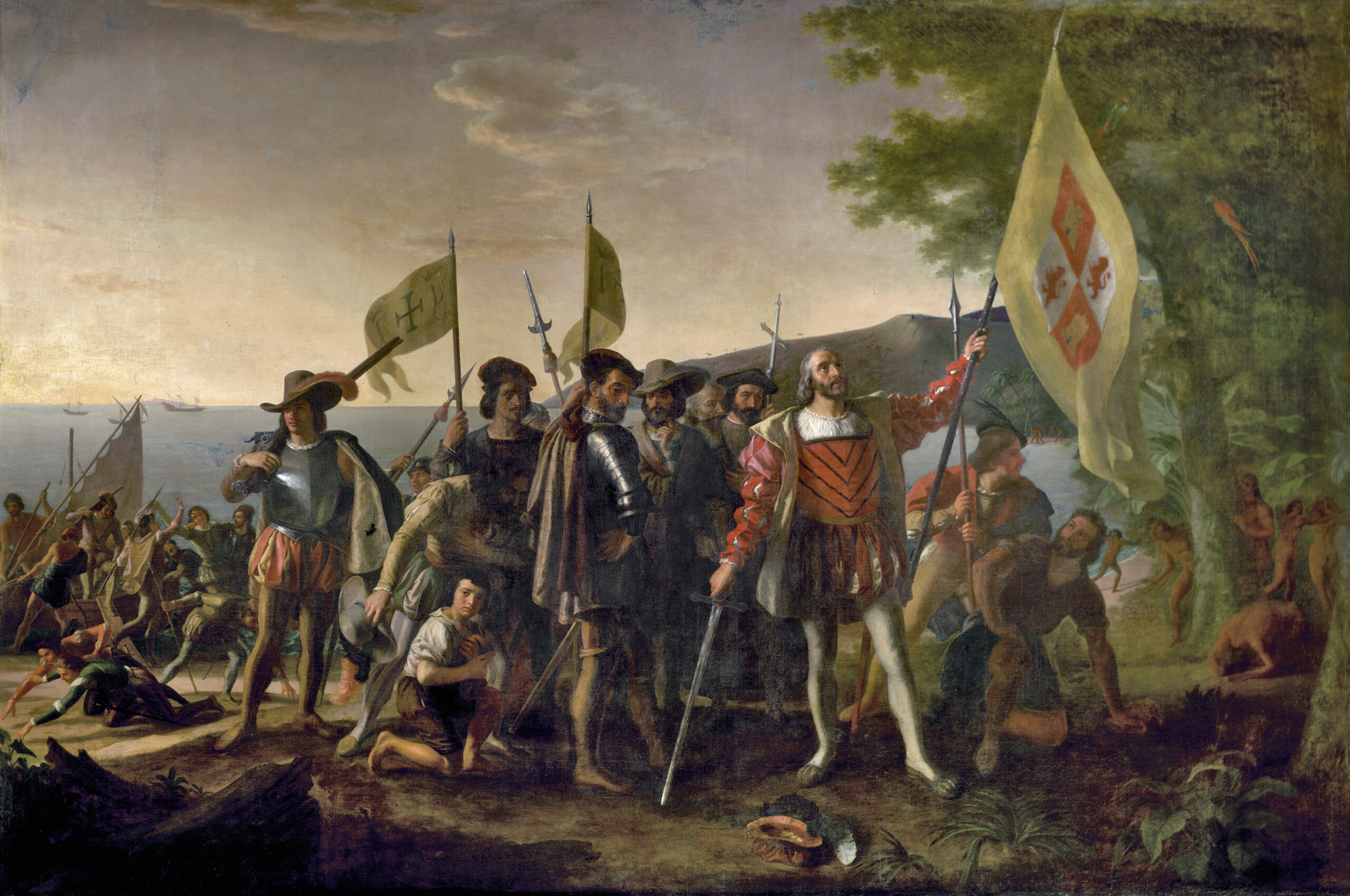
Above: The Landing of Columbus by John Vanderlyn (1847).
The blood of the martyrs is the seed of the church.
– Quintus Septimius Florens Tertullianus (circa 155-circa 220)
The story is long and complicated.
Shortly after the birth of Islam, in Mecca, around 610, Christians began suffering a never-ending nightmare of domination, destruction and death.
Ferociously, rapidly, the religion of the scimitar spread through the cradle of Christendom: the Middle East and North Africa, where Muslims conquered, annexed and absorbed Christian nations.
By 650, the Pentarchy established by Emperor Justinian the Great (born Petrus Sabbatius, 482-565) was decimated. Three of the five Patriarchates – major Episcopal Sees that govern the Christian Church, each headed by a Patriarch, a high-ranking bishop – had been lost to Islamic expansion: Antioch in 637, Jerusalem in 638, and Alexandria in 642. After Constantinople fell in 1453, only one remained: Rome, with its Patriarch, the Bishop of Rome, the Pope.
The speed of the Muslim subjugation – bit by bit – of Christendom, was alarming. By 732, they had vanquished three-quarters of the original Christian world, where the Faith had spread during the early Roman Empire (27 B.C.-A.D. 476).
What remained of the Christian realm – the Latin West – spiraled into the Dark Ages (476-1000), no longer having access to the Classical Studies, the intellectual gifts of the Greek East – the Eastern Roman Empire – where many ancient texts and other archival treasures of the Greco-Roman period had been preserved, copied and expanded, especially after the Fall of the Roman Empire, in 476. Those highly developed, centuries-old, exceptionally rich, foundational branches of knowledge included: philosophy, theology, science, medicine, mathematics, law, engineering, architecture, literature, art and music, which were either annihilated or appropriated by the Islamic victors.
For centuries, savage, pagan barbarians invaded continental Europe and ultimately sacked Rome in 476. Although initially slow to accept Christianity, over time the major barbaric Germanic tribes – Franks, Ostrogoths, Visigoths, Vandals, Burgundians and Lombards – adopted Roman sophistication and eventually converted to the Christian Faith.
As their civilization blossomed and bloomed, that relatively small chunk of Europe became the final bastion of free Christendom, beating back the invading hordes of Muslims, who imposed their doctrines of al-Wala wal-Bara (loyalty and enmity; love and hate for Allah’s sake) and Jihad (warfare; manifested hatred for the kafir – the non-Muslim – in order to convert, subjugate or kill).
And then, in 711, Moor Commander Tariq ibn Ziyad (circa 670-circa 720), along with more than 7,000 Jihadists, boarded merchant vessels docked on the coast of North Africa and crossed the 9-mile Strait of Hercules, launching their conquest of Hispania, a deeply Christian region. They landed and established a garrison upon the rocky peninsula, subsequently named Jabal Tariq, Mountain of Tariq, later adapted into Spanish as Gibraltar.
About the invasion, Lucas (?-1249), the Bishop of Tuy, wrote the following in his historical work, “Cronica de Espana,” around the year 1236:
The Moors brought almost all of Spain under their dominion, through famine, sword and fire, despite the resistance of the Goths, and the provinces of Burgos and Poitiers.
And they conquered the city of Leon through famine, which had once been the capital of the Kingdom of the Suebi, killing with the sword many Galicians who bravely came to resist in defense of that city.
And also, the city of Toledo, conqueror of many peoples, fell defeated in the conquests of the Ishmaelites through the treachery of the Jews, and because they had been stronger and more rebellious.
And while the Christians, on Palm Sunday, were gathered at the church of Saint Leocadia, outside the city, in reverence of such a solemn occasion to hear the words of the Lord, the Jews, who had given a signal of betrayal to the Moors, closed the gates to the Christians and opened them to the Saracens; and the people of Toledo, faithful to God, found themselves unarmed outside the city, and were destroyed by the sword.
After this, the Moors established themselves throughout all the provinces of Spain and paid tribute for a long time to the Sultan of Babylon, until they secured the head of the kingdom and the land of Spain for themselves in Cordoba and chose a king whose name was Judah.
And thus, they truly overthrew Spain, without surrounding walls and without our true God, our Lord Jesus Christ, whom the Goths, a people who in past centuries had endured much, had abandoned, and they [Moors] held it in sacrilege with a court of debauchery.
The Moors held the best places, gained by the avenging sword, and in the churches where the name of Jesus Christ was praised, they publicly proclaimed the unholy name of Muhammad.
And beyond this, they overturned the battlements of some ancient cities; they dismantled some castles that King Rodrigo had renovated; they destroyed monasteries; they burned the books of the sacred law, and committed many other lawless acts, because the glorious people of the Goths had injuriously abandoned the name of the Lord.
But the Goths who remained, in the heights of the Pyrenees Mountains of Asturias and Galicia, wherever they could escape, took refuge.
From Toledo – the capital of the Kingdom of the Goths – the campaign continued. By 718, Moors had conquered Seville, Granada, and then Cordoba, where they demolished the Christian Basilica of Saint Vincent of Cordoba, leaving only floors and columns, considered Halal, permissible by Sharia, Islamic law. In its grave, the victors erected the Great Mosque of Cordoba.
Wherever Muslims conquered, churches were either converted into mosques or razed, with the rubble re-used to build their own religious structures. Any and all symbols of Christianity, such as crucifixes, statues or images of saints were destroyed, as they were considered Haram: sinful, forbidden, religiously unacceptable as proscribed by Sharia.
Moors reached the Pyrenees by 720. Along the march in their northward expansion, they killed and enslaved the Christian population, eliminated the Visigothic Kingdom (circa 418-711) and established al-Andalus, Arabic for Land of the Vandals, a new province in the Umayyad Caliphate, an Islamic empire.
**********
Victorious Muslims plundered great wealth from industrious Christians imbued with a strong work ethic, based on the belief that all labor – no matter how menial – is a service to God, a divine calling to glorify God, rather than merely a means to earn a living or to glorify oneself.
But something brought even greater wealth to Muslims: Christian slaves, a market that grew into an economic pillar in al-Andalus and a widespread institution throughout all Islamic lands. For centuries, Muslims conducted slave raids in the surrounding Christian kingdoms, notably on the coastal towns across the Mare Mediterraneum, the Sea in the Middle of Land, also known as Mare Nostrum, Our Sea.
High-demand luxury items, slaves were also purchased from Jewish merchants, flesh peddlers active in commercial sectors, traversing Europe, especially Eastern Europe, where they acquired Slavic captives. Often, they transported their human goods to the white slave emporium in Cordoba, the capital of al-Andalus and a major hub for human trafficking and exploitation.
Christian slaves were highly prized. Men: talented craftsmen, administrators, scholars, soldiers, and those skilled in animal and crop husbandry. Women: with their perceived beauty, they were highly desirable as domestic staff and as concubines in harems, sex slaves. Children: as domestic servants, agricultural laborers, military recruits and sex slaves.
To ransom and rescue Christian captives, two major Catholic religious orders were founded in the Middle Ages:
First, the Order of the Most Holy Trinity and of the Captives – commonly known as the Trinitarians – co-founded, originally in 1193, by Father John of Matha (1160-1213) and nobleman Father Felix of Valois (1127-1212), the “Holy Hermit of Cerfroid.”
The second order – formally known as the Royal, Celestial and Military Order of Our Lady of Mercy of the Redemption of the Captives; also known as the Order of the Blessed Virgin Mary of Mercy; but generally referred to as the Mercedarians – was established, in 1218, in Barcelona, by nobleman Peter Nolasco (1189-1256) and Father Raymond of Penafort (circa 1175-1275), a friar of the Order of Preachers. Members of the order took an additional, fourth vow: to sacrifice their own freedom for captives.
Nolasco freed thousands. Another Mercedarian, Father Raymond Nonnatus (1204-1240), ransomed 140 Christians in Valencia and then 250 in Algiers. Next, he traveled, without money, to Tunis, where he ransomed himself as a captive in exchange for the freedom of 28 Christians. Imprisoned, his captors used a hot iron to burn holes in his upper and lower lips, through which a padlock was slipped and locked to keep him from preaching. Ransomed by his order, he returned home in 1239, shortly before his death.
And then there was a series of Crusades (1096-1291), initiated by Pope Urban II (born Odo of Chatillon-sur-Marne, circa 1035-1099), who called for the First Crusade, on November 27, 1095, during a sermon to a massive crowd in an open field, at the time of the Council of Clermont, in France.
After encouraging Christians to take up arms to protect and care for pilgrims during their dangerous journeys to Jerusalem, to recapture the Holy Land from Muslim control and to halt Islamic expansion, at the end of the sermon, the crowd exploded with chants of “Deus vult!” “God wills!” which became the rallying cry for the First Crusade.
In his sermon, he described the horrors that befell Christians:
From the confines of Jerusalem and the city of Constantinople a horrible tale has gone forth and very frequently has been brought to our ears, namely, that a race from the kingdom of the Persians, an accursed race, a race utterly alienated from God, a generation forsooth which has not directed its heart and has not entrusted its spirit to God, has invaded the lands of those Christians and has depopulated them by the sword, pillage and fire; it has led away a part of the captives into its own country, and a part it has destroyed by cruel tortures; it has either entirely destroyed the churches of God or appropriated them for the rites of its own religion. They destroy the altars, after having defiled them with their uncleanness. They circumcise the Christians, and the blood of the circumcision they either spread upon the altars or pour into the vases of the baptismal font.
When they wish to torture people by a base death, they perforate their navels, and dragging forth the extremity of the intestines, bind it to a stake; then with flogging they lead the victim around until the viscera having gushed forth the victim falls prostrate upon the ground. Others they bind to a post and pierce with arrows. Others they compel to extend their necks and then, attacking them with naked swords, attempt to cut through the neck with a single blow. What shall I say of the abominable rape of the women? To speak of it is worse than to be silent. The kingdom of the Greeks is now dismembered by them and deprived of territory so vast in extent that it cannot be traversed in a march of two months. On whom therefore is the labor of avenging these wrongs and of recovering this territory incumbent, if not upon you? You, upon whom above other nations God has conferred remarkable glory in arms, great courage, bodily activity, and strength to humble the hairy scalp of those who resist you.
Subsequently, several religious orders were officially established:
Knights Hospitaller – known formally as the Order of Knights of the Hospital of Saint John of Jerusalem, and distinguished by their black mantles originally with a plain, white Latin cross – was founded around 1070, to operate hospitals to care for poor and sick pilgrims in Jerusalem, and became a significant military order around 1120;
The Equestrian Order of the Holy Sepulchre of Jerusalem – identified by their white wool capes with a red Jerusalem Cross on the left breast – was formed around 1099 to guard the Holy Sepulchre and visiting pilgrims;
Most famous of all, in their distinct white mantles with a red cross pattée, the Knights Templar – formally known as Poor Fellow-Soldiers of Christ and of the Temple of Solomon – originated around 1118. They not only functioned as heavily armored shock troops to protect faithful Catholics traveling on the dangerous roads to the Holy Land, but they are also considered the first international banking system, as they operated as primary bankers for pilgrims;
And, finally, the Teutonic Order – identified by their white mantles with a simple black cross – originally founded around 1190, to manage hospitals and protect pilgrims, but later grew into a military order.
**********
Not long after the triumph of the Islamic conquest of Hispania, in 718, Catholics sparked the beginning of the Reconquista, in the summer of 722, with the victorious Battle of Covadonga, the first major Christian victory against the Umayyad Caliphate, led by Pelagius of Asturias (circa 685-737), founder of the Kingdom of Asturias, a bastion of Christian resistance against Muslim rule.
Victories continued. The recapture of Portucale, in 868. Then when the former capital of the Visigothic Kingdom, Toledo, was retaken in May 1085, their military success resulted in a major strategic power shift to the Christian kingdoms. On and on, they vanquished enemy forces: Almeria, on October 17, 1147. Lisbon, on October 25, 1147. Tortosa, in 1148.
And then, three monarchs in rival Christian kingdoms united, joining forces: King of Castile, Alfonso VIII, “The Noble” (1155-1214); King of Aragon, Peter II, “The Catholic” (1178-1213); and King of Navarre, Sancho VII, “The Strong” (circa 1157-1234).
Even with the great disadvantage of having only half as many men as their enemy combatants, the monarchs succeeded in the hard-fought battle and celebrated their crushing defeat of Muhammad al-Nasir (circa 1182-1213) after smashing the Almohad Caliphate, during the Battle of Las Navas de Tolosa, on July 16, 1212, a major turning point in the Reconquista, paving the way for the ultimate Christian conquest of Hispania.
Steadily, the wins continued. Cordoba was retaken, in 1236, ending the centuries-long Christian slave trade in the city. Valencia – briefly recaptured in 1094 by the famed “El Cid,” Rodrigo Diaz de Vivar (circa 1043-1099) – was finally and fully reclaimed, in 1238. With a triumph in Seville, in 1248, power shifted in the southern Hispania to Catholics.
Finally, in 1482, only one Muslim stronghold remained: the Emirate of Granada, founded by the Nasrid dynasty, established by Abu Abdullah Muhammad ibn Yusuf ibn Nasr (circa 1195-1273), known as Muhammad I of Granada.
In February of that year, the Duke of Cadiz, Rodrigo Ponce de Leon (1443-92) – cousin of explorer Juan Ponce de Leon (circa 1474-1521) – led Christian forces to recapture Alhama de Granada, igniting the Granada War (1482-92), the final battle, between the Muslim dynasty and the Catholic Monarchs: Ferdinand II, King of Aragon (1452-1516), also known as Ferdinand V, King of Castile and Ferdinand the Catholic; and his wife: Isabella I, Queen of Castile and Leon and Aragon (1451-1504), also known as Isabella the Catholic.
For ten years the war dragged on, until the defeated Sultan of Granada, Abu Abdallah Muhammad XII, known in Europe as “Boabdil,” (circa 1460-1533), officially surrendered to Ferdinand and Isabella and signed the Granada Treaty, on November 25, 1491, relinquishing Granada. The official transfer of power occurred on January 2, 1492, when he, historically, handed over to the Monarchs the keys to the Alhambra Palace.
That victory marked the end of Muslim rule in al-Andalus and the completion of the Reconquista, when the newly united realms became the Catholic Monarchy, or simply The Spains.
Legend has it that when Muhammad XII rode his horse into exile, in October 1493, as he reached the Sierra Nevada mountain pass along the rocky prominence known today as the “Moor’s Sigh,” he turned and mournfully viewed for the last time the palace and fortress of Alhambra.
Accompanied by his mother, Aixa, she lashed out at him with stinging words: “Weep. Weep like a woman over what you couldn’t defend like a man.”
After the Reconquista, Ferdinand and Isabella began their rule, focusing on The Spains’ survival, a self-preservation dependent upon a unified and cohesive culture, protected from the dangers of fifth-column, internal threats. After all, what had taken only a few years to lose in the 8th century, took almost 800 years to recapture.
To accelerate the acculturation and assimilation of resident tribal Muslims and Jews, the Spanish Monarchs eventually forced conversion of all non-Christians. The only other option: banishment.
Jews – a miniscule minority in the overall population – had no peace treaty or military protection. The Catholic Monarchs – livid that Jews had “Judaized” Christians – issued the threatening and harshly written Alhambra Decree, on March 31, 1492, which ordered the expulsion from their kingdoms all Jews who did not convert by July 31 of that year.
According to the Decree:
It is well known that in our domains, there are some bad Christians who have Judaized and committed apostasy against the holy Catholic faith, the cause being mostly due to relations between Jews and Christians. Therefore, in the year 1480, we ordered that the Jews be separated from the cities and provinces of our domains and that separate sectors be assigned to them, hoping that with this separation would remedy the existing situation, and we ordered that the Inquisition be established in these domains; and within 12 years it has been functioning, and the Inquisition has found many people guilty. Furthermore, we are informed by the Inquisition and others of the great harm that persists to Christians by associating with Jews, and in turn these Jews try in every way to subvert the Holy Catholic Faith and are trying to hinder believing Christians from approaching their beliefs.
It continues:
Let the Jews be allowed to dispose of their homes and all their belongings within the stipulated timeframe. Therefore, we provide our commitment to their protection and security so that by the end of July they may sell and exchange their property, furniture, and any other items and dispose of them freely at their discretion. During this time, no one should harm, injure, or commit any injustice against these people or their property, which would be unjustified, and whoever transgresses this will incur punishment.
An untold number left. Those who remained and truly converted were Conversos. But there were also those who falsely converted, the Marranos, the crypto-Jews who secretly continued to practice Judaism.
Unlike Jews, Muslims – the vast majority – initially had Monarchical protection, outlined in the charitable and benevolently written Granada Treaty – also known as the “Capitulations of Granada” – which generously permitted the continuation of their laws, religion, mosques, properties and traditional dress. The treaty allowed them to either stay or voluntarily leave for Barbary, the coastal regions of North Africa, and also promised freedom from forced conversion.
However, in 1499, Muslim uprisings began. Even though squashed, by 1501, the Spanish Crown declared the Treaty of Granada null and void and ordered the Mudejares – Muslim subjects of Christians – to convert or be expelled. By 1502, those who remained and converted were the Moriscos, with many secretly resorting to the doctrine of Taqiyya, the art of deception, deliberate concealment of their true belief in Islam, kept quietly in the heart, sanctioned in Koran 3:28:
Believers should not take disbelievers [kafirs] as guardians instead of the believers – and whoever does so will have nothing to hope for from Allah – unless it is a precaution against their tyranny.
And in 16:106:
Whoever disbelieves in Allah after their belief – not those who are forced while their hearts are firm in faith, but those who embrace disbelief wholeheartedly – they will be condemned by Allah and suffer a tremendous punishment.
Ahmad ibn Abi Jun’ah, the Mufti of Oran, clarified the matter when he issued, on December 8, 1504, his “Oran Fatwa,” his legal opinion on a point of Islamic law in response to questions asked of him from Muslims living in the former al-Andalus.
One section states:
If at the hour of prayer, they force you to prostrate yourself before their idols, or make you attend their prayers, maintain it as your firm intention to consider what they do as forbidden, and have it as your desire to carry out the prayer specified in Islamic law, bow down to whatever idols they are bowing to, but turn your intention toward Allah. Even if the direction is not that of Mecca, that requirement may be disregarded, as it is in the case of prayer when in danger on the battlefield.
One area of major social conflict between the three cultures – Christian, Muslim, Jewish – was that the Catholic Monarchy had complex legal systems rooted in Roman law, Canon law and Royal law, which were fundamentally and explicitly incompatible with the religious laws of the Jewish Halakha and the Islamic Sharia.
For example, the Tractate Sanhedrin is a foundational text of Jewish law dealing with legal procedures. On page 43a – which deals with capital cases – a section discusses the killing of Christ:
On Passover Eve they hung the corpse of Jesus the Nazarene after they killed him by way of stoning. And a crier went out before him for forty days, publicly proclaiming: Jesus the Nazarene is going out to be stoned because he practiced sorcery, incited people to idol worship, and led the Jewish people astray. Anyone who knows of a reason to acquit him should come forward and teach it on his behalf. And the court did not find a reason to acquit him, and so they stoned him and hung his corpse on Passover eve.
Ulla said: And how can you understand this proof? Was Jesus the Nazarene worthy of conducting a search for a reason to acquit him? He was an inciter to idol worship, and the Merciful One states with regard to an inciter to idol worship: ‘Neither shall you spare, neither shall you conceal him’ (Deuteronomy 13:9). Rather, Jesus was different, as he had close ties with the government, and the Gentile authorities were interested in his acquittal. Consequently, the court gave him every opportunity to clear himself, so that it could not be claimed that he was falsely convicted.
For Muslims, Sharia law is derived primarily from the Koran, the holy book of Islam.
The “Sword Verse,” in Koran 9:5, dictates: “But once the Sacred Months have passed, kill the polytheists wherever you find them, capture them, besiege them, and wait in ambush for them at every place.”
**********
After the Reconquista, the Catholic Monarchs continued to push into Africa, to eliminate the Muslim threat and to establish strategic Christian footholds. Other European powers – who had also been victims of slavery – followed suit.
But more importantly, Ferdinand and Isabella joined the Crusade to free Jerusalem from the Muslims, via a different route: sail toward the West to arrive in the East.
For the journey, they sponsored Christopher Columbus (1451-1506) and agreed to finance the religious quest of the pious and prayerful Catholic, a seasoned merchant sailor, navigator and mapmaker, who resided in a Franciscan monastery: La Rabida Friary, in Palos de la Frontera.
Originally born in the bustling port town of Genoa, Italy – to Domenico Colombo, a wool weaver and merchant, and Susanna Fontanarossa – shortly after his birth, the red-haired, blue-eyed baby boy was baptized Cristoforo Colombo.
When he was only two, the catastrophic Fall of Constantinople, on May 29, 1453, led to the collapse of the Eastern Roman Empire – the Greek East – wiping out the last line of defense for the Latin West, Christian Europe, against Christophobic invaders.
Nicolo Barbaro (circa 1427-circa 1521), on a Venetian galley during the battle, which he witnessed, wrote in his diary:
At sunrise the Turks entered the city near San Romano, where the walls had been razed to the ground by their cannon…Then the second wave followed the first and went rushing about the city, and anyone they found they put to the scimitar, women and men, old and young, of any condition. This butchery lasted from sunrise, when the Turks entered the city, until midday, and anyone whom they found was put to the scimitar in their rage. Those of our merchants who escaped hid themselves in underground places, and when the first mad slaughter was over, they were found by the Turks and were all taken and sold as slaves.
Barbaro continued,
They were all running furiously like dogs into the city to seek out gold, jewels and other treasure, and to take merchants prisoner. They sought out the monasteries, and all the nuns were led to the fleet and ravished and abused by the Turks, and then sold at auction for slaves throughout Turkey, and all the young women also were ravished and then sold for whatever they would fetch, although some of them preferred to cast themselves into the wells and drown rather than fall into the hands of Turks…
All through the day the Turks made a great slaughter of Christians through the city. The blood flowed in the city like rainwater in the gutters after sudden storm, and the corpses of Turks and Christians were thrown into the Dardanelles, where they floated out to sea like melons along a canal…Our Ailo, Jeruolemo Minoto, had his head cut off by the order of the Sultan, and this was the end of the capture of Constantinople, which took place in the year 1453, on the 29th of May, which was a Tuesday.
The campaign – which besieged the “Queen of Cities” beginning on April 6, 1453 – was led by Sultan Mehmed II (1432-1481), known as “Mehmed the Conqueror” and “Father of Conquest,” who was the son of Sultan Murad II (1404-51) and Huma Hatun (circa 1410-1449), a slave of European origin, believed to be Christian, forced into the harem around the year 1424.
As a symbol of his victory, Mehmed II ordered the conversion of the Hagia Sophia – the primary cathedral not only of Constantinople, but of the Eastern Roman Empire – into the Great Hagia Sophia Mosque. Christian mosaics, relics and altars were destroyed and replaced with the Islamic mihrab, minbar and minaret.
As an adult, Columbus understood, perfectly, the dangers Christendom faced from scimitar-swinging Jihadists. When he was thirty, Muslims landed on the heel of the Italian peninsula, resulting in the horrifying Fall of Otranto, in August 1480, shocking Christian Europe.
After a fourteen-day siege gripped Otranto, Gedik Ahmed Pasha (?-1482), Grand Admiral of the Ottoman Fleet, ordered a final assault on the harbor city. After the army of Ottoman Turks breached the walls, the Muslim invaders poured in, rushing from place to place, looting, raping, slaughtering.
When the blood-drenched killers reached the Cathedral of Saint Mary of the Annunciation, they found in the choir of the cathedral: Archbishop Stefano Agricola Pendinelli (1403-80), with crucifix in hand, wearing liturgical vestments, seated in his chair, where they attacked him. Some have reported that he was chopped in half; others have written that he was sliced to bits.
More than 800 men – after refusing to convert – were rounded up. Led up to the Hill of Minerva (later renamed the Hill of Martyrs), they were beheaded for their Catholic faith. The first to die was Antonio Pezzulla, known ever after as “Primaldo.”
Triggering widespread panic, especially in Rome, various Italian city-states joined forces to expel the Muslims, and they recaptured the city the following year, in September 1481.
For Christians, the centuries of invasion, death and enslavement stretched into one, long, dark nightmare.
Then on August 3, 1492, Columbus hoped to navigate the course of the future, when he turned his gaze to the West, for the Holy Sepulchre, for the Holy Land, as he set sail from the port of Palos de la Frontera, with three ships: La Santa María de la Inmaculada Concepción, a three-mast, square-rigged carrack, a seaworthy vessel with a high capacity for storage; and the Niña and the Pinta, both highly maneuverable, fast sailing caravels.
The Admiral of the Ocean Sea embarked upon his Crusade, with the Santa Maria’s sails emblazoned with the Knights Templar’s blood-red pattées splashed on virginal white canvas, flapping overhead in the wind, propelling the ship westward, bobbing on the vast waters of the Mare Oceanum.
Sailing West, he hoped to establish an alliance with the Grand Khan in the East, to convert his people to Christianity and to form an alliance to squeeze out the Muslims and retake the Holy City, lost in 638, after the forced surrender of Greek Patriarch Sophronius of Jerusalem, “The Sophist,” (circa 560-638). Although Crusaders recaptured Jerusalem on July 15, 1099, Salah “Saladin” ad-Din Yusuf ibn Ayyub (circa 1137-1193) won back the city on October 2, 1187.
About his forthcoming Crusade, Columbus wrote in his journal:
In the name of our Lord Jesus Christ.
Because, O most Christian, and very high, very excellent, and puissant Princes, King and Queen of The Spains and of the islands of the Sea, our Lords, in this present year of 1492, after your Highnesses had given an end to the war with the Moors who reigned in Europe, and had finished it in the very great city of Granada, where in this present year, on the second day of the month of January, by force of arms, I saw the royal banners of your Highnesses placed on the towers of Alhambra, which is the fortress of that city, and I saw the Moorish King come forth from the gates of the city and kiss the royal hands of your Highnesses, and of the Prince my Lord, and presently in that same month, acting on the information that I had given to your Highnesses touching the lands of India, and respecting a Prince who is called Grand Khan, which means in our language King of Kings, how he and his ancestors had sent to Rome many times to ask for learned men of our holy faith to teach him, and how the Holy Father had never complied, insomuch that many people believing in idolatries were lost by receiving doctrine of perdition: Your Highnesses, as Catholic Christians and Princes who love the holy Christian faith, and the propagation of it, and who are enemies to the sect of Mahoma and to all idolatries and heresies, resolved to send me, Cristobal Colon, to the said parts of India to see the said princes, and the cities and lands, and their disposition, with a view that they might be converted to our holy faith; and ordered that I should not go by land to the eastward, as had been customary, but that I should go by way of the west, whither up to this day, we do not know for certain that any one has gone.
Thus, after having turned out all the Jews from all your kingdoms and lordships, in the same month of January, your Highnesses gave orders to me that with a sufficient fleet I should go to the said parts of India, and for this they made great concessions to me, and ennobled me, so that henceforward I should be called Don, and should be Chief Admiral of the Ocean Sea, perpetual Viceroy and Governor of all the islands and continents that I should discover and gain, and that I might hereafter discover and gain in the Ocean Sea, and that my eldest son should succeed, and so on from generation to generation for ever.
I left the city of Granada on the 12th day of May, in the same year of 1492, being Saturday, and came to the town of Palos, which is a seaport; where I equipped three vessels well suited for such service; and departed from that port, well supplied with provisions and with many sailors, on the 3d day of August of the same year, being Friday, half an hour before sunrise, taking the route to the islands of Canaria, belonging to your Highnesses, which are in the said Ocean Sea, that I might thence take my departure for navigating until I should arrive at the Indies, and give the letters of your Highnesses to those princes, so as to comply with my orders. As part of my duty I thought it well to write an account of all the voyage very punctually, noting from day to day all that I should do and see, and that should happen, as will be seen further on. Also, Lords Princes, I resolved to describe each night what passed in the day, and to note each day how I navigated at night. I propose to construct a new chart for navigating, on which I shall delineate all the sea and lands of the Ocean in their proper positions under their bearings; and further, I propose to prepare a book, and to put down all as it were in a picture, by latitude from the equator, and western longitude. Above all, I shall have accomplished much, for I shall forget sleep and shall work at the business of navigation, that so the service may be performed, all which will entail great labor.
Columbus landed in the New World, on October 12, 1492, on an island he christened San Salvador, Holy Savior. True to his name – Christopher, from the Greek Christophoros meaning “bearer of Christ” or “Christ carrier” – Columbus planted a huge cross – thus planting Christianity.
Months later, in a letter to the Catholic Sovereigns, dated March 4, 1493, Columbus wrote:
I conclude here: that through the divine grace of He who is the origin of all good and virtuous things, who favors and gives victory to all those who walk in His path, that in seven years from today I will be able to pay Your Highnesses for five thousand cavalry and fifty thousand foot soldiers for the war and conquest of Jerusalem, for which purpose this enterprise was undertaken.
**********
What Columbus began in the New World, others continued.
Exploration spread to the shores of what would become New Spain, after Hernan Cortes (1485-1547) arrived in Chalchihuecan, on Good Friday, April 22, 1519, an area he named La Villa Rica de la Vera Cruz, the Rich Village of the True Cross, which would become the first Spanish settlement and the base of his operations.
Immediately after landing on the beach, Cortes – like Columbus – planted a cross upon the shore to mark the land for Christendom and for the Catholic Monarchy, followed with a celebration of the Holy Mass by Mercedarian Father Bartolome de Olmedo (circa 1485-1524), chaplain and advisor to Cortes.
Commander of eleven ships, Cortes had sailed under his personal flag: a red cross emblazoned upon a blue and white banner with the Latin inscription: Amici, sequamur crucem, et si nos habemus fidem, in hoc signo vincemus. Translation: Friends, let’s follow the cross, and if we have faith, by this sign we shall conquer.
Around 1524, Spanish settlers established one of the first Catholic churches on the mainland of the American continents: the Chapel of the Rosary, in La Antigua, Veracruz.
In May of that same year, 12 Franciscan missionaries, called the “12 Apostles,” arrived in New Spain to convert the native population and to defend their human rights against the immoral and amoral opportunists.
The Franciscans were followed by the Dominican Order of Preachers, in 1526, the Order of Saint Augustine, in 1533, and the Society of Jesus, in 1572. The four primary Catholic religious orders established hundreds of churches and missions, known as conventos, to convert indigenous populations.
After all, the salvation of souls is the supreme law and foundational priority of the Catholic Church.
As opportunistic fortune hunters also settled in New Spain, reports wended their way back to Queen Isabella about the horrific fate of the indigenous at the bloodied hands of the gold-grubbing powermongers. Immediately, the Catholic Queen began her fight for the freedom and for the benevolent treatment of the natives. And she continued to do so, even after her death.
In the Codicil of her Last Will and Testament, of 1504, she demanded that her successors
do not consent or permit that the Indians living in and inhabiting those said Indies and mainland be persecuted in their persons and in their properties; but instead, I order that they be treated well and justly. And if they have received any distress, that it be remedied and corrected.
And yet, the get-rich-quick schemers failed to tamp down their uncontrollable ambitions and exploitative, sociopathic inclinations, which forced the Church to continue its fight for the humane treatment of the natives.
Dominican Friar, first resident Bishop of Chiapas and first official “Protector of the Indians,” Father Bartolome de las Casas (1484-1566) reported the wicked treatment of the Indigenous to authorities, including Pope Paul III (born Alessandro Farnese, 1468-1549).
Subsequently, in the Encyclical “Sublimus Deus: On the Enslavement and Evangelization of Indians,” a papal bull issued on June 2, 1537, Pope Paul III condemned slavery:
The enemy of the human race, who opposes all good deeds in order to bring men to destruction …invented a means never before heard of, by which he might hinder the preaching of God’s word of Salvation to the people: He inspired his satellites who, to please him, have not hesitated to publish abroad that the Indians of the West and the South, and other people of whom We have recent knowledge, should be treated as dumb brutes created for our service, pretending that they are incapable of receiving the Catholic Faith.
We, who, though unworthy, exercise on earth the power of our Lord and seek with all our might to bring those sheep of His flock who are outside into the fold committed to our charge, consider, however, that the Indians are truly men and that they are not only capable of understanding the Catholic Faith but, according to our information, they desire exceedingly to receive it. Desiring to provide ample remedy for these evils, We define and declare by these Our letters …that, notwithstanding whatever may have been or may be said to the contrary, the said Indians and all other people who may later be discovered by Christians, are by no means to be deprived of their liberty or the possession of their property, even though they be outside the faith of Jesus Christ; and that they may and should, freely and legitimately, enjoy their liberty and the possession of their property; nor should they be in any way enslaved; should the contrary happen, it shall be null and have no effect.
By virtue of Our apostolic authority We define and declare by these present letters …that the said Indians and other peoples should be converted to the faith of Jesus Christ by preaching the word of God and by the example of good and holy living.
However, as throughout history and throughout the rest of the world, evil forces of the politically powerful in New Spain proceeded to indulge their plutomania and their megalomania, wielding ferocious domination over the weak, the naïve, the vulnerable.
Even when New Spain gained its independence, on September 27, 1821, nothing changed for the better, only, perhaps, for the worse.
The horrors of the avarice and rapacity of the ruling-class profiteers continued throughout the centuries, right down to the 20th, infecting the nation with Socialism and anti-Catholicism, especially during the Mexican Revolution (1910-20) and the Cristero War (1926-29).
Yet, no matter how ferocious the battles, generation upon generation of heroic faithful Catholics in Mexico continued to campaign for religious and personal freedom – never guaranteed, never granted, to anyone, anywhere.
—————————————————————————————–
Miscellanea and facts have been pulled from the following:
“Cronica de Espana,” by Lucas, Obispo de Tuy.
“El Decreto de la Alhambra.”
“Giornale Dell’ Assedio Di Costantinopoli 1453 di Nicoló Barbaro P.V. (1856),” Corredato di Notee Documenti per Enrico Cornet, Vienna, 1856.
“The Journal of Christopher Columbus (During His First Voyage, 1492-93), and Documents Relating to the Voyages of John Cabot and Gaspar Corte Real,” translated, with notes and an introduction by Clements R. Markham, C.B., F.R.S., President of the Hakluyt Society, published in 1893.
“Medieval Sourcebook: Urban II (1088-1099): Speech at Council of Clermont, 1095, Six Versions of the Speech,” Fordham University.
“Muslims in Spain 1500 to 1614,” by L.P. Harvey.
“Reading Columbus,” by Margarita Zamora.
Sefaria.org
“Sword and Scimitar: Fourteen Centuries of War Between Islam and the West,” by Raymond Ibrahim.
“Tractate Sanhedrin.”
“El Tratado de Granada.”
“Vida Religiosa de los Moriscos,” by Pedro Longas Bartibas.