
Above: Bishop Goldade processes to Pontifical Vespers.
Ecône Diary: Wednesday 1st July, Feast of the Precious Blood
Any visitor to the international seminary of the Society of St Pius X at Ecône is likely to notice the crackling of the powerlines that run near the site and terminate at the electrical plant next door. Wednesday 1st July 2026, the Feast of the Most Precious Blood and the day of the Society’s consecrations of four new bishops, was a day that felt highly charged with significance. There was a crackling electricity in the air – the day had finally arrived and it was to be one of many emotions.
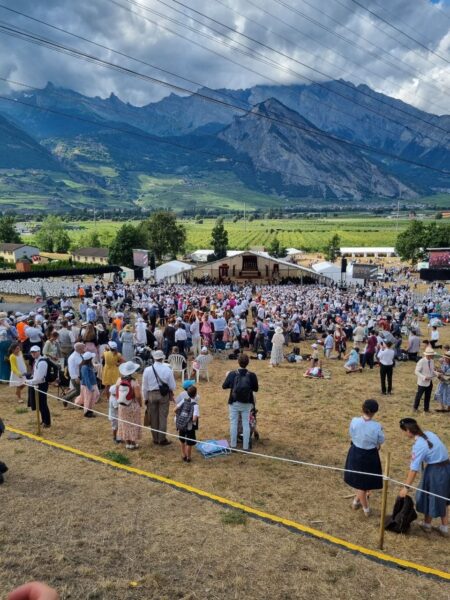
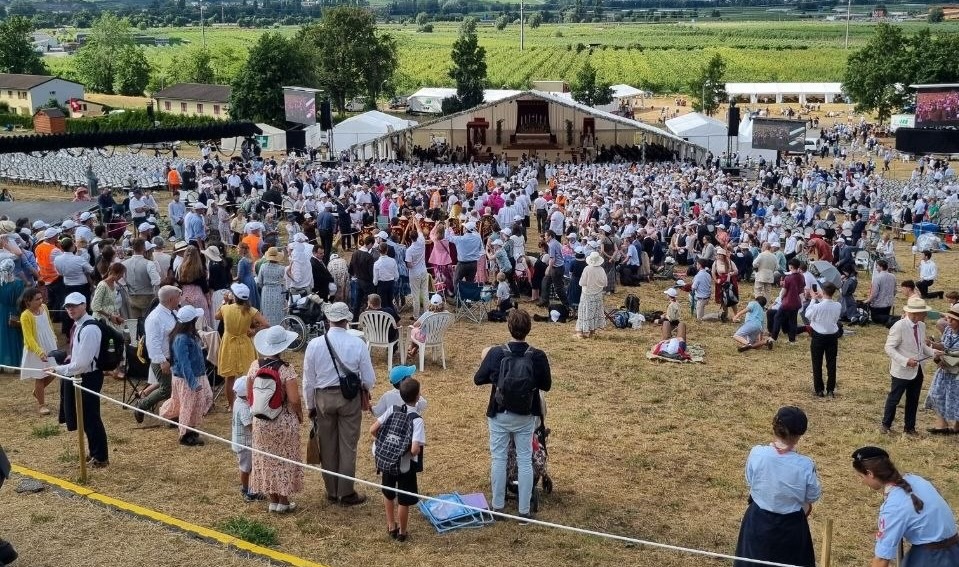
On my arrival at the seminary site, the myriad of countries served by the Society’s priests was immediately apparent. Like the nations at Pentecost, faithful from every continent and many tongues streamed up the hillside. I heard the event jokingly likened to a ‘Trad World Youth Day.’ Official estimates were of at least 16,000 registered attendees with perhaps even more arriving unregistered on the day. There were around 1,000 chairs for priests and religious in the mass tent, 4000 more in the meadow and thousands of laity using their own pilgrimage-style seating in the field.
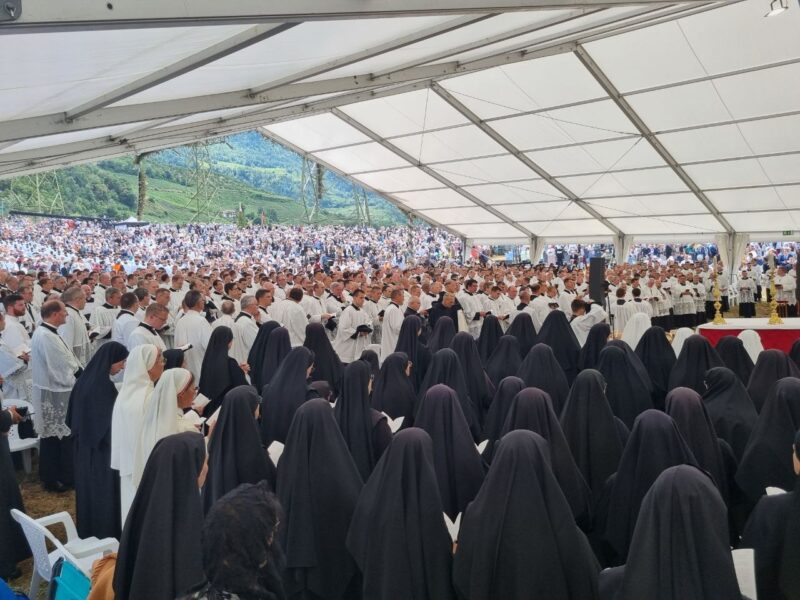
The text in the booklet of the Episcopal Consecrations referring to the consecrator and two co-consecrating bishops may have helped excite rumours that Bishop Schneider or Bishop Strickland would be present as a surprise co-consecrator on the day. In fact, I am informed that the words of the booklet were simply the standard words of the text according to the Roman Pontifical and the Roman Missal.
Bishop Williamson, consecrated in the exact same meadow spot thirty-eight years ago yesterday, memorably described the largely hostile press in their enclosure as like a “pack of baying animals” in 1988. Admittedly, the posture and tone of the Society towards Rome was more confrontational then and to the mainstream media, wedded to the narrative of John Paul II’s “conservatism,” the SSPX were unreconstructed “extremists.” Today, I was in a mixed press tent of around a hundred Catholic and secular media and the attitude towards the Society was more balanced.
Fr Pagliarani’s sermon, after the episcopal oaths and examinations, focused on the virtue of faith. Doctrine has always been the heart of the Society’s argument and it was on this basis that the Superior General justified the momentous ceremony. “We belong to the Church primarily by the virtue of faith” and “we must transmit the faith,” Fr Pagliarani said, invoking the Church’s marks of unity (of profession of faith) and apostolicity respectively. Therefore “we take exceptional measures which are proportionate to the needs of today.” This was the core of Fr Pagliarani’s case.
Some consideration of the course of Leo’s pontificate by the Society after a year was also evident:
it is precisely because we sincerely love the Pope as the Vicar of Christ and head of the Church that we no longer want to see him humiliated alongside false shepherds representing false religions. We have seen this happen so many times over the years. Because we love the Vicar of Christ, we no longer want this humiliation for the Pope, a humiliation that falls upon the whole Church, treating her as though she were on an equal footing with false religions. (unofficial English translation)
When compared to the sermon of Archbishop Lefebvre at the 1988 Consecrations, the tone of Fr Pagliarani’s justification was noticeably softer. There was less emphasis on the putative errors of Vatican II and papal scandals like the 1986 Assisi meeting; the differences between Rome and the Society were instead framed as different languages that were mutually incomprehensible:
We speak the language of faith. We want it in all its simplicity. It is the language of Tradition. Those on the other side speak another language altogether: the language of inclusion, listening, dialogue and accompaniment.
There was also no mention from Fr Paliarani, as +Lefebvre had made in 1988, that one of the motives for the unapproved consecrations was to guarantee the sacrament of holy orders for Society seminarians rather than rely on “conciliar bishops, who, due to their doubtful intentions, confer doubtful sacraments,” although Fr Pagliarani did mention the providential growth of the Society since 1988 under its own bishops.
The words of the consecrator to the newly-consecrated bishop when giving him his crozier are illuminating of the mind of the Church with respect to Her shepherd’s duties in maintaining discipline for the sake of the truth and the common good of the faithful:
Receive this staff, the symbol of the pastoral office: that thou mayest be mercifully severe in the correction of vices, a judge without anger, gently sustaining in the practice of virtues the spirits thou wilt have to govern, without letting this peaceful severity cause thee to forget the censuring of abuses.
How this prayer encapsulates the virtues the Church has such need of from Her shepherds! And yet this practice of “merciful severity” (such as the charitable anathema) is exactly what the postconciliar hierarchy, starting with the popes, have refused to practice in the face of a flood of doctrinal, liturgical and moral abuses since the Second Vatican Council.
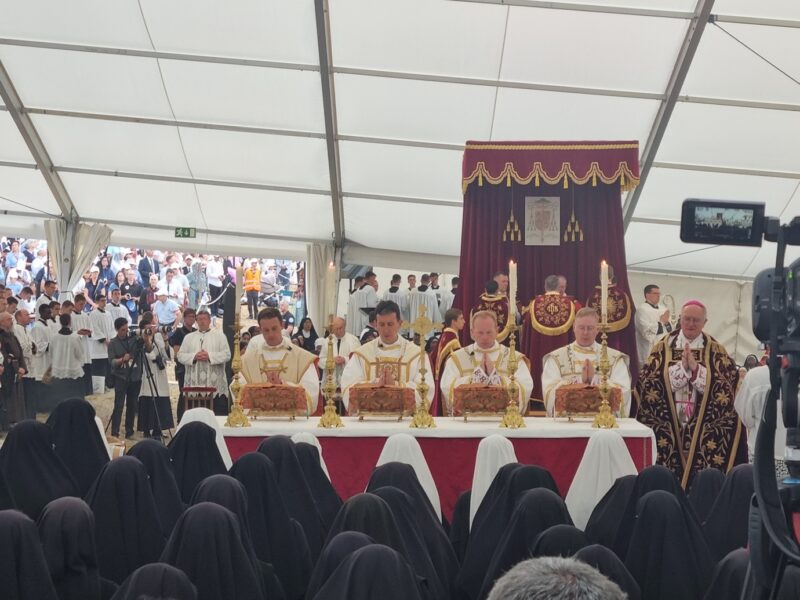
The four-and-a-half-hour ceremony was full of such treasures of Catholic doctrine. Prayers that invoked the Old Testament saints and the types they present of episcopacy were particularly moving and provocative of meditation on the fullness of the priesthood. The bishops’ hands were anointed in turn, “even as Samuel anointed David to be king and prophet” and the consecrator prayed that the figures of Aaron and the Levitical priesthood “clothed in a mystical garment… inspired reverence; and for us, the reality of things must excite a sentiment far deeper than did enigmatic figures.”
Critics of the SSPX have been quick to insinuate that the twenty or so minute-long torrential rainstorm during the time of the distribution of Holy Communion was a manifestation of divine disapproval.
The clergy calmly led the faithful in the recitation of the Holy Rosary during this unexpected interlude. By the time of the imposition of the mitres and gloves and thanksgiving the sun had returned as the Te Deum resounded.
The sun soon dried the clothing of the bedraggled faithful and there was undoubtedly a joyful atmosphere as the assembled people received the bishops’ first blessing.
Time will tell whether the Society of St Pius X itself has passed through the storm.