
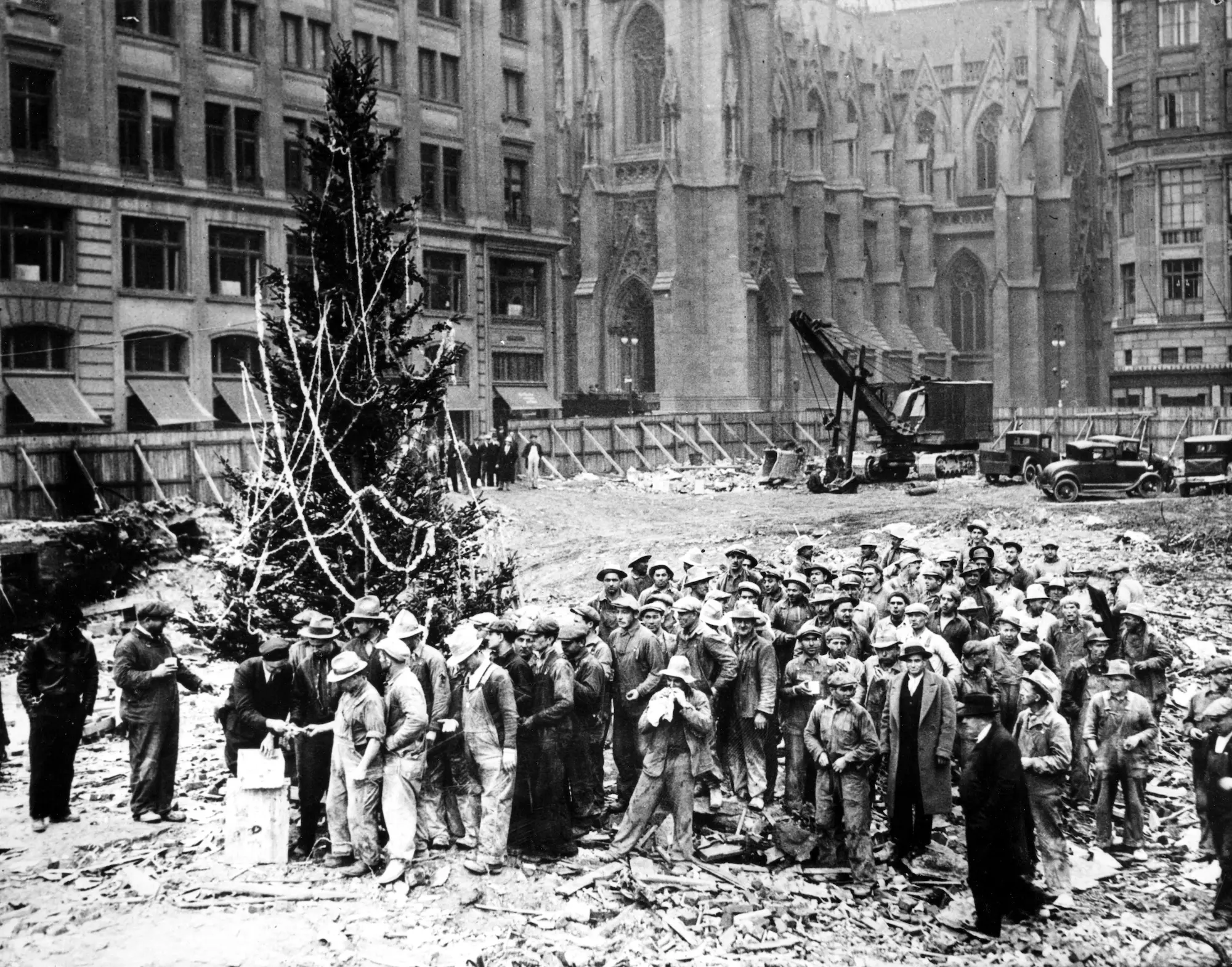
Above: the Rockefeller Christmas Tree, 1931.
And the sage Oloffe dreamed a dream—and, lo! the good St. Nicholas came riding over the tops of the trees, in that self-same wagon wherein he brings his yearly presents to children. And he descended hard by where the heroes of Communipaw had made their late repast. And he lit his pipe by the fire, and sat himself down and smoked; and as he smoked the smoke from his pipe ascended into the air, and spread like a cloud overhead. And Oloffe bethought him, and he hastened and climbed up to the top of one of the tallest trees, and saw that the smoke spread over a great extent of country—and as he considered it more attentively he fancied that the great volume of smoke assumed a variety of marvelous forms, where in dim obscurity he saw shadowed out palaces and domes and lofty spires, all of which lasted but a moment, and then faded away, until the whole rolled off, and nothing but the green woods were left. And when St. Nicholas had smoked his pipe he twisted it in his hatband, and laying his finger beside his nose, gave the astonished Van Kortlandt a very significant look, then mounting his wagon, he returned over the treetops and disappeared.
And Van Kortlandt awoke from his sleep greatly instructed, and he aroused his companions, and related to them his dream, and interpreted it that it was the will of St. Nicholas that they should settle down and build the city here; and that the smoke of the pipe was a type how vast would be the extent of the city, inasmuch as the volumes of its smoke would spread over a wide extent of country. And they all with one voice assented to this interpretation excepting Mynheer Ten Broeck, who declared the meaning to be that it would be a city wherein a little fire would occasion a great smoke, or, in other words, a very vaporing little city—both which interpretations have strangely come to pass!
—Washington Irving, Dietrich Knickerbocker’s History of New-York
I have spent Christmas in many places in my time, and there are many more in which I would like to spend it. Dom Guéranger, in his coverage of the feast in the Liturgical Year, declares that “There are three places on this earth of ours which we should visit to-night. For two of them, it can only be in spirit.” Thereupon he launches into a beautiful description of Christmas at Bethlehem and Rome. But as to the remaining one, he says
And now to the third of the sanctuaries, wherein is to be effected, this Night, the mystery of the Birth of Jesus. This third Sanctuary is near us; it is in us; it is our own heart. Our heart is the Bethlehem that Jesus desires to visit, and in which he would be born, there to live and grow unto a perfect man, as St Paul expresses it [Eph. iv 53]. Why, after all, was he born in the stable of the city of David, but that he might make sure of our heart, which he loved with an everlasting love, and so ardently that he came down from heaven to dwell in it? Mary’s virginal womb held him but for nine months; he wishes us to keep him for ever in our dwelling!
All of this is certainly true, and wherever we happen to be, Christmas can be complete in this sense. Yet as far as these United States go, if there were any one section I would particularly point to as a centre of Christmas, it is the City and State of New York, my birthplace, whose patron saint is St. Nicholas.
Now, this is quite a claim, to be sure – especially given the recent election of a Muslim Socialist as the city’s mayor. But don’t let the garbage of the present hide the realities of the past. Although Catholics in the French and Spanish possessions and in Maryland kept Christmas in colonial days (as did Anglicans in the latter two colonies and the South in colonial days), it was forbidden in Puritan New England. Thanks to the Dutch, and their love of both Christmas and St. Nicholas’ gift-giving propensity, the city and colony of New York were the northernmost bastion of Yuletide festivity. Even when George Washington took command of the rebel forces at Cambridge, Massachusetts, in 1775, the local culture would not relent. His wife joined him in early December, but the two were unable to celebrate Christmas properly. The best they could do was a church service on Sunday, December 31. This was held in Cambridge’s Christ Church, which had been closed for more than a year, when most of its Loyalist congregation were driven from their homes. After that single service, the building would remain closed until 1790.
But Christmas continued serenely in the valley of the Hudson and the island of Manhattan. A decade after the Washingtons’ sombre service at Cambridge, Christmas Midnight Mass at Old St. Peter’s on Barclay Street was the first public act of Catholic worship in a decent building in the history of the city. Built at the expense of the King of Spain, Carlos III (founder of California and Los Angeles, whose intervention in the revolution alongside his cousin, Louis XVI made rebel victory possible), it marked the entry of the city’s nascent Catholic population into the Christmas festivities already engaged in by the Dutch Reformed, Anglican, Methodist, Lutheran, and other churches. Unfortunately, 21 years later, an anti-Catholic mob initially attempted to disrupt the Midnight Mass but were persuaded to disperse. They returned the following day to harass the Christmas Day Mass-goers; but this time, the mostly Irish congregation were prepared and armed. The result was the Christmas riots of 1806.
But if the nastier side of Manhattan had been made clear by that unpleasant event, New York’s underlying geniality would come to the fore three years later, with the publication of Washington Irving’s Dietrich Knickerbocker’s History of New York. This satirical sendup of the Dutch settlement included Irving’s above paean to St. Nicholas; belonging to an Episcopalian family in New York, he loved the holiday. When Irving went to Great Britain, he was befriended by Sir Walter Scott, who spearheaded the revival of interest in things medieval – including Christmas – (there is a direct line from Sir Walter to the Oxford Movement). His newfound friend, sharing his love of the feast, sent him on to another friend of his, Abraham Bracebridge, of Aston Hall, near Birmingham. Irving spent the holidays there, and immortalised them in the “Old Christmas” sections of The Sketch Book, wherein he also introduced the public to Rip Van Winkle and the Headless Horseman. A young man named Charles Dickens fell in love with Irving’s work, wrote his own Yuletide tales – and Christmas in the Anglosphere never looked back.
But Irving returned to New York, and established his home at Sunnyside, to-day a museum honouring the man and his work. Not too surprisingly, there is a lavish Victorian Christmas celebration there every year. Given that he spent the last years of his life removing all the anti-Catholic references from later editions of his earlier work, Irving might be very happy that the Washington Irving Memorial Episcopal Church in Sleepy Hollow is now the Catholic Church of the Immaculate Conception – a refuge of the Latin Mass.
One of the major milestones on the transformation of St. Nocholas into Santa Claus was accomplished by another New Yorker, Clement Clarke Moore, whose 1822 poem, “The Night Before Christmas” solidified the popular vision of Santa Claus – right down to the eight tiny reindeer. Since 1910, the Episcopal Church of the Intercession in upper Manhattan hosts an annual servce in his honour, where the poem is recited. This is followed by a candlelight procession to the nearby cemetery to leave a wreath on his grave.
In the mid-19th century, cartoonist Thomas Nast depicted Santa in a way relatively similar to what we have to-day, and in 1897 young Virginia O’Hanlon wrote the editor of the New York Sun, who assured her that there is indeed a Santra Claus. From that time on, New York-bred or based writers gave us an unending current of Christmas tales from O. Henry’s “The Gift of the Magi” to Damon Runyon’s “Dancing Dan’s Christmas.” The secular and mercantile side of things throughout the country certainly received inspiration from Macy’s Santa Claus and his village, their store windows, and the renowned parade – once Christmas, now Thanksgiving Day. Macy’s prominence in this field was immortalised in the film Miracle on 34th Street. As far as other secular Christmas treats go, it would be hard to beat either Rockefeller Center’s Christmas Tree (the lighting of which is a major annual event), or Radio City Music Hall’s annual Christmas show. Both are highlights of the season.
Now while one may well acknowledge New York’s secular Yule-tide supremacy, the religiously-minded shall ask about what part the Faith plays in all of this. Firstly, it must be acknowledged that St. Nicholas rarely gets his due, other than as the omnipresent Santa Claus. The St. Nicholas Collegiate Reformed Protestant Dutch Church, the elaborate “Dutch Cathedral” (where so many Roosevelts worshipped), was built in 1872, but torn down in 1948. There are three Orthodox churches named after the Saint – one Greek, one Russian, one Carpatho-Russian (the first blown to smithereens on 9/11, but rebuilt). There was a Catholic Church of St. Nicholas, opened in 1833 as the city’s first German Catholic Church; alas, it was demolished in 1960.
But don’t let the lack of churches in honour of St. Nicholas fool you! Every year, the Catholic League puts up a life-size nativity scene in Central Park at 59th St. and 5th Avenue, on the Grand Army Plaza, right across from the Plaza Hotel. Midnight Mass at St. Patrick’s Cathedral is so prized an event that there is literally a lottery ticket system for admission. For me, to be honest, it is the Latin Midnight Mass at Holy Innocents Church that always draws my attention when I am there.
But let’s be honest. Although all of the proofs I have adduced as to the importance of New York in the Christmas scheme of things are true, the real reason why I am so convinced that it is the “Christmas City,” is because my first few Christmases were spent in the Westchester County town of Mount Kisco, in a snug house covered with snow. Parents, Grandparents, Aunts, Uncles, and Cousins were nearby, Santa was real, and the Christmas decorations looked to me to be utter magic.
There is, in addition to the three shrines Dom Guéranger would have us visit on Christmas Eve, a fourth – the place where first we learned its joys and glories. For some it may be Hawaii, for others the Sahara. But wherever one first enjoyed or appreciated Christmas shall live on in one’s heart forever. It is the place against which he shall evaluate all the others where he spends the feast. But it is a question of time as well as space; for me, that magical moment and place is Christmas in New York of 1964. I shall certainly be somewhere and somewhen else for you.
Let us use that nostalgia as an opening, a way into the mystery that is Christmas. When we are sufficiently reminded of that place where first we heard of the Star and the Wise Men, let us then use that sense of magic to go Bethlehem and Rome, even as Dom Guéranger suggests. Then, with hearts as pure and innocent as first we had, let us invite Him in. As with our fondest memories and dearest hopes, it shall be a foretaste of that Heaven where it is always Christmas, Easter, and Pentecost combined, and to which, if we make it, every land in which we have travelled will be part of the golden road to Paradise.