The Catechism of the Catholic Church says that the mystery of the Most Holy Trinity is “the central mystery of Christian faith and life. It is the mystery of God in himself” (CCC 234).
That sentence ought to make any preacher on Trinity Sunday take a deep breath before he says anything. We want to get this one right. Other mysteries of our Faith concern what God has done and does: Creation, Redemption, Sanctification, the Incarnation, the Passion, the Sacraments, the Church, the Last Things. Today we gaze, as far as grace allows, toward the Doer Himself, God in His own inner life, Father, Son and Holy Ghost, one God in three divine Persons.
There was a time when this Sunday after Pentecost was, in the Roman arrangement, liturgically rather empty, because the night from Ember Saturday and the morning had been spent in vigil at St. Peter’s Basilica. In 1334, however, John XXII, the second and longest reigning of the Avignon Popes, extended the Feast of the Most Holy Trinity to the universal Church. John XXII was a complicated figure. He centralized power in his own person, which helped provoke William of Ockham to write against limitless papal claims, and he also preached an erroneous opinion about the beatific vision, which he retracted before death. He also canonized St. Thomas Aquinas and may have composed the Anima Christi: “Soul of Christ, sanctify me, Body of Christ, save me, Blood of Christ, inebriate me.” Sort-of-Good Pope John XXII was not all bad.
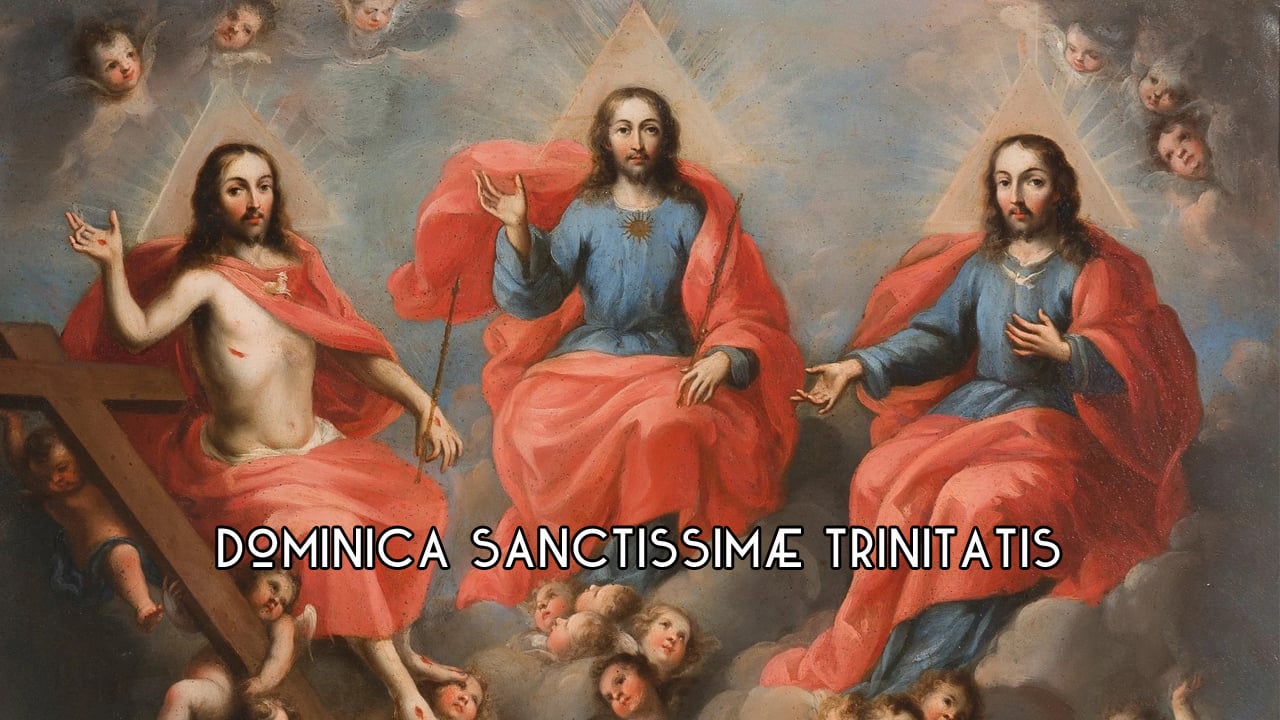
The feast is exactly where it ought to be. Pentecost has come. The Son, having liturgically ascended to the Father, has liturgically sent the Paraclete. The Spirit of Truth has descended. What had been foreshadowed in the Old Testament, revealed in the Incarnation, manifested at the Baptism of the Lord, and hinted through the words and works of Christ, is now confessed openly by Holy Church. The Sunday after Pentecost is therefore given to grateful adoration of the Triune God. Pius Parsch put it well: “The feast of Pentecost leads logically to the contemplation of the divine Trinity, whose mystery has now been revealed.” Blessed Ildefonso Schuster is even more expansive:
“The doctrine of one God in three Persons marks the most sublime height of theological science, and confers on the followers of Christ a perfection and a dignity of so high an order that it may truly be said that this dogma constitutes the honour, the glory, and the salvation of the Church.”
The salvation of the Church. That is a bracing phrase. The Trinity is not a theological puzzle for men with too much time and too many books. The Trinity is the mystery of God Himself, and therefore the source, measure and goal of every saving mystery. We do not begin with ourselves. We begin with God. We do not begin with our projects, committees, anxieties or ecclesiastical slogans. We begin with the Father eternally begetting the Son, and the Holy Ghost proceeding from the Father and the Son, one God, one divine essence, three real Persons, coeternal, coequal, consubstantial.
St. Augustine gives the warning that should be displayed on a banner above every pulpit on Trinity Sunday: “Si enim comprehendis, non est Deus.” “For if you comprehend, it is not God” (s. 117, 3.5). The Doctor of Grace continues: “Attingere aliquantum mente Deum; magna beatitudo est; comprehendere autem, omnino impossibile…. To touch God somewhat with the mind is great blessedness; to comprehend Him, however, is altogether impossible.”
Hence, we approach this mystery creeping like Moses in Exodus 33 toward the cleft in the rock. We may touch. We may taste and see. We may confess. We may adore. We will never master. God is never an object captured by the mind. He is the living God before whom the mind is purified, enlarged, humbled and raised.
The Introit of the Mass already gives the proper grammar of the day while the priest wreathes the altar in the smoke of sacrificed incense:
Benedícta sit sancta Trínitas atque indivísa Unitas: confitébimur ei, quia fecit nobíscum misericórdiam suam. Dómine, Dóminus noster, quam admirábile est nomen tuum in univérsa terra!
Blessed be the Holy Trinity and undivided Unity: we will give glory to Him, because He has shown His mercy to us. O Lord, our Lord, how glorious is Your Name over all the earth!
Note the order. Blessing comes first, then confession. Glory follows. With these first chanted orderly introductions, we put off the shoes from our feet like Moses before the burning bush. This is a day for theology, surely, since the Faith is intelligible and God has revealed truth. It is even more deeply a day for worship. As we see again and again in our time, alas ever more frequently, theology that does not kneel becomes dangerous. Trinity Sunday demands the union of both: adoring doctrine, doctrinal adoration. Alas, many of our churches are infected with worship activity without doctrine. We are being slowly drowned as a Catholics in the gooey syrup of sentimentality. The lifeline out of the sticky vat of self-enclosed cheap affirmation is right in front of everyone’s face. Few of those in charge have the will to use it, to grasp it with hitherto enervated hands. It would be a little painful for those long atrophied Catholic muscles to draw the flock up and out of cloying danger more insidious than mere wolves. It would require some fancy people to admit that “We got it wrong.”
The Collect of the feast is one of those Roman prayers that says everything with almost severe economy:
Omnipotens sempiterne Deus,
qui dedisti famulis tuis, in confessione verae fidei,
aeternae Trinitatis gloriam agnoscere,
et in potentia maiestatis adorare Unitatem:
quaesumus; ut, eiusdem fidei firmitate,
ab omnibus semper muniamur adversis.
Almighty everlasting God,
who granted to Your servants, in a profession of the true Faith,
to recognize the glory of the eternal Trinity
and to adore Its Unity in the might of majesty:
we beseech You; that, in the steadfastness of that same Faith,
we may always be defended from all adversities.
Notice the realism. We ask to be defended “ab omnibus semper adversis,” from all adversities always. There are adversities. There are spiritual enemies. There are temptations, wounds, confusions, fears, vanities, sins, bad ideas, worse habits, and the relentless erosion of distraction. The doctrine of the Trinity is armor. The firmness of the true Faith defends us. The Holy Trinity dwelling in the soul in the state of grace is power. The Father adopts. The Son incorporates. The Holy Ghost inhabits and sanctifies. We are drawn into a relationship with God that no creature could imagine, much less demand. No one could have imagined or made this up. It is revealed by God.
The Epistle, Romans 11:33-36, rises like incense into pure doxology:
O the depth of the riches of the wisdom and knowledge of God:
how incomprehensible are His judgments,
and how unsearchable His ways!
For who has known the mind of the Lord?
Or who has been His counselor?
Or who has first given to Him,
and recompense shall be made him?
For from Him and through Him and in Him are all things:
to Him be glory forever. Amen.
Paul has been silenced by majesty and then made eloquent by worship. He looks into the abyss of God’s wisdom and bows. That is what the sacred liturgy trains us to do. We stand, bow, kneel, strike the breast, sign ourselves, listen, answer, adore. We are fragmented creatures in an age of fragments. Worship gathers us. The virtue of religion binds us rightly to God, giving Him what is His due: adoration, reverence, obedience, sacrifice, praise.
St. Thomas Aquinas teaches in the Summa Theologiae that “religio proprie importat ordinem ad Deum … religion properly implies an ordering toward God” (ST II-II, q. 81, a. 1). He also says, “religio est quaedam virtus… religion is a certain virtue” (a. 2). By justice we give to created persons what is due to them. By religion we give to God what is due to Him. God is personal, indeed three divine Persons having one divine essence, though divine Personhood infinitely exceeds created personhood. The virtue of religion therefore shapes liturgy, prayer, sacrifice, posture, silence, chant, obedience, and the interior devotion without which exterior acts become empty. Proper worship flows from true knowledge. No knowledge is higher than the knowledge of God as Trinity.
The last phrase of Romans 11, “ex ipso et per ipsum et in ipso … from Him and through Him and in Him”, change-rings in the Roman Canon. At the doxology the priest elevates the Host and Chalice: “Per ipsum, et cum ipso, et in ipso… omnis honor et gloria.” The Greek word doxa means glory; a doxology is a glorifying. The Mass culminates in glory offered to the Father, through the Son, in the Holy Ghost. There is a veiled Trinitarian quality in Paul’s phrase. The Father is origin, “ex ipso.” The Son is mediation, “per ipsum.” The Spirit is indwelling and consummation, “in ipso.” We must make distinctions. Qui distinguit bene docet: he teaches well who makes distinctions. The external works of the Trinity are undivided, because the three Persons are one God. Creation, Redemption and Sanctification are works of the one divine power. Nevertheless, the Church fittingly appropriates Creation to the Father, Redemption to the Son, and Sanctification to the Holy Ghost, because these works harmonize with the personal relations: the Father as origin, the Son as Logos and Wisdom, the Spirit as Love and Gift.
In the mystery of the Unity and Trinity of God, we believe that from all eternity, before material creation and outside time itself, the one God perfectly knows and loves Himself. The Father eternally begets the Son, His perfect Word, containing all that He is. The Word is not a created echo, an instrument, or a lesser being. The Word possesses all that the Speaker possesses: being, omniscience, omnipotence, truth, beauty and divine personhood. Thus from all eternity there is Father and Son, Begetter and Begotten, true God from true God. There was never a time when the Son was not.
The Father and the Son eternally know and love each other. Their love is a perfect self-gift, perfectly given and perfectly received. Since this Gift is divine, He possesses all that the Father and the Son possess: being, omniscience, omnipotence, truth, beauty and personhood. Therefore, from all eternity there are three distinct divine Persons having one indivisible divine nature: Father, Son and Holy Ghost, the perfect self-gift of Love between them. Here language strains. Analogies limp. Human words bow beneath the weight of divine reality. Augustine’s warning returns: if you comprehend, it is not God.
This is why the common Trinity Sunday analogy can be more dangerous than helpful. Three candles twisted together with one flame? Then the Persons seem to have the same role. An egg with shell, white and yolk? That starts chopping God into parts. Water as ice, liquid and steam? Modalism comes marching in wearing a grin. The sun with heat, light and motion? A tree with roots, trunk and branches? Three dimensions of space? One can perhaps rescue a partial point here or there, with enough distinctions and enough footnotes to empty the church twice over. Better to say what the Church says. There are three Persons in the Godhead: Father, Son and Holy Ghost. Each Person is truly God. The three Persons are one God. They differ from one another by relation of Person, never by essence. The Father is unbegotten. The Son is begotten of the Father. The Holy Ghost proceeds from the Father and the Son.
The Gospel gives us Christ’s own Trinitarian formula. After the Resurrection, the eleven go to the mountain in Galilee. Theophanies happen on mountains. The Risen Lord appears, and Matthew says that they worshiped Him, though “some doubted.” That little detail is oddly consoling. These are the Apostles. The Lord has conquered death. He can pass through locked doors and show His wounds. Even so, some struggle. How much more grateful we should be for two millennia of reflection, saints, councils, liturgy, miracles and doctrine.
Then Christ says: “All power is given to me in heaven and in earth. Going therefore, teach ye all nations: baptizing them in the name of the Father and of the Son and of the Holy Ghost: teaching them to observe all things whatsoever I have commanded you; and behold I am with you all days, even to the consummation of the world” (Matthew 28:18-20). The word “Trinity” is not found in Scripture, yet the doctrine is there, revealed and then named by the Church. At the Baptism of the Lord, the Son stands in the Jordan, the Spirit descends as a dove, the Father speaks from heaven. At the end of Matthew, Christ commands baptism “in the name… eis tò ónoma”, singular, of the Father and of the Son and of the Holy Ghost. One name, three Persons. Unity and Trinity. Trinity and Unity.
By baptism we are drawn into divine life. We, images of God wounded by sin, are brought into a new relationship with the Triune God. We become adoptive children of the heavenly Father. We are made members of the Son, our Lord Jesus Christ, in the Mystical Body which is the Holy Church He founded. The Holy Ghost makes us His dwelling so that the divine Persons are present to us and in us, informing what we are, do and say. Our membership in the Church opens the way to an eternal relationship of glory and praise with the Trinity. Salvation is Trinitarian from beginning to end.
That brings us to one of the most ordinary Trinitarian acts we perform: the sign of the cross. We make the sign of the cross because Christians have always made the sign of the cross. Tertullian, one of the earliest Latin Christian writers, testifies:
“At every forward step and movement, at every going in and going out, at dressing, at putting on shoes, at baths, at tables, at lamps, at beds, at seats, whatever occupation engages us, we wear away our forehead with the sign of the cross” (De corona, 3).
There is an entire Catholic anthropology in that gesture. The small sign of the cross is made with the thumb upon forehead, mouth and breast. We sign the head, the principle and principal part of the body, in the name of the Father. We sign the mouth, source of speech, in the name of the Son, the eternal Word. We sign the heart, seat of charity and sacrificial love, in the name of the Holy Ghost. We renew the intention that our thoughts, words and works be pleasing to God, useful for salvation, and edifying to our neighbor.
The large Latin cross is made from forehead to breast, then shoulder to shoulder, as Roman Catholics do, from left to right. The vertical movement can remind us that the Son came down from the Father in the Incarnation. The horizontal movement can recall that the Holy Ghost proceeds from the Father and the Son. Innocent III, in De sacro altaris mysterio, gives symbolic explanations for the movement of the hand, including the passage from left to right as a sign of salvation moving in Christ from the Jews to the Church. The shifting of the Missal from the Epistle side to the Gospel side has been explained along similar lines. Our gestures are not empty when they are informed by faith. They are bodily catechisms.
Even St. John the Evangelist, in sacred iconography, is often shown blessing a chalice from which a serpent or little dragon emerges. According to the old account, when enemies tried to poison him, he blessed the cup and the poison was rendered harmless. There’s an incentive for saying grace before meals. Cross yourself. Bless your food. You belong to the Trinity. Act like it.
The so-called Athanasian Creed, the Quicumque vult, gives the feast its bracingly Catholic edge. It was not written by St. Athanasius, though it was long attributed to him. Gregory Nazianzen speaks of a confession of the Trinity associated with Athanasius, and the name stuck. The first section is Trinitarian, the second Christological. Its opening is wonderfully obnoxious to modernist ears but wonderfully medicinal for souls:
“Quicumque vult salvus esse, … Whosoever will be saved, before all things it is necessary that he hold the Catholic faith: which Faith unless every one do keep whole and undefiled, without doubt he shall perish everlastingly. And the Catholic Faith is this: that we worship one God in Trinity, and Trinity in Unity; neither confounding the Persons, nor dividing the Substance.”
There it is. Neither confounding the Persons, nor dividing the Substance. No modalism. No tritheism. No sentimental mush. No sloppy analogies in which God becomes an egg, a puddle, a committee, or a bad parish diagram:
“For there is one Person of the Father, another of the Son, another of the Holy Ghost: yet the Godhead of the Father, and of the Son, and of the Holy Ghost is one, the glory equal, the majesty coeternal.”
Look it up and read it aloud on Trinity Sunday. Make the sign of the Cross before and after. Let the words form your mind. Let the doctrine strengthen your spine. Let glory of it silence the restless interior commentator. We live in an age of distraction, fragmentation and practical atheism, even among those who speak religiously. The Feast of the Most Holy Trinity is a corrective. At the heart of reality there is one God in three Persons, infinite knowledge, infinite love, infinite life. From Him, through Him, and in Him are all things. To Him be glory forever. Amen.